Episode 171 Managing Mom Life with Julia Barbaro
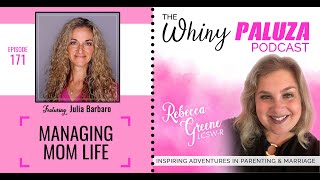
In this episode of the Whiny Palooza podcast, host Rebecca Greene interviews Julia Barbaro, a mother of six, certified life and marriage coach, author, and co‑host of the Julia & Gino podcast. Julia shares her journey of raising a large family, homeschooling, and balancing a marriage and business partnership with her husband Gino. The conversation covers practical strategies for effective communication within families, managing parental worry, the benefits of journaling, creating actionable plans to address concerns, and fostering lifelong connections with children as they grow. Julia also discusses the challenges and rewards of homeschooling, the importance of teamwork and ego‑management in a marital partnership, and how to support each other’s strengths. She introduces her children’s books, "The Cannolis Exploded" and "The Gelato Blast," which teach responsibility and the impact of social influences. Throughout, both hosts emphasize empathy, self‑compassion, and the value of sharing struggles openly, encouraging listeners to be present, laugh at the chaos, and trust that they are doing a good job as parents.
Chapters
No need to whine, it's Whiny Palooza! Have some wine and join us on the Whiny Palooza Podcast with Rebecca Green.
Welcome to the Whiny Palooza Podcast. I'm your host, Rebecca Green. I'm a wife, mother of 3, and licensed clinical social worker. I also have 3 fur babies at home too. My passion has always been to help children and their families. I always dreamed of being a wife and a mother. Parents are always learning through their struggles failures and successes and joys. I am no stranger to this wild ride of parenting, and I know behind every great parent lies a team of supportive friends and family. I want to be part of your support system. I want you to know that you are not alone. We are in this parenting world together. Join me every week for insightful discussions with experts on parenting and marriage, as well as other parents who have found the secret to successes in parenthood. You'll learn tips and tricks to make life with your family better than ever. I hope you will follow along with me while we dive into what it takes to achieve a happy family.
Hello everyone, this is Rebecca Green for the Whiny Palooza podcast, and I am so very excited to have Julia Bar— Barbeiro on the podcast today. How did I do, Julia?
Oh, that was amazing, Rebecca.
Oh, well, thank you so much for taking time out of your crazy schedule to meet with me today.
Thank you, Rebecca, for having me. I am so excited. As I was telling you, I'm in a lot of podcasts with my husband, who is a real estate entrepreneur and investor and all that. But this is my first mom's podcast, and I'm so excited.
Thank you. I told Julia this is all about her today, and she has so much wisdom to share with us. So I'm so excited to talk to her, and I'm going to tell you a little bit about her. Julia is a mother of 6. Holy moly, Julia.
And they just kept coming, you know.
They just listen. And I stopped at 3. I didn't—
it wasn't my plan.
Oh my God, that's awesome. Um, she is a wife to Gino, an entrepreneur and co-founder of Jake and Gino. Together they host the Julia and Gino podcast where they focus on raising a family and running a business. Julia is the author of the Cannolis Exploded and a Gelato Blast books for all ages, encouraging responsibility, creativity, and decision-making. Julia and her family live in St. Augustine, Florida, where they enjoy the old city and the simple beach life. And what I realized, Julia, is that part skipped the whole thing about you being a Certified Life and Marriage Coach. So let me read a little bit more.
That's okay.
After witnessing the power of coaching, she was inspired to become a Certified Life and Marriage Coach. She felt compelled to give back and motivate others to set goals, seek out their soul purpose, and ask what's next in their life. Julia's passion is to empower couples to strengthen their mind, their communication, overcome obstacles, and seek clarity. Together, she helps them create a life plan for themselves, as well as encouraging parents to guide their children to adulthood. Um, this is so perfect for our podcast today. All of these mothers can learn from all of your wisdom today. And, um, I am very excited to ask you all these good questions. So let's jump in.
Yes, I would love to. And I just wanna say that wisdom comes with life experiences.
Absolutely.
Yeah. So we have to remember that we like, we wanna know everything right away and we have to go through difficult times in order to get wisdom.
I just, I just can't get over the fact that you have 6 kids. I'm still stuck back on that.
It's, it's interesting because I have to say that as of right now in my life, in the season of my life, the youngest is 8 and I feel so free, if that makes sense.
Yes. Yes.
Yeah. Oldest is gonna be 23. It, it's just, it's so interesting. We, I'm sure we'll get, we'll, we'll talk about that, but there is hope. There is, there is a moment where the kids do get out of your bed, get out of diapers, stop nursing the whole, and, and it feels like it will never end, but it does. And I am, I am a witness. I, I cannot believe that I'm in this part of my life right now. And I'm happy. That's why I'm here sharing some of the, some of the struggles that I've had and how I overcame them. But how they're important for us to go through.
Absolutely. And I want to tell you, this is one of those days, um, I was laughing with Julia before we started recording because I thought I finally had everything together. I tested all my technology and my dog decided to, um, puke all over the floor where I was sitting. Like, this is the life of a mother. And I just kind of laughed my way through it. But like the constant trying to balance the kids, the work, the husband. Like, it can be a lot.
Oh boy. Oh boy. Oh, it can.
And, um, we're gonna, we're gonna talk more about that, but you have so much success in your life and we can learn so much from you. So let's start with communication. Communication is the key to success, I think. So tell us right now a step we can take to be better communicators.
Communication, Rebecca, is, is such a big topic because it's not just how do I do it? Oh, okay, let me apply it. I was just on the phone with, um, you know, through the Jake and Gino community, we have a women's group that we meet once a week and it's constant reminder of how do we communicate. It's not like once you get it, it's like, oh, I get it. I'm gonna, I'm gonna apply that to my life and everything's gonna be fine because we have to realize that we change and, and everyone around us changes, especially our kids. Like how we communicate with them is different today than it will be next year. And so it's, it's a challenge of us constantly changing and constantly learning. And, and, and my point is that that's okay. Where we are right now is where we're going to start being a better communicator. And so when we think about communication, most of we think about is how we talk, how we talk to people, but it's so much more. And, and I, and I, it's really to start with awareness of our thinking because how we think actually affects our way we speak and, and our actions. And so if my husband's going to come to me in a really rotten mood, let's say he just went through a really tough time, and I'm trying to give him some emotional issue that I'm having, is it the right time? Think about it. Today's not the right time. I'm gonna wait. So that, that first awareness is so important. And, and, you know, my husband and I have many podcasts on awareness because I think that really is the first tool that we need to learn and apply in order to be a better communicator. And so it's our thinking process. Is right now a good time to talk? What do I want to communicate? How do I want to communicate it? And what I'm going to say, because when we think about something, it comes through our mouth. We do have control over it. So what are we saying? What are we saying to our spouse or to our children? Are we, you know, So again, it, it depends on who we're talking to. Our husband's different than our children, than different than our sister and our mother. You know, they're all different people. So if I'm trying to tell my husband something who needs to get to the point, he just wants the bullet points, I'm gonna give him the bullet points. But in order to get the bullet points, I need to know what they are first. So I need to think about, okay, what am I trying to communicate? And then I'll tell him and I'm ready. You know what I mean?
Absolutely.
Yes. And so after that, let me just real quick, and then I wanna talk about it. But after that, when they're talking back to us, it's our reaction. And I know, you know, a lot of moms listening, we can be cranky and we can be tired. Maybe we wouldn't have sleep the night before, but our reaction, and that's part of communication when someone else is talking to us, is so crucial because it really, over time, it will depend. Will the person come back and tell us things, or are they afraid of Mom because she's always yelling at me? Or are they afraid of— because my reaction is so strong, maybe, you know, maybe let's go tell Dad, or let's not tell anybody. And that also comes, comes all in full circle. And so when I say communication is bigger than we think, it's huge. But it all starts with that awareness.
100%. And what I was going to tell you is, as an extrovert, I had to learn to not just blurt out whatever, because I feel like extroverts don't think as much as introverts. Before they speak. So, so it may sound, you know, an introvert might be listening thinking, maybe listening thinking, that's easy. I always think before I say anything. But there also may be an extrovert listening who is like, oh, I have to think before I speak. So it's not as easy for me as it could be, but I do work on this.
That's a, that's what you just said, I work on it, because we are so hard on ourselves and we want to be the perfect mom, we want to be the perfect wife and and this is where we learn things from. I mean, I make mistakes constantly, and I'm constantly apologizing for the words I use, how I use them. And I think that another is another key to communication, because like I said before, when we mess up, when we blurt out what we— be aware of it. Hey, you know what, I shouldn't have said that. And that's all it takes. Can I read? Can I just— can we go back? Can we take a step back? And can I say it differently? And we can ask these things to the people, especially our husbands. Like, we sometimes, we're just so comfortable with them that we'll just blurt out whatever we're feeling.
Yes.
Not thinking about it first, not saying, okay, are these thoughts right? Are they true before I accuse? Or, you know what I mean? And so that's really important. It says whole awareness of our thoughts before we act.
Yes. And, um, self-control. I'm thinking of the word self-control as you're speaking, and I get so upset with with mothers who, who are so very hard on ourselves, on their— on themselves. Because if we're learning from what we're doing, then that's what it's all about, you know?
Yes, I do. And I, and I have to tell you this, that one of my biggest fears in life— and I'll tell you how I overcame it, which is funny, but I think— was the fear of people, which sounds ridiculous, but terrified of people. What, you rejection. You're afraid that if you said something, they would look down on you, they would make fun of you, laugh at you. And so what I did was I said nothing, and I just was— I became a really good listener, that's for sure. But I didn't. And, and so it took me years and years to realize I have so much knowledge about just raising a family, you know. I, I, I've seen people just sit back and pretend their life was easy and good and nothing's wrong, everything's great, my family life is wonderful, my marriage is so good. I'm like, but, but it's not. Like, I, like, you know what I mean? It's not. And it's okay because we're all in it together and we're all learning from each other. And, and that's what I wish I knew back then was it was okay not to be okay. It was okay to ask for help, to go to someone that you're, you know, they look like they have a good marriage. I want to ask them how they do it. But the funny thing is when you ask them, they're like, nah, it's not a good marriage. We really struggle. Well, so everyone is kind of like pretending everything's good, but you know, it's— so that's why I'm out. And that's why when my husband and I encountered so many couples that were like, how do you do it? My first reaction was like, no, we don't do it. We're trying to figure it out. We're struggling. It's hard to have 6 kids. It's hard to have a husband who is in business and is just a go-getter constantly. I'm exhausted sometimes. I just, I don't wanna do all this work. But in the end, it's like, I want to learn. I want to give back as much as I can and to tell ladies who are sitting at home struggling because it's, it's exhausting, you know, you didn't sleep last night, or you're not sure what to do, you're not sure if you're doing a good job. You are doing a good job. You are just because you're there, because you're present. Be present. And that's sometimes that's all we could give. We do the best we can with what we're given. And that's the message that I sometimes just wanted to say.
I hope everybody listening is taking that in because that is so important, and we're all doing a good job. I, I, I just want to scream that out to every single mother. We're all doing a good job. Yeah, good enough, good enough. Yes.
No, but that's all we can give sometimes, Rebecca, right? Like, you know, when the dog throws up and the kid comes up, you know, sometimes kids will come up and ask me if they can have ice cream. They know mom will say give a thumbs up. Yes, you can have whatever you want. Leave me alone. I'm recording here. Recording. You just gotta go with it. You know what I mean? You gotta do the best you can at the moment that you have. You know?
Absolutely.
I, I, you know, I don't know what everyone's background is religious, but God put us here for a reason. Every single person in our life was given to us for a purpose. So he's gotta trust us with that. So trust yourself.
Oh, I love that so much. And I love that you talk about worry. 'Cause it's so normal for us all to worry. So help all of us. What are some things we can do to take the worry out of mothering?
Oh gosh. Worry is, you know, I think one of my biggest struggles back then, because for a couple of reasons is, you know, especially with babies and just being pregnant all the time and, you know, constantly exhausted, you worry that you're, you're messing them up. You're worrying that your kids are gonna grow up. Leaving you saying, why did you raise me like that? Really, we were afraid of their, um, lack of success, let's say, or, you know, you know what I mean. And so we constantly worry, am I doing the right thing? Am I, am I being too strict? Am I being too lenient? And so everything we— every single thing we do, we question and we second-guess ourselves. And we try something, oh, it's not working. We try something else, okay, that's working, but it doesn't help with this kid. And so You know, I, I've— from my experience, worrying doesn't do anything. It literally doesn't do anything. We could sit and worry all day, but what in the end have we done? Nothing. Where there's no plan, there's, there's, there's no steps to get to that plan, to that goal that we're creating. And I've— there— we homeschool as well. We've always homeschooled from the beginning. And so, um, it took me until my daughter, who was the oldest, last literally got into college. So it took her 12 years of school at home to get into college to say, my gosh, to my husband, I guess I'm successful at teaching them. Like, you know what I mean? But I second-guessed myself all the way because there's no one telling me I'm doing a good job, you know what I mean? And so sometimes it takes time, or sometimes it takes someone— whoever's listening to this, You're doing a great job. You're doing what you can. If there's something that you don't like about how you're doing it, come up with a plan. Because when we come up with a plan, let's say our kid's on the devices too long, let's say the kid watches too much TV, or they're not playing with— whatever it is that you're trying to achieve with your child, or even with your husband, come up with a plan. One step, that's all. Maybe it's with the devices, because that's real— it's a real big issue right now. Maybe it's instead of— I'm gonna go crazy because I know how reality is— 5 hours on the iPad, maybe we'll cut it down to 3. Just little by little, because, because we can't go, you know, it's, you know, when, uh, it's New Year's and everyone makes these resolutions and 2 days later they're like, forget it. Sometimes I think too big.
Okay, small.
Start with one little step. Take the little step and then decide to take another one. Because when we worry about something, we don't come up with a, a plan. We don't come up with something successful to do. So take the worry aside for a minute. We know it's gonna be there anyway. We know all of that's gonna be there. Let it be there. Don't try to fight it, but just acknowledge it and say, okay, I'm gonna come up with a plan. Whatever it is in your life that you are worrying about, write it down. Because when they're in our head, when all these worries are in our head, it's just taking up room. It's taking up room in our head. If we take it from our head, write it on a piece of paper, we just took an action. We just, we just did something about it. Maybe read it later and be like, you know what, this isn't such a big deal. If it's not a big deal, then just put it aside. But if it is a big deal, then decide to do something and write up a plan of what I'm going to do. Here's my first step. Maybe here's my second step. If you want to put the outcome that you would like to see on the bottom. To, to get yourself to that, that's helpful too. But we look at worry and we're just like, oh, I'm always worried, I'm always afraid. We have to name what it is and we have to come up with something that will lead us to where we want to be.
I love that because when we're worrying, I think about it as wasting energy.
100%.
And I like that you're tackling it and trying to problem solve it versus just letting it be a thing.
Absolutely. And it causes wrinkles. Let's be honest. We don't want that.
We don't want wrinkles. Well, and you're talking about writing, so let's move to journaling because I know you love to journal. Can you talk about how journaling helps you?
Journaling is new to me. And I have to say, like I said earlier, my fear of people. I used to write things down in detail, like just my thoughts, my feelings, all that fun stuff. And then I would rip it up and throw it away because what if someone read it one day? That was my thought.
Yeah.
And then I went to life coach school. I'm like, you know what, what if people wrote— what if people read it? And then I would have to answer that question. So what? Maybe they'd learn something from me. And that's what I mean. It's like we are here for a reason. My experiences no one else has experienced. Everyone out there has something to offer everyone else, something unique that they've been through that no one else has. That they could share with other people. But we don't because we're afraid again that what if that person judges me? What if they look down on me? They don't think I'm a good mom. I mean, we tell ourselves anything we want. You know, the lies in our head are unreal. It's incredible the things that we tell ourselves.
It's true.
But lies— someone said this and I can't remember who, but lies are as powerful as the truth. If we believe it, we can tell ourselves a lie straight out and we know it is, but we're going to believe it and we're going to go— we're going to go with that. But the journaling, what it does is it takes the thoughts in our head and the feelings, all of that stuff, and it goes from our head down to the paper, and now it becomes real. And like I said, a lot of us act on emotion, and I'm going to give a little bit of a pass for you tired moms because that's, that's a real deal to be, to be, you know, sleep deprived I mean, that's torture in some countries, right? Sleep deprived. You have to remember that is that sometimes we cannot function correctly and that's a real thing. So please don't be so hard on yourself if you're sleep deprived. It really does mess with our emotions and our daily life in general. But once we take our thoughts and put them down on paper, then we could say, okay, am I leading by my emotions? Am I making decisions based off my emotions or what I know to be true? You know, you know, a lot of us moms were like, oh, we don't have it together. Maybe sometimes we feel lazy, and so we tell ourselves we're lazy. So write it down, write whatever it is that you feel like about yourself, and then say, okay, I need evidence. This is— I'm telling myself, I need evidence that I'm this way. Because most of the day you're not. Most of the day you are putting in all that you can to watch the kids, take care of the house, to drive the kids around. I mean, It's cooking, every— there's so many things that we have to do. So we need to disprove all these lies in our head. And I think by journaling, getting 'em out, putting 'em on paper is the first step. And it really, we have to reread it and come up with a path to get to where we're trying to be. You know, I, I, I always, I mean, we all know people that read everyone's books, you know, self-help books. You wanna learn anything, you read a book. We have a whole book in our head, and sometimes we avoid it because it's too difficult. But just one little step of writing down something once a day is just like a journey. Like, your journey in life is so interesting, you know, and it's so unique. Why not? Okay.
Yeah, I find it so helpful if I'm stressed about something. I know it's time to write it down. That's how I— that's how I operate.
I love it.
I want to get to this homeschooling. Oh boy, um, you're homeschooling 6 kids. Oh boy. Um, how, how did you start this, and how did you get over your doubts about starting? Like, how did you overcome everything? How did you do this?
Yeah, it, like I said, I just, I just think, like, okay, so I'm just gonna give you an example of We were in a part of a homeschool group. We were from New York originally. We moved down to Florida. But when my kids were all younger, I would look at the older, more mature moms that, you know, the kids were a little bit older. And like I said before, I thought they all had it put together. I thought their kids were brilliant, you know, like the scholars, the spelling bee kids you see on TV. You know what I mean? It's just my assumption. I never asked. I never questioned. I never heard that they were, but my assumption was they're all amazing. And I'm literally trying to stay awake at the table because I'm like 7 months pregnant at the time. And you know what I mean? And so I'm like, well, I can never live up to them. And so I questioned myself forever for years and years and years. And it was one day when I was at— the kids were doing this homeschool skating. It was ice skating. And I just sat there again. I was big and pregnant. I'm sitting there thinking like, these ladies are amazing. And they are. They are amazing. And I was overhearing the, um, the oldest of them, you know, she was probably 40 at the time and she just was always put together with the makeup and the bags and perfect with her kids. They would come like little ducklings, you know, and she was just like sobbing to the other woman about how difficult life was. And I'm like, oh my gosh, like, this is amazing. Like, she is struggling too, but nobody told me. Nobody said anything because again, we want to make it sound like everything's fine. Homeschooling is the most difficult thing you'll ever do. I'm just going to put it out there. Is the, the most, you know, yes, parenting and, and childbirth, all of that stuff is amazing and it's sacrificial, but, but homeschooling is a new level of sacrifice because you are basically taking all that extra time in your day, which you don't have much, and putting it towards school when you can just send them out the door on the bus, you know what I mean? Goodbye, have a good day.
I, I don't know how you do it.
It's huge.
It's huge.
But I have to say, in the end— and I questioned myself over and over, I talked to my husband many, many years— and I, I saw the benefits of it years and years later. And so, you know, just like with children, you have them, you're raising them, am I doing a good job? The same thing with homeschooling. But what it was, was my husband had a restaurant at the time and his hours were very different. He would work on the weekends, he'd work on the holidays, and his off times were during the day during the week. And so the question was, is this what would be better for our family? And it was. And that's why we chose to homeschool. It wasn't because of any other reason but scheduling, as far as when are we going to spend time with Dad, because that was a big priority for us. And so in all of our challenges and our struggles, it literally became part of our life, just the way that we lived our life. And I think, you know, looking back, as hard as it was, it was 100% worth it. I ask my kids now, the older ones that are out of college and in college, I'm like, how did I mess you up in school? Like, what do you wish that you would have, you know, what did you miss out on trying to help with the younger kids? And they're like, Mom, you did a great job. We didn't learn everything we could have in school. And that's what they'll say. We didn't learn certain things, you know what I mean? They didn't have the biology labs that you could get in the high— you know what I mean? But she's like, that said, we really, we loved it. I said, okay, that's all I need to hear.
That's wonderful. I love that you created a schedule that worked for your family so that they could see their father. And I love that you talk about the fact that every single mom thinks every other mom has it all together, and we're all struggling. I mean, we're all doing a good job and we're all struggling.
Well, that's the— when we got on this call, Rebecca, you were laughing about the dog. Now that alone is the example of another person would be like, oh, this is terrible, I gotta cancel, you know what I mean? And so our— how we show up, people don't— we're not complainers, maybe And so if you're, if you're the type of person that doesn't really complain about every single thing, people think you have it all together. But I'd rather be that way.
Yeah.
I'd rather be the, the laughing about, you know, the ridiculous things, the nail polish breaking on the floor. You know what I mean?
Instead, I was like, I was like, just laugh, just clean this up and laugh and Julia will wait for you.
That's right. Of course. And everyone else understands. And that's the thing. We all are going through difficult times. And just show up.
Yes. And keep going. I feel like, I feel like throughout the day I pick myself up and dust myself off multiple times in the day.
Right, right. You know, and that is something that we have to choose because I, I talk to a lot of ladies that, um, that don't want to because it's too difficult, let's say, or it's just they don't feel it's worth it. And I, you know, I just encourage them to just— it's— we're going to have really, really hard times. And I mean, sometimes it's months, sometimes it's years of difficult moments. You know, maybe, you know, I have friends who have Down's children and it's just— it's a challenge. It's a challenge for a long part of their life. But in the end, they're like, the struggle was worth it because it made me who I was. It gave me the strength and it gave me the character. And now, as now we're where we are in life, I'm 47. As I was saying before, I just feel so free that my youngest is not— she can literally— we're big with food in the house. My husband's Italian, so we do a lot of cooking. And food is really, with cilantro, whatever it is, really good tasting. So they can literally make lunch for themselves at this point. But I, I walked out of the house today into the— we have a garage, um, office— not worrying because I'm like, they're taken care of, they're okay. This is the next part of my life where now I can, because of my struggles, because of my fears in life, like I was talking about, I can actually, even if it's just one woman saying, okay, I could do it. Okay, I'm doing a good job. Okay, I can get up. Even though it's difficult. Like, that's all worth it to me, you know. And so we're here to help everyone, and we're here to not even help them but just walk with them. We want to fix everyone as women, right? We want to fix everyone's problems, but we're not called to fix them. We're just here for support, for encouragement, and to tell you that it's okay, you're doing a great job.
Yes, walk with them. I love that. And I want to learn from you because your kids um, range in age, and you have learned a lot about older children too.
Yes.
So how can we as parents build a lifelong connection with our children? Because I think that's so important.
It is. And we don't think about it because, you know, especially when the kids are little, we can't even imagine them as adults. Like, we, we have no idea. Like, it's just, it's foreign to us, you know, especially babies. But even when they're toddlers and 10 even, it's like, it's like, what are they going to be like as an adult? And, uh, 2 of my kids, they went to college just 6 miles from us. It was local. They chose to stay home and I thought that was great. But there was a moment with Gabriella, my oldest. I was standing in her doorway. She was a junior in college and there was this like, who am I? What, what role do I play in your life? Do I tell you what to do? Do I give you chores? There's this moment of— I just walked over and I said, "Gabriella, how do you want me to be?" She looked at me and she's like, "I don't know, Mom." She doesn't know either. I'm like, "Oh wait, you don't know either." I'm like, "This is great." Because there's no manual on once the kid goes to college, now your relationship changes. We had a good laugh, but it was more of an emotional cry into a laugh and trying to figure out both of our roles. Because here I am, still the mom, she's still the daughter, but she's an adult. But is she an adult? She's still living at home. And so the fact that I asked her, how do you want me to be, I think opened up the conversation. Because a lot of times what we do is we don't say anything, and so we just trial and error it. And we give her some tasks to do with the house. Okay, she's getting mad about that, let me not do it. And so it's that communication. It goes back to that communication of just ask the question, you know, and tell her, 'Listen, I don't know how to be around you. I'm not sure what you're looking for in me. This is new to me. I've never done this before.' Because sometimes the kids don't realize that you don't know what you're doing, you know. And for them to hear, 'I don't know what I'm doing,' really does open up a different communication line. And they're like, all right, mom, I don't know either. Why don't we just do a little by little and see how it goes? And so that really helped us to figure it out a little bit, but it's a journey. It is.
It is. I tell my oldest, I have apologized to him. I'm like, you're my guinea pig.
Absolutely.
And I learned so much from you.
Yes.
And I said to him the other day in the car, I said, you know, I'm growing up with you. Like I'm growing up as a parent with you as you grow up.
Exactly. And we don't realize that because we think as parents we need to have it all together. We need to know what to say to them. We need to help them along the way. You know what I mean? But we don't. And I think that's okay. I, I love, I love being, I love not knowing. And I think that's okay because it's part of our journey. You know, embrace that instead of fight it. A lot of people just fight it. No, I'm gonna say this, this, and this when my kids are older. I'm like, okay, you can try it. See how it goes. But you know, it's kind of like having children. You can read all the books, but you got to go through it. And it doesn't, it doesn't go along with the book. It really doesn't.
You know, they all have their own journey. That's for sure.
But enjoy it. If that makes sense, because a lot of us stress so much that, you know, we don't know what to say. We don't know how to say it. They always get mad at us. Tell them that. Say, listen, I don't know what to do. Could you help me? Could you guide me? My gosh, the kids, as adults, they love that.
It's true. I have said the words, I'm trying. Yes, I'm trying.
Yes.
And, and that always shuts them up.
It does, it does. Absolutely. How do you need me? You can ask, you know, what are you looking for? Because it's, it's new and it's beautiful. It is. We just look at the negative part of everything and we dwell on that. And I just encourage everyone, look at the positive even in the struggle. There's always something, there's always something good. There's always a little seed there about to sprout into something beautiful, you know. Yeah.
Let's shift to your marriage for a minute because we can learn a lot from you. Um, talk about noticing, you know, this is a really good point for all of us busy mothers. You talk about noticing when our marriage is drifting apart, right? How can we notice this and what can we do?
You know, this is so common, and sometimes we let it, we let it drift. Um, a lot of times we're just busy, but sometimes when we're busy, it's not— I'm going to say intentional, because we're literally busy, busy, busy, and we, we can't wait to see our husband, and that's different. But sometimes we let it because we have some— there's some kind of wall up between— with our husband, whether there's bitterness or there's always something And again, it's always usually in our head. And that's why I encourage journaling where we— my husband thinks this of me, my husband, I'm sure, you know, we're always assuming. And this is an example of when I wanted to life coach again, my daughter was about 5 years old and I left, I walked to the beach and I just felt so free. And I'm like, I'm going to, you know, life coach. I'm going to tell my husband. I texted him. I walked to the beach. I texted, what do you think if I become a life coach? Because I really honor his opinion and I respect him. And he didn't get back to me. And my excitement was so high that I was like, this is going to be amazing. I'm going to help other women. I'm going to, you know, all that stuff. And within 5 minutes of him not texting me back, I'm like, man, he thinks I'm going to be a bad life coach. He doesn't think it's a good idea. I mean, the assumptions were incredible. And when I got home, I'm like, you know, did you see your text? And he's like, no. And he grabbed his phone from the drawer because he's so good about putting stuff You know, he's so good about getting rid of the electronics. And he looked, he's like, oh, that's amazing! I'm so excited for you, you're gonna be amazing. And I thought, what happens in our mind is not reality most of the time. No. And so when I say sometimes we disconnect from our husband, sometimes it's not real. Sometimes it's our imagination telling us he's thinking this about us, he might be thinking that. And so we, we literally create um, some kind of bitterness toward them. And that's why I encourage you to journal it and get evidence. Get evidence. If something's bothering you about your husband, find out if it's true or not. And we can literally ask them, hey, I've been thinking this, is this true? Because it will cause a conversation. It will cause a conversation. And just like with every relationship, we have to put the effort in. You know, we've been married 25 years— it'll be 25 years this year— and it's still as much effort as it was in the beginning. Remember when we were dating? We have to make dates, we have to call each other, we have to intentionally have conversations. It never stops. And so if your intention is to have a good solid marriage, you have to keep it up. You have to want it. And if you don't want it, you have to ask yourself, well, what's blocking me? There's something in there that's, that's, that's stopping me. Figure out what it is. And if, and if it is something, address it, just like we said before, just like with writing it down and creating a plan. Because we all want to be loved, right? We all, we all want to be loved by our husband, but are we loving them? And that's the question, because we can only, we can only control what we do. We can't force our husband. You know, I, I hear a lot of people, can you help me fix my husband? No, I can't. I can't. And you can't either. But we can fix ourselves. Yes, we can fix— when our husband comes in from work and he's in a really bad mood, we get to decide what to do. We could do nothing, we could give him a hard time, or we can make tea for him and cheer him up. Because what is going to happen after that is in our control by something that we decided. You know, if we just stop trying to fix our husbands and just trying to just support them and be there for them and love it, you know what I mean? Love them. That's a decision that we have to make. And it's little by little, little steps. You walk by your husband, do you ignore him or do you put his hand on his shoulder? Just that little physical touch is huge, you know what I mean? Just to say, hey, I'm here. We did a podcast with Gary Chapman, 5 Love Languages on our podcast, and everyone should watch it because he's 85 years old. I don't know if you know who he is, but I do, I do. 85 years old, and I'm like, why is he on— why is he on our podcast? Like, who are we for him to be on? He is the most giving person ever, but his Five Love Languages is definitely something to read because it's a tool. It's a tool that we could use, and it can be abused, so we have to be careful, but it's a tool that we can use to say how How do I want to be loved? And how does my husband want to be loved? So I just encourage you all to watch that, but also get the book.
I will go find that podcast. And I have read the book and I, it was so helpful for my husband and I to learn about each other because we need different things from each other.
Yes. Yes. We weren't told that when we got married.
No, no, no.
And it's just, we're changing. We're changing as the kids grow up, but we are too, like you said in the beginning with You're, you're growing up with the kids. We're growing up with our husbands.
Yes.
And so we have to relearn each other. And it's exciting.
It is exciting. I really like that. That's a good way to look at it.
Yeah.
So I have to ask you about working together.
Oh boy.
Yes. So that is huge that you and your husband work together. Um, tell us what works well. Give us some pointers.
Yeah. It's, it's funny cuz a lot of people are like, nah, I can never work with him. Well, you're working with them already. You're raising a family, you're running a house, you are working with your spouse. But one of the biggest things, and it's, and it's, again, it's the ego. Sometimes our ego gets in the way. And when we see the gifts in our spouse, yeah, I see the gifts in my husband, and sometimes I have to let go. It's that control that we have. I don't know if any other ladies feel that way, but that control that we have where I want to do this part, I want I want to be the one in control of this or in charge of this, but meanwhile my husband's better at it. That's what I'm going to let go of that and say, you know what, Gino, you're better at this part. I want you to do it even though it's my desire to be good at it, you know. And so staying in your own lane, if that makes sense, because sometimes we're like literally working on top of each other trying to do the same thing, trying to compete. We're not in competition. I think that's the biggest thing is don't be in competition. And this is even running the house, being the parent. Sometimes we want to be the favorite one, or, you know what I mean, the calm one and the fun one. We're working as a team, and that's just in life. You know, if my husband wants to come home and I just, you know, I hear this a lot, and that's why I keep bringing these up, because I want everyone to listen, know that their situations, we've all gone through them and we still go through them. You know, I've worked all day with the kids, whether they're crying all day, you know, the house is a mess, everything is going wrong. By the time they come home, everything's good. The house is nice, dinner's made, the kids are in a better mood. Husband comes home and, and just kind of changes it up a little bit and we get irritated. Like, hold on a second, I was home all day with the kids and we, you know, let him be the dad. I feel like sometimes we don't as moms let our husbands be the dad. I know I'm veering off of working together, but it really does go together.
Mm-hmm.
So when the husband, when your husband is, is trying to do something, encourage him instead of nag him. When he's trying to be a better dad and he's trying to be patient, whether it's through business or family, encourage him, applaud him instead of giving him a hard time. And so when it comes to work, it's the same thing. And so he has a business that I'm just coming into doing podcasts. I, you know, I help him with the film and stuff like that. And so we stay in the same lane, but we respect each other. But when it comes to work, if we're having a little bit of a disagreement with something personal, it's really important that we learn to just put that aside and say, okay, we're gonna talk about this later. I'm not gonna let it affect what we're doing because that's super— and that takes time. It really does. It takes effort and we don't do it perfectly. We try.
Such good tips.
Yeah.
I just can't believe you're homeschooling, working with your husband. Cleaning the house, cooking, doing dishes before the podcast.
I learned something that I do want to share with you, Rebecca, because sometimes when you like it, like right now, I'm getting anxious because you're telling me all the things.
So sorry.
I got to the point where I wake up in the morning and I say, God, whatever you want. And that's my prayer. And I get up and I do what I have to do. And I don't think about it because then it causes worry. It causes anxiety. Tomorrow I have to, you know, bring the kids here, here, and here. How am I going to do that? Tomorrow will come and everything will get done, and you'll do the best you can. Just live in the moment because that's all we have. Plan for tomorrow, but live right now. Because I think if I had gone back— and I don't regret, I don't have regrets, because like I said, if all the mistakes, all the situations that I'm like, I can't believe I did it that way, it all led to my character, but so I'm saying with my kids' characters, like, we are forming them with our mistakes. If you really think about it, it's amazing, but somehow it works out. But if I look back, I would have been more present. If I, if I can give advice to people, just be more present in the moment with the kids, even if it's a little bit more. It's so tempting to say, oh, I have something to do, go on the electronics, go, go on your iPad or whatever, because quiet time, but we crave it too. We don't realize it. Just sitting with the kids and letting them tell us what's going on, it's just, it's, it's, I feel like that's, you know, even dinner, have dinner with the kids, even if it's loud, even if it's messy, so what? Look, it cleaned up, you know, that time goes by and, but those memories last. And that, like I said, we're guiding our kids through life and we're helping them create their character all of our presence with them is part of it. So even if you can do it a little bit more, and I, it's, this is a reminder for me too, by the way. So when I go home, I'm, when I go back in the house, I'm gonna have him turn the TV off. It'll sit, sit and talk.
You know what? When I am giving advice, I am also talking to myself.
Exactly.
Right.
Yes.
So tell everyone about your books and where they can find your books.
We, um, like I said, my husband's all into real estate. And I'm not at all. But what I am into is children and teaching children responsibility because we can tell them anything, but it's our example that's really teaching them for real. And so we created these two books. I have it, whoever's watching in video, it's The Cannolis Exploded and The Gelato Blast. And it's just, it's three characters and it's cartoon characters and they just, something bad happens. Happens, and the three of them take three different paths on how they react to it. Because like I said, that responsibility of what are you going to do? And so one of the characters is Responsible Rhino, and he goes out and gets a job and gets his resume done. And Pity Party Pig, he feels sorry for himself, he binge watches TV, you know, he eats whatever he wants and he complains a lot. And then Creative Caterpillar does stuff creative. Thinks outside of the box.
That's awesome.
It's just adorable because it's, it's a conversation starter for children to say, wow, it doesn't have to be one way. You don't— something bad happens, doesn't mean that you, you know, everything's lost. What are you going to do about it? What's your path going to be? And then the second, the second book, the Gelato Blast, again, something bad happens, but it talks more about who are we encouraging and who's encouraging us and who we surround ourselves ourselves with. Because sometimes the people in our life are either bringing us down or helping us. And, and that's a big deal to teach kids.
Yes.
Because when we're teaching the kids, we're also— just like you said, when you give advice, you're also taking it.
Yes.
When we teach the kids, we're also taking— we're also teaching ourselves. And so these books are super fun and laughable, which kids need. They need to laugh. Yes, but it's good for the parents too, for sure.
So tell everyone where they can find you and where they can find your books.
Sure, definitely go to juliaandgino.com, and from there you'll see the cannolis books. Uh, you'll even see for the kids, you can print out coloring pages and activity books, and it's super awesome. My kids print them constantly, and you know, and on that page also you can find Julia and Gino Podcast, which we talk about family we talk about raising kids. I mean, all sorts of, all sorts of amazing guests that we've had just talking about balancing work and family. And also there is— you can email me at juliabarbero@gmail.com. But also we have another, um, it's, it's, um, it's a finance academy because my husband, who was into finance, basic questions my kids asked of like, well, what does a bank do? What is money really? And so he put this whole academy together for the younger crowd, meaning younger crowd, meaning like high school and beyond, because a lot of us were never taught basic finance, a credit card. What is a credit card? How does it work? And so that is also on the juliaandgino.com page.
Awesome.
Yeah.
Well, I can't thank you enough for taking time out of your busy day to talk with me.
So fun. Rebecca, I just want to thank you because this is, like I said, my first podcast away from the real estate world into the mother— and I love talking to moms, so I am so excited to be here. And I, I hope I brought value to your listeners.
You brought so much value. We all learned so much from you. Everyone's going to love this podcast, and you have so much goodness to share with the world. So thank you for sharing with us.
Thanks, Rebecca.
This is Rebecca Green reminding everyone to spend every day laughing, learning, and loving.
Thank you for tuning in to the Winey Palooza podcast. If you like what you heard, please be sure to subscribe so you never miss an episode. While you are there, leave a review. I love to hear your feedback. Thank you so much for listening. Until next time.
This show has been produced by Market Domination LLC.
To discover how you can have your own show completely done for you and turn it into a real published book and become the authority in your marketplace, Go to www.marketdominationllc.com/podcastoffer.










