Episode 176 Thriving With ADHD with Dana Kay
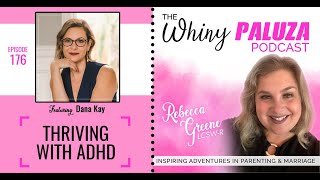
In this Whiny Palooza podcast episode, host Rebecca Greene (a licensed clinical social worker and mother of three) interviews Dana (Donna) Kay, a board‑certified holistic health and nutrition practitioner and founder of the ADHD Thrive Institute. Kay shares her personal transformation from accountant to holistic health advocate after witnessing her son’s struggle with severe ADHD symptoms and multiple medications. She explains how a food‑first, gut‑health strategy—eliminating inflammatory foods like gluten, dairy, and soy—dramatically reduced her son’s symptoms, allowing him to thrive academically and socially. The conversation delves into the gut‑brain connection, describing how gut inflammation, dysbiosis, and nutrient deficiencies affect neurotransmitter production (serotonin, dopamine) and frontal‑lobe function, leading to ADHD‑related behaviors. Kay outlines practical, step‑by‑step dietary changes, emphasizes gradual implementation, and recommends specific supplements (high‑quality fish oil, probiotics, magnesium, vitamin D) while warning against low‑quality products. She expands the scope beyond diet to address hidden internal stresses such as detoxification pathways, hormonal imbalances, environmental toxins, and genetic factors, using functional lab testing to identify root causes. The episode also promotes Kay’s ADHD Thrive Method for Kids program, her bestselling book Thriving with ADHD, and her online resources (website, social media). Throughout, both hosts stress that parents are not to blame for their child’s condition, critique the medication‑centric medical model, and encourage a holistic, evidence‑based approach to help neurodiverse children thrive.
Chapters
No need to whine, it's Whiny Palooza! Have some wine and join us on the Whiny Palooza podcast with Rebecca Green.
Welcome to the Whiny Palooza podcast. I'm your host, Rebecca Green. I'm a wife, mother of 3, and licensed clinical social worker. I also have 3 fur babies at home too. My passion has always been to help children and their families. I always dreamed of being a wife and a mother. Parents are always learning through their struggles failures and successes and joys. I am no stranger to this wild ride of parenting, and I know behind every great parent lies a team of supportive friends and family. I want to be part of your support system. I want you to know that you are not alone. We are in this parenting world together. Join me every week for insightful discussions with experts on parenting and marriage, as well as other parents who have found the secret to successes in parenthood. You'll learn tips and tricks to make life with your family better than ever. I hope you will follow along with me while we dive into what it takes to achieve a happy family.
Hello everyone, this is Rebecca Green for the Whiny Palooza podcast, and I am so excited to have Donna Kay here with me today. Donna, thank you so much for spending time with me today.
Rebecca, I'm so excited to be here too.
I want to introduce you to Donna because she has quite the interesting bio. She is a board-certified holistic health and nutrition practitioner and the CEO and founder of the ADHD Thrive Institute and— oh, and the creator of the ADHD Thrive Method for Kids program. I missed that when I read this the first time. As a mother of a child with ADHD, she knows firsthand the struggles that come with parenting a neurodiverse child, but she also knows the freedom that is possible once parents learn to reduce ADHD symptoms. Donna has been featured in Forbes, Authority Magazine, Medium, Influencive— is that how you say it? Influencive— Thrive, Thrive Global, and various others. She has also been a guest on multiple parenting and ADHD summits and podcasts. Her mission is to help families reduce, reduce ADHD symptoms naturally so that children with ADHD can thrive at home, at school, and in life. Well, as I told you before we started, this topic is absolutely fantastic and so needed, and I'm so very genuinely excited to talk to you. This is good stuff.
Great. No, I am too. It is definitely, uh, it's definitely a needed topic out there, and That's why I'm just so passionate about getting the word out to all the families that are struggling with kids with ADHD, because they don't need to struggle.
No, and, um, you have so much to teach us. I mean, I would love to start with like, what inspired you? Like, how did you become a board-certified holistic health and nutrition practitioner? What an awesome mouthful.
Yes.
And then tell us how— what inspired you to start the ADHD Thrive Institute?
Well, uh, it is an interesting story, and there's always a story behind, um, a lot of careers out there, for sure. Uh, I was actually an accountant in a previous life, so, um, yeah, don't laugh at me, don't tell anyone except for all the listeners listening today. But oh my gosh, I probably would have continued in that field for, for my whole career, uh, you know, unless you know, my son's health issues, you know, concerns grew over my son's health issues. And, uh, you know, I used to always dream about when I was a young child that all I wanted to be when I grew up was a businesswoman with an office. And I achieved that goal. And, you know, I would have continued that way, but my son, when he was— oh, look, even, even at the age of 2, I always knew that there was something a little bit different than other kids. Um, he would be so active and he would bounce off the walls, and he would be the kid in the playground that would be— you, you couldn't even keep your eyes on. He would— he's— he was a runner, that was for sure. I remember, you know, going from the supermarket with my, with my trolley. And, um, actually, do you call it a trolley here in the US? No, no, but that's okay.
I knew what you were talking about, like a shopping cart.
A shopping cart. Oh my gosh, even though I've lived here for over 8 and a half years, there are still words that come out and people look at me as if I'm crazy. But if I say any more, just let me know. So I was in the— with my shopping cart, and like, he was holding on to the side and literally just bolted off down in the, in the car park. And as you can imagine, that would be pretty scary at that young age. So he was the one that had so much energy. He would have these meltdowns that were just just so full-on and dramatic, and they would stop the whole family. More than just the, you know, the terrible twos, it continued into the, you know, the threes and then into the fours. And, you know, four was really one of the worst ages for us. And my gut told me that there was something going on, and I would ask his teachers and they'd be like, no, he's just a boy. I'd ask my pediatrician, no, he's just a boy. But You know, eventually his tantrums became even more severe and, um, his hyperactivity just shot through the roof. And that's when his teachers really started noticing the difference as well, when he was about 4. And we went to a developmental pediatrician and he was diagnosed with ADHD. And I was handed a prescription, um, prescription to, to go and put him on medication. And honestly, between you and me, I I was relieved, uh, you know, I was relieved of the diagnosis because I wasn't a bad mom. Um, there was something that was actually driving this. It wasn't my parenting. And I was relieved with the medication because finally we were going to get some help. There was going to be a pill that was going to fix my family. Yeah. And, um, so I went to that drugstore and I got that and I gave it to him as soon as I could. And at first things were great and Uh, you know, then, um, then it started to wear off early and all of these other side effects started, and the doctor increased the dose. And then we had some more side effects and the doctor added another prescription on top of that. And then, you know, uh, and then more symptoms came. And then my son, at this age, probably was by 5 by now, he was on 3 strong medications.
Oh my goodness.
Yeah, and then he started having terrible anxiety, and the doctor suggested an SSRI, a fourth medication, to counteract some of those new side effects. And I honestly just couldn't do it anymore. And that's when my life, my career path, completely changed. Uh, I dove into all the research that I could get my hands on. Um, there had to be a better way. I went back to school, I did my holistic health degree, I did multiple specific certifications in this particular area, and I really learned that ADHD symptoms can be reduced naturally. And, um, I learned how food can have so, so much effect on so many parts of our lives, and that there are other things out there. And today my son's thriving. He's in middle school, he's a straight-A student, but he did get a B this semester and he was really upset about it. Um, but I think the most important thing is he's happy and my family is happy, and now we have peace and calm in our house. And once I learned all of this, and once I saw the changes that it had on my own family, I just couldn't keep this information to myself. And that's what really inspired me to, you know, create the ADHD Thrive Institute, because you can thrive with ADHD. And I didn't want any other family to go through the struggles that I went through. Um, and over my— over the years of me working and running the ADHD Thrive Institute, I've been able to help close to 1,000 other families get to the same place as me, but just so much quicker, without as much pain and stress as I went through.
Well, I can't give you enough kudos for going down this path to help your son and to help so many others. And I mean, I think that there are some families listening who, you know, I mean, I'm not, I'm not saying this is bad. I'm just saying sometimes we don't know, and we put our child on the fourth medication because we don't know what else to do. So I, I can't tell you enough how amazing it is that you were like, a fourth medication? Like, let's go find something else. Like, that's amazing.
Yeah, no, thank you. And look, it's not anyone's fault. Listeners out there, if you're thinking, oh my gosh, this is the situation that I am in, It is not your fault. No, you are trusting what the professionals are telling you to do, and that's okay. Um, but you're here, you're listening to this podcast, and you're learning that there may be something else out there that can help you.
Absolutely. And you know, that leads to you, you talking about food, and you call it the food-first approach, right? Is that what you call it? Can you tell us, can you tell us about that?
Yeah, look, um, and this is really what I am so passionate about, and I just— even if families don't work with me, it's, it's not about that. It is about that, you know, when a child is diagnosed with ADHD, the first course of treatment that most doctors suggest is medication.
Yeah.
And many of them don't even tell parents that altering the diet can significantly reduce ADHD symptoms. And that's what happened with my son. You know, when he was diagnosed, the only thing that we were told about was medication. And unfortunately for us, the medication did more harm than good. And with each new medication our doctor suggested, my son had new side effects and then another medication to counteract that side effect. So, you know, I knew there had to be a better way. And that's when I really started learning about the effects of food on the body, the effects of food on the gut health and on the gut-brain connection. And on how when we heal the gut, ADHD symptoms are really reduced or even removed completely. And so for my son, medication didn't help him, food did. And that's why I always recommend a food-first approach with any family out there. I'm not against medication, but it shouldn't be the first course of action, especially with our kiddos, uh, not when food can sometimes be even more effective with no side effects to worry about. So You know, if parents want to reduce ADHD symptoms in their children, they must do something much more than just give them a pill or even just even a supplement. You know, supplements are really effective, so a medication can be too. But if your child continues to eat processed inflammatory foods like gluten, dairy, and soy, those ADHD symptoms are not going to go away because the foods they eat are exacerbating the symptoms. So food first to me means rather than trying to fix it with a magic pill that's going to fix your child and fix your family, just like what I thought, we clean their diet up instead. And in doing this, we reduce inflammation, and then the symptoms start to reduce because we're getting to the bottom of what's causing them in the first place. Um, you know, and it's so powerful, and a lot of people don't know it. People don't realize. People aren't told it, and they need to— they need to be. And that's what my mission in life is, to get the word out there. I hope that one day it will change, you know.
Um, well, and I actually had the pleasure of interviewing a pediatrician and she was frustrated because she said all she was taught was to give medication for ADHD. So she said she wasn't taught anything else to do.
Yep.
But I know everybody listening is probably feeling how I'm feeling right now. And you— and when you said, when you said eliminate gluten, dairy, and soy, I was like, oh my Goodness, that's a lot. That is a lot. So tell us, I mean, that sounds challenging. How did you start to implement this?
Yeah, look, there are so many, uh, um, so many, uh, you know, strategies that we use to implement this, and that it is— it does sound overwhelming. Okay.
Yeah.
And I can tell you that, you know, me just dropping that, families are going, yeah, right, there's no way that we're gonna be able to do that. I know, but I can tell you, you can. Okay? And, you know, um, there are a number of challenges in changing the way a family eats, and then, you know, the challenges will be different for every family. And for me, um, it was that I tried everything to do it on day one, um, and this is not the approach that I teach in my program. I always tell families, Rome wasn't built in a day. Transforming your family's diet will not be complete in a day either. You know, it's not a race, it's a marathon, and it's okay to take it slowly. It's okay to take it one step at a time. And if that pace that's doable for you and your life is like one change a week or one change every two weeks, then that is perfectly okay. Families really need to give themselves permission to take things slow because it's not a diet, you know, it's, it's not a phase, it's a permanent lifestyle change. And when it becomes part of your lifestyle, it becomes second nature, and then changes don't seem as overwhelming or hard anymore. You may think to yourself, well, you know, every Tuesday night we do Taco Tuesdays. What are we going to do now? Well, tacos can be made gluten and dairy free, I can tell you that for sure. And so we're just going to slightly adjust it, and you're going to be having gluten dairy free tacos every Tuesday. And once that becomes your normal, that's easy. You don't even think about it anymore. And so it's just recreating your new normal. And when it becomes your new normal, you don't even think about it. You know, it's like going to the gym. Yeah, it's really hard at first because you're just not used to doing it. And so you do it every day for 30 days, and all of a sudden it's part of your normal now. You don't even think about it. It's part of your routine. It's the same way with this.
That makes a lot of sense. And I like that you said, you know, like one change at a time instead of feeling like we have to throw everything out.
You do not. I always tell families, never throw away food. You know, when a product finishes, let's buy a better one.
That's good advice. Yeah, that's really good advice. I'm laughing because we're going to have a Girl Scout party this week, and guess what I'm serving? Pizza.
Yes.
And I'm like, oh, that is totally okay.
Don't stress. But you know what? My son is, he's at summer camp at the moment. Yesterday they went to Zeke's Pizzeria and, uh, for on, on camp, and you know, they gave him a gluten dairy-free pizza. So it is okay, there are options out there. You do not need to give up pizza. And again, when you get to that point and when you start to feel better, it's amazing. The parents, like, when they change themselves, they start to feel better, and they're like, well, actually, I don't really feel like that anymore. Like, I— here I've got, you know, cucumber and hummus, and, um, I had an egg wrap. And so, you know, this is what I crave now. I don't crave the other things anymore because that's what my body wants and that's what my body likes to eat.
That's amazing. I'm very impressed with you.
Oh, thank you.
Can you, can you tell us more about the gut-brain connection?
Yeah, um, look, I think I'll, I'll start with some statistics. So, uh, in 2018 there was like a survey done— oh, not a survey, but a study done— and it was estimated that 54% of American children had been diagnosed with a chronic illness. Um, and that figure was only 15% a few years before that. So you look at that increase and you think to yourself, oh my gosh, 15 to 54% of children, you know, one in two have anxiety, asthma, Type 1, Type 2 diabetes, epilepsy, cystic fibrosis, heart problems, learning disabilities. I mean, sinus infections. 1 in 5 have allergies, 1 in 6 have developmental delays, and 1 in 68 have autism. And I think that that has actually now changed. I think it's something like 1 in 32. Um, but why do you think that this rise has occurred so rapidly? And the answer is simple: it all begins in the gut. And, uh, that's because 80% of the body's entire immune system is within the gut wall, along with billions of nerve cells and an extensive amount of beneficial gut bacteria. So all of our children's health is quite literally connected to everything that occurs in the gut. Okay, so let's tie that to ADHD. You know, when I speak to a family, when we're doing an intake, we ask them, you know, is your, your kid healthy? Do they have any health symptom, you know, health history? And they're— most of them say, yeah, they're super healthy, they haven't really been sick. But then we sort of dive a bit deeper and we ask them, you know, what is their gut like? Have they got constipation or diarrhea or bloating or gas? And a lot of them tell me they have, and they're really surprised to learn that it's not healthy and it is not normal. It might be super common, but it is a byproduct of an unhealthy gut, you know. And then I ask is if their child has been on antibiotics, uh, when they were younger. And I would say like 80% of the families that, you know, the children had, uh, I kept a tally. That's just me going off the, you know, the top of my head, but I wish I would have kept a tally. But what happens when you take antibiotics is it works by killing bacteria or preventing it from going. Unfortunately, most antibiotics can't distinguish between good and bad bacteria, and that means they can wreak havoc on the gut's healthy bacteria. And many people actually suffer lasting changes in their gut flora as a result of taking antibiotics. So a large percentage of these children have been on antibiotics, and this in turn is compromising the gut. And when the gut is compromised, it's not a huge surprise to see that disorders and illnesses on the rise. Does that make sense?
Makes 100% sense to me.
Yeah.
Yes.
Yep. So let's, let's bring ADHD into the mix. Yeah. So, uh, what the gut-brain connection means is that in essence our brains are deeply connected to our guts. And so if our guts aren't functioning well our brains won't be able to function well either. And the main area in the brain that is involved in gut function— there's a number of them, but the main area is the frontal lobe, and it talks to the gut via two-way chemical messengers and the vagus nerve. And the frontal lobe is involved in things like attention and focus and executive function and planning and organizing, problem solving. Do any of those areas sound like ones that are affected by ADHD?
Oh yes, absolutely.
Yes. So if you're familiar with common ADHD symptoms, they should definitely sound like that. So children with ADHD often struggle with all of those tasks because the frontal lobe is in the brain. Many people are under the impression that the brain is what needs care, when in reality it's also the gut that's causing the problems. But, and this for me is I think the biggest thing, um, the body is response— uh, sorry, the gut's responsible for making 95% of our serotonin and 50% of our body's dopamine. And so they're produced in the gut basically, and these neurotransmitters are the ones that help us manage emotions, balance our mood, help our cognitive function. And emotional dysregulation is a common symptom of ADHD, but many parents don't realize that this emotional dysregulation actually starts in the gut where the serotonin and the dopamine are made. And so the problem then is not the emotions themselves, but the fact that the correct amounts of these vital neurotransmitters are not being made in the first place. So by working to improve gut health, many parents of children with ADHD find that the emotional dysregulations, uh, problems solve themselves. And so, uh, Don't worry, we all, we all have dogs and kids. Please don't worry. Oh my gosh, I know, it's always the way. He hasn't barked at all day, and then now as soon as I'm on a podcast, he starts barking.
It's totally okay.
Yeah, so, and they resolve themselves. That's actually one of the first things that changes. The amount of families I speak to, their lives are on hold because of their child's emotions. They can't go out, they can't go to the supermarket with their child. They stop going out as families because they're worried about the next meltdown. And I can tell you the first thing that changes when we work on reducing inflammation in the body is a reduction in meltdowns, a reduction in tantrums, improvement in mood, you know, the severity, the length of time, the frequency all reduce. And it is wonderful to watch because that is actually the hardest thing to deal with, with a child with ADHD, is that emotional dysregulation. And I just want to tie it, I think, to a bit of an analogy because sometimes it's hard to sort of visualize why that's happening. So have you ever felt butterflies in your stomach because you were nervous about something? Mm-hmm. Totally. I used to get that all the time. I still do, you know, we were on first date. I mean, I haven't had one of them for a while, but, uh, you know, a test or, or a conflict with something. And that's a perfect example of the gut-brain connection. So our bodies perceive whatever we're nervous about as a stressful situation, and then our brain trigger raw emotions in the gut. And so they result in the butterfly feeling or feeling nauseous, and that's the brain talking to the gut. But the reverse is also true. Our guts talk to our brains as well. And when the digestive system, and specifically the intestinal tract, has a higher level of bad gut bacteria than good, it's called something called gut dysbiosis. So an imbalance. And gut dysbiosis creates inflammation that travels through the vagus nerve to the brain. And once this reaches the brain, it creates symptoms like brain fog, which is inability to focus, confusion, poor memory, and a whole host of neurobehavioral disorders like ADHD, depression, anxiety. It goes beyond ADHD, and it's kind of like a highway. The gut and brain are constantly sending messages back and forth, and when medication is prescribed for ADHD, it's often to treat the symptoms in the brain alone, but the medication does absolutely nothing about whatever might be going on in the gut.
And I want to tell you that I would guarantee you every single person who listens to this does not know any of the food stuff that you're talking about. And it's just because the message isn't out, you know, like you and I are helping to put the message out.
We—
this—
people do not know this. So I am so glad that you are letting us know this today.
Oh, you're welcome. And that's, that's, as I said, that's my mission. It's not— it's just, I wish this was mainstream. Yes, I just recently released a book, and it, it was an international bestseller in child health, and it's called Thriving with ADHD: A Guide to Naturally Reducing ADHD Symptoms in Your Child. And I just wish that doctors out there, instead of handing a prescription medication hand them a copy of my book. And it's as simple as that. It's all that needs to be done.
Totally agree. I'm with you. I'm gonna help you get this message out. That's all I can say. So, so let's go beyond food. Yeah, let's talk about what other steps parents can take to support their ADHD child naturally.
Yeah, so, you know, food is the foundation of everything. Uh, you know, it's like building a house. When, when you build a house you— a solid foundation is not optional. Uh, you know, if you don't have that solid foundation, the house is not going to be very strong, and the body's the same. So I always say to families, start with food. But, you know, I would say about 50% of the families I work with, we change the diet in the way that we suggest and the symptoms go away, or, yeah, and I've reduced so significantly that they don't need anything further. But the other 50% may have some underlying issues going on in the body as well that need to be investigated, and they're these hidden stresses, sort of dysfunctions or malfunctions, and opportunities that we can investigate to find out what we can do to help that body so it can function at its best. And so we look at the gut, obviously, because that's the biggest thing. We look at the immune system, we look at detoxification, energy production, nervous system. And all of these hidden internal stresses and dysfunction highly correlate actually with the most common health complaints. It's not just ADHD, it's not just mood. It is like, honestly most of the common health complaints out there. I've had families go through my program where they've done all of these changes for the parents as well, and the changes in the parents, like going from always being chronically high, um, blood pressure or cholesterol to like going back into normal ranges.
Wow.
Um, you know, I had one lady whose hip joint was so inflamed she couldn't walk upstairs to go to her own bed. She was waiting for a specialist appointment and to find out where the inflammation was coming from and to get medication. 10 weeks into my program, the specialist rang and said, you know, I've got an appointment for you. And she's like, I don't need to come anymore, it's completely disappeared. So, you know, we talk about ADHD, but this is everything really at the end of the day. And so what we're doing is we're really investigating what the underlying root cause is that's contributing to those symptoms. And there's a number of them. You know, gut breakdown is a, is a huge one, obviously. Nutritional deficiencies and food intolerances. Um, so for example, my son had a raspberry, raspberry food sensitivity. I mean, who would have thought? Like, that's healthy, isn't it? Um, but that was driving inflammation in his body. Another child I worked with a few years ago had a banana sensitivity, and once we learned about that, we can temporarily remove the food, we can heal the gut, and that helps the inflammation in the body go down. And, you know, some other common things are, uh, um, things like compromised detoxification pathways. And so, you know, there's genetics that you can have these gene mutations, which is a whole other topic, um, but that can compromise your detoxification pathways. And so I like to— again, another analogy, um, everyone's got a bucket when they're born, and, uh, you know, we get exposed exposed to all these toxins and heavy metals and environmental stuff, and all of that goes into our bucket along with our diet. You know, if we have a bad diet, the bad diet goes into the bucket as well. And what— that bucket over the years, you know, fills up. Some people can, you know, empty the bucket to allow the body to keep functioning. Other people struggle to empty the bucket. And so what happens is the bucket fills up and fills up and fills up, and all of a sudden it's so full that tips over and that's when symptoms come out, okay? Um, and that's because that person's detoxification pathways are not optimized. And so for one person, you might live a completely same life as someone else, but they could be experiencing all of these symptoms of ADHD because their bucket is so full because they haven't been able to empty it over the years. So that's another example of something that we're looking at. Hormonal imbalance. And we know a lot of our hormones are made in our gut. So again, that ties back to the gut. Um, even like cultural and lifestyle factors can contribute, uh, environmental toxins, heavy metal, heavy metals. Um, you know, when you have pharmaceutical medications, it breaks down the gut just like what we explained with antibiotics. So there are a lot of contributing factors to what's going on in the body, and we use functional lab testing to basically get a little microscope out looking deep into the body to identify what those hidden stresses are, and we're able to target that.
Oh my goodness, you are speaking my language. I was raised by very holistic parents. They own a health food store. And wow, I, I mean, like, you're, you're preaching to the choir. I, I just can't emphasize enough how good all of this is. And I think that people don't realize The food is causing the inflammation, which is causing the symptoms. That is the link that we are all learning today. And, and I'm just— I'm so happy that your son is thriving. So he's doing well?
Yeah. Oh, he's doing amazing. I mean, he's, he's now a teenager, and so, you know, obviously we've got a teenage boy in the house, which comes with a whole host of other issues, but they're normal teenage boy issues. They're not like us walking on eggshells or like on this emotional roller coaster. They're normal teenage boy issues, and that's the, that's the exciting or not exciting part of it.
Oh my goodness, you said that there's some beneficial dietary supplements. Can you tell us about that?
Yeah, look, and, and I will say that again, it comes back to diet. If you're pounding the body with inflammatory foods, no supplement's gonna work, and you're gonna end up really expensive poop. Am I allowed to say that on air?
Yes, yes, it's true.
Yeah, because you take it, your body can't digest it, and it goes out the other end, and you end up wasting so much money. So I'm really a big proponent of like, don't just go out and buy supplements without doing some of these other changes as well, because it's going to be a waste of money. Another thing to keep in mind is that, uh, with supplements, every child is a bio-individual, meaning every child is unique. So what works for one child might show little effect for another child. But that being said, there are a number of supplements that I love for children with ADHD because, you know, they are the most effective and definitely ones that I do suggest. A really good quality fish oil for omega-3 fatty acids. And there's lots of studies out there that show that the fish oil and omega-3s and a good balance of omega-3 and omega-6 can support memory and hyperactivity and clear thinking, behavioral disorders, and organizational skills. And so, that's the top one for sure. A good quality probiotic. Again, lots of research out there. We tie it back to that gut-brain connection. Once we can heal the gut, we can really optimize that gut-brain connection, but they're not all created equal. And it's the same with any of these supplements. Don't just go to Target and buy, you know, Calm powder or, you know, Focus Factor or— sorry, am I allowed to say brands on the— on air? Or, you know, um, or, uh, oh, what's the gummy ones that everyone has? Smart— Smarty Pants. They are not going to get you to where you need to go. And so it's really about a good quality probiotic that will help nourish the good bacteria, help fight off the bad bacteria. They can support detoxification. It can help with mood so much and also support the body against the damaging effects that toxins and everything in the world can, can create. Uh, so that's another one. Another one's magnesium. Um, a lot of parents find that magnesium makes a surprising difference to their kids' anxiety or depression, sleep, reduction in hyperactivity. But magnesium is needed for over 300 biochemical processes in the body, which is a lot. And so most people are deficient these days, and there's actually research to show children with ADHD or anxiety often have low magnesium levels, and using supplements can really be beneficial. Another one that I love is vitamin D, and it can work wonders to support children with ADHD, depression, anxiety, and pretty much everyone, especially when it's taken with an omega-3 fish oil. Uh, and you know, the best natural way to get vitamin D is to get outside and get into the sunlight. But as this is not always possible, especially like being here living in Seattle, I can tell you there's not a lot of sunshine all year round. There is right now, it's beautiful right now, but, um, it's not always possible. And so vitamin D supplementation can be very, very beneficial. And again, most Americans are deficient in vitamin D. Um, so they're my top sort of 4 supplements. I could go on and on and on, but I don't think we've got all day. But definitely the top 4 for kids with ADHD.
Those are awesome. I had actually had someone I just spoke to tell me that my chocolate cravings are an indication of low magnesium levels.
Oh really? Well, it could be a number of things. Um, I could actually give you a couple of other different reasonings. Um, or it could just be that you love chocolate.
Yeah, that is, that is very true. That's very true. Well, I mean, we've given them so much information. Is there anything else that you think is super important to share today?
Look, I would just, you know, again reiterate, I know that this is a lot of information. Some listeners out there might, might be feeling, you know, guilty that, well, how come I'm not doing this for my kid? Or how come my kids' diet so bad. I haven't done any of that. Don't feel guilty, you know, it's not your fault. Uh, this is the way of the world, unfortunately. And unfortunately, the medical industry is driven by pharmaceutical companies and insurance companies. And that's the difference in the medical industry here in the US compared to, you know, the, um, the UK and Australia, is they've got a public health system, so they want healthy people. Whereas here it's driven by, you know, pharmaceutical companies where healthy people need meds. Um, that's—
but again, that's just— that's just a story for another day. Interesting. I— that is really good stuff. Um, tell everybody where they can find you and your book.
Yeah. Um, so yes, my book has launched. As I mentioned, it's called Thriving with ADHD. Um, for me, uh, you know, all I wanted years ago was a book, uh, on ADHD that clearly spell out exactly what I needed to do to support my son with ADHD naturally, but I could never find it. And I was constantly Googling for something, and I struck out again over and over again. There was no book out there. And there was a quote from novelist Toni Morrison. He, he once said that if you find a book you really want to read but it hasn't been read yet— it hasn't been written yet— then you must write it. So that's what I did. So that's the book. You can find it at my website, which is adhdthriveinstitute.com/book. It's also available on Amazon. There are a lot of free giveaways in there. You get to scan QR codes. Everyone knows QR codes now. It never was a thing prior to a couple of years ago, but there's QR codes all through my book where you can scan them and get free resources to download. You can find me adhdthriveinstitute.com. I'm on Instagram, Facebook, and other social platforms as well. I'm even on TikTok, even though I don't really want to be there, um, but my team made me do it. And so yes, you can watch me being stupid on TikTok.
Oh my God, my girls got me on TikTok and I was so resistant, and now I'm having fun with them.
So it is, it is like, it is addictive when you're watching. It's like you just sit there for hours and hours and hours. But if you want to learn something about ADHD, I'm on TikTok, so you can binge on my content.
I will go find you in all the places, and I just want to thank you so much for your time and for your knowledge.
Thank you so much, Rebecca. This has been super fun being here. Um, thanks for having me.
This is Rebecca Green reminding everyone to spend every day laughing, learning, and loving.
Thank you for tuning in to the Winey Palooza podcast. If you like what you heard, please be sure to subscribe so you never miss an episode. While you are there, leave a review. I love to hear your feedback. Thank you so much for listening. Until next time.
This show has been produced by Market Domination LLC. To discover how you can have your own show completely done for you and turn it into a real published book and become the authority in your marketplace, Go to www.marketdominationllc.com/podcastoffer.










