Episode 204: Food and Body Freedom with Jessah Autum
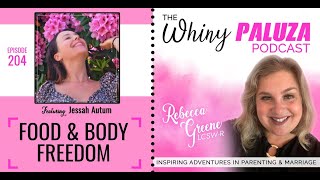
This content was created by Rebecca Greene. This content was uploaded by Rebecca Greene. This is a YouTube podcast episode titled "Episode 204: Food and Body Freedom with Jessah Autum" (created 2022-12-30). It features host Rebecca Greene (host of the Whiny/Whining Palooza podcast; wife, mother of 3, licensed clinical social worker) interviewing guest Jessah Autum (certified health and life coach). The discussion focuses on intuitive eating, food freedom, body-image healing, the subconscious roots of dieting, parenting strategies to counter diet culture, practical principles (honoring hunger/fullness, eating for energy, gentle nutrition, movement that fits, abundance mindset), coaching success stories, and resources (Instagram and a Facebook support community).
Chapters
No need to whine, it's Whiny Palooza! Have some wine and join us on the Whiny Palooza Podcast with Rebecca Green.
Welcome to the Whiny Palooza Podcast. I'm your host, Rebecca Green. I'm a wife, mother of 3, and licensed clinical social worker. I also have 3 fur babies at home too. My passion has always been to help children and their families. I always dreamed of being a wife and a mother. Parents are always learning through their struggles, failures, and successes and joys. I am no stranger to this wild ride of parenting, and I know behind every great parent lies a team of supportive friends and family. I want to be part of your support system. I want you to know that you are not alone. We are in this parenting world together. Join me every week for insightful discussions with experts on parenting and marriage, as well as other parents who have found the secret to successes in parenthood. You'll learn tips and tricks to make life with your family better than ever. I hope you will follow along with me while we dive into what it takes to achieve a happy family.
Hello everyone, this is Rebecca Green for the Whining Palooza podcast, and I am super excited today because I have Jessa Autumn here with us today. Jessa, thank you so much for joining me today.
I'm honored to be here. Thanks for asking me to be on the show.
This is going to be a wonderful conversation. I'm going to tell you a little bit about Jessa. She is a certified health and life coach who helps women heal their body, heal their body image, and guides them to a sustainable approach to food and freedom so that they can finally feel confident and free in their body. How amazing does that sound? I mean, it just sounds like exactly what we need at this time of year. We were just talking about the holidays and the New Year's and how this is the perfect time for this conversation. Right. So let's jump in. And I always like to start with— I love learning about people. So tell us what inspired you to become a Certified Health and Life Coach.
First of all, I am just so, again, honored and excited to be here and to share a little bit of my story and see if anyone can get any inspiration from it. So a little backstory about me. Growing up as a girl, I always had a lot of body image struggles, and unfortunately those turned into— it turned into an eating disorder. And so I had this for many, many years. And I say this with a smile because I really know that my story and my transformation, it has allowed me to come to the place where I am now. Where I get so elated and it's like my mission to help women through this period because I know that so many women go through these struggles as well. So through my healing process, I got actually really interested in nutrition and food and health. And so it's really beautiful, the turnaround that I was able to experience. And so through my— I like to call it like the wound or the wounded healer. So through all of that, I was able to see clearly my soul's purpose and my mission, and that's to share the message about body image struggles are real in our day to day, but to also be able to help women to grow and heal and to create awareness around the struggles so that every woman can get the health that they deserve. Because I always like to say health is our birthright and we all deserve it. And when we can really realize that I saw a quote the other day and I loved it. It's like, our body is not an ornament, our body is an instrument. So that one really hit home for me.
Oh my gosh, I'm writing that down.
I should quote that. I think it's two, um, they're two girls. I came across them and their book. I will link it after for you, but it's a really beautiful book and I really love the work that they're doing as well. I always find inspiration Every day, new inspiration. It's amazing.
Me too. And you have been part of my inspiration. I am so inspired by you. And now I know even more about you. And I just love that you took your own struggles and made it your mission to help other people from it. That's just so beautiful.
Thanks. That's really sweet of you to say.
Well, and I'm so distracted because you have a beautiful dog behind you. If you're watching us on YouTube or Facebook, oh my gosh, who is this dog behind you?
So this is my dog Kali. She's a rescue dog from India. So my partner and I, we were traveling India and she was this cute little street dog. And so we decided to be a little bit crazy and we picked her up. And at the time we were traveling on our motorbike. So we traveled from Northern India on the motorbike with this dog Kali. And I didn't even actually see that she was behind me. She must have snuck up.
Oh my gosh. She's beautiful. I'm sorry. I'm such a dog lover. I'm so distracted. My dog is at my feet right now. So.
Dog, dog podcast party.
It's a dog podcast party. I love that. Well, and I think that a lot of our listeners probably don't know what intuitive eating is. Can you share with us what exactly that is?
Yeah. So intuitive eating, it's basically a non-diet approach and it's changing the habits and the way that you think about food. So there is a program based off of it. The way that I do it, it's more like teaching women how to eat with intuition, which it sounds very similar into intuitive eating. They have a set principles. They follow 10 basic principles and steps that you do, which I do incorporate a lot of those because they really work and they're all backed by research, which is amazing as well. So proven that it works. So basically it's just helping us to rewire the way we think about food. And we're putting away diet culture. Um, and diet culture is being the pervasive way we think about our appearance and the influence that we're getting, um, which doesn't honor our health necessarily. So it's always like diet culture is appearance first, health second, if that makes sense. Um, so yeah, the really beautiful thing with intuitive eating is it just really connects us back to ourselves because if you think about it, we're all born intuitive eaters as children. So if you think about a little one, they're, they're really curious about food, they're really interested in it, smelling it, touching it, uh, they'll have little bites of it and eating like what I like to call a beginner's mind. Um, but then when they're done with the food, they're just done with it and then they go on with their day. So that's all part of, um, what many parts of— what little parts of intuitive eating is that you're just starting a new way of eating without having all these rules and restrictions over food anymore.
That sounds so freeing, which, which brings me to my next question. Is that different from like, what is food freedom? Is that connected?
Yeah, it's connected. So intuitive eating, it's basically like the teaching of how to get to food freedom. So yes, so food freedom, that is just like the release. I love that word, that release. And I love the— I get a lot of clients, they'll say like they feel like a weight's been lifted, which is really funny. But so food freedom, it's just that release of the restrictions around food and any rules that we have around food. So it's like starting from square one and learning to build trust again with our bodies. And because that trust is so important so that we can make decisions that honor our body while listening to our cues, but also we bring in our guiding principles about like honoring our health and eating for satiation, um, listening to hunger and fullness cues. So it's just like taking it a couple steps back and just relearning all these things so that we can build trust in ourselves. But if we don't have that food freedom or like before, like if we don't release all those rules and restrictions, it's really hard to listen to what we truly need and desire.
I'm just, I'm sitting here thinking because so like what I find for myself is that when I eat, okay, so there's like the rule that you can't, I'm quoting in the air if you're not watching this, there's the rule that you can't eat after dinner. Or you shouldn't eat after dinner. And what I find for myself is if I eat late at night, I don't sleep well. So I have made, like, in my mind, I try to make this, like, see, I just need to shift how I'm thinking about it because I'm making a rule for myself not to eat late at night so that I sleep better. So, like, to me, that's kind of— I'm using, like, the rule language. So that's not really food Freedom, right?
Well, you know, it's interesting. I really like this, actually. This is like a creative way to explain because I'm sure lots of people have questions. Excuse me, I have a little cough. I'm sorry. But so there's also honoring your, your specific makeup and your health. So there's a lot of people as well. So say someone has celiac disease or like me, they're lactose intolerant. So I don't necessarily have a rule that like I can't eat dairy, but I choose not to eat it often. I still do sometimes, but I choose not to eat it often because I know the effects that it will have on my body and it makes me uncomfortable. So then going, say for you, instead you could, if you want to try it out, instead of saying, no, I don't eat after dinner or I'm not allowed, just say something along the lines of, I'm choosing to stop eating and just have dinner because I know that it'll affect my sleep. So it's kind of like— it sounds really simple, but just switching your wording around, it like brings the power back to you. But that being said, too, like, we don't really need to overthink it. If it's— if it feels like, you know, like a lot of pressure and it's causing more stress thinking about like letting go of the rules, then that stress in itself is like worse for us. So, um, and I think that's really common as well. Like, I can't eat too late before I go to bed either, because I do wake up in the night or, but then it's interesting because this is why this is beautiful because we're all so different. So for you, you know that it will disrupt your sleep, whereas some women, they might need to actually have a bedtime snack because their blood sugar gets really low in the night. So this is, again, this is, comes back to that whole circle of like with diet culture. And there is not one, one-size-fits-all approach when it comes to our health because we are all so beautifully unique, as you mentioned, like even with you and the sleep, whereas someone else might have to have something before they go to bed.
So yeah, that's so interesting. It's like listening to your body. And I, you know, and I love— yes, it's— I, I'm trying so hard as I age to just focus more on what makes me feel good. I'm trying to shift. I'm working with you to shift. You're helping me.
Oh, makes me happy to hear that.
Oh my gosh. Well, and the whole body image and confidence, I have to tell you, my youngest is 10 and I see it with her and her friends and it's making me want to cry. So I certainly need your help to help her and to help the girls, the kids and the women feel more confident in their body and have a better body image? How, how can we do this?
Okay, so how do— can we get started? I think the most important thing— this is a huge reason why I'm doing this as well. I don't actually have any kids of my, my own, but when I do, or if I do one day, then it's so important for me to teach them off the bat because growing up Maybe I, I'm grateful for where I am. Like, I don't— I didn't want my story to change. I'm honored to be in the place that I am. But maybe we could— thank you. But maybe there's ways that, like, it could have been different, you know? So I think it's so important. The first thing I would offer for if you're a mom, if you have kids, especially young girls, is to make them aware, make them very hyper-aware of diet culture. So we see things like in ads, in TV, in shows. I do a little series on my Instagram page and Facebook. It's called a diet culture. When, like, when we're growing up. So I show little clips of like TV things or shows, sorry, or movies, and where it's like these crazy diet culture things that are coming up. When— so during that time when I was growing up, I didn't have this hyper-awareness that I have now. And so I was just taking in all these messages as a young girl growing up, thinking that this was the way it was. And so I think as a mom, or even if you're like— if you have any young girls in your life, just to be an advocate and just to say either this is wrong or just to explain that— explain it in a, in a nice way that this isn't the way it is. Even though that these people think that this is what we should be learning or listening to, that it's not the way that we have to think about our bodies. I think that's really important. But also just being empathetic and compassionate. That's a big, big, big, big one too, because I know it's a really confusing time for girls and they tend to judge themselves and there's a lot of comparison. But I think the first step is just awareness and making sure that they have the tools so that they can be aware when diet culture is coming up. Um, but also letting them know about boundaries. And I think I saw one of your episodes, um, that you were talking about setting boundaries, and that's so important for young girls as well, just so that they can have the voice that— say if they're with some friends and maybe their friends are talking about that, they can say that they don't want to talk about that, and that's so empowering for them as well. And then they can go play and not worry about their body because they're a young girl. They don't need to worry about that stuff yet. So that's probably where I would start. But I know it can be a tricky and sticky situation and it's hard. But I think for us as older women and the women who are mothers, just being, being advocates for your daughters and just feeling that empowered feeling that you're not going to let them go through kind of like maybe what we did when we were younger.
Well, and I think everything that you have said applies to us too. Definitely. Right. So like me being aware of diet culture and me setting boundaries and everything you just said helps me too, for sure.
Yeah, that's the number one thing too. Even for myself, I like to say I'm on a continuous healing journey. Even though I'm teaching women and I'm empowering them and educating, this is also helping my healing journey. So every day it's like 1% better. And I think collectively we can all rise up and just come back into that empowered feeling of our bodies, and again be reminded that our bodies are not this ornament, that they are this physical vessel that we are here to experience life in. And for us to get out of that trap, that mind-body trap of just, again, the comparison and the control and the scarcity, it's just like, it just brings our energy down. But that's my hope, is that every woman can feel this beautiful surge of that empowerment and that trust and that control over their bodies, because then at the end of the day, they can just go out and enjoy life because that's what life is all about.
Oh, sounds so wonderful. I, you know, I'm just— I'm sitting here thinking about— I think it was you talking about honoring your body. I think I was listening to you and It's just amazing to me how hard we are on our bodies. We're not honoring it. We're not trying to take care of it. We're like, we're picking it apart and criticizing it and being hard on— and like the stuff that we put— when I think about, oh my gosh, when I think about all the diets that I have been on my whole life, it makes me cringe. Like, I wish that I knew then what I know now. I wish.
Yeah. Yeah. And it's, you know what, you're not alone there. Like, there are so many women who they are struggling and they just want to feel this control. But this is why it's so— oh, I get like angry about diet culture. It's because it's an industry. They don't want us to succeed. They want to make money off of our failures. And I like to use these statistics. It's like the worldwide diet industry, I think it's like $170 billion or something in the US alone. I think it was like $70. I might be wrong on those numbers.
Gosh.
But, and you know what? And then there's what, like about 7 billion people on the planet. How does that work? That, that includes men, children, women in those statistics. And if the diet industry actually, if a diet program actually worked, then those numbers wouldn't be so astronomical, right? So again, like, they, they don't want us to succeed. Otherwise, then there'd be no more money made if every woman on the planet, if they succeeded in a diet, then that would just be it. And so I think it's really important again for us just to become hyper-aware. And it's also noticing about the diet cycle, you know, so we get our bodies in this state of feeling we're struggling, we're stressed because we don't know how to take care of ourselves. So then we go on a diet. But then our body becomes in this more stressed state. And then oftentimes after a diet, women like 98% of women will often gain back the weight that they lost initially, plus some, because now their body is in this human survival mode. And so it's just trying to find this place of homeostasis in this place of balance. And so that's why with my coaching, I, it's like, I don't like to say it, but I like to say it's like the last diet you'll ever have to do. And again, it's not a diet, but I like that phrase because it just sounds so freeing that But now you will have the power and you won't ever have to diet again. You're going to know how to guide yourself while you're healing your body image. And I think it's just really important. I think every woman deserves this and deserves this knowledge.
Absolutely. Oh my gosh, you just explained so much.
I know. And I tend to get very— because it's again, I'm very passionate about this and I can feel it like in my stomach sometimes when I'm talking because I just— and that's how I know too, that this is what I'm meant to do. and I'm meant to share this message as well.
Oh my gosh, 100%. I can feel your passion and I can't even express to you how much I love this topic. This is just perfection. Well, and you know, you talk about getting to the root, to the subconscious root, which, um, I think a lot of women don't know that there is a subconscious root to their dieting. So can we talk about an example of that and what you can replace it with, with a, like a new, better reason?
Mm-hmm. For sure. So it's interesting. So I like to explain like the subconscious mind. So let's think of like an iceberg, right? So just the very tip of it is on top of the water. So that is our conscious brain. That's what we can like see, our thoughts that we like are— we know that we're thinking about the way that we perceive the world where our subconscious thoughts, that's all under the water. And so this is all this messaging and programming that we've gotten our whole lives, which really dictates the way that we actually think. And it also dictates our actions and our identity of who we are. It shapes our beliefs. And so an example I like to give for that. So say there's a woman who comes to me and even though she, you know, she doesn't want to diet anymore, but she still wants to lose weight, which is okay. Everyone has like their things about them, but we work through the reasons why. So how I like to get to the subconscious root of this is I like to ask her why does she want to lose weight? And oftentimes the answer is to feel maybe more confident. That's a really common one. And that's, you know, I'm sure a lot of women would love that. And so then I start going deeper with her and I'm like, why do you want to feel more confident? And she might say, well, you know, I want to feel more confident in a bathing suit. And so I'll say, well, why do you— what's important about feeling confident in a bathing suit? And she might say, well, you know, I just really want to look like sexy or nice at the pool and then maybe attract my husband. I'm like, oh, okay, so now this is changing a little bit. And I say, so what's important about attracting your husband? And she answers something along the lines of, well, you know, I feel like we're not connecting as well, or our intimacy is lacking. So right there, it's like, oh, okay, so it doesn't really have anything to do with her body. But the deep root of what's going on is she's lacking intimacy. And so a lot of the times, too, in our lives, we go through these motions and we have these fears, and a lot of them stem to like fear of not being loved, fear of judgment, which is a big one in our bodies, fear of abandonment. And so understanding the roots of what we are really wanting and desiring is so powerful and important. So that we can again heal our body image and, you know, get a healthy body, because I know it's really important for our longevity. But understanding what do we really desire, like what does our soul want? Because it's oftentimes not just about our looks or our body. And also just understanding as well on the side of that, the subconscious thinking that we have and why we think our bodies will get us that love that we are looking for Or, you know, and a lot of times it comes from generational, like what we've been hearing as women from— it could be grandmas, aunts, mothers, and then again from ads and magazines, or we're hearing, uh, you have to look this way if you want to get a husband, or someone in our family is like, well, you'll never get a husband if you're eating that. You know, it's just all these messages, messages we receive. And so that's why, um, I find it so powerful in coaching is just getting really to the, again, the subconscious root. And then making this their truth. So the way that we can go about this is, okay, how can we get you more intimacy? How can we get you in that conversation with your husband of where you're confident enough to voice what you're needing or what you're wanting? Because at the end of the day, it's like your, your soul is telling you it needs some more nourishment and it's non-edible nourishment, but it's— that's what it's desiring. So then we'll work through that and how to get that for them.
It's amazing what's underneath the desire.
Yes.
You know, when you get to the root cause of the need, of the feeling of the need to diet and be thin.
Yeah.
Oh boy. This is such a complex topic.
I know it's a, it's a lot to unpack. And I think I always love, um, a lot of the realizations too when I'm talking. I did an event last week and some of the stuff I was saying, the woman who was hosting as well, she was looking at me like, wow, like, and it's, it's really beautiful and powerful and I love sharing it as much as I can. So that's why, again, I'm grateful that I'm here with you so that we can share this message to so many women because I hope that they will get that same feeling as well.
I hope so. I hope that we can help people move into a better place with food and body image and that's That's the goal. That is definitely the goal. Well, and I love that you talked about letting go of food rules and replacing them with the principles. And I would love— can we talk about what the principles are? Because I would love to know. I think this will help us.
Yeah. So a couple principles I like to share with clients. So there's like specifically to like the Intuitive Eating method, they have 10 specific methods. I do things a little bit differently. Again, I like to incorporate that. But the intuitive eating program that is like rewiring again the way of your eating habits. So what I do is I do like a lot of body image healing while we're working on eating habits and then movement that works and whatnot. So principles, for example, can be about honoring your hunger and fullness. I really like to invite one in of eating for energy. So these are the things of what can we add into our diet? And again, diet just being what we eat, not a diet program. But what can we add into our lives? So, and I like to talk about the theme of abundance because I'm sure— excuse me, sorry.
It's okay.
I'm sure that a lot of women, you know, after dieting for so long, they're so used to that scarcity and the restrictions. So it's such a nice turn to be like, oh, it's like this abundance theme. What do I get to add in to make my my cup fuller? What can I do to make myself healthier, more vibrant, more glowing? So again, bringing more energetic foods in. Other things include eating for satiation. So learning how to cook meals that are satiating and not just eating meals that aren't going to satisfy us. Also honoring our health and incorporating gentle nutrition, movement that works. So doing movement that we actually enjoy and not just because a program promises specific results. And again, this one's really important too, because if you want to create consistency with any movement plan, then enjoying your movement is so important. And it's, it's so valuable. And even myself, you know, I battled with that a lot of the times and I would try all these HIIT workouts in this program. And then also learning about a woman's cycle is incredible. That's a whole nother thing. And learning that like, I can't do a HIIT workout while I'm the week before my period, say, you know, and it just doesn't work. So just understanding and respecting the body that I'm in, it's huge and it'll go so far. And yeah, so I think it's just really lovely being able to say like, I don't have rules or restrictions such as I don't eat carbs or I don't eat after 7 or low fat, but just saying I have this, this toolbox of principles that help me to become my most healthy, vibrant self.
That's so beautiful. It's all in our language. It's amazing how if we shift our language, it's shifting our thoughts. Like, I can feel myself shifting as you're changing, you're changing the language for me.
Yeah, exactly. And that's what— and it takes, you know, it takes some time. But again, it's like the awareness piece is so beautiful. And as soon as someone becomes a little bit aware, they're going to be like, huh, interesting. And now they're going to notice the language. When those things come up. And then I always like to say to clients, like, the muscle is like a brain. So the more that you work it, the stronger it becomes. And then these habits and these lifestyle changes just become what you do and you don't have to think about it. And it's amazing.
It is amazing. I remember watching an intuitive eater. Well, she calls herself an intuitive, a mindful eater, intuitive eater. And she was eating a piece of cake. In like the middle of the day. And she was like, you can have a piece of cake in the middle of the day. And I was like, I can.
Yeah. And it's, and it's like such a freeing thing. Like, even I love how you said it. You're like, I can. And it's like so many women would probably love to hear that. And that's also another principle is giving yourself permission to unconditionally eat. So when we— again, that's like releasing the restrictions and the rules. And it doesn't mean that you necessarily are going to want to eat cake at 12, 11 AM, whenever it is, but it's just letting yourself know that you can if you want to. But, you know, and a lot of people too, they'll think like, oh, when you do intuitive eating, and again, you don't do intuitive eating, you like embody intuitive eating. But people think that you're just going to eat whatever you want and that you're just going to, you know, a lot of people are scared of gaining weight and that they're just going to eat pizza or hamburgers. And that's not really how it is because when it comes down to it, I don't want to eat pizza 3 meals a day. I'm probably going to want to incorporate, you know, some like fresh veggies, some juicy fruit, some nice protein because that's what we actually crave. And that's— those are the foods that give us energy. There's definitely a place for pizza. I love pizza. My husband makes amazing pizza. But, you know, this is the— just to like alleviate that stress that people do think that Um, they kind of have that same reaction of like, I get to eat cake.
Oh my God, the stress and the rules that we have around food. Well, and that brings me to mistakes that we're making. I mean, what do you think you're seeing is the biggest mistake that women are making with food?
Hmm. There's a lot. There's a lot. I don't like to say miss— stake, but there is room to grow and room to release some habits. That's the way I like to frame it. I'd say there's things like, you know, like counting calories and all those little things that I would really encourage women to let go of at some point. But the number one thing that I would urge women to work on is eating enough in the day. So this is similar to like the diet cycle and the diet loop where a lot of women, they're really, really, really trying to eat so clean and so light all day. And in their minds, they feel really good about it. But then a lot of the times when they come home at night, their brain is in that human survival instinct mode where it needs food. Because if you think about it, our— most of our energy is spent during the day and the sun is the highest in the middle of the day, which is when you should be eating most of your food so that you're energized for the rest of your day. But a lot of women, again, they're under eating in the day and then they get confused about why they might be overeating or bingeing at night and they just can't stay out of the snack cupboard. And so there too, they feel that shame and that guilt and they don't understand why they just can't control this. And then it's the next day, it's the same thing over and over. So it's— they're telling themselves, okay, I'll be better and using those words too. I'll be better tomorrow when it's again, just like coming back to the honor for our bodies and the honor for our energy levels. So really prioritizing nice balanced plates in the day and letting yourself eat food in the day is so important. And I think a lot of women will find that if they're eating enough in the day, they're going to feel more energized. And by the time nighttime comes, they're just going to eat that normal amount that feels good in their body. And if they have a snack or two, whatever, that's okay as well. But they're not gonna feel that out of control hunger at nighttime.
That makes so much sense. That is such a typical mistake that we are making. I mean, that is really like, you nailed it because even breakfast, um, I'm laughing today because, um, there's 5 of us in my family and I made everyone breakfast and I didn't like, we're guilty of this. I didn't make myself breakfast.
Yep.
And I got everybody out the door and I got home from an errand and I went, oh my God, I'm I'm starving and I didn't eat. I've been up for hours and I didn't eat.
Yeah. And it's so common. But also just like realizing it again with— and I love that you laugh about it because it's like having that compassion for ourselves. And I know as like a mom, it's like in your innate nature just to be generous and to care for everyone else first. But I brought this up the other day and it's like when you take care of yourself first, it's like when you're on an airplane And, you know, if like, hopefully this doesn't happen, but if the oxygen masks come down, they always tell you to put your oxygen mask on first so that you can take care of everyone else. And so that's the same thing with our self-care, with ourselves. It's like we're this spring-fed well, I learned in a program. And the more that we fill ourselves up, then the more the well can just like— we can keep outpouring our love and our support and all the good stuff that we offer to people. But if the well dries up, it's really hard to do that. So same with just honoring our bodies and our energy and letting ourselves be nourished. It's really important. And I'm sure you, like you said, you realize after you're starving.
I got home and I'm like, I'm starving.
You get hangry?
I get hangry. I was hangry. I was like, I need to feed myself before I do anything else. But my husband is really good at everything you're describing. And he will even say to me, shouldn't you feed yourself first and not last?
And I'm like, oh, it's incredible too, because so many guys, they're just naturally intuitive eaters because they didn't have the same— and that's not to take away— I know a lot of men struggle with body image as well, so not to take away from their struggles at all. But if you do see the statistics of men versus women dieting, it's women are a lot higher. But because They men, they didn't have that same influence that we did growing up. And so they carry that natural ability of being an intuitive eater when they're a baby and carried it into life. And it's just like natural and normal for them and they don't even have to think about it.
I mean, my husband so much.
Yeah, my husband all the time too. He'll, if he's done with his plate, it's just done and he's got food on his plate and that's okay. Just like telling yourself, I know that I can have some food later again if I'm hungry.
Well, it's so funny because my husband, his pattern is he takes his dinner plate and he puts it on the stove and he says, don't touch it, I'm coming back to it. And I'm like, oh, I love this, that he just knows he's going to want a second dinner.
Yeah, perfect.
Does anyone stand out to you? Like, do you have any sort of success story to inspire us that stands out to you?
Mm-hmm. I think one that stands out for me is I had a client and we did some body image coaching and it was really beautiful because before she was so self-conscious of her body and especially going out to like swimming around friends. And so she would never let herself wear a bathing suit around people. So she was often wearing like dark tights and covering up her body and swimming uncomfortably in these clothing, like clothing instead of a bathing suit. And then so after we did a lot of work together, she was able to— she sent me a message about how she was so happy and she was at this retreat and she could never have imagined herself before being around all these strangers. And she was in a bathing suit. And, you know, hearing that, that freedom again, it's like that body freedom, just being able to enjoy our body. And we don't necessarily have to like or love our bodies, but just accept it. That's the first step. It's my goal and my dream to work with women until they do love their body. But I will never tell them that you have to, but just like, let it be neutral. Just let it just be a body. And, you know, our bodies deserve to be comfortable. I know a lot of women, they will cover up even if it's really hot out because they want to cover their arms. I had another client tell me about that. She doesn't let herself wear long shirts in the hot weather, but she was working towards that now. And, you know, just allowing ourselves to honor our bodies and, you know, even the sunshine, it's so beautiful getting vitamin D and it's good for our bodies. Whereas, like, again, the diet culture thoughts, they come in. And so we're neglecting that, neglecting our health in a sense, by again not getting all the vitamin D that we could be getting or making ourselves uncomfortable. So that one really sticks out to me. I love that that's happened for her and just makes me honored to help. It was all her that did it, though. I just helped to guide her there.
That is, that is a wonderful story. I can't tell you how many women won't even put on a bathing suit. It's just so sad. Yep. It's so sad. And I say to myself, I'm going swimming.
Yeah. And that's like, it's beautiful because it's like, I love swimming. I'm a water bug. I love being in the water. So for me, it's a really easy yes. But I do know that a lot of women struggle with it. And I know it's like not a change that happens just overnight, especially if someone's been struggling a long time. But I do, I can promise that there is an end and that if they want something, if they want to work towards it, they can get that. So like, for instance, this girl who she did want to be in the water in a bathing suit and she was able to overcome the thoughts and her inner critic and we worked through them and she was able to trust and feel more confident in her body. So it was beautiful. Just this beautiful freedom.
That's amazing. Freedom is— freedom is the key word in this whole conversation.
Oh yes, I use it a lot.
It's a great word. Well, okay, so we're going into the new year. And I'm curious if you have advice for us, like one step that all of us women can take in a better direction with food, our relationship with food, our relationship with our body. What is one step that you would recommend?
I would highly recommend— so a lot of women, they'll want to make this the year that this diet works, right? Yeah. So instead of that, I have a new little— I should start a little a little club about let this be the year that we don't diet anymore. Let this be the year that we trust our bodies and that we learn how to tap back into our cues while honoring our health and our body. I think that's a more beautiful thing because, you know, we're not broken and we don't need to be fixed. A lot of women, they'll think that going into the new year. And I know it's interesting, like seeing the gyms and all, like all the diet programs, they make so much income and money. After the holidays because it's like, OK, again, the new year, new me. But you don't need to be a new you. You are perfect just how you are. And so I think, yeah, letting go of diet culture once and for all. Let this be the year that you become your most healthy, vibrant, empowered self. That's what I would love to help guide all these women to.
Oh my goodness. Yes. Couldn't agree more with that. So tell everyone, because you have so many awesome resources. Your group and tell everyone where to find you everywhere.
Yes, you can find me on— I'm on Instagram @jessaautomwellness, and I also have a Facebook group. It's the Intuitive Food and Body Freedom Community for Women. So I started this community so that it's like I'll see like there's a lot of like diet programs or weight loss communities. This is not one of those. So this is again, it's like an abundant group and a community of women, like-minded. So that we can all support each other through our food and body freedom journeys. And I just think being able to collectively bring the energy in that group, we can all support each other in doing that. And, you know, we can— I love if people would share things about like, oh, I added this new recipe into my day, or I prioritize eating a balanced breakfast, or I found out a new way to exercise that I love. So these ways of encouragement I think it's really powerful and to help women. And then again, in that Facebook group, I offer lots of free resources. So the resources can be on topics about like healing body image, about ways the physical aspects of our bodies, so like nutrition and mindful eating. And then I do a little bit of soul healing as well. So kind of non-edible nourishment or what are some other ways that we can practice self-care. So that's the Facebook group. And if you want to be my Facebook friend, you can add me as Jess Autumn as well.
Wonderful. Well, is there anything else that you think is important to share before we wrap up?
I think we did a really good job here of hitting everything. You did great asking all the perfect questions.
I'm so glad.
Yeah, I just— again, I'm really honored to share this. And I— if you feel that little urge in you, whoever is listening, that's your intuition. So lean with it. If this conversation or this topic, if you felt something from it, Please don't hesitate to reach out to me. I can offer you support. I can even— I'm doing this month, I'm doing a couple of these insight calls, so they're complimentary, and I can get you a roadmap to see of how you can get from, say, if you're in a place of inner critic, diet culture, I can get you, show you how to get to the place where you're your most loving and self-empowered self. Yeah, so that's— I think I'll just finish with that.
Well, I can't thank you enough for your time and expertise today. This was such a wonderful conversation.
I really enjoyed it, and again, I'm honored, and I'm glad our dogs were able to join us as well.
I know, my dog is pacing. He's like, are you done yet? He's like, let's go outside. Well, this is Rebecca Green reminding everyone to spend every day laughing, learning, and loving. Thank you so much, Jessa.
Thank you.
Thank you for tuning in to the Winey Palooza podcast. If you like what you heard, please be sure to subscribe so you never miss an episode. While you are there, leave a review. I love to hear your feedback. Thank you so much for listening. Until next time.
This show has been produced by Market Domination LLC. To discover how you can have your own show completely done for you and turn it into a real published book and become the authority in your marketplace, Go to www.marketdominationllc.com/podcastoffer.










