Episode 206: Healing Adult Daughters of Narcissistic Mothers with Dr. Stephanie Kriesberg
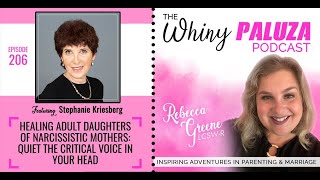
In this Whiny Palooza podcast episode, host Rebecca Greene interviews Dr. Stephanie Kreisberg, a licensed psychologist with nearly 30 years of experience who specializes in treating adult daughters of narcissistic mothers. The conversation begins with Dr. Kreisberg’s personal journey from journalism to psychology, establishing her expertise. She defines narcissism, distinguishing between grandiose and covert (vulnerable) narcissistic mothers, and explains how these patterns manifest in parenting. The discussion moves to the specific psychological impacts on adult daughters, such as a relentless critical inner voice, rumination, shame, difficulty setting boundaries, and heightened stress, especially around family holidays. Dr. Kreisberg offers therapeutic tools: education about narcissism, naming and validating emotions, self‑compassion (citing Kristin Neff), mindfulness, and a practical “signal vs. noise” framework for discerning useful versus harmful internal messages. They also address challenges of navigating relationships with narcissistic grandparents and how daughters who become mothers can break the cycle by practicing present‑moment awareness, accepting imperfection, and fostering resilience in their children. Dr. Kreisberg promotes her book, Adult Daughters of Narcissistic Mothers: Heal the Critical Voice in Your Head and Live the Life You Deserve, and provides her website for further resources. The episode closes with encouragement that women are not alone in this experience and an invitation to listeners to seek support.
Chapters
No need to whine, it's Whiny Palooza!
Have some wine and join us on the Whiny Palooza Podcast with Rebecca Green.
Welcome to the Whiny Palooza Podcast. I'm your host, Rebecca Green. I'm a wife, mother of 3, and licensed clinical social worker. I also have 3 fur babies at home too. My passion has always been to help children and their families. I always dreamed of being a wife and a mother. Parents are always learning through their struggles failures and successes and joys. I am no stranger to this wild ride of parenting, and I know behind every great parent lies a team of supportive friends and family. I want to be part of your support system. I want you to know that you are not alone. We are in this parenting world together. Join me every week for insightful discussions with experts on parenting and marriage, as well as other parents who have found the secret to successes in parenthood. You'll learn tips and tricks to make life with your family better than ever. I hope you will follow along with me while we dive into what it takes to achieve a happy family.
Hello everyone, this is Rebecca Green for the Winey Palooza podcast, and I am very excited because I have Stephanie Kreisberg here with us today. Hello, Stephanie.
Well, hello, Rebecca, and thank you so much for having me and inviting me to the podcast. I'm very happy to be here.
Well, I'm so happy to have you here, and I want to tell everyone a little bit about you. You are a fantastic, very experienced lady. Um, Dr. Stephanie Kreisberg is a licensed psychologist in private practice in Concord, Massachusetts. Dr. Kreisberg has nearly 30 years of experience in clinical practice and specializes in the treatment of daughters of narcissistic mothers. She also specializes in the treatment of teens and adults with anxiety disorders. Dr. Kreisberg is president-elect of the New England Society of Clinical Hypnosis. She has been quoted in national publications for her expertise on narcissism. Um, we can learn more about Dr. Kreisberg at drstephaniekreisberg.com, which we will tell you again at the end. And there are media copies available of her book, Adult Daughters of Narcissistic Mothers. So let's jump into questions because I have so much I want to ask you. I love this topic. Can we start with, um, what inspired you to jump into being a psychologist?
Oh, great question. Well, you know, when I went off to college many moons ago, um, I really, you know, that was not my interest. I went to school to study journalism, and I went to journalism school at Northwestern in the Midwest. And after a while, I realized, you know, really writing hard news was not for me, and I switched into the English department to study creative writing and English. And so I guess The theme is I've just really always loved people's stories.
Mm.
And if you're going to be a psychologist, that's really the heart of it— stories. And so I went to New York after that. I worked in publishing for a while, and that didn't really seem like quite the right fit. I'd had my own therapy experience, and I started thinking that that would really be a good fit for me, because after all, if you're going to be a psychologist, you really have to I love people's stories. And so I transitioned into learning psychology and becoming a psychologist.
That's wonderful. And I've never had anyone explain that to me, that they liked hearing people's stories, because isn't that what it's all about?
That's what it's, that's what it's really all about. And so in some ways, although it might seem like a leap, you know, how do you go from journalism to being a psychologist? Theme was always there from like being buried in my Nancy Drew books, you know, when I was a kid.
Well, yeah, because as I think about it, as you're talking, journalism is all about people's stories too. So it's really not that far off.
It isn't. And asking questions and being curious and listening, it's— it really just all, you know, just led me to that career.
Well, and I want to tell you, 2 years of doing this podcast and I have never had anyone say that they are an expert of daughters with mothers who are narcissistic, and that just like jumped out at me. I have never gotten to talk about this topic. How did you become an expert on this topic?
Well, you know, I worked for, you know, many years, both, you know, in hospitals and clinical settings, and then in my private practice with kids, teens, doing parent guidance, and with a lot of individual adults as well, mostly women because mostly women come to therapy. And I just started seeing these themes of women who are just so, so hard on themselves. I know you talk about this a lot on your podcast, right? Um, especially when they're mothers, these critical voice in your head that you can't turn off, you know, beating yourself up all the time, self-doubt. And then I started to see this connection between women who maybe did that more and some experiences they had growing up with their own mothers. Started to kind of put the pieces together, and that's how I came upon this pattern of growing up with mothers, more difficult, more difficult or challenging mothers, mothers I would identify as what we call narcissistic, and women who are maybe having more challenges in this way. And Rebecca, I do want to state at the beginning, okay, that this is not about mother bashing, you know, beating mothers up, because, you know, we have enough of that in this world. Yes, we do. And I am— it is not my job to contribute to that. I'm a mother. I've raised two daughters who are now in their 20s, and boy, if I could turn the clock back, there's plenty of things I would do differently. It's a very humbling job. So this is not to say, oh, these mothers, they're terrible, they're horrible women. It's really about understanding how did these women— how are they influenced? How can they change that voice in their head and move forward to have healthier lives and healthier parenting experiences?
I love that you said that because mothers are hard enough on themselves, right?
Absolutely, that's right. And you know, we don't need to add to the conversation about horrible mothers.
No, but I think that our listeners probably don't know exactly what narcissistic is. Can you explain that to them?
Yes, so narcissism, when we think about that in psychology, there are different patterns of what we call personality, and personality is a collection of traits or characteristics, okay? And we all can have these traits that we call— fall under the umbrella of narcissism, okay? Maybe You know, sometimes we are, you know, maybe critical of other people, or we're, you know, um, snap at other people, or we're a little self-centered, or, um, certain traits, um, or we're a little bit more selfish than we want to be, or we're not empathetic. Okay, it's not that if you're not narcissistic you're never like that. It's a matter of degree. And it's a matter of self-awareness. So people who have— in psychology we say people who, for these traits, are problematic, these traits are inflexible, they are really rigid, they can't soften in different circumstances, they really show up all the time, or almost all the time, in different circumstances, in family, in work, in their social setting. They— and people who have, we say, have narcissism, they don't— and this is really critical— they have no self-awareness. They can't step back and say, oh, I really snapped at my daughter today, I really feel bad, I'm going to go apologize to her. No, they can't do that. It's like, she was terrible, it's all her fault. And the daughter is left feeling like something is wrong with her. Um, so it's characterized by lack of empathy, lack of self-awareness, inability to regulate their own emotions. So you might just fly off the handle, um, but not have any awareness, you know, of that. You might not see there's any problem. Everything is always the other person's problem. I'll stop for now to see if any questions before I go on.
No, that's really good. I think that that's an excellent explanation. I think it's probably hard for people to identify if their mother is narcissistic. Um, can you tell them what to look for? You've kind of touched on this.
Yes, so there's sort of two distinct patterns, all right, and they can overlap. One is what we call the more grandiose narcissistic mother, okay, and she's the type of narcissist that we tend to think of when we think of a narcissist, a narcissist, right? The person with the really big personality, okay? You know, maybe think of somebody on a reality TV show, okay? This is the person who takes up all the attention in the room. Everything is about her. So she— and maybe she just needs her daughter to live in her shadow. She really can't meet her daughter's needs. Maybe, you know, if she was a really talented athlete, she needs her daughter to be an athlete too and be just like her, and the whole family revolves around that. But maybe her daughter isn't like that and doesn't want to be an athlete or isn't skilled in that, and she just can't see it, and every conversation revolves around her. Okay. And She can't ever bend from that. Okay. And the whole world is about, really about her. And then there's what we call the vulnerable or covert narcissist. This is a narcissistic mother who kind of flies under the radar. And that is much harder to recognize. She may be depressed, anxious, needy, maybe abuse substances. She, rather than being very successful and full of herself, she may be someone who's never really accomplished much in life and needs her daughter to take care of her. So the way that she sucks up all her daughter's time and energy, it's sort of the reverse. Um, she demands all her daughter's resources, even maybe as a child or a teen. Um, she needs her— it's like a role reversal. Okay. And if her daughter pushes back, it's, how can you do this to me? Okay. Does that clarify it? Yes.
Now, I didn't know about the second type. I think we all think about the first type when we think about narcissism.
Mm-hmm.
Yeah, so I'm glad you explained that.
Yes, so there are these two types, and you know, there can be some overlap, but often it's the second type that flies under the radar.
Definitely. Well, so if someone is identifying now, or who has identified that they have a narcissistic parent, how can, um, you help them cope? What can they do to cope with this?
Okay, so that's a great question. So first, let's talk a little bit about what they may be experiencing.
Yes.
Okay, so then we can talk about what are some of the coping skills.
Absolutely.
All right, so what they may be experiencing is— and some of these things that I'm going to say may sound like things a lot of women, a lot of moms deal with, okay, but if you were raised by a narcissistic mother, these things are going to be just dialed up, okay, sort of on steroids, all right. So you may be experiencing just a constant critical voice in your head. It's known as rumination or repetitive negative thinking. One woman I spoke with said, and it's often, it truly is your mother's voice, okay? You can literally hear her voice in your head commenting on, you know, your housekeeping or how you're raising the kids, or why are you letting them stay at daycare so long? Oh, you know, a bad, you know, good mother wouldn't let their child stay at daycare till 6 o'clock. Whatever it might be. Okay. One woman actually told me, I hear her voice, you know, the minute I wake up in the morning. Okay. Um, difficulty setting healthy boundaries. Um, a lot of physical symptoms of stress, always second-guessing themselves, a lot of self-doubt. Maybe some women may, you know, be able to find their path in life, but some may be really struggling to find out who am I, what do I want to do, living for others instead of themselves. Okay, the other thing can be a lot of shame, secret keeping, and isolation. Rebecca, a lot of women feel a lot of shame about this relationship. It must be me. There's something wrong with me that I, you know, have this relationship with my mother. Okay. And it especially comes up, as you can imagine, around holidays, Mother's Day. These holidays are so fraught. Okay. And they don't want to talk about it, you know, when everyone's saying, oh, my family's coming for Thanksgiving. And, you know, maybe you're dreading it, or, you know, you're not even having holiday with your family, and there's just so much shame you feel about it. Okay, um, any questions or, you know, about that part?
No, I'm— you know, it's interesting because I think a lot of women would say that they have some of these challenges that you're talking about. And I think what I'm thinking is, can we clarify— and this is challenging— what is like a normal struggle with your parent versus what is a more like, my parent is narcissistic and this is not a normal parent challenge? Does that make sense?
Yes. I, and I think it's, it can be really tricky. It's a level of degree because what you will find, because, you know, a lot of people might say, a lot of them might say, oh, my mom's coming for Thanksgiving. Oh, I mean, I, I totally get that. What we're talking about with a narcissistic parent is a degree of criticalness, of lack of empathy, lack of self-awareness, and, and often really of, of cruelty. So the narcissistic parent might come in and just from the minute they walk in the door start, you know, criticizing, you know, everything that you're— not just what you're doing, but who you are as a person. So it's not just like, oh, you know, why didn't you pick up the living room? But it's personal. It's like, you are such a slob. So it's about who you are inside. You know, everybody always said you are, you know, that you're so disorganized. So it's this contempt, this causticness. So it's about who you are. It's— I talk about, uh, it's like if you make a mistake, you know, in their view, You are a mistake. It's about who you are. Okay? And that's the voice that you carry with you. There's something wrong with me versus, oh, you know, I burnt the toast. Oh well. You know, it's there's something wrong with me or I'll give you an example. Okay, here's an example. One woman I was working with, she told me this story about how we all know about bake sales, right? So at least pre-COVID, there were bake sales. So she had to make something for a bake sale. And, you know, she was so stressed out about it because she was working and she didn't have time and she should make it from scratch and all that. And then a friend of hers said, oh, I was going to make something for the bake sale. And then I opened my refrigerator and I realized I was out of eggs. And I was like, "Huh, I'm out of eggs." And she was so like, "Laissez-faire" about it. Like, "So I'm out of eggs." And this client of mine thought to herself, "If I opened my refrigerator and saw that I was out of eggs, I would have felt like a piece of garbage. Like I would have heard my mother's voice saying," How could you run out of eggs? What kind of, you know, mother runs out of eggs, doesn't keep her fridge stocked? That's the difference. Does that kind of clarify?
That is very helpful, and it makes sense to me why so many women have the strong critical voice in their heads. It's their mother's voice. Yes.
And my patient was truly flabbergasted that her friend could be like, sorry, she just— that was astounding to her.
That's amazing.
Yeah.
We are certainly very hard on ourselves, aren't we?
Yes. And that's why some women, it's, it's in a different category.
Yes.
Okay. And it's so much more painful. So let's get to what helps.
Yes, please.
It is a process, okay? It is a journey. There's no— I'm not gonna lie, there's no quick fix. So one is, and I always say the first step, and that's why I'm so grateful for doing this podcast is education. Okay, so just learning about, oh, this is where, you know, maybe some of the roots of this are from. I'm not crazy. I understand. So first, you know, when I work with women, or, you know, we just start learning about this is where this comes from.
Okay, so important.
Yes, I think education about narcissism what made your mother tick, how it shows up inside you, is really important.
Okay, absolutely.
So then, many women, Rebecca, who grew up with narcissistic mothers where their emotions were never seen and never empathized with and never validated— and now we know a lot about that, right, how important it is just to listen to your child, validate her emotions. It doesn't mean you're going to run out and solve the problem, but you empathize and validate feelings. A narcissistic mother really is incapable of that, right? Or does it very inconsistently. So that means that this woman can't do that for herself. So we work on really learning, being able to identify what do I feel What am I feeling? How do I identify? Many women will tell me, I don't know what I feel. I don't know what I feel. Ask, what are you feeling? I don't know. Because she learned to squish down her emotions. We literally work on giving names to feelings, which seems very overwhelming. And learning how can you just sit with them, maybe ride out the wave of an emotion, learning that it, it isn't going to kill you, and that all emotions, like a wave, have a beginning, a middle, and an end, and you literally can surf the wave. Learn to ride. That's a very, very helpful tool. Okay.
And that, and that right there is very hard because people spend so much time finding ways to numb or not feel. That's just what you just said is so much work in itself.
That's right. So that's why this is all a process.
Yes.
Another, you know, skill is, um, and you may have discussed this on your podcast before, um, is self-compassion. Okay, which is something that was really, um, popularized in a very good way by a psychologist named Kristin Neff, who wrote a book called Self-Compassion. And it's learning to treat and talk to yourself like you would to a friend. Okay, so does this ring a bell to you?
Yes, this is, this is such good stuff. I think that it floors me. I had to learn this too, though. I mean, I mean, nobody's alone, right? We're all learning this. But I started to notice with myself and my friends that we were so kind to each other, and then we would go home and be so mean to ourselves. Like, I would say things to myself like, you didn't get that done again, or you didn't clean that, or look at, look at what you, you know, this, this isn't good enough, or whatever I was saying to myself. I would never say that to a friend. And I started to discover I needed to be my own best friend. And that was a, that was a long process for me. And I, you know, I, I come from very healthy parents and that was hard for me.
Yes, that's right.
It's, it's a hard journey to learn to have self-compassion and be your own friend, and it's so much practice, as you know.
So much practice. And the truth is, our minds are sort of wired from an evolutionary standpoint to be negative, to look for what's wrong. That's what keeps us safe and alive and out of danger. Thank you, evolution.
Such a good point though.
Right, it's true. So one thing I really learned is that we also can't beat ourselves up for being negative, looking on the, you know, dark side instead of the bright rosy side, because that is part of our wiring and how we've adapted to stay alive. However, it's not so adaptive most of the time for Sam, okay? So, you know, using self-compassion means, first of all, noticing when that voice comes up, being able to step back from it, letting yourself know you are not alone. You know, maybe you're not the only one who ran out of eggs or didn't vacuum the family room this week. And then talking to yourself with kindness, like if a friend came to you and said, you know, oh, my house is a mess right now, would you say, well, 'You know, you're a really bad person and you should really feel crappy about that, right? You would never do that in a million years.' You know, you would say, 'It's okay, you're doing great, and no one cares that your house is messy. You are doing just fine as you are.' And gosh, the power of saying that to ourselves is amazing, but it takes a lot of practice and reminding. And honestly, I encourage women to like put it on a Post-it, make it the wallpaper of your phone, leave little card notes around, because it's so easy to, you know, just to forget.
Yeah, and even like you said, you know, the awareness of when you say it and then saying Well, what would I tell my friend? I have said that to myself before. What would you be telling your friend right now? Because it wouldn't be what you just said to yourself.
Exactly. That's right. And can I tell you, there have been literally thousands of studies— I'm not kidding, thousands— on self-compassion and the impact it has and how powerful it is in depression, anxiety, all sorts of problems. And it is— I mean, the results are just amazing. It's not just some like la-di-da kind of thing. I mean, it really works well.
And are you seeing like— I mean, I'm not going to hold you to this, but do you see like an amount of time that it takes to see these women start to change their voice in their head?
You know, I think it all depends on the person. You know, for some, just using, you know, using a tool, one tool, can be very helpful in a short period of time. You know, I would say that the impact— I'm not going to lie— the impact of having a narcissist mother probably never fully 100% goes away. You know, it's something that you manage throughout your life. I kind of think of it as like having diabetes. Let's say you have diabetes. You know, it's some, you know, every day you have to eat healthy, exercise, manage yourself, you know, manage your self-care, right? And it's kind of like that. Yes, will you certainly leave certain traumas in the— can you leave certain traumas in the past and feel much better? But probably every day you have to take care of yourself.
And I love that you used the word manage because we put this pressure on ourselves in life that we have to solve something. And I don't think— I think most things in our life are not solved. They don't go away. It's something that we take care of and manage every day. And I know that changing that for myself has led to so much less pressure. I felt so much pressure to solve things and get rid of things. I love that word.
Yes, and that's how I look at it. You know, it's an ongoing process, and you put tools in your toolbox, and you give yourself self-compassion, and you give yourself, you know, space about this. You're not going to fix it. It's not going to be boom, one day you're just all set. It's, you know, you work on it every day.
So, um, for, for someone who grew up with a narcissistic mother and is now a mother herself, Yes. How can she do better? What can she look for to know that she's going to do a better job?
Okay, well, you know, for some daughters of narcissistic mothers, they feel really confident that, you know, I'm just going to do a better job than my mother. And, and they do, and they're determined. You know, for some, there's a lot of worry about that. They're very hard, very crit— you know, very, very critical of themselves. And so one thing that can happen is they get so caught up in their worry One, that it's hard to be present. So, and I know one is just really being mindful of being in the present moment. And there are many practicing, you know, some mindfulness doesn't mean you have to sit around and meditate all day, but just, you know, kind of noticing in the here and now what's happening instead of maybe just too much projecting into the future or beating yourself up. Another thing is remembering that you don't have to be perfect, that, you know, kids also need us to, you know, they need to learn to be resilient as they're growing up. So for example, let's say, you know, you are the one who might be the last one to pick up your kids because of your work schedule. That's going to teach your child to be, you know, entertain themselves, to be independent, that, you know, you don't have to meet every need all the time, all right, perfectly in a certain way, because you're teaching your kid life skills that way.
Absolutely.
Um, Rebecca, another issue that comes up for daughters of narcissistic mothers when they're sort of— when they're in the heart of child rearing, which I would raise, is one dealing with grandparents, um, because there's the narcissistic grandmother, right? Um, so that's another issue that women often struggle with. Okay. And there's— is it all right to talk about that?
Absolutely.
Yes. Okay. So, um, you know, how do you have— and there's no— I don't have any answer for that. It's so individual. But, you know, if listeners are out there and have this problem they might be struggling with, um, you know, my relationship with my mother is so painful and difficult, you know, do I let them, or how do I have let my kids have a relationship with my mother, even if it's really painful for me? How do I manage that and set limits about that? You know, where do I draw the line? You know, if she comes in and she's not so nice to me, but she's really good to my kids, Is that okay? And if she comes in but then she starts being, you know, not so nice to them too, maybe that's where I draw the line. So this is another thing that just comes up that you, um, a daughter who has a narcissistic mother really, really struggles with and has to navigate, and it's a very individual decision.
Um, so complicated.
Yes. So another tool is when there's a lot of worry, um, you know, a daughter of a narcissistic mother might be just constantly, like I said, second-guessing herself. And this is a tool you may be familiar with, is differentiating when that worry voice comes up is the difference between signal and noise. Okay, so when your worry comes up, you can really ask yourself. So a signal is like, let's say when you pull up to a traffic light, right? You have green, yellow, red. That's a signal that gives you useful information that you need to pay attention to. Red, stop. Green, go. You want to pay attention to that. Okay. But let's just say noise is like static. Okay. Like the buffering on your iPad or the noise in between stations on the radio. You know, let's say there's noise between your stations on the radio. You don't like lean in and try and listen to it. And what's it saying? Right? You're like, you just tune into the right station. It's not useful information. So if you hear your mother's voice in your head saying, why are you doing that? Why are you doing this? You can tell yourself, is that a signal? Is it helpful information to me that I can get something out of and I should listen to? Or is it just noise? Is it static? And I'm just gonna Tune it out. It's not helpful to me. That is also, that's another tool that can be very concrete, that can be very helpful when you struggle with that inner critical voice.
That's really helpful. I love that. That is really, um, an easy, helpful way to explain how to help with that voice. Um, I have never heard that before.
Mm-hmm. So I, you know, I like that one. I mean, I use it all the time. It's really clear.
Yes. Um, my, my wonderful mother always had really big healthy meals on the table every night, and it took me a while to adjust my own expectations in my head. Like, I can hear her saying, make your family a healthy dinner. And there's plenty of nights where we are so busy and I'm like, good enough, Rebecca, it's good.
Yes, absolutely, that's right.
So then, you know, that's an example of our wonderful mother's, uh, expectations and, and managing it in our busy lives.
Mm-hmm. Yes, having to forge your own path, set your own boundaries. For yourself.
Absolutely. Yes, yes. I talk to my friends all the time about rejecting expectations. I just say, reject. I reject that.
Yes. And it's just so much harder to do when you feel like it's about who you are, so much who you are as a, as a person. And the voice in your head is really, is really cutting. You know, and it's just so much harder. It takes a lot more practice to separate yourself from that voice and realizing it's about, I am a separate person, I am my own person. And that's so much of what it's about.
So helpful. Well, and you wrote a book, an excellent book that I would like to read. Can you tell everyone about your book?
Sure. My book is called Adult Daughters of Narcissistic Mothers: Heal the Critical Voice in Your Head and Live the Life You Deserve. It's out on Amazon. It's published by New Harbinger. You can get it from Barnes Noble, and it really focuses on, you know, helping women understand what a narcissistic mother is, but then mostly how it impacted you. And moving forward, learning very specific skills so that you can feel better, um, handle that critical voice, learn to set boundaries, be assertive, find your strengths, and, you know, become your own person, become your own woman. And even if that voice is still there, you can find a place for it. You know, you can put it on the shelf. It doesn't have to follow you around, you know, your whole life.
Yes, leave it at home on the shelf. I like that.
Leave it at home on the shelf.
Well, the book sounds amazing. Um, is there anything else that you would like to share that I didn't think to ask you?
Um, you know, I just want to say that, you know, To women who have, you know, a narcissistic mother, you are not alone. I think that's the biggest thing women feel like somehow, that they are not alone. One woman told me it's like we're a secret society because no one talks about it. So I'm really grateful that you have this podcast so it's more out in the open. It's nothing to be ashamed of. You can feel better. You can move forward. And you really are not— you're not alone with this problem. So true.
I love that. Can you tell everyone where to find you?
My website, it's, it's long, I have a long name, is Dr. Stephanie Kreisberg and the book, um, Healing the Daughter— Adult Daughters of Narcissistic Mothers, um, is available on, on Amazon.
Wonderful. Well, I can't thank you enough for your time and expertise today. This was such a helpful conversation.
Well, thank you. I really enjoyed talking to you, and thank you for the really good work that you do on your podcast. Um, helping others.
Thank you so much.
That's so sweet. Okay, thank you, Rebecca.
Thank you. This is Rebecca Green reminding everyone to spend every day laughing, learning, and loving.
Thank you for tuning in to the Whiny Palooza podcast. If you like what you heard, please be sure to subscribe so you never miss an episode. While you are there, leave a review. I love to hear your feedback. Thank you so much for listening. Until next time.
This show has been produced by Market Domination LLC. To discover how you can have your own show completely done for you and turn it into a real published book and become the authority in your marketplace, go to www.marketdominationllc.com/podcastoffer.










