Episode 240: Free To Be with Shirin Etessam
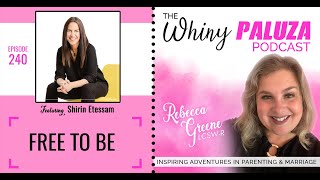
In this Winey Palooza episode, host Rebecca Greene interviews media executive, entrepreneur, and author Shirin Etessam. The conversation begins with Shirin’s background—her work in film and television, her role as a LGBTQIA+ advocate, and her personal identity (intersex, asexual). The core of the interview is Shirin’s new book and 6‑week program “Free to Be,” which she created after a painful breakup in 2013. She explains how six years of personal spiritual searching were distilled into a practical, week‑by‑week curriculum: Week 1 – Mind detox and “infoxication” (content overload) with tools like the “Daily Purge.” Week 2 – Heart detox, redefining the heart’s needs, and honoring the full range of emotions. Week 3 – Body detox, shifting the relationship with the physical vessel. Week 4 – Play, including eight play‑personality types and concrete examples of adult play. Week 5 – Finding your “true north,” distinguishing soul (unique personal imprint) from spirit (universal consciousness), and using concepts like ikigai. Week 6 – Manifesto: writing a new life story, integrating practical exercises. She also discusses “spiritual bypassing” (toxic positivity, guru‑following, ignoring mental health), the importance of daily practice, and a framework for managing relationships called “Taser‑Shield‑Filter‑Hug.” Throughout, Shirin shares anecdotes about parenting, friendships, and how her tribe emerged after her breakup. The episode ends with details on where to find the book (Simon & Schuster/Amazon) and her social media contacts. The interview blends personal storytelling with concrete wellness tools, offering listeners both inspiration and actionable steps for spiritual wellness.
Chapters
Hello everyone, this is Rebecca Green for the Winey Palooza podcast, and I am so excited to have Sherine Atesem with me here today. Sherine, how did I do?
You did really well.
Oh my God, Sherine and I have been practicing. Um, she is an entrepreneur, a seasoned media executive, and transformational speaker. She has produced films, original television series and specials, created several companies, and led campaigns for some of the world's most recognized companies. A proud member of the LGBTQIA— you're going to have to tell me the extra initials that I don't know— and community, community, Shereen founded OML TV, a popular platform dedicated to streaming and curating quality Queer Female Video Content and MOL Originals, a female-led production company telling diverse female stories through a vast spectrum of film and television genres. Sherine is also a regular contributor to Rolling Stone and Forbes Today. Sherine guides seekers in her 6-week program Free to Be to disconnect their human being from their human doing. To find true and lasting fulfillment. She lives in— is it Marin County?
Marin.
Marin County, California, with her wife and two children. Well, thank you so much for doing this with me today. Your resume here is very impressive.
Thank you for having me on your show.
Okay, so educate me. I should have asked you this before we started. Okay, so I know LGBTQ Can you tell me I-A?
Intersex and not androgynous. I'm like asexual.
Okay, so my children would know this. My children are more well-educated than I.
It actually kind of, if I may step on my soapbox for one second.
Yes, please.
It actually, though I stand shoulder to shoulder with all the other letters, It really actually bugs me that they've clumped us together. It's like there's straight and then there's everybody else, and then it expands instead of it being a spectrum from— which is what it is— from the straight straight to the gay gay, and everybody else falls in between, you know. And yeah, all of that. So it's— I feel like it's great that we have a community that's ever expanding, but it's also othering. And that bothers me, but I'm off my, um—
No, that's— educate us. I, I love hearing about this. I love the work that you're doing. I'm so excited to talk about your book. Let's start with your book because it sounds fabulous. Okay, so tell us about your story and what led you to write Free to Be.
Well, thank you for asking. So I And I mentioned this in the book, I've always considered myself a half-ass spiritualist, you know, sort of spiritual window shopping, uh, in that, you know, I would basically visit spirituality when convenient, you know, when like a retreat would pop up or a yoga class or, um, I don't know, wearing spiritual jewelry, whatever it is. I wasn't really spiritualing Anyway, at the end of 2013, I went through a major breakup, uh, with my partner at the time. And we were together for 13 years, and we were dear friends for 9 years prior to that. And 22 years of my life just finished in a 20-minute conversation, and it propelled me into this abyss of nothingness. And it's really strange because at the time I had everything that everybody would equate to success, right? I had the lofty title, I had the beautiful partner, I— we had two kids, we had the houses, we had the, the, the cars, you know, the great community and all of that. and I truly felt dead inside. I just felt empty. And so I realized fairly quickly that it wasn't just my heart that was broken. Everything felt broken. And I'm like, this cannot be my final chapter. It can't, it can't end like this. You know, I'm far too young and still need to experience a lot more. So I set out to not just write a new chapter, but a whole new book, so to speak. And then I wrote a book based on that book that I created. So I, in the early days, I, you know, I had a motto, um, #BetterThanThis. And the thought was that if I felt just a tiny bit better the next moment, that was an improvement. And my kids at the time were 5 and 7, so— and I was really, really worried about them. And I was primary caretaker, and my ex was, you know, wanted certain custody, and there was all of that. And I just wanted to make sure that they were okay. And I wasn't feeling okay and how to shield them from it. So I started taking tiny, tiny steps, and I spent, you know, the, the minutes became the hours, the hours the days, the days the weeks, the months, and then years. And for 6 years I dove in deep. I mean, mind you, I was still parenting, adulting, super responsible, but I made it my primary mission to find my inner fire, inner soul, inner star, because I was so disconnected from it. I didn't even know if it existed, where it was. And having gone through 6 years of what I call bobbing for spiritual apples because I didn't know what I was doing You know, and I read a lot of books and I went to more retreats and all of that, but nothing was quite it. And so I realized that, you know, if I knew what I was doing during those 6 years, that truthfully the process could be truncated into 6 weeks. And so I wrote the book that I wished that I had. When at the Crossroads. So, and it's like such a surreal, magical experience. I don't think that I could, even if I tried really hard, I don't think I could be the person I was in 2013. Like I just, I feel so vastly different and love it. But the process is, I mean, I don't know who, And I will stop shortly, but I don't know who thinks that spirituality is woo-woo and all about sitting in the lotus position on a mountaintop or whatever. But seriously, I mean, it's dirty, it is scary, it is dark, it is, you know, confusing. But then You know, you have— there's the breakdowns and then there's the breakthroughs. And those breakthroughs, my God, they are everything. I mean, that's, that's truly how I believe we reach enlightenment, is, is greater and greater awareness. So, but I'll stop there.
So, okay, so I'm following all of this. I think it's amazing. So you're basically taking us through a 6-week spiritual soul journey is what it sounds like.
And it's super practical. If you want, I could just do— run through it really, really.
Oh, I would love that. Yes.
So, so the first part of it, and I deliberately made it— I mean, there's all these theories about making and breaking habits and that it takes 21 days. There's some studies now that kind of rebuke it, but I set it up that way because I think it's probably, you know, pretty, pretty on point. Maybe it's not 21 days, maybe it's 30 days or whatever. And I didn't make it specifically to make or break a habit, but that's baked in. So the first 3 weeks, the first part of the book, so each chapter is 1 week and there are 6 weeks of it, not including the intro or acknowledgments. The first week is all about detoxing our minds. They're the biggest culprit, right? Like, you and I are sitting here talking and we're very focused, but there's still that background chatter, right? Like, did I turn off the kettle? And I've got to— oh, I forgot to pay that bill. And sometimes that chatter becomes so loud Right. And, and study after study shows that the majority of our thoughts are negative, thanks to the amygdala. I call it Amy G. Gala. I could talk about her. She and I—
I love that.
We've had a love-hate relationship. Still do. Um, and, uh, so negative thoughts, and they're repetitive.
Yeah.
And what we do is consume more content Daily, because, you know, we make fun of screenagers, but truthfully, we've all become screen addicted. Yeah. And now it's the way that we do since the pandemic. It's also much of how we do work. So information, information, information, the negative thoughts coming in, repeating all around. It's just like a washing machine of crap, right? So how do you liberate yourself from that? So there's, there's, there's very much— it's very much a how-to. So again, practical ways of detoxing our minds. Then it's, uh, week 2 is about detoxing our hearts. And I think that we task our hearts with the wrong things, like a lot of things that need to be decided from a soul place or from our minds we task our hearts with. And truthfully, the heart— I mean, I can talk to anyone and they will nod when I say all the heart wants is to be loved. That is it. To be loved, to be acknowledged, to be seen, to be cared for. That is it. It is a puppy, it is a baby.
Oh, I love that.
That is the truth. So just like stop giving it stuff that it's not supposed to do. So a lot of it is about shifting your relationship with your heart, but mostly about taking care of it and how you can take care of it and the boundaries that you need to create and who you let in and who you don't.
I love this.
And all of that. So it isn't just, you know, about Emotions, though. There's also a big section on emotions and how each emotion is important. So you can't, you know, be a happiness junkie and fufu sadness. Like, I don't know if you ever saw Inside Out. That— yeah, I mean, as moms, I think we're obligated, but like, that movie is so brilliant. Yeah. That's exactly it. You can't have one without the other. So don't— I liken it to the RGB colors of our TV because, you know, I'm in production. But if you don't have the RGB, you have black and white. You have, you know, you want life in Technicolor. So feel all the feels. I talk about that. And then the third week is all about our relationship with our body, what I call our Uber ride. Through this life. We've got one vessel, one vessel, and we seriously need to take good care of it because we either ignore it or we're mean to it, we're abusive somehow. So shifting that relationship, and certainly good diet, exercise, sleep, and all of that, but really shifting our relationship with our bodies. So, and the reason I have all of that is because when you have so much schmutz of everything that I just talked about— heart, mind, body— you can't get to your soul. You know, people talk about, you know, following your bliss. It's like, where is it? You would think that— you know what I mean? Where is it? And then how, right? Like, people fail to mention that. So this is what I mean about practical spirituality. And I'm actually— I am on a crusade of sorts to change the term spirituality to spiritual wellness and spiritual health.
I like that.
Who calls it mentality, right? Nobody's like, oh, did you mentality? You know, are you— are you mentality? It would be like, are you practicing mental health, right? Right. So what is spirituality anyway? So I'm getting off my soapbox again. So once you have, you've cleared your slate, so to speak, then hopefully you're, you're able to be— I actually feel like it kind of becomes a byproduct of, of the cleansing, of the detoxing, because then you're, you're left with truly your authentic, pure self that's just like, oh my God, I see the light of day. And then once you get connected with your soul, or at least get a, a small hint that it may be there, then we start part 2, um, chapter, uh, chapter 4, week 4, which is all about play. I'm a huge, huge advocate of, of adult play, and I could talk about that later if you'd like. Yes. So it's the number one way of letting your soul free I am convinced having done it for quite a few years now is playing. And there's so many fun ways to play. And I play with my friends all the time. I play with my wife all the time. And I know it sounds kinky. It's not, it actually is not. And that's where the adult brain goes. Like as soon as you think play, it's like, oh, you know, Vegas. Oh, you know, it's like, no, no, no, it's not any of that. And then week 5 is all about trying, is about finding your true north. And I think that a lot of people get our soul and spirit mixed up. I consider spirit the same as our higher consciousness, the all there is, universal energy, God, Jesus, Allah, whatever people associate with that is outside of them that they find guidance and celeste in. But our soul is unique to us. So my soul is completely unique from yours. That is like our soul imprint in the universe, and that, that's what makes us the unique stars that we are. And, and it's the dance of the soul and the spirit where the magic happens. So that's week 5. And then week 6, I call it, um, Manifesto like you mean it. It's actually manifest like you mean it, but then there's the O because in doing so, you really are writing your manifesto. You're rewriting your story, and I'm very practical about that. I talk a lot about ikigai, which is a Japanese Venn diagram of a way to find your raison d'être, your reason for living. So again, practical, practical, practical. So it isn't this, you know, go sit on a mountaintop and wish for the best.
I mean, it sounds like so much work. I mean, in a good way, it sounds like really deep work.
It's deep work. It's deep work and it's daily work. The Buddhists— and I don't ascribe to any specific religion, and Buddhism technically isn't a religion, it's a philosophy because the God is within. But the reason I mention it is because the Buddhists call anyone who's practicing Buddhism practitioners, and it's because you're in the practice of it, and that practice needs to be on a day-to-day basis. So it has to be integrated into your life. So you have to spiritual while you're driving and while you're doing the dishes and vacuuming and so forth. You can't visit it. You're either on the path or you're off the path. There is no— and I learned that way. It is actually a switch. I mean, it gets brighter and brighter and wider and wider, but it is a switch. You can't— you switch it off and on. You might as well just have it off until you're ready.
It seems to be a theme that everything that we want to get to, we have to practice every day, whatever it is.
Absolutely, absolutely.
Yes, yes. Well, and you have this term that I'm so curious about. It's spiritual bypassing. Can you tell me what that is?
Yeah, I mean, spiritual window shopping is one of them. If you are— if you— there is no one who knows anything about working out who would disagree with the fact that you have to go to the gym on a regular basis in order to get the results you want. If you are seeing a therapist, it isn't like, um, okay, maybe I'll see you in 6 months, you know what I mean? You are in there diving in deep. And I actually believe that you can have through mental health without spiritual health. But I can talk about that later. So that's one form of spiritual bypassing. Another is, uh, gaslighting— gaslighting yourself or someone else. And the way that happens in the spiritual world is, you know, good vibes only and, um, look at the silver lining. I mean, they talk about toxic positivity a lot, that would be spiritual bypassing. Because this world is hard, it's difficult, it just is. It's challenging, all of that. So if you're like, oh yeah, I'm spiritualing now and everything is fine, big bullshit. I mean, seriously. So that's another form of it, following a guru with, uh, you know, blindly and believing. Like, I've hunt and pecked all throughout, and I absolutely believe that there are people on this planet with higher levels of awareness and consciousness, and we can learn a lot from them for sure. Do they know everything, and should you follow them blindly? No. I mean, if anyone did that with me, I would literally pack their bags and, and send them. And I'm like, you are clearly not ready, you know. So that's bypassing to you. And I list a bunch more, but those are some examples.
Okay, we'll go back to play. We have to talk about play. Yeah, tell us examples of play and how you play.
Yes. Okay, so just a quick basis for the, the need for play, and it's actually, um, the, the need for us to reclaim our souls as well. In that somewhere between the age of 0 and 5, 0 to 7, we disassociate. And this is, again, study after study on what disassociation is. And whether it's because we feel unworthy or don't feel safe or don't feel seen, whatever it is, we disassociate from our inner star, you know, that— I mean, you see babies, toddlers, they're like giddy, full of life and all of that. And the more responsible we become, the more the world starts setting in, the more we start living outside it— outside in instead of inside out, right? Because we're like, oh, we got to follow the rules, we got to get the grades, we've gotta, you know, all of those things right, which, which makes us more responsible and, and functional and all of that. But we stop connecting with our souls. And then somewhere a little bit later, usually it's 10, 12, we slowly stop playing as well. And as, as we start adulting, right? And so many studies have shown the importance of play, not only in the childhood years, but in animals. And in like the difference between animals kept in a shelter, separated in cages versus deliberate times where they can play with one another. And, and how they thrive from that. And then us adults, you know, we just, we stop playing. And truly, like, you think about what is what we consider playing, and so often it's like, you know, going and meeting friends at a bar, you know, right? And then you're consuming alcohol, which again, I'm not foo-fooing, I like my glass of wine, You know, but if that is your outlet, and then what do you end up talking about mostly? It's usually either your relationships, your children, or work, which, I mean, none of those— I mean, they're all wonderful, but that's not playing, you know. So I'm talking serious playing, and it depends. There's 8 different personality, uh, play personality types. So you have to, which I talk about in the book. So you've got, yeah, kind of have to know. And most of us are a combination of someone, but some of them don't ring true at all. Like there's the director, which loves organizing and coordinating. And if I'm playing, that's the last thing I want to do. I think I'm pretty decent, you know, in doing so as a mom and in my work and all of that. Yeah. Does not spell play to me. Or like a collector. Um, uh, you know, who collects stamps. I don't like stuff. Like, less is more with me all the time. So the idea of gathering stuff is like, good. But then there's like the Explorer or the Creative, and I'm like, okay, yeah, that's me. Or the Joker. Like, I, I love, um, uh, not necessarily telling jokes, but making light of things and being playful in that way. Though I don't like, like, what is it, pranking people. I don't like doing that. So I kind of mix and match. So you have to know your personality type. And then it could be anything. I mean, it could be cartwheels in your backyard. It could be taking over playground and seesawing with your friend. And there's a huge swing here in Tiburon, and God bless whoever put it there. And you always, you see people and sometimes we walk by, my wife and I walk a lot. Walking, frankly, can be a form of play. But we walk by it and if I see someone there, I'm just like, okay. But it makes me happy seeing someone swinging because I'm like, they're playing. But then I'm like, but it's my turn. So it could be doodling, it could be painting, it could be spoken word, it could be I love dancing, and I put on disco or house at any given time and dance my butt off like no one's watching. And hopefully no one's watching. There's a place here called the Church of Eight Wheels. It's roller skating rink with disco.
Oh, fun!
Play, play, play.
My family makes fun of me. See, now I'm going to go tell them about this interview because I'm all about a new family adventure and I want to go explore and find new things to do together.
Yep. Role play is another one. And those kind of adventures, like you can be— my kids and I got stuck in a hurricane in Belize, which was quite the adventure. And they were quite young. And while we were holed up in the bathroom, which was the only place with four walls, for 4 hours while the hurricane was going through, um, I told story after story of Tintin because that's the only— that's what I grew up with, and I— all I could remember. I'm sure I embellished and all of that. And then we would also play it out, you know, we would be like the whatever, the detective, and you know. So yes, all of those things are important, and also travel is a form of play too.
That makes sense. That makes sense. So see, now I understand why play is important to me. I was like, I was like, am I too in touch with my inner child?
And I think that's, I think no, that's not too in touch. You're actually allowing your child to, to live out loud. You're taking, that's your way of taking care of that, the, the baby, the puppy, you know? So Yes.
Well, thank you for teaching me that. I love this. And I really want to know what infoxication is.
Well, how does that— Yeah, infoxication is the— goes back to week 1.
Okay.
It's— there's nothing foxy about it. It's basically content overload. Yeah, and we all have content overload to different degrees. And the, the issue with infoxication is that you have so much content coming in that you can't truly make a decision clearly. That's when you know you're fully infoxicated. But I think, you know, it's the difference between like coming down with pneumonia and having the flu. I feel like we all kind of have the flu. Yeah, continuously. And then sometimes we get hit with pneumonia because we haven't taken care of that flu. So full-on infoxication looks like pneumonia, you know, to, to the mind. And otherwise we kind of continuously have the flu and we're trying to just manage. And there are ways to either filter or block content from coming in. And it's really important. It's this— I mentioned in the chapter that you don't go, you know, from drive-in to drive-in and just order things just because you can. But we do that with content. You know, when we're scrolling, you know, like we're just consuming it, consuming it, and it becomes mental junk food. So it's our responsibility to block that out. And in Week 1, I talk about ways of doing that.
So does that have to do with your reference to a daily purge? How do we do a daily purge? I love this.
You know, the Daily Purge is sort of like a quickie combo of everything because it can be— they can have little elements of play in it. But really it's about vomiting all the negative negativity that's in us. I mean, you think about it, you wake up in the morning. I mean, the, the mind does not skip a beat, right? You, you wake up and you got to do this, you got to do that. And again, those thoughts are usually anxiety-producing, stress-producing. It isn't like you wake up and you're like, hmm, what am I gonna do with my day? How am I—
oh, I want to do that though, that sounds wonderful.
So, so the daily purge basically is telling your thoughts to shut the fuck up. And the way that you do that is that you throw them up. It's you purge them out. And whatever it is, there is some— have you read Julie Cameron's The Artist's Way?
No.
I feel like I'm such a huge promoter of her book. Not that she needs it. It's one of those evergreen bestsellers. She wrote it, I think, in the '90s, '80s. Anyway, very much of an evergreen, and it's all about how to become more creative. And I did it like 20, 25 years back religiously. And she has this thing called the morning pages, which is 3 pages of unstructured prose. Not even prose. It's just, it's basically writing down everything that's in your mind just to cleanse it. What I realized, so it's somewhat based on that, except that I realized that many don't like to write. And, and frankly, I have more energy than, than my hand can keep on, and definitely not typing it, but writing it out free form. So it's really 6 minutes of, and it can go as long as 30 minutes. I would say 6 to 10 minutes is good just because you want to get on with your day. Yeah, it is whatever way, whatever means helps you to purge that stuff out. So I literally will stand there and I meditate and all of that, but I'll like shake about and it like physically do— I know I must look crazy, but it works, you know. And I'm, I'm just like you know, um, I'll say different things like, I hate the fact that my car isn't working like it's supposed to, and, you know, my son said this last night and really pissed me off, and blah, blah, blah, you know, you just— and just purge, purge, purge. You could do it, you know, while you're running or whatever it is, as long as you're super intentional about doing that. And I'm telling you, do it for 6 minutes. Like, after this call, just do it. You'll be like— and it's interesting because the reason I wrote this book the way that I did was that I— it was really important for me and is really important to have it feel experiential. So right now you are— if you haven't done the daily purge, it's kind of like this conceptual, like, oh, that's a great idea. But then you do it and then you're like, oh. And I truly believe that it is in the doing of things where you have your aha moment. You know, your mind can only go to a certain point, so just try it. And I tell, tell people in the book, I'm like, if you don't do any of the exercises in the book, and each week has daily exercises different than the daily purge. But the daily purge should just be done all the time. So I say, even if you're not going to do the exercises, just do the daily purge because it is such an instant way of clearing your slate and feeling really good. My agent swears by it. She's—
No, I think you're right. I have never done it every day. I have done it, and I— it feels like a weight is lifted off of you. Yeah, you're absolutely right. Um, I am so intrigued by finding our people. How do we find— not everyone's our people. How do we hone in on who our people are for our lives?
Yeah, um, really great question. I believe ultimately that our people find us.
I love that.
The, the people who are in my inner circle really showed up. I, I made a deliberate shift in the early days of my breakup, so say the early, early 2014. And it's interesting because the friends that I thought would be there weren't there. And then the— and then there were some friends, like this one friend who I hadn't seen for at least like 13, 14 years. She also had gotten married to a woman and had— they had 3 kids, and, you know, um, and then she was separated, and she showed up and never went away. Like, it was just— and she's one of my, one of my playmates, by the way, uh, so she's very much in my circle. Another friend who was— who we were friends but we weren't really close— like, she would literally show up at my front door and she's like, I'm gonna just work out of your living room, because she knew I needed— you know what I mean? She just knew it. That's wonderful. Yeah. So, so those, those people who truly have earned, you know, as Brené Brown says, a seat at your table.
Oh yeah.
And you know those people. And I have many friends, acquaintances, colleagues and such, but truly I would say 6 to 8 people that, that are my tribe. One of them is my sister, who I call the boss. She's often critical of me, but she so has my back, you know. And I've got two best friends. One is like my spiritual soul sister, the other one really heady and intellectual, and she's also from Iran, so we share the same culture. There's just— so those people and the people who are your tribe. There's also the, the tribe within us, which I can talk about, different than our tribe. Those people have the right to call you on your poop. So if you do stuff, and my two besties have no issue doing that, be like, buddy, maybe that wasn't the best idea.
No, that's good, that's good.
And it's, you know, and then it's up to me to be accountable and be like, yeah, you're right, you know. So that's, that's your tribe. I have this section in, um, the heart section. This is where I talk about the tribe, and, uh, I have this process called Taser Shield. Taser Shield, Filter, or Hug. Taser is for people that need to just be tasered out of your life— not literally, but like toxic people that should just not even be in the periphery. If they don't need to be in your life, don't have them be in your life. Shield is like a co-parent who you know, your ex who you have to co-parent with and, um, setting boundaries and such with them. Strong, strong boundaries. Filter is really about just not oversharing with people who aren't your tribe. You know, not everybody is your people, and, and know that. Like, people who overshare on social, it just— it, it's so hard for me to even read it because I'm like, We get a tiny— we have no context for what you're talking about.
Right.
A little bit, and then everybody chimes in, but they don't know the— oh, oh, eh. And then hug. Hug is your tribe. And really figuring out who belongs where.
And I think that's so important. And I say all the time, I think about how I feel. When I'm with someone and when they leave, right? How do, how do, how do we feel? And I mean, I could talk to you all day, but, um, I'm not going to because I know you have another appointment.
But I think that's a really good qualifier. It's either do— whoever you're with, do they expand your heart?
Yes. Oh, that's a good line.
Do they?
Yes.
There's your answer.
I'm gonna use that. I'm gonna use that. I want your book. So let's talk about this. Where can we find your book and how do we learn more about you?
Um, so, uh, my social— like, right now it's interesting because I'm making this transition and somebody had said, you know, media executive and entrepreneur turned spiritual teacher. And I'm like, I'm not turning anything, you know what I mean? I'm— and I still have my, you know, my projects and, and a few companies It's— I'm— I feel like I am evolving, you know. So it isn't— so if you Google me, you often find like producer, entrepreneur, and, and all of that. And, and I'm— it's slowly changing the more I, I do these kind of interviews and stuff. So anything author-related and having to do with the 6-week process is my name, so shereen@assam.com.
Okay.
TikTok and Instagram is also Shereen@Assam. Those are my, my handles. Please check it out and follow. And the book is available. It's distributed through Simon Schuster, so it's in on a lot of platforms. Amazon's probably the easiest way to get it, and it's available for pre-order. Now.
Well, I can't wait to read it. I'm gonna go on a journey with you, and I can't wait.
Oh my God, I'm very, very curious what, um, oh, and I mean, obviously you have my contact info for, but for anyone listening or watching, um, I love being contacted. I mean, and hopefully I can continue to respond to people personally. I don't, I'm not great with, um, the comments necessary. If like within 24 hours, I'm good. But if somebody comments on a post, you know, 3 weeks later, I might not see it. But if people DM me, I, I'm usually pretty good. I might not do it immediately, but I do respond, and I love hearing from people.
Wonderful. Well, thank you so much for your time and your wisdom, and I absolutely loved getting to talk to you today.
Thank you for having me on your show.
This is Rebecca Green reminding everyone to spend every day laughing, learning, and loving. Thank you for tuning in to the Winey Palooza podcast. If you like what you heard, please be sure to subscribe so you never miss an episode. While you are there, leave a review. I love to hear your feedback. Thank you so much for listening. Until next time.
This show has been produced by Market Domination LLC. To discover how you can have your own show completely done for you and turn it into a real published book and become the authority in your marketplace, go to www.marketdominationllc.com/podcastoffer.










