Episode 310: Help Me Save My Broken Marriage
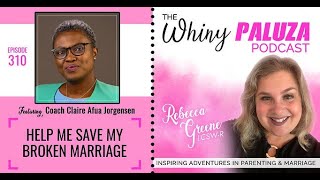
Coach Claire Jørgensen, a Ghanaian-Danish therapist and PhD candidate, talks about her own divorce and remarriage after years of infertility and pressure. She uses neuroscience and faith-based coaching to help couples, including those dealing with affairs, and runs an NGO in Ghana building safe houses for women escaping abuse.
Chapters
Hello everyone, this is Rebecca Green for the Whining Blues podcast, and I am extra excited today because I get to talk to Coach Claire Jørgensen. Claire, thank you so much for being here with me today.
Thank you for having me.
So I am in Buffalo, New York, and it is 9:30 AM. Claire, tell everyone where you are.
I am actually right now in Ghana, um, in West Africa, and it's 2:30 PM.
She is a traveling lady doing amazing work. Before we dive into our guest's incredible journey, I'd like you to reflect on this: What's the most valuable lesson you've learned from a challenging relationship experience, and how has it impacted your current approach to relationships? Our guest today, Coach Claire, has dedicated her life to helping individuals and couples navigate these challenges. She's here to share her wisdom and insights to help us consider our answers to this thought-provoking question. Coach Claire has coached many women, men, couples to use her method to save their marriages and would like to share it with the world. She is pursuing a PhD in neuroscience, psychology, and faith-based on concepts she has found and keeps developing. She is passionate about helping women to live their lives to the fullest and in the early stages with other visionary women forming an NGO to empower women through various initiatives like building safe homes for women and children in abusive relationships, helping put young girls back in school, empowering wise women by assisting them in creating wealth and succeed in their career and life in general. What is NGO? Ngio— ngio!
Non-governmental organization. Ah, so it's— yeah, it's the same as nonprofit organization, actually.
Amazing, amazing. And you're doing amazing work right now where you are. Um, do you want to tell everyone what you're working on right now?
So we are working on opening, um, the doors to one of the safe houses so that we can actually accommodate, um, some women and children. We do, we do already help in other shapes and forms together with different divisions in Ghana, the Ghana Police and the Division of Violence and Victim Survival Unit. So we do help.
Wow.
But there is a big, a big need to actually provide accommodation that they can be in, because if you don't put them in a place where they are safe, they end up going back to the abuser because typically they depend on the abuser financially. So we are trying to open one of those houses, um, and our target is just before Christmas, so we are busy.
Absolutely amazing and godly work that you are doing. And when I opened up your website, it says, help me save my broken marriage. And as I told you before we started, marriage is my favorite topic, so I'm like so excited to talk to you. And your marital journey is super unique You have an amazing story. Can you share with everyone your marital story and what led you to where you are today helping others?
Okay, so, um, I am originally from Ghana, um, and I got married to a Danish guy. We met, you know, we're quite young, working in the same company. So it was a classic, you know, fairy tale love story, which means we also had to fight for each other because our families are like, are you sure about this? And we're like, yeah, we are so in love. And we did get married happily, except that life too has a lot of— I mean, not a lot, but challenges. Like, we all do go through challenges, and the first of those challenges was actually navigating this interracial marriage. Um, and between the two of us, we were fine, but nobody is an island, so we have other people around us that we had to navigate with. And then the other thing was Infertility, that was actually a big one, a big one for both of us. I think we were not prepared for it. We did not expect it. And in the beginning we were like, okay, there's a problem, we find a solution. Not, not a big deal. Except that the solution, you know, kept postponing. So the two of us are crazy. So we ended up doing so many IVF treatments and that was not good for us. It was not good for us physically, emotionally, spiritually, psychologically. It was just not good. Nobody should do that. I don't like to say the number because it is actually quite, quite a crazy number. So I was always on hormones, um, either I have just finished a treatment that didn't work— some of the treatments worked and then I got a miscarriage— or I was getting ready to have a treatment which we typically try to shorten the period, so for maybe one month, and that was because the doctors forced us to stop. And waiting between the next treatment, or I had finished the treatment and very high on hormones. And, and so it didn't help. And I think we were struggling to have a conversation about this whole infertility thing. And it was infertility that was caused by both of us. So we each felt bad. We felt responsible, guilty, blamed. We felt blamed. We just couldn't figure out how to talk about this. So we didn't. And I mean, we tried, but we didn't talk about it in a good way. So it also meant that we were each quite lonely in this journey and it didn't help the relationship. We were very fortunate that we got beautiful kids, but— and we had so much fun. We are so grateful and we enjoyed them. Absolutely. But it didn't solve the problems between the two of us. If anything at all, it made it worse because now we were also sleep deprived. On top of it all. Yeah, yeah. And especially when you have been through such a long journey to have kids, you put this excessive pressure on yourself that you have to get this thing right. You have to get— this is what you've been fighting for years, so we had to get it right. So excessive pressure on each other. We also had parenting challenges from different cultures. Um, we actually were very good at being parents together. But our relationship not so much. So eventually we tried a lot of stuff. We tried to help ourselves, we tried to go for, um, what is it called, counseling or coaching sessions. Um, we tried different things, um, but it didn't save our marriage. It helped us quite a lot to keep— to stay married for a longer time, and also to in some way actually be able to navigate and gets out properly. So we ended up divorcing, um, because we had a conversation about maybe we should separate, you know, and my husband was not in favor of that. He's like, it's black or white, this thing in between, what, what is it, you know? Are we together? Are we not together? I mean, how do you navigate being separated? And it's also economically very expensive because it means that you have to rent something else.
Yeah.
And you are keeping all your properties together, you know, it's for him it was not an option. Um, and then the kids have to go between the two of you, yet mommy and daddy are still together. So he said, it's either we are together or we divorce. So then for me, I think I was very tired of the relationship. I was very unhappy. He was also very unhappy. And I kept saying to him, you are also miserable. Um, so it's not just me that's miserable, we are both miserable people. Maybe we should separate and see if we find something else in life. So we did, and we, we were very good at coming up with a good agreement of being co-parents, um, and navigating that. And I had a little baby at that time, so, you know, she was with me, and then the boy was going back and forth between us, um, and then sometimes he took both of them to help me. And I remember one day just sitting down and looking at this whole setup and thinking, oh my God, have I just become one of those statistics? You know, this is sad. You know, this is not— this is not what I want. I mean, I would like to have a partner, but even if I don't have a partner or I'm not together with my ex-husband, it's like the vibe between us was not very good, you know. And that's not why we embarked on being together at all in the first place when we met. Some years ago. And now I'm talking about now, it had been about 12 years, right? Um, so we, we broke up around the 11-year mark. Um, so I was sitting there thinking through this, and I was like, what if we could actually come up with, um, you know, a solution? We don't have to be together. That was not even in the cards. That was not even in my mind at all, to be honest, because I think at that time my husband actually had a girlfriend. Um, so, and that was fine. We could talk about that fairly easily. It was not a big deal. I was— I had a baby that was breastfeeding, everything. So that was not in my mind to a large extent. Um, and so I thought, what if we could get along well and then come up with a setup that is actually good for all of us? And one of the key drivers for this, you know, conversation or thoughts was the fact that that year I was alone for Christmas. Because he had the kids. And I'm like, is this how life is gonna be? Like, you know, this is not the life I signed up for. And also because for me, I was living in Denmark and my original family are not in Denmark with me. So I had friends, and I had some friends inviting me, but I felt like a third wheel because in Denmark Christmas is about family. Everybody goes to their family at Christmas time in Denmark. If you don't have family in— in Denmark, it can actually be very sad unless you go to a church where they have things that they invite people, or you know, there are Christmas parties at work, and maybe you can make that fun. But on Christmas Eve, Christmas Day, New Year's Eve, forget it. Everybody travels across the country to go be with their family whether they like them or not. They spend Christmas with them. It's actually something that we joke a lot about, that people, you know, they go through everything just to be together. Even if they don't like each other, they will get along on Christmas Day just for the occasion. So I was like, do you really want to go and be with some people's family? And, you know, come on, you are a third wheel. So it was a very quiet and very pensive Christmas for me. And then I decided, what if I could try and change the vibe? Because my husband, his mind was somewhere else. We are very different personalities. I make decisions very quick, but then, you know, in the background I sometimes reflect on it continuously. He takes a very long time, but once he's made a decision, he's made a decision. There is no looking back, looking left, looking right. So he was going, moving on in his life. It was not even something he was thinking about, like, oh, should we consider getting along? For what? You know, we are divorced. There's no motivation here. Um, So I started looking into, um, you know, trying to get us to reconcile. That's the word I use. We— I was trying to reconcile us, you know. It's not like we were fighting, but we were not— I don't think we liked each other. And if you ask me about, oh, how is your, you know, how is your kid's father, I'm sure that you get a whole bunch of things that were not good coming out of my mouth from the depths of my heart. And I'm also sure— I don't think he did the same thing to that extent But I don't think he felt the need to say nice things about me either. Um, and so, but I, I started this journey of reconciliation, and what I found out, it shocked me because I was very convinced before we got divorced that if this man just cleaned up his stuff, this marriage would have been so good, so much better. If he just did what he promised me when we met and we were young we also met very young, like in our 20s, and we were young and we loved each other and all these things we spoke about and all our dreams and visions and this amazing guy that he was to me at that time. If he just stepped up, we wouldn't be here, you know. And I realized, ah, that was not very true. When I started this journey of reconciliation, I would come to realize that a lot of what was going on had to do with me myself. There was so much stuff going on with me, my need to respond, my need to be right, my need to indulge my ego, my need to correct. I mean, I, I was like, oh wow, you know, because right now it was me going on my own journey. I didn't even— he wasn't even part of it. I hadn't even had a conversation about it with him yet, and, you know, in the beginning. So suddenly I realized that a lot of things, the mood, the tone, the response between the two of us I was actually also quite responsible for it.
What was, what was teaching you, what was teaching you that? What were you doing on this journey?
So what I was doing was I wanted us to get along, right? So normally when he comes and we have to discuss simple things, you know, the attitude was like, I'm gonna show you that, you know, I'm the best parent, and, you know, you cannot come and tell me what to do. And it was this defensive, unconstructive posture. From both of us. So every conversation had to be very, very, you know, precise and focused on what's going on with the kids. But my husband and I, we've always been friends and kind of like being around each other. So we could be around each other. I mean, he could come, you know, dropping the kids, and then I'll be like, oh, I'm cooking, or I'm getting something ready. So he'll be there, he'll just be hanging around. We didn't have a problem with each other. Or the opposite, I'll be watching the kids and then he said, do you want me to cook something for you guys? So we were actually friends to some extent, but we couldn't have normal conversations about anything, whether it is finances, whether it is the kids' future education, school. We couldn't without it being about my ego and what I feel. And we also had cultural issues there. So it's like, in my culture we do it like this, and in your culture— so suddenly I became very against Danish culture, he became very against Ghanaian culture. And so it was— everything was a conversation. That was not nice.
Yeah, no.
So I realized, you know, sometimes when he started talking about something, oh, we need to talk about the school thing, and then I was like, okay, reconciliation journey. I realized that the conversation, it was about the thoughts going on in my mind and what I wanted to say rather than actually paying attention and listening to what he was saying. And so that was where I recognized, oh wow, it's a lot of stuff, you know, it's gotten to do with me, my thoughts. My feelings, my posture, how I want to behave rather than anything. Even the thing we're talking about, to be honest, I don't think either of us cared that much about the topics.
That makes sense.
It was exactly— it was more, you know, kind of— I call it a fight of egos. Um, and I can talk a lot, my husband, he can be very soft-spoken. Still, both of us equally height, you know, very high levels of ego. So he would just say a word and it's like, mm-hmm, I've just said what I think, I don't care what you say and I don't care what you feel. Whereas I'll talk a lot and it was— it's still the same thing. I don't care what you think, I don't care what you feel, this is what I feel. So then we would just each talk past each other and then move on. Um, and then eventually just settle for what is standard. So in the school system, for example, the normal school system, because that's fine, that's what we can agree on. We can't agree on anything else. So I realized also sometimes when he was saying something, it was my interpretation of what he was saying. I became very aware of it because now I wanted to reconcile, which meant I wanted to have a good, you know, relationship or vibe between the two of us. And I realized the things that by default I wanted to do or say, they were not helping. That's not reconciliation. That was not a path of reconciliation. So now I had to catch myself and then think differently. What else, you know, what, you know, what else could I think? Yeah, what else could I say? I mean, do I need to respond? The guy is talking about his fishing trip and something something. Do I have to say some sarcastic negative comments? Is it necessary? Must I tell him, you know, something that—
Good question.
You know, are you— you're a terrible parent, you take the child fishing. You know. And I love fishing, by the way, but it was this thing where you just got— yeah, yeah, into a place where negativity was a normal thing that was coming out. So suddenly I realized that it was not even about him. So this whole journey of reconciliation ended up with me doing a lot of work on myself.
That's awesome.
It was a big shock for me because I was not, you know, I thought I was going to be this very wise person telling him how to behave and then finding ways of making him behave like that so that we could figure out how to come together.
Yeah, yep, sounds about right.
Only that I realized that I didn't even have energy to focus on the guy because I had so much stuff going on with me that I needed to deal with, you know. Um, that whilst I was dealing with it, the pleasant surprise I had was he also responded the right way, which, which made me realize that people by default, you know, want to be happy or positive or have, you know, some good vibes around them. The challenge is if somebody will take the leap and do the work, because believe me, there was a lot of work on myself. I had a lot of conversations with God as well. At that time, I was not even sure whether I was really a Christian. I was a Christian, but I was not sure if— I think I was also mad at God. Me and God, our relationship were a bit dicey. Um, and the way the work that was going on with me, I was always having conversations with myself, with God, like, are you sure that this is what I should really do? So it was a lot of reflection, but I very quickly saw the results, so it was quite difficult to ignore it. Because suddenly the dynamics between us, the vibe in the house, even our son, you know, you could see he was thriving in a whole other way without, without us being together. We're still apart, but the conversations, the tone, even how we each— our stress levels were, you know, it started dropping. Um, and then I actually told him that, oh, I am, you know, trying to— this thing where we should reconcile, you know. I'm paying quite a lot of attention to the way I talk to you, the way I respond to you, and the way we are together. And, you know, I think it's helping. So he said, oh yeah, I can actually see a change. So yeah, he also said he also would like to do the same. And then we agreed to go on a trip together. These are people that are divorced with two kids. We booked a trip together, and I remember this, you know, very well. We decided to book a trip that was not super expensive in case it did not go well. Then we can just get back on the flight and get back, and then okay, not a lot has been lost. And but that was one of the conversations whilst we're talking about reconciliation. What if we could also go for holidays together even though we are not together, you know? So if I found a guy or he found a girl, that would be a conversation that we will have with the girl or the guy that, you know, I have this agreement with my ex for the sake of the kids. We go on summer holidays together for 2 weeks every year this is the deal, you know, you're gonna have to accept it. Are you okay? If not, okay, bye-bye, let's find somebody else. Um, so we said let's try it out, and we went for this trip, and it was one of the best trips ever, you know, because there was no pressure on anybody. We don't have to be together if we don't want to. If he says I'm gonna watch football, okay, bye-bye. I want to go and do a spa, just lie by the beach or swim or do something else, that's fine. Because he's not my husband, I'm not his wife. He cannot tell me what to do, I cannot tell him where to be at the vacation. The only thing that we, you know, um, we coordinated was spending time together with the kids together to give them that experience of mommy and daddy and the two of the kids together. But it was also fine, sometimes you have the kids alone, sometimes I had them alone, um, and when they went to bed, you know, we could sit and play games together or have a chat or not be together. It was not a big deal. So we realized that actually there was no conflict left anymore. The conflict vanished in itself by us figuring out how to treat each other right. That's it. It's not like I changed. I did not change. He did not change as a person. All the weirdness about us and all the positives were still there, but we had chosen how to view each other and view the relationship between us differently. And that made all the difference. So that was the start. And then I think from there we started, you know, having conversations of being together again. And then we actually did get remarried. That's the crazy part of the story.
It's— I mean, literally, I want you to know, when I read your story, I cried. I cried. And I was like, oh, this is like the stories that you want to read. And you know what I love? I love so many things about what you said. And the first thing that I love is that we don't need to be making changes with our spouse at the same time. He doesn't have to agree to do it at the same time. We can start on our own and they tend to follow.
Exactly.
So you were inspired to take this and then help others.
Exactly. And I, I will say something because, um, I, well, I had a lot of coaching and counseling. I mean, even when I got divorced, I did not know. I thought when I get divorced, I'll be free. That's it. To get out of my life. Let me get out of your life. Let's move on. Except when I got divorced, I got a big reality shock that, oh my God, I'm grieving and it's so painful to navigate this whole thing. And the whole point is I am the one that insisted on the divorce. So why am I in so much pain? You know, why am I— do I feel like this is not what I actually wanted, even though this is what I also want? So I had to get, you know, help with them. And I had two coaches at that time, or counselors in my life, therapists. And I remember, um, and so I always say to people that when you— when you are in, you know, difficult phases in life, be deliberate about the people you surround yourself with. Because these two coaches, they sowed seeds that later I realized. So one of them, one time I went there just venting about my ex-husband, and she knows him, you know, because she had been coaching the two of us together and him individually as well. She was one of our favorites. Um, she was not a marriage coach, but she was a therapist, and so she could navigate challenges. And after going blah blah blah for a while, she was like, Claire, maybe you should stop talking about your ex-husband like that. You know, you don't gain anything. It doesn't help you. I love that. And who knows, maybe one day you will be back with him. And I, I stopped and I looked at— I was like, are you, are you crazy? Did you just say that? I mean, we are divorced, right? She's like, I know, but you never know. And I was like, okay, that's a very odd comment from— I was thinking, this woman is off today. But later, when we started, when the relationship started, you know, building up it occurred to me that this is somebody that will help me and will cheer me on if I ask her to help me. So of course I called her and I told her, you know what, Anas and I are now looking into, you know, whether we can have a relationship. You know, maybe you can help me, you know, cheer me on, because sometimes I have doubts about this whole matter. And she did cheer me on. So she sowed a seed that grew later. And I'm so grateful for her. And then there was the other one as well that, um, I told her because I couldn't even accept to people that I was sad that I had divorced because that was all I claimed I wanted, you know. I want to get a divorce and blah blah. And my, you know, my, my husband at that time, you know, he wouldn't sign it. Not because he didn't— he wanted to keep me, but he was like, are you sure? Because I can be spontaneous. Are you sure? So he gave me a lot of time to think through it. You know. And then just before the deadline, he's like, if you want me to, I'll do it, but are you really sure that we cannot work this? And I'm like, we've been trying for years, you know, let's just give each other a break in life. And you say you don't want a separation, so there is nothing else left. Um, and I remember I went to speak to her and I told her, and she looked at me and she said, you are sad, you are grieving. And I'm like, oh God, somebody that I can talk to about this. And she said, it's okay to regret the decision. It's okay to not feel good about the decision, but it's also okay to understand that you just stopped almost 12 years of a marriage. So you are grieving. It's, it's difficult, and let's work through it, how you feel and how to, you know, make peace with it. And I was shocked because I thought I had actually made that decision after a lot of thinking and deliberation. So these two people I think they actually helped me to, you know, eventually when I started considering the reconciliation, they were huge, um, sources of help and they were deliberately positioned to help me. I couldn't have done it by myself.
Yeah, well, we shouldn't do anything by ourselves, especially something so hard like that. And, you know, you, you told this like beautiful story and evolution of your marriage. So you went through all of that. So now how do you take that and use it to help others? How is that impacting you?
So, um, I'll talk about how it impacts me and then how I, you know, it impacts others. So today, for example, earlier today, my husband and I were walking on, you know, a street somewhere, um, and I always get these you know, moments where I take just a few seconds and I'm grateful. Because in the past— so he was walking way ahead of me. I mean, my husband used to be in the military, he was fast, and I don't walk very fast. And it's not a problem, you know. So sometimes you stop and say, oh, I'm waiting for— I'm like, just go, it's okay, you know, I'm behind you. And every now and then he'll stop because he wants to show me something, and then he'll stop and we walk maybe 2 minutes together, and he's still ahead of me. In the past this was a huge source of conflict. So when you see us walking where he's ahead and I'm behind like that, it's not a good thing. We are fighting. I'm angry, he's angry, and we are trying to get away from each other deliberately, you know. So it's not because I'm moving slow and he's moving fast, it's because we are actually trying to get away from each other. And sometimes he may run away or I may run away, you know. And I just, you know, I just got this flashback and I'm like, wow. I'm so grateful that, you know, we are having a normal walk that normal people should have, you know. And it's not a— there is no— there's no pain, there is no problem, there is nothing. It's only joy. And he's— he actually noticed somebody weaving something we call kente on the path. I didn't notice it at all because we're going uphill. I was more focused on just moving. And he was like, oh, the guy was making kente. And I'm like, I didn't see him, you know. And then he showed me a picture of you know, you're taking— I'm like, that's a very odd place to sit and make painting, you know. No wonder I didn't see him. And then he laughed, and then he just continued ahead of me. And so the impact in my life is I appreciate this person that, you know, God has given me that I'm supposed to do life with in a whole other way. I also appreciate the work that has been done on me myself so that I'm even capable of enjoying you know, this person in the marriage. That's the biggest impact. I enjoy so many small, small silly things that I used to take for granted those times. So what brings joy and peace in our marriage right now is nothing big. It's small, tiny things. This thing I'm wearing, I've said I'm wearing this throughout the holidays. It's silly, it's crazy. Every time I'm not wearing, he's like, are you not wearing it? And then I put it on and they laugh at me. But I'm wearing it just to make a point. And I can feel joy in this. It's a very silly thing, it's a very small thing, it is irrelevant what it is. I couldn't even enjoy big things when my marriage was in a very challenging place. And that, that's why sometimes we get even more pain, because you look at a situation that should have brought you joy and you are not capable of enjoying it. And so my, my life, my marriage, and it's not even just a marriage, but everything in my life, I suddenly have an appreciation. And I am deliberate how I show up, because I realized that I didn't show up deliberately in the first, you know, at some point in my marriage. And that's why it went— it went really off, considering that we are still the same people, the dynamics are still the same, there are still some issues, but we are honestly, genuinely very happy. And we were the same people some time ago, we were so miserable. It was not even funny. If I tell you some of the stories of the fights we had, some of the fights, you know, we, we needed help, you know. It was not good. Um, and so what changed is, you know, how we chose to see things and how we chose, you know, to deal with ourselves and deal with each other. Nothing dramatically changed. And so that's my impact in my own life. And then for other people After I, you know, I started working— whilst I was— we're still working on our own marriage, I realized that I started getting the opportunity to counsel and coach people. I've always been counseling and coaching people about different things. It could be career, it could be something else, it could even be relationships, you know. But when my marriage broke down, I mean, I was not good to counsel anybody about relationships. I will tell you, we are all doomed to not make this marriage thing work. Don't marry, don't No, I was not very positive.
You were like, don't do it, don't get married.
Exactly. Yeah, no, it's not good, you know, it's just an illusion, it's all a big illusion. So at that time, fortunately, I didn't get a lot of people coming to me for marriage coaching. But when I was working, or we were working on our marriage, I started getting a lot of people and I realized it was exactly the same thing. And most of them were women, that's why, you know, I started being more interested in women. And it didn't matter what the situation was, it was the same formula: focus on you, and you will be shocked how much power you have to change the situation. So that's how it always started. And then of course there are different dynamics, and they are, you know, there are different levels of, you know, severity. So then there are some things where other things need to be done, but the foundation was exactly the same. So I started feeling, you know, and people also started telling me, including my husband, maybe you should do this for real. Because I used to have a proper corporate job, and sometimes 2 AM when my husband is sleeping beside me, I'm coaching somebody on the phone. He's like, this is a hobby that is on a whole other level. 2 AM. I'm like, the person was very distressed. So it started gradually, you know. So I started getting training, I started getting interested in, you know, education about it. As well. And I realized everything I learned, just, you know, everything I read about, or I was led to read about, like NLP— NLP, neuro-linguistic programming— it's, you know, it has one foundation, and that foundation is everything starts with you, and everything is about you, and it's about your view of the world. So, and then I started looking into neuroscience as well, and then of course Christianity, because I'm a Christian. And it just all somehow had bits and pieces of what I had learned. So I started also applying it to people, and I am so grateful that I have been part of very, very many success stories. And so it is also helping people to also mend their marriage. I have a bold statement that I say: if you want to save your marriage, you can save it. It doesn't matter what, you know, how terrible it is, but it requires one person that is interested in doing that. Work. And sometimes the work needed is really hard, but if you will do it, you can save the marriage.
Is there any certain— obviously no names— is there any certain couple that is standing out to you right now that you saw shift?
Yes, I have seen, um, so one of the biggest issues that come up that, you know, put people in a place where they are wondering if they should save their marriage is of course marital affairs. And I do get a lot of that. In fact, I have a whole, you know, webinar and stuff on marital affairs because it's a big thing, because there the trust has been broken and it's challenging. And I've had a case where even a child came out of that affair, and it was very difficult for the partner that, you know, had been cheated on. And they were, they were, you know, willing and ready to just move on, but with some work, um, quite a lot of work actually, and accepting to just forgive. And I say just forgive, it's not just, it's, you know, accepting to do the work and heal and forgive the person, um, and also address what is it, you know, because even the affair is, is a symptom, it's not a root cause. What happened there, you know, how could we have been different in this? And, you know, they are happily married and have accepted the child. The child is part of Of course, the mother of the, you know, the, the other child, she has the child most of the time, but they also have the child sometimes. And, you know, she has, you know, what is it called, socialize her children with the child from the marital affair. And there is no pain left inside her about it. Of course, the guy also had help to realize that there are some non-negotiable standards in marriage, and cheating is— it's not is a non-negotiable standard. So it's not like we condone it, but like I keep saying, he also needs help. You know, she needs help, but he also needs help to understand what happened there and how can I position myself so that I don't do that anymore. People are weak, they are not necessarily wicked. So that was a weakness, it was not wickedness.
Like, oh, I love that. Good line. Yes, yes. Oh, that's a beautiful story. You said a very important word. I think people can feel lonely in their marriage. So to the people listening who are feeling lonely right now, what step can they take to feel less of that?
So, um, my— I keep saying this, I keep repeating this— if I feel lonely, to a very large extent, it is about me. I will say that it is some— it is also about the dynamics between myself and the people that I love in my life. Um, but for me to change that dynamics, I have to change, you know, the fundamental way I see the world, my, you know, my belief system, my view, you know, my map of the world, how I see things, how I process things. When I'm able to process things the right way, it is fairly easy to affect the dynamics and what makes me feel lonely. And so, you know, when we feel lonely or we feel sad or we feel something else, it is basically like a mechanism that we have put together that we are used to doing, you know, because we, you know, we have an emotional need, we have some kind of need. Whatever they need is, to a large extent, is an emotional need. And without knowing how to navigate it you know, we get into these feelings. There is a rule of thumb that we use, and it's in— it's called positive intelligence, actually. It's also a coaching framework that we use. If I feel any negative feeling, and they say one minute, one second, or no, one minute, and I think one minute is a bit too short. If I feel any negative feeling for more than 5 minutes, it means it's about me. There's something going on. If I feel sad because something— somebody did something, and it takes me about 1 minute, 5 minutes, and I move on from that sad feeling. It is normal behavior. It's not normal human being human and, you know, having feelings and emotions and processing what is going on around you, around me. But if I feel lonely, you know, it doesn't matter who did what, it doesn't matter what the situation is, for more than 5 minutes— and typically we feel these, you know, tough emotions more than 5 minutes— it means that there's something that I need to process. There's something I need to work on and then stop this feeling of loneliness. But it's okay to feel lonely once a while, you know. Sometimes you can be with people and be like, oh, I don't feel like I fit, I feel lonely. 5 minutes, that's fine. 10 minutes, all the time. 1 hour, a whole day, then there is a problem. So what I would advise is that there is, you know, there is a lot of help out there, you know. You can do so much to help yourself. It doesn't have to be dramatic, it doesn't have to take your whole day. Sometimes it's Simple things like exercises, 15 minutes a day, can make a huge difference if you know the right thing to do.
Do you feel like when— okay, so I'm a woman and I'm coming to you with my marital issues and you're telling me— now obviously, you know, I'm a therapist, so I understand what you're saying, but you're saying to— like, you're saying to the woman, okay, well, this starts with you, let's work on you and you're gonna fix your marriage. Do the women get are they responsive? Are they defensive? How does that go?
Yes, so the first reaction is— I always tell my, you know, my, uh, the beautiful women that I work with that I'm shocked that they stick with me, that honestly, I, I say, I say the truth. I actually say the harsh truth, um, but in a loving way and with empathy. So I'll see you, I'll hear you, I'll understand you, I appreciate you before I tell you, but I would tell you very very fast that, you know, how we're going to work on it. And then we have a conversation. And I remember one particular lady that came to me, and we're having a chat, you know. It was actually quite late that day because we're in a retreat together, and we were having a chat. So this was not even a paid session, but we're having a chat about, you know, her issues in her marriage. And she was very frustrated. And the words that came out of my mouth is, you need to go and say you're sorry to your husband. And her eyes almost popped out. Like, what? Um, and I'm like, yeah, I know it doesn't sound very nice, but just hear me out and let's have a conversation about this. Now, the honest truth is that people reach out because they honestly have help— they want help. And so when they are able to understand and appreciate that I may have a different perspective of the issue and I can see it differently than they can see it, and they can see that I'm willing to be honest with them but work with them at their own is, they typically, you know, calm down. But in the beginning, sometimes there is this what, you know, kind of behavior. And this lady that I'm talking about, while we were doing the session, and it was just a 1-hour session, she started crying and she said, I need to call my husband now, I need to call. And I'm like, it's 3 AM, it's 3 AM, let the guy sleep, let's call him in the morning. And she did call him at 5 AM and said, I am so sorry. You know, we talk a lot about men abusing women, but this was a situation where the woman, from what she told me, she sounded a bit abusive towards her husband. I'm like, that's not how you should behave in a marriage, no matter what is going on. So I think you need to apologize to this guy and, you know, get a proper perspective of how, you know, how to make the— how to express your emotions. It's not because she's a bad person, but she was struggling with some things and she didn't know how to express it, so she was not necessarily always nice. So of course the harsh truth was, no, you should say sorry. And towards the end she got there because I don't just say, oh, do this. I actually give you the background, the framework, and I understand you. And it's always from the point of view of we want to help you, you know, to get the best and get the results that you want, not, you know, to criticize you. And so there's a difference between judging and actually giving honest feedback. And what we do is we give you, you know, that we give you the honest feedback. We are not judging you, and we also help you with the how to do it. So I— but I do get people that get mad at me, but they always come back because they're like, fix my husband, not me. Exactly. And it's also because I have been like that, so I can share my stories. Yeah, I know exactly where you are. I knew if somebody would just wave this, you know, magic wand and tell this man how to get a grip of his stuff. But I found out that that was not the truth, right?
Oh my gosh. So if I want to take one step today to better my marriage, what would you tell me to do?
I would say that invest in, you know, being a healthy version of you, and, you know, totally, because the marriage is as healthy as the two individuals in it. And I always say that even if one person is healthy in the marriage the marriage can thrive. What happened in my marriage is we are both not healthy people. We were just screwed up people, you know, blaming each other for our messes. Um, so if you want to do something simple, focus on investing in you, in being okay. Take care of yourself. Um, sometimes the issues that we deal with in marriage is because we do not take care of ourselves enough. And then we are, you know, like our cup is empty. We are, we literally are working on fumes. And so it becomes very challenging to even process what is going on and properly deal with it. So just take care of yourself. Just do small things to take care of yourself.
Well, and that makes us a better mother too, what you just said.
Exactly.
Yes, exactly. Exactly. So what do you think the best advice is that you've ever received?
So the best advice that I ever received was that everything is for a season, and it keeps me, it keeps me, um, in, in perspective. Because sometimes we are going through a very challenging period, whether it's marriage, it's sickness, whatever it is, it can— your mind can just go way into the future and say this is permanent, you know. But if you just get this perspective, like it's for, you know, a season. And even use this simple word, yet. So I am— my marriage is not where I want it to be yet. Instead of saying my marriage is terrible, my marriage is not where I want it to be, you know, it makes the brain think, okay, there's no solution, it's hopeless. You just put yet at the end of it and say it's just a season. And that was the best advice that I ever got.
That's fabulous. Now you are pursuing your PhD, you're working, you're a wife, you're a mother. Um, how, how are you doing all of that? How are you balancing all of that?
I want to say it's God's grace, but I also want to say that it's not balanced. You know, I just learned something that, you know, when you say it should be balanced, it means the work should be here and then life should be here, and then it's work-life balance. It's not balanced. But together with my family, um, we talk about it and we make it work. And I am, I always say that I do me and I don't put excessive pressure on myself. If, you know, if I feel like I'm tired, I take a break. If I feel I can sit and work until 5 AM, I do it. So I don't have any fast rules about it. I feel myself. I am, you know, I also pay attention to my family. I feel, you know, if I see I'm putting too much pressure on them, I, you know, I withdraw. So I am flexible and I accept the fact that it's not balanced. But it is a season.
Ah, I think that the word balance can feel like too much pressure. As, as— yeah, yeah, we don't need balance.
No, sometimes there is a balance, sometimes there isn't a balance, right? But it's also fine, and it can tip anyway. Sometimes there's so much fun and little work, other times there's a lot of work and little fun. But as long as we talk about it and we each know where we are and we pay attention to each other, we take care of each other, we are good.
That's, that's wonderful. Well, and you talked about your infertility journey, and I guarantee that there are people listening who are struggling with that. Any words of wisdom to them?
So my biggest lesson in that journey was I put so much pressure on myself. That it is ridiculous. And I look back and all that pressure did not help. I don't think that's why we got the results that we got. In fact, the results came when we calmed down in the situation. So I, I would— the one advice that I'll give is that take the pressure off yourself. And for those of us that are Christians or have some faith, have faith, have— because for me it was faith that eventually helped us through that process. But the first— and I don't want to say how many treatments we did, but at least 13 treatments. We were like— that's the first, so there was more. We were like crazy human beings.
Yeah.
And the lesson there, and what I want to share with any woman, any man, is take the pressure off yourself and please work through it together as a couple. You are a team. We were not a team. So be a team. And put effort, even if it has to be, you know, the focus has to be on your marriage, your relationship, working on it, and pack that infertility, you know, fertility treatment for a short period, for 6 months, and work on the two of you. It is a better investment because I also do have friends who did not have kids and they were much more happier than my husband and I when we got kids because they worked through it. They actually focused on their emotions and how they feel and properly dealt with it. We didn't. We just went on the fertility, if it, you know, IVF streak, um, and the effects was devastating. It was a marriage that broke down, you know, which then at the end of the day, what's the point having kids, you know, and then not being able to make the marriage work, you know. So take the pressure off you and focus on each other and the marriage. The other thing, have faith. It will come with the help and with the work you are doing. It will come.
Such good advice. Any final words of marital wisdom?
Yes, so I would, I would say that, um, if you are struggling in, you know, in this, in your relationship right now, please get help if it's possible. And it doesn't have to be me, you can get help. I mean, Rebecca is also here as a therapist. There are so many amazing therapists out there. Find the one that fits who you are, fits your style, but more importantly, fits the outcome that you want. Because if you want to save your marriage, don't go for somebody that doesn't like men or women, or who believes that, you know, get out of the marriage. Because I also did go there at some point. It will not help you. But if you also don't want to be together, then don't come to somebody like me, because I'm gonna try to help you save your marriage to the extent possible. So Please find one that fits your desire. But whatever the issue is, I am convinced that it is possible to save it with the right help and with the right work. So find the help. There is nothing wrong with getting help. We all need help for sure.
Now, can you tell everyone where they can find you?
Yeah, so you can find me on my website, and it's Claire, um, and I'll say the, the way it's spelled, Jorgensen, but it's pronounced Jorgensen. So clairejorgensen.coach, um, or claire@clairejorgensen.com. You can also, um, on my website I do have the option for you to book a free, um, what is it called, um, transformation call for 45 minutes for us to explore if we can work together. And even in that call, I'll still give you tips about how to you know, navigates the situation. I do have a— I have two free quizzes. Uh, one of them tells you what is the biggest issue in your marriage and how to deal with it. The other one also tells you whether your marriage can be saved actually or not, um, and where you are depending on the issues that are going on in the marriage, or how easy or difficult it is to save the marriage. And then I have a free ebook as well that tells you 5 simple things that you can do if your marriage is in trouble now. Thank you, and they're all on the website.
Well, thank you for your resources. Thank you for your time and expertise. I absolutely loved getting to talk to you today.
Thank you so much, Rebecca. It's been such a pleasure. Thanks for having me.
Absolutely. This is Rebecca Green reminding everyone to spend every day laughing, learning, and loving. Thank you for tuning in to the Winey Palooza podcast. If you like what you heard, please be sure to subscribe so you never miss an episode. While you are there, leave a review. I love to hear your feedback. Thank you so much for listening. Until next time.
This show has been produced by Market Domination LLC. To discover how you can have your own show completely done for you and turn it into a real published book and become the authority in your marketplace, Go to www.marketdominationllc.com/podcastoffer. 49 faces looked to him in triumph. Over the last 12 months, they had each taken turns and promoted his business for a week at a time, driving over $987,342 in revenue. What if you had a network of 50 centers of influence who promoted your business every week for a year? Grab your copy of the number one Amazon bestselling book, The Ultimate Guide To Growing Your Business with a Podcast at 33% off the Amazon price by going to ultimatepodcastbook.com. Again, that website for 33% off the Amazon price is ultimatepodcastbook.com.










