Episode 366: Empowering women through perimenopause: tips and insights
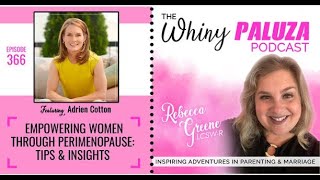
In this episode of the Whining Blues podcast, host Rebecca Greene interviews women's wellness expert Adrienne Cotton, creator of the Master Menopause Now program. The conversation begins with an introduction to Cotton’s background—a former political and public‑affairs professional who pivoted to wellness after recognizing her own health neglect during her 40s. Cotton shares her personal perimenopause experience, describing a "perimenopause prison" and the discovery of four perimenopause stages, each with escalating symptoms such as irregular cycles, migraines, night sweats, vaginal dryness, and weight gain. She outlines a holistic, five‑pronged approach to navigating perimenopause: (1) sleep hygiene, (2) stress‑resilience, (3) calendar micro‑breaks, (4) strength‑focused exercise, and (5) nutrition centered on protein and balanced meals. Practical tips are provided for each pillar – cool, dark bedroom; limiting evening screen time; scheduling short wellness slots throughout the day; incorporating functional strength movements in 20‑minute sessions; and planning three protein‑rich meals with mindful calorie awareness. Cotton emphasizes the importance of habit formation, recommending at least three 30‑minute strength sessions per week and using habit‑stacking to embed wellness into daily routines. The interview also covers systemic gaps, noting that many OB‑GYNs feel unprepared to counsel on menopause. Finally, Cotton promotes her Master Menopause Now online course (60 short videos, worksheets, workouts, $199) and offers contact information for further support. The episode ends with encouragement for listeners to adopt one simple step—lifting weights—in their weekly routine.
Chapters
Hello everyone, this is Rebecca Green for the Whining Blues podcast, and I am very excited today because I get to talk to the fabulous Adrienne Cotton. Adrienne, thank you so much for doing this with me today.
Oh my gosh, I'm so happy to be here with you. Thank you for having me.
I have read a bunch about her and we all need her, so I'm so happy that she's here with us. Um, I was just telling her that my friends are all complaining about perimenopause symptoms, So we're going to dive in and help everyone, but I want to tell you a little bit about her first. Adrienne is a seasoned women's wellness expert and the creator of the Master Menopause Now program. How amazing does that sound? With over 20 years of experience in wellness coaching, she specializes in guiding women through the physical, emotional, and mental challenges of perimenopause and menopause. Adrienne focuses on practical strategies for sleep, stress resilience, and lifestyle management to empower women to transform their midlife health. Her approach moves away from restrictive diets and intense exercise, promoting foundational wellness that includes mindful scheduling and effective stress management. Through her online course and workshops, She has helped thousands of women achieve a more balanced and fulfilling midlife. And I mean, could that sound any more amazing? I'm— I told you, I'm so excited for this topic.
I'm excited that you're excited about the topic. I'm not sure you're going to be excited about perimenopause. I shouldn't say that. It's not true. It's actually one of the best times of my life.
Oh, that's awesome. I love that you're saying that. And I have to tell you, like, I want to hear about your own personal journey with perimenopause and what has led you to be becoming a women's wellness expert?
So two are— they're sort of one and the same and sort of not. So I, um, I came from a background from Southern California where I was raised as an athlete, and then I came— fast forward about 23 years and I landed in Washington, DC. And from Southern California, I was really surprised at how individuals here are so incredibly brilliant and so driven. And so driven to help people because there's so much— we're surrounded by people in service of all of us in the government, and people work a lot here. And I found that when I first landed here for 17 years, I worked in politics and in public affairs and in government and association world. Yes, I have a first— this is my second career. Okay.
Career.
I was surrounded by, and I still am in my second career, really, really brilliant people who are really focused and their passion is to help others. And some of them are in service in the government and associations and law firms. But I was pretty surprised at how individuals here were not focused on their health, their wellness, and their fitness. I just was really surprised. So it always stayed in the back of my mind and I became one of those people. So I was not fueling myself well with foods that I knew were going to fuel my life and my body for what I really wanted to do with my life. Movement was more of a chore, less of something that I had fun and I played with like it was when I was in my younger years. And so over the course of time in my first career, I recognized that I was not really serving anyone. I didn't feel like I was serving myself first, which is what I need to do. We need to take care of ourselves first and everyone else. We know the old oxygen mask metaphor, which is— I truly believe is the key to our health and our wellness, particularly women in this phase. So I walked away from that career in corporate America and I started a fitness and strength training gym. Mm. But during that time I had the gym. The gym in itself was in existence for about 17 years as well. So I found that people were very focused on their food and on their diet. When it came to feeling really good in their body. And what do I mean by feeling good in your body? I mean, you can take a few guesses. What does it mean when you feel good in your body? Well, let's be honest, you fit in your clothes.
Mm-hmm.
You feel like you're rested. You have energy. You make really good choices about others with whom you spend your time, and you make good choices about all kinds of things, like the foods that you choose and the exercise you choose. And how you spend your time. So on come my early to mid-40s. I had twins when I was— a boy and a girl— when I was 40. So I reached my mid-40s and I had these 5-year-olds, a boy and a girl. I believe I experienced postpartum depression and I was heading into perimenopause at the same time.
Oh my goodness.
Yeah. So I call it in my speech and with you and with everyone, it's called my perimenopause prison because I felt imprisoned by this old set of conventional wisdoms and myths. I owned a fitness company and I was trying to stay fit, which I wasn't, by shrinking calories, and going to the really, really hard cardio-based exercise programs because I was not feeling good in my body. I was so stressed and I was not getting my sleep because of all these reasons.
Yes.
So over the course of about 10 years, I figured out I wasn't alone.
No.
I looked around my, my company, my gym, my members, the trainers who I was working with, my friends. And I was listening to women talk, and I realized I was not alone, that I was feeling similarly to other women in my age group. I happened to land in the doctor's office of a menopause specialist, and there is such a thing. And she told me, I don't know how you've made it this far and not landed here because you are in full-blown, the last stage of perimenopause. Perimenopause has 4 stages, and I was in the— it's called deep perimenopause.
Oh my goodness. I didn't know any of that.
Right. So I didn't either. So then I thought, oh my goodness, the women who I work with and the women I know, they're all going to want to know this. So I dove in and I figured out my own, what I call my own approach, my philosophy. I call it my revolutionary method, and it is really a combination of sleep, stress resilience, which means you respond, not react. Mm. Filling your calendar with little snippets of time throughout your day that you own for you, which could be exercise, which could be cutting some carrots, could also be calling your mom, could be writing a gratitude journal, could be shopping online for a new pair of underwear. I mean, something that you do for yourself throughout the day so that at the end of the day, you're not giving away all your time, which we all intend to do. It feels really good to serve others. And then, of course, I really honed in on the approaches of food and exercise. It's a 5-pronged topic. It's a 5-pronged approach: sleep, stress, calendar, exercise and food and a, and a beautiful combination of all of them. When one is on, they're interconnected. When one is on, the rest of them tend to fall into place. When one of them is off, let's say my sleep is off, which is very common in perimenopause and menopause, and I can explain to you why. Yeah, but when our sleep is off, we are more reactive.
Mhm.
Based We're hungrier for foods that aren't going to serve us well. We're not going to want to exercise first.
No.
And we're not going to want to put our oxygen mask on first because we're going to be racing through our day and our to-do list that's a mile long. So that's what happened. I closed the doors to the gym in 2018, and I've had the company now, Adrienne Cotton Now, You do the math for about 6 years. And I serve women. I help them transition through this phase of life. It's typically in their early 40s through the rest of their lives on finding their own tools that are different than what they learned in their teens and 20s and early 30s, because our bodies are vastly different than they were in their teens and 20s and early 30s. So why are we all still searching for those shiny new exercise programs and diet programs that served us really well back then before our brain and our body really changed? I mean, we're going from being able to reproduce to no longer— our body is no longer able to reproduce. That's a big change.
Huge.
So that's a long answer, but that was my journey. But in part, it was watching women around me and my own journey.
Well, and you said so much that I want to ask you about. So, you know, I don't want to put— I don't want to put you on the spot, but I didn't know there were 4 stages of perimenopause. Can you tell us, do you know those stages to tell us what they are?
Yeah, loosely. Yeah. So really what is so confusing for most women who are your friends and your listeners who hear this, perimenopause really is very typical in your late 30s, early 40s.
Okay.
And you still have your cycle. Okay.
Okay. So that's good to know. Yes.
So stage 1, you still have your cycle. Little things are happening, but really not much that you can notice. Okay, stage 2, and there's a whole range of symptoms that come up as stage 2, 3, 4. Okay, so migraines, histamine problems, hair loss, the cycle becomes a little bit irregular, but not irregular enough that you're thinking, hmm, something's going on because we tend to be so busy. Working others, and which can be in this stage of our lives, we tip— a lot of women have either children or teams at work or at a volunteer capacity taking care of, and elderly parents. So the fact that we may have been, you know, 2 weeks late or missed a cycle, a month here, a month there, eh, most women don't pay much attention to it. But then allergies come on and migraines come on and joint pain happens. And then you start to creep into 3, and then there's more cycle changes. So you're definitely becoming more irregular. And then you're having— you're starting to experience some of those night sweats and your temperature regulation. What happens is during menopause, our ability to regulate temperature, our body's ability, our brain's ability to regulate our temperature declines. So that's why we get night sweats and hot flashes. So all the other symptoms keep coming, they keep coming. Still, many women don't really know what to do about it, and still a lot of women may be even talking to an OB-GYN who is not educated on menopause. They make really good OB-GYN doctors who are very good at helping them with their deliver their children, and contraception. But they are not as schooled in menopause. In fact, there was a really well-known study now that Johns Hopkins Medical School OB-GYN graduates, 75% of them said they were unable to coun— they felt lacked confidence in counseling women on menopause because they just weren't taught in medical school. So that's who we naturally talk to.
Yeah.
So then you have that missed cycle, you have more stress, in part because your brain is really anxious because all it knows is that regular cycle and your job is to reproduce. And now your brain is sending your body some odd signals, so it creates anxiety. Piled on top, caring for the elderly, elderly parents, have the kids, have the folks at work, have a really busy lifestyle, and then you have more stress. And then we're practicing all those old things we thought we knew, whereas let's increase our cardio, and our doctors often will tell us to change our diets. And again, Oftentimes doctors don't know a lot about diet and exercise. They're not taught. It's some crazy number. Don't quote me. It's like 5 hours in medical school on diet and exercise. So you're really lost and we don't need to be, right?
We don't.
Yes.
Well, and the hardest thing that I have heard is trying to find a doctor educated in this to be helpful.
Yes. Yes. And you can now. And I can give you all the tips and all the tricks. Awesome. Let me just finish through the phases because at some point your cycle will really start to decline. Okay. The top 4 symptoms of perimenopause are night sweats, sleep disruption, vaginal dryness, and weight gain. Fun times.
Good, good times.
Good times.
Women.
Yes, I had them all. So what you do is you find a woman who is— first of all, they work with me, and I can help counsel them through holistic practices because I do believe the more we tend to all of our wellness, not just our diet and exercise, try so hard, ladies and gentlemen who are listening, for your, your kids, your colleagues, your nieces, nephews. I believe this is a message for men and women.
Yeah.
Try to walk away from the old conventional wisdoms that you just are one diet away from losing that 5 pounds and feeling good, because it's just not true. We've been sold a lot by the diet and fitness industries, and there They're doing such a good job in so many ways, but women sometimes need to add calories, right? Because our metabolism doesn't like it when we continue to shrink those calories, and then we work out so hard all the time, and sweat is— seems to be an indicator for a good workout, which I'd love to challenge. And we just need to slow down. And you'll be amazed at how well your body responds. So then you have perimenopause. Yeah, you go through these 4 phases and then you are in menopause when you complete 12 consecutive months without a period.
Oh, okay.
Yes, 12 consecutive months. You can go 11 months and get your period and you are still not in menopause.
Oh my gosh. I think that happened to my mother now that I think about it.
Uh-huh. Yes. So it happens. I have a dear friend of mine. I think she's 56, 57. She still is in perimenopause, although the average age for perimenopause is 47 and the average age for menopause is 51.
Well, so I don't want to give TMI here, but, you know, I get my period. I'm turning 48 this month and I get my period every month. And in June, it just decided to not arrive.
Yes. Perfect timing. No, no pun, but perfect timing for our call.
Yes. I'm like, okay, period. Where are you? Are you coming?
Where'd you go?
Are you skipping a month? Are you coming any day now? I don't know.
Chances are it's gonna come. Chances are it's coming and it's gonna leave and it's gonna come and it's gonna leave. That's fairly typical. Oh. Is it comes and it leaves and it's heavier. And then it's lighter. And it's just a really— it's a really interesting ride. And I would say for you, I'm happy that you even noticed. There are many women who I meet who don't know when they had their last period.
I mean, I keep track on the calendar.
Good, good.
So I can't imagine not keeping track. I would like to know when it's coming.
Yes, it's awfully nice to know. A little inconvenient. Yes.
Oh my gosh. So, so I wanna go over, you know, the, the few things that you talked about starting with sleep. Yes. I mean, that's the biggest complaint that I hear is the disruption in sleep. So how, how can we help that?
I am crazy about sleep.
Yeah, me too.
And I can tell you, I'm so glad you are, Rebecca, because I'm glad you're— then your listeners may be as well, because sleep— if you get your sleep, let's go to the positive. You will have less reactivity the next day. 100%.
Me too.
You will be interested in getting some time for yourself. That's the calendar piece. You will fuel yourself with foods that are good for you most of the time. Listen, we're not— nobody's perfect. And if they tell you they are, They're lying. No one's perfect. I have 80% rule. 80% of the time you're fueling yourself with foods we all know. You don't need to buy another diet app. You don't need to go and join another program. You know what is really fueling you for the life that you have. And then your exercise choices are going to be a lot better and less punishing because oftentimes I find women who've had some unfortunate experience in their elementary school on the playground. That sticks with them. And exercise can be a really negative— yeah, term in their lives, and it can be a really negative experience. And exercise should be fun. And exercise can be anything. It doesn't have to be all of the things that we see as we scroll through our phone on the exercise programs. So sleep is everything. So how can we get it? So number 1, you have to make the decision that you're going to make sleep a priority. And that sounds fairly trite. There's a big decision. There's a big difference between making a decision and making a commitment. I can decide I'm going to make sleep a priority, but everything else in my life can come in the way. Okay? And those things can be not enough outdoor time. It can be not getting my exercise. It can be taking on something too late at night. It can be not wrapping up my day early enough. It can be so many different things. I have a long list of items that I could give you. It's too much social media later in the day, too much social media, period.
Yes.
Making the commitment that I'm going to make sleep priorities number one. Level 1 in my program, I'm going to give it a little bit away for your listeners, is to really focus on your bedroom environment. Your bedroom environment, the best environment for our body and our brain to sleep. Our brain is busier when we're asleep than when we're awake. It's doing a lot, like growth hormone, like helping us generate muscle, keeping our memories. I mean, this doesn't just happen. A lot of this happens when we sleep. Vital organs regenerate. Our brain detoxes while we're sleeping to get rid of some of the proteins in our brain that actually, when we— when they accumulate, lead to Alzheimer's. Really important thing sleep is doing for us. So you take your body and you put it in this beautiful environment in your bedroom that is calm, cool, 66 to 68 degrees. Yes, quiet. Dark. And I— those are the four. And a place you look forward to going. It's not a place you work, it's not a place you walk to watch TV, it's not a place where you eat, it's not where you scroll. Again, social media, we're not— nope, tech is out of the room. It is a place that is your space where you sleep. That's level 1 of my program. And it takes a while to get there. Yes, the 66 to 68 really, really gets some second looks. However, that's the best environment for our brain to sleep.
Well, that's helpful because I walk upstairs. My son loves it, 66 to 68, and I freeze. And I walk upstairs and I'm like, it's freezing. And Max is like, don't touch it.
Yeah, it's like the wars of the thermostat. So you give yourself about an hour in bed and you'll warm up.
Yes.
Just to warm up.
Yes. Okay. That's great advice. Oh my goodness. So many things. Okay. Is reading in bed okay?
It's great. In fact, I highly recommend it. A book. Okay. A real book.
Yeah. Yeah.
Reading in bed is great. And keep those lights dim. I'll give another thing away. When the sun goes down, I dim as many of the lights as I can dim, or I turn them off. I mean, some of the real sleep purists will candlelight. I don't do that. But really, because we have to tell our brain that the day, the day is coming to an end and that there's no more light outside. Because you know what? All this light we have around us is not— it's very tricky. It's tricking our brain into thinking it's daylight and it's not.
That makes so much sense. That is why we're supposed to go outside in the morning and get sunlight.
Okay, that makes sense. You totally get it. You could teach this course. Absolutely. Studying that circadian rhythm. Yes. Early in the morning, as soon as you get up, when the sun comes up, check out the sun, go crazy, go for a 5-minute walk. Oh, man. It sets your whole day up for success.
Oh, that's awesome. Well, and you had so many tips. I mean, diet, mindfulness, calendar. We gotta go over this stuff. Calendar management. How do we manage our calendar better? Help us. Okay.
So I'm gonna get a little deep here.
Okay.
Because I think that your audience will really appreciate this.
Yes.
When we reach this time in our lives, plus or minus a few years, months, we're about halfway, right? We're halfway through. We need to make a decision about how we're spending our time. It's time. It's time. How much time are we spending? How much— how are we spending our time? And how much time are we spending on things that don't fuel us or those close to us, which could be a colleague, which could be a dear friend, which could be your family? So how we spend our time, and that's another part of our program, and that's part of Master Menopause Now, is having a mindset, developing a mindset where my calendar is going to serve my ultimate purpose for my next, let's say, 50 years. Okay. A big part of my calendar program is to stop the craziness of thinking that you have to spend an hour working out every day, because how often does that hour sweaty workout actually happen? For most of us, it doesn't. However, I teach how you can get 5 to 10 to 15 minutes here and there, and it serves you just as well as that hour sweaty workout. So you get 5 minutes here, you get 10 minutes here, you get a walk in here for 4 minutes if you have time between meetings, 4 minutes, 5 minutes, they add up. You can do a few squats on your dining room chair if you're working out of the house, or if you're, you know, in a teaching setting, if you're a teacher, you can sit and stand 5 times before the class comes together. So you build little bits of wellness throughout your day, which include not only exercise, like I said, cutting a carrot or two between meetings. Does it mean you have to cut the whole stock of carrots? No, cut one or two.
Oh, that's less overwhelming.
Yeah, just little things because we know, and part of my program is really utilizing the science of habit and really tapping into how are new habits formed. We know that willpower starts really high in the morning, which is why individuals tend to have successful wellness programs, including exercise, when they exercise in the morning. But it goes down, down, down, down, down throughout the day. Your willpower goes down. Okay, so what we need to do is build small habits that last, and habits are typically incorporated into our lives with a time, a specific time and location. So if I know at 11 o'clock every day, 11 o'clock every Tuesday, that I take a 10-minute walk around my block, and I'm going to put that on my calendar. So if I work in a setting where others share my calendar, blocked. Or if I work, or if I just need it for myself, blocked. 10 minutes. For the walk. That's it. If you simply got that 10-minute walk on Tuesday at 11 o'clock— and it could be 10 AM, it could be 3:30— if you get that, at least you got something. If your day implodes, which, how often does that happen? How we thought we were going to spend our day sometimes changes because we are in these caregiving roles Oftentimes, and that's okay because that serves us. We know that's serving our life and our purpose. So if I just set aside, or if I know tomorrow is going to be a really busy day and tomorrow's Tuesday and 11:00 is not likely, because I do believe we need to look at the next day. At the end of every day, we need to look at the next day and see what do I have coming up? If I'm working, what kind of material do I need to produce for that next day? How do I look a little bit further in the week to see how I can be prepared? No surprises on my calendar. And then where can I build in 2, 5, 6, 7, 12 minutes? Research a recipe, fill out a kid's doctor's form, all of the things that we need to do, and we don't have to do them all in an hour period of time. Little bits of time and you can get a lot done.
So helpful.
Beautiful.
Okay, so let's shift to exercise with what you've just said, because I'm so interested. So, okay, we have this mindset that we need to block off, you know, an hour time for some, like, in something intense. And I've even been told that a walk isn't good enough. So what does my exercise every day need to look like? To be beneficial?
It depends where you're starting. That's a great question. It's really not an hour. So we have somewhere in our belief system that it's an hour. An hour is the magic amount of time. Yeah, it actually doesn't have to be an hour, but what it does need to be is it needs to be planned and it needs to be done in a place that, you know, you're going to do it. Because we look at our country, we are not exercising. You know, and we have so many different illnesses and that, that actually I truly believe that movement is medicine. So what I believe for every woman is that strength is your biggest power suit that you can put on every day. Get strong. Does that mean that you should lift 100 pounds over your head tomorrow if you haven't lifted any weight before? No. But that means actually maybe trying to get to that big girl push-up. You can do it. Maybe you've never done that before. Well, does that mean maybe I can actually, you know, pick up that dog's, the dog food, the 25-pound dog food, and instead of asking the guy at the grocery store, the gal at the grocery store to help me put it in my cart, my job is gonna be to start to think about buying smaller ones until I get to the bigger one. And boy, throughout the day, you know, in the week, if you're lifting your own stuff, It's incredibly empowering, particularly during a period of time we're not feeling really good in our body. Mother Nature is really playing tricks on us. But if we work on our strength, it's very confidence building. Part— definitely you're going to build muscle, you're going to build strength, your metabolism is going to be very happy, you're going to be less hungry. Your stress is going to be better. Oh, and your sleep. All of those things around the wheel that I was telling you about, when we get strong and we actually lift something, including ourselves with our body weight, we start to generate this beautiful cacophony of cells that build muscle and strengthen bones and help our brain become the amazing brain it is. The overall benefit of resistance training is still— I think— I don't even think we've scratched the surface.
It is so interesting, everybody. It's so funny what I— this is, this is the message I'm supposed to hear right now. Exactly what you're saying. This is what is coming up, is doing strength training. And we think that it needs to be cardio, cardio, cardio.
We do.
And, and my mom in particular is like, where is that weight training?
Mom. Thank you, Mom. Yes. And you know, it doesn't have to be one and the same. We can turn— you work with me— we can turn your strength training session into a session that feels like you're in a crazy, you know, a spin class.
Love it.
Because I'm so masterful at some pretty simple movements. So functional movements, you know, the hinge or the deadlift that I teach. It's just like unloading the dishwasher or picking some— something up from the floor. The squat is sitting in a chair or sitting on the toilet and standing up. You know, the push-up is pushing the door open. So we do these functional movements and we get really good at them. And then you start to add perhaps either some repetitions or some load. All you need is 20 minutes.
Oh, I love this. I love this.
Yeah. And you're getting so much bang for your buck.
And you're doing this— are you doing this like online with people?
I do, yes.
Yes, yes. I'm intrigued. Okay, so we talked about the exercise piece. Let's talk about the diet piece because it's very hard. And, and I'm speaking for all women because all women are going to agree with me. We want to nourish our bodies. Yes. And we think, me in particular, that we have to restrict our calories.
We do.
So, you know, so I don't know that I'm even eating enough, if I'm honest with you. So can you help us with what— help us nourish ourselves in the way that we should at this stage in life?
Yes. So I think the first thing I want to do is I want to change some language.
Yes.
I want to talk about food as a form of fuel. Food is the enemy for so many of us women. And we've been— again, I pick up my phone again for you, Rebecca. We have been sold this sense that food is the enemy and food's the thing you should cut. So if we have a deprivation mentality about food and we're constantly telling ourselves we need to cut, cut, cut.
Yes.
How stressful is that on the brain? So your cortisol hormone, your stress hormone goes up. And by the way, that leads to belly fat. So what we need to do is need to fuel our bodies. I am a believer that we need 3 solid meals a day. I do, particularly when we are in perimenopause, for sure, because that's most of your audience, perimenopause, and then 51-ish, 55 later. I still believe that deprivation, you know, intermittent fasting became very popular Yes, and it does have its place for a lot of people, particularly, you know, intermittent fasting is really good for a lot of different, a lot of different audiences and people. But perimenopause, there have been studies— no, because we don't want to deprive ourselves of fuel that our body needs to go through this transition. Our body needs 3 meals a day starting with protein. So there's a formula that I share in my program, and I can share— I can, I can tell you it's a really simple formula that always blows away the women in our program. And I do work with two men. I really enjoy working with men too, where I explain to you, we take your body weight in grams and then we convert it into the number of calories, the number of grams of protein they should eat. It has yet to happen with hundreds of women with whom I've worked in the Concierge program that they're eating enough.
Oh gosh, no. Right.
Because protein takes work.
Oh, it does.
It does.
My son is a football player and he turned me on to this because he was so busy calculating his protein.
Uh-huh.
And I was constantly trying to feed him enough protein. It's not easy.
It's not easy. No, it's not easy, but it's worth it if you actually become satisfied. You get this level of satiety. It's a fancy word for saying satisfied. It leads to higher satiety, satisfaction. It builds muscle, because if we're going to exercise, whether you do your cardio-centric class or you do your resistance training or you walk for exercise, those muscles need protein to build. That's how we burn fat. So you're going to be more satisfied, you're going to build muscle. It's a calming agent in our body. Muscle is a calming agent. It reg— it regulates our hormones, it increases our immunity. So the more we build muscle through increased protein, the better off we're going to be. So that's where the calorie myth goes a little wrong because protein has higher calories. So if you simply look at protein in grams and then you couple it with a really nutritious fiber program, game on.
Oh my goodness, this is so interesting. The things that we need to calculate that we're not doing.
Yes. And the things we're calculating that can go away for a little while. But we should be conscious of calories, of course. But somewhere we caught the 1,200 calorie diet. I, I don't even know. I think it was like 40 years ago when it was developed. We do know this much, that Dr. Lulu Peters in 1921, she was advising Hollywood producers on how to help actresses Stay Pretty. She is the woman who came up with the idea of calorie counting.
Fabulous.
Hollywood actresses. You may be a Hollywood actress, I am not. That's why it was— that's why the whole idea about counting calories came up.
Interesting. I never—
around 100, 100 years later, we're still counting calories.
Oh yes, we are.
Only counting calories has its utility. Protein and grams helps, fruits and vegetables. And then I do believe, as much as we can, our society, we are so surrounded by food. I drive past Starbucks, I drive past this muffin place, we drive past the grocery store, the gas station has a mini mart. So our brain's thinking all the time about food. So cut ourselves a little bit of a break because your brain is thinking about food all the time.
Mm-hmm.
But if we can slowly get to a place where we're eating 3 squares and our body, it does not need that 3 to 4 PM afternoon snack because that's generally what women need. And I believe that's because we have very few hours between breakfast and lunch. Again, the American way is lunch at noon. And then we're expecting our bodies to get to 7, 6 or 7, which is a long time. So plan the snack.
Mm.
Smash an avocado and have it with some vegetables or some pita crisps or whatever. Plan it. Have it ready in your refrigerator. It's worth the time. I have found that with our really veteran members here who've been with me since the beginning of this Concierge program, I have small groups of women that I teach I teach, the women who make the best progress with their food have prep on their calendar.
Yeah.
Now they can be single women, or they can be women with families, or they can be women who have— are empty nesters, or no, you know, or, or single and they're working. They all— the ones who do the best have meal planning, which means Sometimes ordering out. Meal planning can be ordering out, but meal planning includes the chopping of the vegetables. It's getting the chicken, the fish, the whatever ready. It means looking for the recipe. Meal planning is the whole piece of it, and we don't give it the amount of time it truly deserves. We expect, just like our sleep, We expect to have our lives filled with all this activity, and then we want our body to go to the pillow and fall asleep. It doesn't work that way. We have to prepare it. I use a, a system called the reverse alarm that I, I learned from one of my old coaches, um, um, Craig Ballantine. The reverse alarm, you've gotta get your brain ready for sleep. The same thing goes for your food. We have to prepare, plan it. If you can't plan for the week, plan for the next day.
Yeah, it's worth it. That's good advice. It's really good advice. Well, for the women listening who know that they're experiencing symptoms.
Yes, ma'am.
Can you leave them with— this might be too hard, but can you leave them with one step that they can take today to help on their journey?
One.
Where to start?
Yes, yes, I can. So they're in perimenopause and some, or they haven't approached it yet, or they're in the, the deep part of it that I was. I would say lift weights. It has the most— it has the biggest impact on the rest of my wheel. On your sleep, on your stress, on your calendar, on your food. Lifting weights— and, and a weight can be you. You can be the weight. You can do push-ups on your bathroom counter. You can stand on one leg when you're brushing your teeth. That's lifting weights. Lift weights.
And when, and when you say lift weights, what does that look like in our week? How many times a week are you suggesting this?
So my foundational practices in my program, I ask women to aim for at least 3 30-minute strength training sessions a week. So eventually we grow from there, but if we're at 3, we probably planned 4, but 3, that's a good place to start. And if you have none right now, then you're gonna plan one 10-minute, and then you're gonna master that for several weeks. New habits take about 90 days to develop. So it's that same day. Or close to that same day for 10 minutes over the course of a year, I promise you and all of your listeners, you'll get to that 3:30. You'll get to it.
That's awesome.
Yeah, it's really— it's really not as difficult as we sometimes make it out to be. We can be our own worst enemies.
Oh my gosh. Totally. So true. Now, can you tell everyone about an exclusive offer you have for them? If they're interested in joining your Master Menopause Now course.
Yes. So in your show notes, correct, you're going to have— we're going to have a link to Master Menopause Now. We have it really well priced right now for all of your listeners. And I don't know if we have a discount. I don't think we gave you a discount code, but if we didn't, we will have one on there for your listeners. We're so excited to be on this podcast. I can tell you, when I found out about you, I said, I've got to be on that podcast. And I really did. I don't say those things like, I got to do this because I really want to— I really want women to learn early on, like I didn't. So I would say my Master Menopause Now course is really reasonably priced. It's $199, and you can get really and truly, it's about 60 videos. Wow. It's 60 videos. But the cool thing is each of them are about 8 minutes in length because we're busy, and it's maybe about All You Can Handle. And then there are interactive worksheets. And I have workouts included in the physical movement program. And it is just jam-packed with my over 20 years of research and experience working with thousands of women. Amazing.
I mean, I can't thank you enough for being willing to be on the podcast.
Are you kidding me? I wanted to.
Oh, this is just fantastic information. We all need it. I know I need it. I know my friends need it. And I have to ask, you might be my first stand— am I correct that you are standing?
Oh, yes, I'm standing.
Okay, so you're my first standing desk interview, and I am so inspired.
You know, we sit a lot. I mean, I could sit a lot. I could sit all day in front of my computer. Yes. And there are days I do.
Yes.
Yeah.
Oh, I love that you're standing. I just thought it was very cool and I needed to point it out.
Oh, that's so fun. Yeah. Amazon. It's a— it's one of them. It goes up and down. It's—
I love it. I love it. I'm inspired. I'm inspired by you, by so many things you said. And I just can't thank you enough for your time and your expertise.
You are so very welcome. I'm inspired by you. Thank you so much for having me on. I hope that I've changed your perspective, and maybe we've changed a few lives along the way.
Absolutely.
Always happy to entertain any emails. My, my personal email is adrienne@adriennecotton.com. So if anybody wants to get a hold of me, come straight to me. I'm happy to help.
Thank you. And is there— did you tell us the website to find you?
It's adriennecotton.com. A-D-R-I-E-N-C-O-T-T-O-N.com. And that's where you can find my Master Menopause now as well. But you can also find— I work with small groups of women. The magic and the power of small groups of women in community who don't know each other is really beautiful, and how they grow together and they work on these different topics around my, my wheel. And they are just incredibly strong. Yes, physically, but really emotionally. And they know what they want. It's a really beautiful time in our lives to really figure out what we want to do and be. And go for it.
Love it. I love what you're doing, and I have no doubt that you're helping so many women.
Thank you. Thank you. Thanks for having me.
This is Rebecca Green, and I want to remind everyone to spend every day laughing, learning, and loving. Thank you for tuning in to the Winey Palooza podcast. If you like what you heard, please be sure to subscribe so you never miss an episode. While you are there, leave a review. I love to hear your feedback. Thank you so much for listening. Until next time.
This show has been produced by Market Domination LLC. To discover how you can have your own show completely done for you and turn it into a real published book and become the authority in your marketplace, go to www.marketdominationllc.com/podcastoffer.










