Episode 378: Give Yourself Permission: Be Confident. Be Happy. Be You.
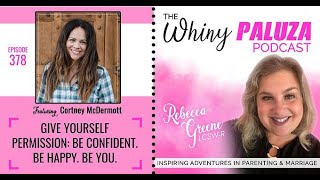
This content was created by Rebecca Greene. This content was uploaded by Rebecca Greene. This is a YouTube podcast episode titled "Episode 378: Give Yourself Permission: Be Confident. Be Happy. Be You." (created 2024-09-20). It contains an English interview-style conversation hosted by Rebecca Greene with guest Courtney McDermott. The discussion covers Courtney’s background (bestselling author, TEDx speaker, mind-body expert, LSE graduate, international living and corporate experience), her book Give Yourself Permission, and themes of confidence, trust, reframing limiting beliefs, practical techniques for increasing joy and mental clarity (movement, shaking, yawning, relaxation), and parenting by example. The excerpt reads like a diarized interview/podcast transcript.
Chapters
Hello everyone, this is Rebecca Green for the Whining Fluza Podcast, and I am super excited today because I get to talk to the fabulous Courtney McDermott. Courtney, thank you so much for doing this with me today.
Thank you, Rebecca. I'm excited to be here.
I can't wait to tell you about her. I've been reading about her and she is an exciting lady with quite the resume. So I'm going to give you a brief overview of some of her greatness. So Courtney is a bestselling author. She's a TEDx speaker, mind-body expert with a Master of Science from the London School of Economics. How cool is that? Her work in the field of self-development and business strategy has been featured in Inc., Women's Health, Success, the Huffington Post, Fox News, and many other mainstream business and lifestyle media. Courtney's career highlights include her time as an executive at Vanity Fair Corporation, Vice President at Sustainability Partners Inc., and then running her own businesses with clients and audiences at Universal Music Group, Google, Nike, and Virgin Unite. Courtney speaks 4 languages. I want to hear about this. And she lives between Italy and the US. I have never even been to Italy, and you have lived there. Like, oh my goodness.
You have to go. You have to go. Everyone has to go to Italy.
It's on my list. It's on my list. I said to my kids, I have 3 kids. I'm like, let's go and explore and go to London and Italy and Paris. And they're like, eh. And I'm like, you guys are nuts.
They are nuts. Yeah, you got to go.
Oh my gosh. Well, you have quite the resume and there's so much I want to talk to you about, but I've been hearing about this fantastic book that you wrote. So let's start there and let's start with what inspired the book, Give Yourself Permission, and what messages do you hope to convey to readers?
So Give Yourself Permission sort of came as a download of sorts. It was like this. I think it had so much to do, though, with the fact that the people I'd been working with, especially really high-performing women, were always struggling with giving themselves permission. Yeah. And they were also struggling with, like, the subtitle of that book is, um, you know, be, be free, be confident, be you. They were really struggling. I saw, and I had been too in so many previous versions of myself, with how to free myself, how to liberate myself from so many of the constructs that we live in, that we operate in, and that we put on ourselves, especially as women, especially as moms. And, um, so it was, it was a lot about that liberation and also about confidence. That's been in the subtitle of both of my books actually, because of the fact that I see so many people and you would be, I find lots of times I'm really astounded by the people who have, uh, crises of confidence and, um, they're, they're at the highest levels of their game and you would think they're the most confident in the world. But what I love to, I love to kind of dispel the myth about confidence being out, you know, a person who's outspoken or a person who can, you know, do all these things. Really, confidence, it comes from the Latin confidere, which means with trust or with reliance. And so really it's about, do you trust yourself? Do you trust the world? Do you trust others? In other words, it's a little bit like Einstein when he was talking about your most important decision is whether you live in a friendly or hostile world or universe, right?
Wow, that's profound.
And so the book just came from this desire to really, um, dispel a lot of those myths and create a much more solid foundation for people to feel that real kind of confidence and freedom.
So I think what amazes me from what you've said is that there's people in high-power positions who do not feel confident. So, I mean, can you talk about that and why that would be? Because that's surprising, right?
Well, I think it happens at all levels, obviously, but the trick is it's all around trust, like I was saying a minute ago. So it's really funny to me when I started realizing that, hey, this went for me, this goes for all of us, I think, or most of us, is We trust in 99.999999 whatever some odd percent of what's happening both within us and outside of us, right? We have to. We wouldn't survive if we didn't. So if you were questioning the trillions of biochemical reactions that are occurring in your body every second, and you were wondering if you needed to create a 5-year plan for all of that to stay on track, you'd be in a heap of trouble. Right? In the same way about your heart beating, or if you went to bed at night and you thought, is the sun going to come up tomorrow? Is it not going to come up? Is it going to come up? Right? You trust that the planets are going to continue on their rotations. You trust that these infinite, as far as we can tell, solar systems are going to keep doing whatever the heck they're doing.
Right?
We just trust. And we don't actually— we don't even think about it. So it's a default trust. It's pure faith. And then we take this infinitesimal part that's left over, right? This tiny 0.00000 whatever, 1% that's left over. And we say, not that. I've got to create— I've got to force a specific outcome there. I have to make the relationship work. I have to do this. I have to do that. This other person should behave in this way. That thing should be going that way. If it's not, then the sky is falling. And usually the funny thing is that the higher up people get, the more they insist on this illusion of control.
That's true.
Not everybody, but a lot of high performers will be like, if I don't get it right. And that is the trap. Or as Shakespeare put it, therein lies the crux. Because the more you become like that, the farther away you get from the truth of who you are. And the more scared you become and the more your life becomes about a specific outcome, be it material or otherwise, and the less you get to live every moment, every passing moment in joy.
I am amazed at the people who are sent to me and the messages that I'm supposed to hear. I mean, that was perfect for me for so many reasons, but I want to talk about you because you have been on this journey of hopefully giving yourself permission and gaining more confidence. And you have said you have been many versions of yourself. So can you talk to us about the evolution?
Sure. I, you know, it's funny, I just heard a song. I think it was 3 days ago, 4 days ago. I really like Trevor Hall's music. I don't know if you've ever heard it, but Trevor Hall, and I guess maybe he's married to this Emory Hall. I don't know. But anyway, he did a They did a series of tracks together, and one of them is she's saying something like, I've been 1,000 women.
Yes, I feel that way.
And I have been reborn from the ashes so many times. I mean, right now, actually, my daughter and I are just in the process of this huge move. I was living in Italy for the last 23 years. I was living in France before that. I was living in London, England before that. So I've been out of the States for over half my life. I mean, I travel a lot here for work. A lot of my clients are here and on the West Coast specifically. But we just made this humongous life transition where a lot of the previous version of me had to die to awaken to a new version. That's the version over here. And it's so funny because the more you do this, even just in micro installments, you know, because sometimes people are like, well, I'm not going to— I can't just drop everything. No, you don't have to. There's this beautiful— I love it. It's been attributed to Warren Buffett, but he says, don't test the depths of the water with both feet. You don't have to dive into change. I've done it lots of times, but you don't have to. It's those incremental changes that are actually creating a new you every day. And so all these versions of me, I mean, I was a corporate executive. A lot of what you said at the beginning, I remember my first book when I wrote it, I coined, or I think I coined because I had never heard it before, the expression miserably successful. Because I had all the things, right? I had all the things. I had all the titles, all the accolades. I had, you know, reached really amazing heights in academia and then in the corporate world and just all these things. And I was married and I was a marathon runner and I was all the things, and I was so miserable. And there's this point where, um, and I wasn't, you know, always miserable because these things would give me a momentary high, but the high wasn't a real lasting joy-filled, like, wow, everything that's come thing is just a gift. It was— if I don't, like I said earlier, if I don't get that thing, I can't be happy. And in our society creates this— it has created and it continues to reinforce this very destructive narrative, which is without that, I can't be good. And so we never look for that peace. That's an inner peace and inner knowing and inner stability and inner drive and inner motivation and inner love and joy, we, we sort of say, well, I'm not going to go to that treasure house. Instead, I'm going to keep looking outside to try to find some, you know, pick up some diamonds on the path. And you've got all of it in you, right? And we know that from all our greatest spiritual traditions, we know this. And yet, for whatever reason, you know, it's like that saying, the best place to hide, you know, God is in the human heart, because no one will ever look there. You know, and it's like you get these glimpses, and anyone's listening, anyone, you know, who's— we've had these glimpses. And what I'm talking about is just live in it. Like, not a glimpse of, wow, this is so spectacular, but to really just go into, to dive into that richness within you. And so all these versions of me, to come back to your question, they've all been a coming closer and closer to that and an uncovering in the process. Like, okay, how does the person, how does the, the character show up in service to that? And I can talk more about that if you want, but yeah.
I'm learning so much.
You know, it's so funny.
I am always doing this to help listeners learn, and I forget that I learned so much too. I mean, you're teaching me so much. And my husband and I have had so many conversations lately about material things that we thought that we needed or wanted, and that, that's really not what this journey is about.
Mm-hmm. Mm-hmm.
So we have to back up to something that you said. You said that you lived in France, right?
Mm-hmm.
And Italy.
Mm-hmm.
And now you're back in the States, but let's back up to, okay, so how did you end up living in France? And Italy, and tell us what you learned from that experience, because that's amazing to me.
Okay, so I— wow, all right. I finished my undergrad work when I was really young, so I was 20 and I was done, and I had, I had, um, I had done all sorts of additional programs like university honors and, um, departmental honors and a thesis, thesis and all these things. But I was so young, and, uh, I was supposed to go on to do some other things over here, but instead of I said, you know, I want to go, I want to go to Europe. And so I applied to some schools in England. I applied to Oxford and I applied to London School of Economics. And I really had my sights set on London because to me London seemed like that's where I want to be. And, and they accepted me. And so I went and I did my— yeah, I did my— they call your postgrad work there. And I also finished that program really early. So I was sort of I was sort of ending that program. And as I was ending that program, I met my husband-to-be. So we met. It was really funny. He actually didn't speak English at the time. I didn't speak Italian. We met at a mutual friend's house. And then he just wouldn't— he didn't give up. He was very persistent. But he actually didn't even live there. So he just kept coming back. And we were married 9 months, actually, after we met. Not because of any reason other than and just that's just how it worked out. Because I moved to France, I finished my dissertation work in France, and then I moved— well, then I came back to the US for just a month, I think, or a month and a half. And then I moved to Italy to live out my life with him. And it was really fun. So we were married for 18 years. We had a really good run of it, and we have a beautiful daughter. And yeah, we just, we, that my whole life, like I said, changed so many different ways. I mean, when I moved there, I was out in the middle of nowhere. I mean, they, they called, they had a saying, uh, they say un posto dimenticato da Dio, which is, uh, not so nice, but it says a place forgotten by God. And, um, there's this other saying in Italian, they say chi vuole soffrire le pene d'inferno, Trento d'estate, feltre d'inverno, which means if you want to suffer the pains of hell, you go to Trento in the summer, Feltre in the winter, and I lived in Feltre. So, you know, coming from Chicago, I was like, no, another winter. Um, yeah. And then, uh, but it, you know, it was a beautiful— it was so many blessings to be there, to live that life, to have a different, totally different perspective on so many different things than I had had growing up in the States. But it's really funny because now coming back to the States, it's like every single thing is different, everything. From, you know, how I drive my car because I drove a stick shift there and it was like everything's automatic here to even things like how the dishwasher works or how, you know, whatever, how the dryer works or I don't know. I didn't even have a dryer until about 4 years ago. I didn't have a dryer or a dishwasher until 4 years ago. So I went 20 years without those gifts. But anyway, yeah, so that's a little bit of that background. It's a huge— it's so many lifetimes packed into those years that I don't know where you want to take it, but that's a little bit. What a story.
I mean, you sound like a high achiever to me. I—
wait, go ahead.
No, I was gonna say you graduated early from your programs and just decided that you wanted to go to London. I mean, that's just not something that I would just do, so I'm impressed.
Thanks. Yeah, you know, it's funny, I used to literally be— consider myself a very high achiever, and funny now, I feel like things— you, you do what you are. And so it's really about becoming those versions of yourself. And the more you become them, the more— there's something called the law of least effort. And so the— it's the minimum amount of effort in with the minimum combined with the minimum amount of time. And so it's really becoming the kind of person who like, yeah, it seems like, wow, that's so much, but actually you don't really feel it that way because there's so much, I guess, this life force energy that kind of leads, leads those activities, if that makes sense.
It does make sense. It just, it's making me think about my advice to my kids, and I think you're going to like this, but I keep telling them that I want them to go on a path where they find a career that does not feel like work, something that draws them, something that they're passionate about, something that they want to go do every day. Because there's so many people who are like forcing themselves to go to work. And I feel like if we're in touch with who we are, what our passions are, then it shouldn't feel that way.
It's such good advice to say find what you love. In fact, it's one of the chapters of my last book is permission. Give yourself permission to do what you love.
Yes.
Because if you're filling your days with something you don't love, it will be hard. There are days I personally I love what I do. I mean, I love— I couldn't love more what I do. And there are definitely days where it feels like work. There are definitely days where it feels like, holy moly, this is a tough one. But it's that love that gets me through that toughness. So it's not like, you know, there's that— I think it— I don't remember who it was. It was like Zig Ziglar or something who says, you know, you'll never feel like you worked a day in your life.
Right.
But I felt that way. And yet I feel very on purpose. I feel very— I get so excited about just, like, nothing. I'll just get so excited. I was saying this in an interview shortly before leaving Italy. Sometimes I'm so excited at night, I can't get to sleep, like a little kid. And I'll be excited about random stuff, like making my little mocha coffee pot in the morning. I'll just be so excited that I get to do that.
Oh, I love that.
I mean, I'm on some major stages all over the world. It's like, that's not the thing that is exciting me. It's like, oh, my gosh, I just moved to this place, and I've got hundreds of hummingbirds that are just all over the place, and I lay in this hammock and it's these hummingbirds just coming so close to me, and I'm thinking, how is this possible, right? It's so amazing. So it's just, it's really reveling in that rather than— so because I think we get trapped in like, it has to be this way or whatever, or we hear a lot of these clichés, and it's— while it's true that clichés are clichés for a reason, it's really important to find your truth. Within that, you know, kind of that, um, maybe an ethos or something, but where does your truth lie in that? And that's where you start to come into your own and more and more and lead from that place.
Well, and you might have just answered my question. I mean, I guess what I'm seeing from you is you radiate the word joy.
Mm-hmm.
And, and joy is what I think we're all seeking. I think everybody just wants to feel joy. So to the listener struggling, she is not feeling joy in her day. Can you give her some advice?
Yes. Oh, gosh. I wasn't feeling joy yesterday.
But you're feeling it today.
So it's so funny. And it's really funny. I had an interview scheduled yesterday, and it just— I don't know what happened. The host didn't show up. And I don't think that's ever happened. And I've done hundreds of interviews. And I thought this, see, this was exactly divinely perfect because I was in a little bit of a funk. Interesting. And so I think looking, you know, looking at other people, sometimes we get the impression that they don't have their struggles, right? So it's a little bit like, oh, you'll, you won't feel like you've ever worked in a day in your life. No, you will. You're going to have that. And it's so important to just, for me at least, to say, Whoa, timeout. Let me get with this. What is this revealing to me? Let me dance with it. Let me move with it. Let me cry with it. Let me sit with it. It's okay. It's okay. I don't have to be like this. I don't have to be like that. I can be fully in this emotional expression. Now, here's the thing. We have the tendency to over-identify with an emotion or a thought. And I really dive deep into this in my second book. I mean, my second book is very— it's so simple to digest, but there are so many things in there that give you a lot of really practical tips too on this, which is the— your thoughts, right? So most people think, well, oh, I'm thinking this way and I shouldn't be thinking this way, or whatever else. Okay, we need to drop that because a thought is nothing other than an electrical impulse. That's what it is, okay? It's an electrical impulse. The bizarre thing is, with all of the advancements that have been made in neuroscience, we do not know the origin of a thought. So you cannot point to a part of your brain like the prefrontal cortex and say thought originates there. We don't know. What we do know is that the vast majority of humans are thinking somewhere between 50 to 70 thoughts a day. And for most of those humans, those are the same thoughts every day. Oh, it's time to get up. Hold on, let me hit the snooze button. Oh, let me hit it again. Oh, let me do this. Oh, now I have to go take a shower. Now I have to go make the coffee. Now I have to whatever. And it's funny, they actually did some studies on this. I don't remember when, and I can't recall the origin of these studies, but I'm sure looking them up you could find them, which is that you could literally superimpose most people's days one on another for a year, and it would look like the same day. And then you wonder how your life got molded into that. So we got to kind of find ways to start, um, to start one lessening, lessening the thought stream, but also choosing the thoughts. This is an arduous— this is very— most people will never undergo this kind of work. It's very— it's, it's not so difficult, it's not so easy. But the easy, the easy solution in the meantime for someone who's really struggling is get physical. So the fastest way for you to change your mental state and the thoughts is to get physical. And sometimes people don't really underestimate this, but if you think about any time that you were struggling with something and you went for a walk and got back and you said, even if it was just a walk around the block, and you're like, oh, I feel, I feel better. Why? You increased the level of oxygen that your cells were receiving. You, you started to clear out some of the gunk. That's the key. That's the key for anyone listening. You got to clear out the gunk. Imagine you had a house full of crap. You've got to clear it out. And that means taking it bit by bit. But I promise you, sometimes it'll feel like, oh man, this is never going to get clean. And other times going to be like, whoa, that, that corner, I just cleared away that corner. That thought pattern that was there isn't there anymore. Wow, my house is getting cleaner. Acknowledge those victories. But like I said, the physical— one of the things I do that I love, that I constantly tell people about, is, um, shaking. And I learned this, uh, from a practice called Koya. The founder, Rochelle, when I was— I took this retreat, I had this retreat with, um, this Koya retreat in the south of France, uh, few years back. And one of the things she said was So she had us shake one hand, and anyone listening could do this. So you just shake it really vigorously while, you know, she's telling this story. And it's a really powerful exercise. You might wanna try it. So it's like you just shake one hand as fast as you can. And she told us a story about a gazelle being chased through the wetlands by a tiger, but the gazelle gets away. However, the gazelle does not go to therapy for the next 10 years. About this time that the tiger was chasing her through the grasslands, what the gazelle does is she shakes through every part of her body, releasing the tension, releasing the fear, and goes back to being a gazelle. When I first learned this practice, I couldn't shake parts of my body. That's how much stuck, stagnant energy was in my physical body. So now I can shake like I'm, I'm like a little— I mean, I don't know, like a little rubber flimsy rubber something, I don't know. But, but at that time I couldn't, and I had so much pent-up energy, and I just like wasn't able to, to release it. I had a lot of trauma in my past, and I just held it, could hold it in our bodies, like that book The Body Keeps the Score, which I haven't read, but I love the title. It does. And so it's like releasing a lot of that is so hyper important if you're going to start to feel better. And it does take a bit. And I I would love for people listening to say, well, I try, you know, I, or, you know, you hear this, I tried, I tried for a couple of days. It didn't work. You got it. You got it. You got to realize how long it took for you to get where you are.
Yes.
And I promise it'll take a lot less for you to start shifting that if you just give it the space it needs. We need to give it the space it needs. So that's one of my highest, quote unquote, technique. I have a lot of other things that I would recommend, but that's one of the major ones. There's one other that I, I feel really called to say before, because it's so important and it's so hard to get, but if you get it, if you get it, you, you will really— there's so much here, which is relax. And it's so hard to hear that when you're not relaxed. It's the hardest thing in the world to hear when you're not relaxed, but it seriously the most powerful thing you can do. And it— because it allows you to just seep into that trust more and more that we were talking about the beginning. And all you have to do to relax— there's two ways that you could do this that are super easy. One is yawn. Just yawn. Start yawning. Set a timer for 30 seconds and yawn. What happens when you yawn is you actually send a message to your vagus nerve that you're safe, that everything's okay. It's also— yawning is considered the best-kept secret in neuroscience because it energizes and relaxes us at the same time. Yawning gives you a whole new kind of outlook. In fact, they also suggest doing this with— in partnership or with your kids, because yawning releases a lot of oxytocin, which is a feel-good hormone that is usually— we get it when we cuddle. That's why it's commonly called the cuddle hormone. But you can get this in yawning. A very, very powerful relaxation technique, one that unfortunately we were taught not to use but is built into us for this precise purpose. So yawning, and the other one is just get horizontal. And I know this might seem tricky sometimes, you're like, I can't lay down. Lay down for 2 minutes. If you say you can't, lay down longer.
Lay down longer.
It's like the Dalai Lama who said, if you think you don't have, you know, 20 minutes to meditate, meditate for an hour, you know, or something like that. If you think you don't have time to lay down for 2 minutes you need to lay down for 10 or 20 or 30 or an hour.
That's really, really good advice. I can't even tell you how many people are going to listen to this who need to hear what you just said. That is so true. And I hate when people say that they don't have time for something because we make time for the important things. And this is important.
Mm-hmm. Yeah.
Yes. Yes.
Yeah.
Oh my gosh. You've said so many things that, you know, it's so funny. You're talking and I have a question and I have a question. I have a question. But, you know, I wanna go back to your book because you have so many things in your book that I want to highlight for people. And I know that you talk about reframing limiting beliefs. And I think that, you know, like when we brought up the words, I can't, or I don't have time, there are so many limiting beliefs that we have throughout our day. So can you speak to the challenges that you're seeing people face and how your book and you help them with that?
Sure. So what happens is lots of times what you're seeing when you think I can't is what I call a calcification of the persona. Okay? So if you actually look at the origins of the word person, it comes from persona, which were the the Greek, which were the masks that they wore in ancient Greek theater. If you sit with the profundity of that definition for even a minute, if you literally, if you contemplate that for as, as long as a minute, your masks will start to fall away. You are not the character you created. You are not. But you keep trying to reinforce that character because it gives you some semblance of safety. In the unknown world that we are all in, surprise, surprise, you have no idea what's gonna happen. Second to second, day to day, you don't know. You think you know, and you think everything's gonna continue this way, but it's not. And you try to get everything to continue this way for you to feel kind of safe, but it's not. It's not ever going to. There is the maxim, the only Constant is change. And I find that absolutely stunningly, in its simplicity, stunningly profound, which is the only thing we can know is that we don't know, or the only thing we can depend on is the constant evolution of things. You know, it's funny, we think a relationship's gonna stay this way. We think it would, and we do everything we can to get it to do that, which is crazy. So we say, but it's like this. And by the way, every time we say it's like this, like for instance, if we say I don't have time, there's a part of our brain whose sole function is to find the corresponding answer to that, uh, belief or that question and to re— and to just bring that up to your awareness. It's its job and it's called the reticular activating system. It's this part of our brain that functions a lot like Google, only it's infinitely more powerful. And so you, you put something in, you get give it some input, and it just has to take from all of this gargantuan amount of data that you're exposed to, it's going to pull out those pieces that match your predominant beliefs or thoughts and questions specifically. So I am very clear about how to start shifting that in the book. But one of the things I will say here is the questions you're asking yourself, this is why they're so important. If you're asking yourself the question, why are there no— why don't I ever have any time? Why are all men like this? Why? How come I can't lose the weight? Whatever it is. And if you pay attention and if you have the courage to let some other people around you tell you what your questions are, because a lot of your good friends will be listening and think, oh, man, she's on about this thing again, or whatever. And they won't actually say it to you.
Oh, goodness.
But if you get them to, you know, and you tell people you love, look, I'm, I'm invested in kind of seeing if I can change this character. Let me go back to that. It's so profound and so important. The minute you start realizing you're playing a character is the minute you can put your inner knowing and that, that intelligence, you have an intelligence coursing through you and you can give it whatever name you want, but it's the same one that's beating your heart, that's conducting the trillions of biochemical reactions that occur every second that I mentioned a little earlier. Okay, it's that intelligence. When that intelligence within you is in service to the character and not the other way around, where you're trying to force the intelligence to serve a character, but instead you let the character serve that, then you start to realize Oh wow, I'm actually not the character. And that's when you will start to be able to play any character you want. And you will be able to move around, dance around the stage, and really be like— or even exit the stage. You know, Castaneda talked about that a little bit in his work, or a lot in his work. Is it— I didn't use those words, I— and I'm not as familiar as I'd love to be with his work, but this idea of like just, I think he said, exit the, the mansion altogether. There's all these rooms that you could explore, and then you could just leave the mansion. And, um, I've had so many experiences like that in my life that have, um, been so profound of really recognizing like, this isn't what you are. And that allows you to enjoy this, you know, this whatever the character is doing. You're like, oh, that's so funny, look, that's so, that's so entertaining, that's so great, um, what that character is doing. And yet I'm not that. You know, I'm not that. I'm consciousness expressing itself as that.
I'm, yes, yes. I mean, I'm thinking about people. I'm thinking about examples as you're talking.
Mm-hmm.
I mean, the goal is, is to help everybody listening. And I know that you speak to confidence. Confidence is huge in so much of what you're saying. And having the confidence to change, having the confidence to know that you can change your thoughts. And I think that as a mom, you know, what, what you and I want is to instill confidence in our children. So knowing what I know now versus when I was a child and lacked confidence, you know, you wonder how you went on that journey to gain it. So So I know we need to trust, but there's, there's so many people who do not. They don't trust themselves. My kids, you know, my kids don't always trust themselves. So how, how can we help them to move along in this journey?
I love that question. And, um, and it's definitely one that I consider every day with my own daughter. And I think the biggest thing you can do for your children is to be it. Yeah, you have to be it. I can't talk to my—
just made me cry. That's so true.
Right, right. I mean, I can't tell her, oh, you know, be confident and just trust in whatever, if I'm not living my life that way. If I tell my daughter, oh, you know, don't smoke, but I smoke If I say don't drink but I'm guzzling down, you know, a couple bottles or whatever, like, I can't say, oh, you shouldn't do those things. Look, our job, as far as I can tell— and parenting is the, is, is the only job that we don't get a manual, we don't get instruction, and we don't get, uh, we don't get titles. I mean, can you imagine? There's pretty much any job that you have, you can perform, you got to do some sort of training. But for you know, parenting, all you hopefully need is just two consenting adults, right? And so we, we are— parenting, I think, is something that requires so much study. So I'd be very, you know, careful to offer any advice, and this is not advice per se, but it's rather what I've noticed as a parent is that I have to be the thing I'm talking about. And it doesn't just go for parenting, it goes for everything. If I'm trying to tell you how to do whatever, but, um, I haven't become the kind of person who's able to do that, then my advice is never going to quite hit the mark. There's something about it that's going to seem a little bit off to you. You might not understand exactly why that is, but it's going to seem off. So the number one thing I think as a parent that you can do, and not just a parent but as a human, is look at yourself. Go within, look at yourself, keep going back, look at yourself. Do not look at them. Do not look at them. You know, people say all the time, I hear this thing like, you made me whatever. Um, you know, someone like you, you know, whatever. And Eleanor Roosevelt put this so brilliantly. She said, well, I'm paraphrasing because she said, no one can make you feel inferior. I say no one can make you feel anything without your permission. No one can make you feel anything without your permission. And your kids are reflecting back to you what you probably need to look at in yourself if it's upsetting in any way. And that's hard to hear, but it's the most profound if you will take it on in an open and unchallenging way, and you will dare to go in those places where you have to look. You will be confronted with some real magnificence because it's only in doing that work that not only you can change, but what you're seeing around you will start to change and you will be informing the field by how you have as a particle changed. You know, Einstein has— is really amazing. He said one of the most profound things I ever learned from his, um, from his work was, um, he— the field is the sole governing agency of the particle. And I used to think that that meant that your environment was shaping you. And while that is true for the vast majority of, of of humans and life forms in general, there is a point where your field, the inner field, is informing everything else. And I think that's really, if I look at his work and the evolution of his work and where he was going with that last theorem about the unity of all things, I think that's what he was going to, is this, the microcosm affecting the macrocosm. And I'm getting a little too, maybe, um, not really esoteric because it's very scientific, but, um, it's so profound when you realize, like, Oh wow, the only way to change anything in the body is to work on the individual cell that's, that's unhealthy. And once I get that cell into a place of optimal health, it's going to start affecting the cells around it. And that's your job, as far as I can tell.
Such good advice. I mean, you have so much wisdom to share. I think my mind is like, I have taken notes. I always laugh at myself because I have access to this to listen to it whenever I want. But I process taking notes. So here I am taking notes.
That's great. Well, there's so much power in writing. That's wonderful.
Yeah. So, okay. So for someone who is starting their journey, they wanna be more empowered, more confident, journey to self-discovery, tell them where to start today.
Because I don't need to push my book at all. I really don't. But both of my book are— books are bestsellers. They're available everywhere and all over the world. But I really do think that those resources, and I speak from my heart, like, those resources and those— what's in those books is how I came where I am to become who I am. And I do think that that's a great resource. But even if it's not those books, find something that really resonates with you and put all your attention on it. You know, really go deep. Don't be one of those superficial, oh, I read a book and I'm going to read another book, and now which— what should I I move on to next and all these things. No, go deep until it becomes your own knowing, not something someone else told you, but your own knowing. That's what I suggest in that second book specifically, is like, read it to a point where this becomes yours, because it is yours. This knowing is in you. It's this, like, this beautiful line from Ram Dass, aka Richard Alpert, when he said, um, I'm not going to tell you anything you don't already know, but the perplexing problem is you don't know you Oh, yes. And so our journey is one of remembering the truth and the power and the wisdom and the joy that's within us. And so if anything is pointing out there, it's missing the mark. Anytime anyone says, oh, just do this 5-step whatever to whatever, no, I call no. Instead, go keep going in. It's not the easiest work in the world, but it is the most rewarding.
Well, I mean, we know that your books are amazing resources. Can you, can you tell everyone where to find you, where to find your books? I mean, I, I need to read these books.
Thank you. Yeah. So the, um, so my books are wherever books are sold. My name is Courtney without a U, so that piece is important. So if you look up Courtney McDermott, you wanna, you wanna use Courtney without a U. So C-O-R-T. We also have the short URL for the website, which is C-O-R-T inc, so courtinc.com, and you can find some additional resources there. We actually— things are moving so fast that a lot of what you find will be through researching different podcast interviews and different things. But the book is available everywhere books are sold. It's in Amazon, Barnes Noble, iTunes, and the audiobooks, which I finally finished while in the middle of this new move. They're coming out very, very soon. The, the fir— the second book is going to come out first, and I'm so excited about it because I had been really dragging my feet, and the publishers were like, no, we need this within the next however many weeks. And it actually corresponded to the time that I was moving from Italy to the US, and I was like, how am I going to do this? But I got my butt— because I wanted it to be my voice, I wanted to transmit my energy into the work, and so I got my butt into a studio every day until those audiobooks or the files were completed so that the second book, which is— I'm so excited for this audio to come out. We're gonna be doing a big kind of, yeah, announcement series around it, but it's coming out. I think it should be out either toward the end of August or the beginning of September at the latest. It might even be out a little sooner than that because the files are ready. We're just getting a lot of other permissions granted. So, yeah.
Well, I mean, I will certainly share this with everyone who follows me because I know that I'm not alone when I say that I tend to be a mommy taxi. I joke about it almost every day when people ask about my day. And so my newest love is audiobooks. This is new for me. So this is gonna be perfect on my journeys in taking my children to all the places. But I mean, I can tell that you have just so much wisdom to share with this universe. And I just so appreciate that you took some time to share with us.
Thank you, Rebecca, and thank you so much to everyone who listened. I love what you're doing. I'm so excited there are people out there like you and keep going.
Thank you so much. This is Rebecca Green, and I wanna remind everyone to spend every day laughing, learning, and loving. Thank you for tuning in to the Winey Palooza podcast. If you like what you heard, please be sure to subscribe so you never miss an episode. While you are there, leave a review.
I love to hear your feedback.
Thank you so much for listening. Until next time.
This show has been produced by Market Domination LLC. To discover how you can have your own show completely done for you and turn it into a real published book and become the authority in your marketplace, go to www.marketdominationllc.com. Podcastoffer.com. 49 faces looked to him in triumph. Over the last 12 months, they had each taken turns and promoted his business for a week at a time, driving over $987,342 in revenue. What if you had a network of 50 centers of influence who promoted your business every week for a year? Grab your copy of the number one Amazon bestselling book, The Ultimate Guide to Growing Your Business with a Podcast, at 33% off the Amazon price. By going to ultimatepodcastbook.com. Again, that website for 33% off the Amazon price is ultimatepodcastbook.com.










