Episode 433: The Art of the Juggling Act
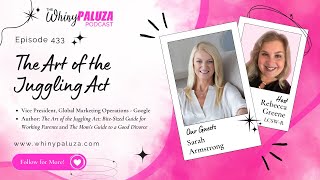
In this Winey Fluesa podcast episode, host Rebecca Greene interviews Sarah Armstrong, Google’s Vice President of Global Marketing Operations and author of The Art of the Juggling Act: Bite‑Sized Guide for Working Parents. The conversation explores why the book was written, defining “balance” as an ebb‑and‑flow rather than a static state, and how to move from surviving to thriving as a working parent. Sarah shares personal anecdotes—including navigating a divorce, turning down a promotion, and creating “Grace time” on her calendar—to illustrate the importance of setting boundaries, protecting personal time, and building a “compartmentalization muscle” that separates work emotions from family moments. Practical tools are presented: intentional family traditions such as a yearly birthday‑question list, a three‑piggy‑bank system (spend, save, give) to teach children financial literacy, and strategies for managing technology (the “cupboard” concept). The dialogue also covers building support networks (nannies, friends, community), prioritising self‑care (weekly massage, Pilates, walks), and debunking myths that working parents have it all. Sarah’s hope is that listeners take bite‑sized, actionable guidance from the book to create a fulfilling, balanced life, and she directs listeners to her website thejugglingact.com and various book purchasing channels.
Chapters
Hello everyone, this is Rebecca Green for the Winey Fluesa Podcast, and I am so excited today. I have been looking forward to talking to this fabulous lady. I'm going to tell you all about Sarah Armstrong, but first I want to thank you so much, Sarah, for being here with me today.
Oh, Rebecca, so great to be here with you. Really looking forward to our discussion.
We're going to have such a good discussion. It's going to help to so many moms, so this is gonna be great. But let me tell you about her and why she's so impressive. Sarah Armstrong is Google's Vice President of Global Marketing Operations. I had to read that a few times. She is the author of this fabulous book. If you're watching, I'm holding it up. It's The Art of the Juggling Act: Bite-Sized Guide for Working Parents. She has also written The Mom's Guide to a Good Divorce. She's a working mom herself. She shares practical strategies to help parents manage work, family, and self-care without the pressure of perfection. Sarah has been featured in over 75 media appearances offering relatable, actionable advice for parents juggling it all. And don't we all need help with that?
So It's not called The Juggling Act by accident. That's—
oh my gosh. My producer told me about your book and your topic, and I said, sign me up as quickly as I could because we all need help with this. But I really want to ask you, in all of the things that you're doing, your life is so busy. What inspired you to write this book?
It's interesting because I step back. First of all, my daughter's now 22. OK, so I've had the benefit of raising her, and now she's about to graduate from college and off into the world. But over the years, I've talked to so many colleagues and peers, and this topic of how do you juggle the day-to-day of being a working parent and trying to have a career is just such a very real dynamic for so many people. And over the years, I reflected on the fact that we learn a lot about different topics in school. You know, we do not learn about parenting in school, right? We do not learn about how to manage our career in school. And then we do not learn about how to manage these aspects of our life, two of the most important things we're going to do in life, and how we really want to do them well. But we've never actually had any formal training or schooling in this. And so I think the other part is, how do we do it where we're both healthy and happy doing both. Right, Rebecca? So that's my goal. My goal is to pay it forward to the next generation of working parents who I'm watching, you know, on a day-to-day basis try to figure out the juggling act every day. I work with a ton of young working parents. And I just want to make— I want to help them to shift from surviving, which I see some of them are surviving, versus to really thriving as working parents. So that's really the reason I wrote this book.
I had so many women tell me they're just trying to get through the day, and that makes me so sad.
I would agree. I would agree. And I see that. I mean, I see the just— it's almost a deer in headlights, like, oh gosh, okay. And, you know, every day— I mean, as you know, as a working mom, you know, every day there's going to be a curveball thrown at you. That is inevitable. You know, whatever it is, either work or something happens with your kids, or, you know. And so it is really a day in and day out challenge. And, but there are ways that there, I do believe, and the reason I wrote this book in the way that I did with these bite-sized pieces of guidance is I do think if you can take it down to bite-sized pieces of things you can do very pragmatically, very practically, I think you can shift from that feeling of, you know, hanging on, you know, hanging on for dear life each day to actually saying, you know what, I'm going to try to enjoy this, this journey, this ride that can be a bit of a roller coaster, but I think it's meant to be fun.
Yes, that is the goal, for us to have fun and try to enjoy the journey and not survive the journey. Exactly.
Exactly.
So, so there— I mean, I have so many questions for you, it's hard for me to even— like, if you saw the list, you would laugh over here. But we have plenty of time.
We have plenty of time.
Let's start with the fact that I don't know that people know what balance actually means. Can you talk about maybe your definition?
Yeah, no, it's a great question. And I think balance can be a bit of an elusive concept for people. And from my standpoint, I think— I actually think balance, it's more of when you're— I use the analogy that if you're standing on a platform that's constantly moving, Okay, so it's never going to be completely static, you know, where it's just completely level. Your life will never be as level and balanced as you'd want it to be, but it's actually the ebb and flow and managing the ebb and flow that I think is what balance is about as a working parent. And so, you know, one thing is going to be kind of pulling you in one direction, another thing's being pulling you another direction, and it is how you manage that that ebb and flow and that pull that I think is what balance is all about. And so I personally, you know, have looked over the course of my life. Now, by the way, there's times when it can feel like you're so out of balance, like the ebb and flow is off, you know, and in recognizing that and actually naming it and saying, no, this is, this is not how I want to be, you know, managing the day-to-day. It's okay to say that. It's okay to acknowledge it. But then it's like, how do you get back into the ebb and flow that actually feels appropriate for what you're trying to juggle each day and what you're trying to balance.
So, you know, I don't want to put you on the spot with this, but as you think about your life and trying to balance everything that you had going on, can you give a concrete example of you feeling off balance and how you rebalanced?
Absolutely. You know, I think probably one of the best examples is when I was going through my divorce. And I really needed to focus on what was going to be the best for Grace. She was front and center, as you know, and also how I was going to reshape my life as a single working mom, which was never the goal. But then I also had my career, you know, and I had to quite honestly make some tough decisions. I actually passed up a promotion during my divorce process because I said, you know what, I can't do that right now. I can't take that new responsibility on you. I appreciate the, you know, confidence in me, appreciate that, but that's— this is not the time for me to do smart, you know, because I needed to be there for Grace. I needed to figure out what this life looked like. And I knew that if I tried to take on that new challenge while I was doing that, something was going to break, you know, and not break in— quite honestly, it would probably be more on the personal side than the professional side. And that wasn't worth it to me, you know. And that's— so I think that's, that's probably front and center, an example that I really lived through. And it wasn't you know, a week or a month. It was over the course of time that I needed to rework what that day-to-day, you know, operating models, I call it, of life was going to look like. And so that was a point where there was probably a bit of imbalance in my life, but I felt like I needed to make the right call for Grace and myself before what was probably best, or best is in air quotes, but what people might have thought would be best for my career.
Such a good example. Some, sometimes it's Sometimes it's not about the career, huh? Sometimes, once in a while, once in a while.
Oh no, I think lots of times you have to think about what, you know, what I— again, I think you have to figure out what's your value system of how you make decisions and then really try to keep that as a North Star as you go through those points in life when you're being challenged on what the right call is to make.
Such good awareness. That was such a perfect example. And I wanted quote you because there are so many good lines. Obviously, I'm going to remind everyone at the end to go get your book, but one of your lines was that balance is different for everyone and we all have to define what it looks like for us. And I really never thought about it that way. Yes.
Well, it's true because if you think about what you're trying to juggle and balance in your life, Rebecca, with you and your 3 children, and I'm trying to balance with Grace, again, different number of children, different career demands, you know. So it is— you can look around and try to compare yourself to others, but I always say, you know what, look at what may define what's going to work for you. And what works for you is all that really matters.
Yes, yes. So, okay, so that's going to take us to the word perfection. So, and it's so funny because, you know, I wish I knew this, you know, 18 years ago before Max was born. So we're striving for perfection. I think some of us have kind of realized it's not possible. Some of us are still going for it. Why do you think it's so hard for us to let go of this concept?
Yeah, it's interesting. And believe me, I call myself a recovering perfectionist. And also I use the term relaxed Type A as another Another phrase I use. So what I would say is because there's this mental model that's put out into society of what we're supposed to be like, you know, as moms in our career and all these things. And there's a lot of ways those perceptions are formed. And I just, I talk about the book that I just don't think perception is not the goal because if you keep that as your bar every day, you're going to feel like you never hit it. Because there's no way with what we just talked about, which is this ebb and flow of life, that everything's going to be perfect. And I used to have a saying, and I still have a saying, I use it often, but definitely over the course of raising Grace and trying to juggle these two important aspects of my life, I tell her, "Mom's doing the best I can." I like that line. And that was my little mental mantra, you know, that I would say out loud to her, you know, in moments when things weren't quite going as planned. And I would say it to myself. Many days, like, you know what? And you, you know, we always tell our kids, do the best you can. You know, that's like, you know, go out and I think we have to say it to ourselves, you know, and allow ourselves to believe that that's okay, that that, that's the bar you need to set.
So instead of telling ourselves to achieve perfection, tell ourselves to just do the best we can.
Absolutely. Yeah.
Yeah.
And I think if you switch that out, that's, then you can say, I did the best I could today. You know, that's, you know, and, and now was it maybe all that you thought it'd be?
Maybe not.
But you know what, that's where we have to give ourselves much more grace. And then we do. And I think that we just set really high— and again, I set very high standards for myself in life, don't get me wrong. But, but I do think there is something about allowing ourselves— and, and that's why I use the term relaxed Type A, because I'm definitely Type A. I'm, I look to be a high achiever, but I have a, I think, a more relaxed view about it than most people would think, given how they would probably perceive me. And so that's one of those things. I think there's a little bit of that perception versus reality piece of it as well.
Well, that's amazing that you've shifted. I definitely have come a long way. I'm still working on it. And I want to talk about a really important concept that you talk about. And I'm going to try to say the word. It's a tongue twister. The compartmentalization muscle. I'm like, you can do it. Just ask Can you talk about what this concept means? Because it's so important.
It is so important. So I talk about the fact that in life we build a lot of muscles. And I actually, I do Pilates and I know they talk about your core muscle and all these things. One of the most important muscles that I think we need to have as both working parents, quite honestly, as moms and as any individual is a compartmentalization muscle. And what that means is that emotions can run high in different aspects of your life. Or, so that's one aspect of compartmentalization. And I'm not saying that you should stuff emotions down and not deal with them, but I'm saying there's time, there's a time and a place for certain emotions to come out. So that's one aspect of compartmentalization. The other is if you're at home with your kids, then building a muscle where your work life doesn't come into those few hours that you get to spend with your kids is really important. And so compartmentalizing out what happened at work or some things you're thinking about. And then flip side is if you're at work, you need to be able to focus at what you're doing in your work. And if there's something that happened in the morning with your kids, or if you know your kids are off doing something at school, that's great. But to have that kind of creep in and distract you from what you're trying to do can also not allow you to do what you need to do in that moment on the work side. So I think there's the emotional side of compartmentalization and there's like almost like the focus. And being present in the moment for what you need to do. And it is a muscle. It is not something I think we're all naturally born with. Some people have it and maybe more naturally inclined to have that muscle in place. But if you don't have it, or if you don't feel like you have it, it's something to reflect on of how would you build that muscle? How would you strengthen it? Because I do think it's one of the, for me personally in my life of this juggling act and also having gone through my divorce, Having this compartmentalization muscle and strengthening over time has allowed me to live both aspects of my life to the fullest and to really be present where I need to be present with Grace in the moments I'm with her and at work when I'm with my colleagues.
Yeah, I mean, I think that a lot of us have really struggled with this concept. And I asked my husband, I noticed, you know, and I don't want to be sexist, please forgive me everyone. I've noticed that men don't struggle with it in my life. What I've noticed. And women struggle more with it. So I asked my husband one day, like, what was his strategy to just be so okay with it? And he told me to just be where my feet are. And I know, right? And I know that it sounds so basic, right? It just helped me so much. I couldn't figure out why he was so good at it.
Yeah, no, I think that's a beautiful way to say it in terms of, in a very, actually very pragmatic way to say it. It's like, where, you know, you're standing, where are you standing? What are you looking at? What are you focused on? And then focus there.
Yes, yes, definitely a muscle we all need to build. And I think that that is an awesome strategy. And I'm wondering if there's anything else that you have used for yourself that's made a huge difference in your work-life balance. Yeah, I've worked—
you know what I'm saying? I do. I do. I think that one of the biggest things that I feel really strongly about is setting and protecting your boundaries, very much related to the compartmentalization discussion we just had. And because I do think in this life that we're down living and with many of us working in a hybrid situation where we're at home working, you know, we go into the office, all the things that come with that. I think figuring out what do you want your boundaries to be, both boundaries personally and professionally. And then the key about boundaries is you need to be able to share those boundaries with those around you so that they can— quite honestly, they can respect those boundaries that you're setting. Because if you only tell yourself about your boundaries, and then someone steps over them. They can't respect and protect boundaries for you if they don't know they exist. And you might get upset with that person because you're like, I said, or I thought to, you know, I, I've set this side of time. But if no one knows that that side, that time is for your children in the evening, for example, and someone calls you thinking you'll take this quick call, but you're— so I, my personal example of that is when during all of Grace's childhood on my work calendar I had blocked out what I called grace time. It literally said grace time. So when I left work from 6 to 8 PM, I would not take calls. Now, if someone said it's urgent, I would say, I can talk to you at 9 PM. I can talk to you at 8 AM after carpool drop-off. You know, so, and again, I'm in fairness, I'm not in a medical field where there might be different urgent people, but I, you know, I blocked that time and that was Grace's time. And no one, no one.
Yeah. And well, and nobody can know that unless we tell them, like you said, you have to tell them.
And then, and then once then, you know, most people, I would say of my entire career, I mean, there were maybe a couple of times in my Grace's 18 years of being at home that I would have taken a call between that, that window. It just, it wasn't to be touched. And so, and then that she knew that mom was going to be there, you know, with her in that moment. So that's, so that's, that's a piece of it. Now there's one other piece that I feel very strongly about, especially in this technological era that we all live in. And I call it finding a cupboard. And what that means is if you either— if you work outside of the home and you're coming home, putting your laptop somewhere where it is not in view. And so I actually had a cupboard in my back hall. I'd walk in and literally my whole tote bag laptop, I always put in there, you know, and once Grace went to bed, then it came out. But finding somewhere where your electronics cannot be— I joke that if the laptop's on the kitchen counter or the dining room table, It talks to you. Yes, it will talk to you. If you have a home office, in fairness, and your work is, you know, your work and your home life are very combined, close that door or section it off or do whatever needs to be done. I had a young colleague that I worked with that actually during COVID you know, her, her makeshift office was in her bedroom. And I said, put a, you know, beautiful quilt over it, do something, but like cover that space. So that it's just not constantly pulling at you. Because I do think that's something that we all struggle with, you know, with where technology sits within our day-to-day lives. And I just don't think, I never wanted Grace to associate mom and a laptop or mom and her mobile phone. And so I really took it very seriously that that was not an association I wanted to have her walk away from her childhood with.
I love that example. I was going to bring up that example because I love that you carved that time out. And I love that you're so intentional about birthdays, movie nights. And I was like, what I noticed about Sarah as I read her book is that she's very intentional. And I could definitely learn from that.
Well, and I appreciate that. And I do think there's something— I think because life can just go by so quickly, Right. And there's so much that we want to do, or we intend to do, or we talk about doing, but then do we ever really do it all?
Right.
You know, that's— and so, and I do think I reflected, I have amazing parents. They've been married for 57 years, and I feel so fortunate to have been raised by them. But, you know, my mom actually stayed at home with us. And so I was doing— I was really— I wanted to be my dad. I wanted to go off and have a career. It was just a different model that I was looking to do. But one of the things that I look back at my childhood is that the 3 things that I remembered were travel, traditions, and special moments. You know, honestly, the rest of the day-to-day life kind of becomes wallpaper. You know, I mean, it's like, those are the things that I think about my childhood so that when I had Grace, I said, what do I want her to remember? And so to your point about being intentional about birthdays, for example, I created this little tradition where Every year I asked her the same 20 questions on her birthday, the same exact questions. And I did in this moment get out my laptop and I would be like, okay, Grace, let's— I wouldn't show her how she answered it the year before. And so I literally, and then I started age 3. So from 3 to 18, I asked her the same questions and it was so fun. And we laugh about the birthday, we call it the birthday list. We laugh about the answers that she was giving us at 3, 4, and 5. Like, where do you wanna live when you grow up? And she'd say next door to mommy and daddy. Those would be the types of answers versus at age 18, where she's like, you know, all over the world, you know. So, but you see, you see the transition of your child and their perceptions on these very, quite honestly, basic questions. I actually put the list at the back of my book.
But I saw that, I love it.
Yeah. And so it's just a fun little thing. And, you know, those are things that, you know, I've shared that and some people are like, oh, it's just such an easy thing to do. And if you just kind of put it in with like the things you're going to do on the birthday, like let's pull up the birthday list and have a fun little tradition. They don't have to be, again, I really focus on these aren't meant to add yet another thing to your to-do list that is going to be like, ugh. It's meant to be things that really kind of make you happy to do with your children from a tradition standpoint. Because I think that's another thing is that's, those are those moments. That's what you're going to remember together.
And you know, I told you there's so many things that I loved, but out of the whole book, I want you to know that is what I told my husband last night. I was like, I got to tell you about her birthday list.
I love it. I love it. It has been a fun— it's been a fun one. I've had a lot of young parents that I work with now, like, I'm doing the birthday list. I'm like, it's great. Again, it doesn't have to be the list of questions I'm asking. It's just, I just think the concept is a fun thing, fun thing to do.
Well, and the other thing that I loved that I want you to explain to everyone is your 3 piggy banks.
Oh yes. Okay.
Can you tell everyone?
Yes. Yes. So one of the things that I I think is important. And I, again, I love my parents, as I mentioned earlier, but I, um, growing up, one of the things that we did a lot of— I was taught how to save, okay? That was something that, you know, we were taught how to save. Um, but I think there's 3 things in life you need to be able to do. That you need to be able to spend, you need to both save, and you need to be able to give. And my parents were very, very giving as well, but I as a child didn't know what that really meant in terms of, you know, the, the financial considerations. So what, um, what I did, what we did, is we gave Grace 3 piggy banks. One was called and literally on the mouth of the piggy it had spend as the little smile, and then save, and then give. And so spending, saving, and giving. And so each week, um, when starting when Grace was 3, we gave her $3, one to give to each piggy, you know. So each— so she would give into each of the banks. And then when she was at a point where she had enough in her savings, we took her to the bank. Like, I think we do so many things these days virtually and online, but took her into the bank, stood in line, went up to the teller, gave the teller the money, showed her what it meant to open a savings account. And then each time she was ready, we'd go back to the bank and do that together. It wasn't like I just took it out and handled it for her. I wanted her to go through that process. And then on the giving, she was able to take out all the money that was in the giving bank and decide where she wanted to give it to. And she has a huge heart for animals. And so we would go to the Humane Society and where we were living, and she would take her money into the Humane Society and give it to them. And that was her, you know, that was where she— and so I think there's this, this need to teach that muscle early because I think if we all learn that early in life, then it becomes just the natural way that we manage our money. And so, and again, the spending, by the way, she could go, she could take out her spending, go spend that on what she wanted to spend it on. That's so, so in each instance it was about her decision of first putting it in there. But then, you know, what she was going to do with when she took it out.
Well, and what I like about this is that we think so much about saving and teaching our kids to save. But I realized that I needed to teach my son how to spend. Yes. Right. So we forget about the spend. There's a spending muscle too.
There's a spending muscle. And it's like, how do you responsibly spend versus— and all of us love to also, you know, there's some irrational spending that goes on. But, you know, and that was another thing, you know, I think financial management as a whole, again, you could— there's lots of books written about this, but you know, when Grace was in junior high school, I actually had her sit down with me and start helping me to pay the bills because I felt like to understand what this life looks like and how this life works, it isn't just magically happening. So let me tell you, this doesn't— so I would sit down and show her what it costs, what our mortgage costs, what our electrical bill costs, what the water bill costs. You know, that was something I think is especially for this generation that Things are so easily showing up at our doorstep, you know, Amazon packages show up magically. And so I think understanding the cost of life is something that is a muscle and an understanding that I think we need to build. And so I do touch on that very briefly in my book, but I know there's lots of books that do a much more in-depth review of this, but I do think it's an important thing to register as we're thinking about the early days of you know, spending, saving, and giving. And then down the road, as you're sending your kids off into the world, have you prepared them for what it looks like to— you know, another great example is health insurance. There are points where Grace, um, uh, was, you know, going to the dentist for things. I would give her the health insurance forms and be like, you know, as she was in high school, I'm like, fill these out. And she'd be like, what is this? I'm like, this is how we manage insurance. And usually mom's doing it, you know, Sunday nights at 11 o'clock, but why don't we do this together, you know, during the day? And so, I mean, those are because those are the muscles we have to teach our children over the course of life. And I don't think necessarily we're always preparing them for that angle of adulthood and the adulting that comes with it.
Well, and that's funny because I never thought of it until I went to the doctor with my son. He had gotten a concussion from football, and the form is asking me all these questions, and I'm like, I can't answer this. And I handed it to him, and I was like, fill this out. And I was like, you know what, he's old, he needs to be filling out all of his forms.
Totally. And so Grace says freshman year on, she filled out all of her insurance forms.
Yeah, such a good point. You make so many important points that are not— they're bite-sized. They're bite-sized points that we can all do that make a big difference. And I want you to know that these are big change. They're manageable, but they make such a big punch.
They do. I think that's the goal. So in the book, there's 140 topics. And, you know, so there's, there's a lot in there, but they are broken out. It's only a paragraph or a page for these topics, but it is there. I tried to be very both comprehensive but very thoughtful of like what, what really would matter in the struggling because there's a lot that comes at us as parents. But I hope that I tried to strike that balance between, you know, the practical and the pragmatic, but the thoughtful and the kind of meaningful, if that makes sense.
Definitely achieved your goal.
Good, good to hear.
Now let's talk about support because we can't do it by ourselves and we all know that, but we all try.
Yes.
So can we talk about how to build an effective support system?
Yes, you know, I think it's one of the— as you think about being a parent and as I think in the early days of parenthood, sometimes we think, no, this is my test. Like I'm supposed to be able to do all of this all by myself. And that is not the goal, and that is not the case. So I think building your support network and figuring out what your support network— again, similar to our discussion on balance, it's what you need for how you're looking to manage your life, and it's going to be different for everyone. So whether you have family nearby that you can lean on or not— I didn't, my family was across the country, so my support network needed to be friends, or we hired a nanny, and we were in a situation financially where we could do that. But it's about figuring out what is the support you need and then really just actively managing that over the course of your children's lives and not putting the pressure, by the way. So I'll use the nanny example. You know, when I, when we hired Grace's first nanny, I didn't put the pressure on that this was like the nanny for the rest of her life. I thought, you know what, let's figure out what we need right now. And interestingly enough, my first nanny focused on infants. Like she's like, I'm not going to be with you forever. I'm going to be with Grace, for— I'm all about infants. I'm like, great, I don't know anything about how to raise an infant, so we're going to be good together. But I think it's about figuring out what you need, and then over the course of time it will evolve. And, you know, we actually had a nanny because I traveled internationally for my job. We had a nanny throughout Grace's life, and toward the end, you know, in high school, she's like, Mom, I don't need a nanny. And I said, no, but Mom does. I said, I go, Mom does for two reasons. One, I don't want you coming home to an empty house.
Mm-hmm.
Right. If I'm traveling and your dad's like, we're not doing that. And secondly, there is a shift to what do I need as a working parent and juggling this. And so there is the errands that need to be run and those things. And so I used to joke, I'm like, yeah, you're right. The nanny is as much for me as it is for you. And so, but just being really clear on what you need.
Yes. Well, and I love that you told her that you needed it, even if she didn't, because sometimes we do need things that they don't need. My kids Right. My kids will say, no, no, I don't need that. I'm like, I need that.
Exactly. And part of it's peace of mind. Yeah. You know, part of it was peace of mind. I wanted to know that if I was traveling, we weren't the house that, you know, everyone could go hang out at and there wasn't a parent home.
Yes. Yes. Very smart lady. So let's talk about recharging and self-care because I think that is another muscle. That us women need to work on. So can you tell us, like, what works for you?
You know, it's interesting. I'm a big believer that we have to carve out time for what is going to give us the most energy and recharging possible. And so personally, I, I love to work out, and I, I walk, and I do Pilates. So I make time for that and always have. It's a very important aspect of my life. But I also gave myself the gift of a weekly massage. That was my 1 hour a week where I would say to my husband at the time, and even when it was a, you know, single family, single household situation, where that was an hour that, that was, that was my recharging moment. It was, you know, it helped me manage my stress. It got out all the kinks. And so I think everyone, you know, it could be time with friends, you know, and, and spending time with girlfriends, or, you know, so whatever the situation is in terms of what you think you need I really think the thing we have to remove out of our mental models as moms specifically, but as working parents, is that somehow that's, you know, not allowed, or it's, you know, oh, I don't have time for that. It's like, it is one of the most important things you can do is create the space to give yourself the chance to recharge, because otherwise it is a very long life, and it is really hard to not keep your energy up for being this amazing working parent that you want to be if you haven't given yourself the chance to recharge.
I mean, I couldn't agree with you more. And I hear people all the time say, I don't have time, I don't have time, I don't have time. That is the biggest line I hear from women.
It is. And you know what, and I think it's like, we have to create the space when, you know, and we have— it's a gift. I just say, what's the one gift you want to give yourself every week? What's the one? And if it's One hour, even if it's just one hour, what's the one hour a week? Think of the many hours we have in a week. What's the one gift you're going to give yourself every week that that's your hour, that's your thing? And it might be getting a mani-pedi, it might be getting a massage, it might be literally going for a coffee with a girlfriend, it might be going on a longer walk than usual because you just want extra time to think. What is that thing? But I, going back to earlier conversation, if we don't do it, if we don't create the space, no one is going to create the space for us. Our kids are going to go, ah, Mom, you should really go and take an hour for yourself. They're not, I mean, they're not, they're not thinking in fairness, they love us, but that's not what they're worried about. No, no. As much as they care, you know, they are, you know, juggling their own lives. So we have to figure out what is it that we need and then figure out how we carve out the time to, to give that gift to ourself each week.
I mean, I think all of, out of all of the women I've talked to in all of the years, there was one woman who said that her kids said to her, please start running again. Please, please go run.
You know, it's funny. I mean, Grace always knows if mom goes for a walk, she just says, she's, you know, I just come back lighter. I come, you know, I just, I've cleared my head. You know, I do think there's something about being, you know, being, being active in just like, it, it gives you a different, different energy.
Couldn't agree more. Well, and you do such a good job talking about volunteering and set, you know, the way that you— we could give the school and all the charities all of our time if we let them take it from us. And you are really good at setting good boundaries. So can you help us with that?
I will happily help you because this is one of my big sticking points as a working parent. So I'm going to give a little context to the topic. Quick because as we were looking for schools for Grace, there were a couple of schools that we looked at, one specifically that basically said if you can't be in the library, let's just make every Tuesday afternoon to sort books, then that's going to be an issue. And I looked at my husband at the time and thought that this school is not for, for us. And, you know, I'm like, it might be for Grace, but it's not for us as a family. And that— I can't put that expectation on me. So the school she went to balance that. And the teachers basically said, we are going to teach your children, we are not expecting you to be in the classroom every day. And I looked at my husband, I'm like, this school's for us, you know. So having said that, when we got to the parents' night where all those little sheets are out on the table and you're asked to sign up for something, I looked at all of those sheets and thought, oh, even, even though it was the right school for us, I thought, wow, this is a lot. So I had a moment, I thought, you know what, I'm just going to pick one. So I picked Valentine's Day, and I did this from the time Grace was, you know, preschool all the way through till they— until they didn't want you in the classroom for— for so through 5th grade. But every year I, I did one, one thing. It was Valentine's Day. But what I did with that is then I made it a tradition, to go back to our earlier conversation. So we— Grace and I had these little cutout cookies that we'd make together on a Sunday together and frost. And then I had these funny little— they're called Knox blocks, little Jell-O hearts that we would make and cut out and take to the kids. And I will tell you, up until Grace's graduation, I had kids walking up going, "Mrs. Armstrong, I love those little hearts you made at Valentine's Day." And, you know, third grade, and I thought, you know, it's just that— so it's those little things. And again, this isn't— these aren't big elaborate things, you know, but the combination of focusing on one thing, doing it each year, and creating a tradition with it allowed me to feel like I was part of Grace's school with her and her classmates. And that was what mom did. She knew I was— now, I wasn't, by the way, at a lot of the other events. You know, I couldn't make the Christmas party because of my work schedule, whatever. So you have to also allow yourself to know you're not going to be everywhere all the time if you're a working parent, and all of those events are happening. Some of them you might not be there for, and that's okay. You know, so that the volunteering thing, but the demands and the expectations, we have to define what is going to work for us and then just figure out what that thing is for you. And then just try to do one thing really well. And then on the outside of school, um, that was the other thing. Grace and I did go to serve at a soup kitchen together that we did a number of, about 4 or 5 times a year, um, from the time she was 7 when she wasn't able to serve herself, but she was with me through her, through graduation. We went to the same soup kitchen on Sundays, and we were living in Atlanta at the time. It's the longest serving soup kitchen in the city. But it was such an amazing experience. And I always say that Grace and I both always walked away from that time there with both perspective, with appreciation. And, you know, there was one Sunday where one of the people were serving, which Grace was serving— she had her own table at this point that she would serve. The man tried to tip her and, and thank her for taking such good care of him. And I said— and she said, Mom, I couldn't take it. I go, no, I'm glad you didn't take it. But I said, Grace, that man barely has two pennies to rub together, but he is thanking you for being so kind to him. And so those are things you can't— again, it's teaching moments and moments of just the appreciation of, of life and how people are meant to interact. And so I just think, again, that was the one thing we did together outside, and I wanted to do something that we could do together. And so again, going to your rec— I was a bit intentional on that. Finding, by the way, finding a place that allows you to volunteer with your children at a younger age is tough. I had to really look for the one— there was only— that was the only soup kitchen that would allow her to come in at 7. Um, but then over the course of time, she graduated into having her own table, and, you know, and you could see. And, and that was just fun to watch the evolution of that.
Well, and everything you're saying is so manageable. That's what I love about it. You're not telling us to go volunteer for every party. You're telling us pick one.
Yeah, pick one, pick one. And even on the outside, pick one thing on the outside. I always say pick one thing for school, one thing in the outside world that gives maybe a bit more perspective of what's going on in the world. And that's, that's I mean, is it enough? Could you do more? Yes, there's always room to do more. But I think the pressure of feeling like we have to do everything is what we have to relieve ourselves from. Because that is where everyone is feeling like, I can't keep up. And if you see, and this is where I have amazing working mom friends, but also amazing stay-at-home mom friends. And the stay-at-home mom friends will be probably doing more. And you see that and you're like, oh, but I'm not. I'm like, you know what? They have, they've chosen a different path and, and they're defining what they want that path to be filled with. You have your own path and you need to define what you want those elements of that path to look like and not feel like you're having to keep up with the other working mom that you know or the stay-at-home mom you know. It's your path.
Yes, the comparison is what is, is really upsetting to people, and if we stopped doing that, we would have so much less, less grief.
No, no, I think keeping up with the Joneses is a very, very tiring journey and quite honestly not a fulfilling journey.
Agree. Agree. What do you think is the biggest myth about working parents?
Oh, that's a great question. I think the biggest myth about working parents is that when you come down to it, It, there's actually way more effort to enjoy both sides of your life than some people. And it's maybe not a myth as much as a misnomer. It's like, yeah, you really have, because some people are like, oh, they have it all. They're doing this and that. And it's like, yes, but there's such, you have to be so intentional of how you're approaching both aspects because You are trying to do both. And the myth of just because you're doing both, that it's like all fabulous and great. And I think that might be the biggest myth is that, you know, I just, I see a lot of people, Rebecca, that I just don't think are enjoying both. So you assume everyone's like, oh, that's awesome. But, and they might not be, they have challenges. They either might not be enjoying what they do career-wise. I know a ton of successful people. That don't actually enjoy what they do each day, which I think is so unfortunate. And then I see other people that have said, well, because I'm not happy there, then I come home, I'm not really happy on parenting. Because so it's— so I think the myth for me is just the misnomer that just because you're trying to do it all, that it's going to be this happy path.
Really good point. So you wrote this fantastic book that I'm going to hold up again. Can you tell us what you hope people take away from this book?
You know, my hope is that people can, um, take those bite-sized pieces of guidance that are in there and think about what it looks like for them to live the most fulfilling life, both as a parent managing their career, that they can do both and that they can thrive and really enjoy the journey of what being a working parent is all about. And so that's really my hope. And I, you know, just strongly believe it's possible. I really believe it's an attainable outcome to come to the end of raising your kids and sending them off into the world and also look at your career and go, you know, I'm, I feel I've done the best I can and I've enjoyed, I've enjoyed the ride and I've enjoyed the journey. And so that's my, that's what I hope everyone takes away from the book and can reflect on their own, you know, own situation and see how some of those little nuggets can, can help them along the way.
I love it. It's a, it's a beautiful message. It's an awesome book. Tell everybody where they can find the book and where they can find you.
Great. Yes, so I have a website called thejugglingact.com, and so you can go there. It has information about me. You can contact me through the website. Um, you can get access to the book. The book is available on Amazon and all the various ways you can buy books these days, and it's available in paperback and in ebook, iBook, Kindle, you know, versions. And I'd be happy to have anyone reach out. I'm also on LinkedIn if anyone wants to connect that way. But hopefully it's helpful for everyone, and the juggling that we all do is definitely worth it. But I think we— but we need help along the way, and that's what this is meant to do.
Well, I, you know, I loved your book and I loved talking to you, as I knew I would, and I cannot thank you enough for your valuable time.
Oh, well, thank you, Rebecca, for having me. Loved our discussion.
This is Rebecca Green, and I want to remind everyone to spend every day laughing, learning, and loving. Thank you for tuning in to the Winey Palooza podcast. If you like what you heard, please be sure to subscribe so you never miss an episode. While you are there, leave a review. I love to hear your feedback. Thank you so much for listening. Until next time. This show has been produced by Market Domination LLC. To discover how you can have your own show completely done for you and turn it into a real published book and become the authority in your marketplace, go to www.marketdominationllc.com/podcastoffer.










