Episode 439: 6 Steps to Fewer Days that Suck
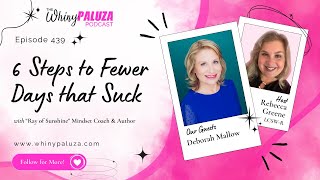
In this Winey Palooza podcast episode, host Rebecca Greene interviews mindset coach and author Deborah Mallow about her upcoming book, 6 Steps to Fewer Days That Suck. Mallow explains how the guidebook, designed like a double‑page journal, combines personal stories, visual prompts, and actionable “aha” moments to help readers break negative habits and cultivate daily joy. The conversation covers the core philosophy that we must first give ourselves permission to be enough, rewire the brain’s negativity bias, and commit to a conscious decision to focus on positivity. Practical self‑care tactics—smiling, walking, endorphin‑boosting activities, affirmations, and pausing before reacting—are discussed alongside strategies for overcoming procrastination (task‑breaking, list‑making, Parkinson’s Law) and handling change (curiosity versus jealousy). Mallow emphasizes the importance of accountability, recommending her Positive Energy Club, worksheets, and an accountability partner. Parenting advice centers on modeling self‑kindness, building realistic confidence, and teaching children to be curious rather than jealous. The episode ends with a call‑to‑action: visit thedailydecisions.com, join the club, and purchase the book when it releases in early April.
Chapters
Hello everyone, this is Rebecca Green for the Winey Palooza podcast, and I am already having such a fantastic time talking to Deborah Malo. Deborah, thank you so much for doing this with me today.
Thank you so much for having me. And everyone out there, I want to do one thing because this is what I find makes you feel better. Smile and give yourself a big hug.
Oh, I love that.
Get the endorphins going and say, I love myself, because we have to do that. We have to find time with all the parenting adventures and everything to really care for ourselves.
Anyhow, I will stop now. Such a good start. I have been chatting it up with Deborah, and I said to her, oh my God, I got to stop interviewing you and press record. I love this lady. This is going to be— a fantastic discussion. You're gonna love her as much as I do. But let me tell you about her. Um, not surprisingly, she's known as your ray of sunshine. She is a creative thinker and mindset coach dedicated to helping people live happier, healthier lives. She developed the 6 Steps to Fewer Days That Suck. I love the title. A solutions-based approach to breaking negative habits and creating lasting positive change. As the founder of the Daily Decisions Positive Energy Club, Deborah empowers others with practical strategies to shift their mindset, reduce stress, and boost joy. She has been featured on Fox 5 New York, WGN Radio, Women's World, AARP, and more. I started talking to her and the time just flew by, and she is amazing. I mean, I already feel so much joy. So I want to show you, we're going to talk about this, but if you're watching, you can watch us on Facebook and YouTube. The 6 Steps to Fewer Days That Suck. I'm holding the guide. Tell them when it's, it's officially coming out.
It will be out definitely by the first week of April on Amazon and then hopefully in bookstores as well. I'm working on that now, but the paperback and hardcover will be on Amazon and it's actually worth I think getting the paperback or hardcover ebook is fine, but you can't, you can't write what you can't do. You can't see it in the format that I actually wrote it because it's not a chapter book. It's double pages of all the trials and tribulations and the positive things we go through and tips and action items, little stories, everything on a double page that energizes you and gives you solutions and little soundbites and visualizations and tips to think about. And the summary at the end of each step with a lined page for ahas, it really is. I'm not trying to sell that at all. I'm just— no way. This is how I wrote it. Cause it was, as Rebecca knows, I didn't plan to put it out into the world. This was my way to make changes in my life because I was the quintessential overachiever, driving myself to exhaustion, being hard on myself because it wasn't all the great things that I did each day. I was a number one sales rep year after year. Wasn't that— it was all the negative things or the things that I felt didn't measure up to my potential, which was Not even close because I did the best. And that's what we all have to give ourselves permission to say. We do our best and we shouldn't be so hard on ourselves and we need to live present in the moment. Stop worrying, stop those negative thoughts and just enjoy life more because we can, we do things to ourselves. Mm-hmm. So we'll talk more as I talk to Rebecca. I don't wanna talk too long on this, but that's really what it is. We have to give ourselves permission to care for ourselves and be present in the moment.
So I had the pleasure of getting to read this before it comes out. I feel very privileged. And I could not stop smiling reading it. It just feels— we talked about how she wants— Deborah wants it to feel like a hug. Like, I feel like I was hugged through the whole thing. And so it sounds like to me that it helped you. It was your guidebook. So you want us to have this.
That's— I just want to help people get unstuck because there's a lot. I know I raised a son and I know the pressure that we put ourselves under, try with our jobs, because everybody— not everybody, but so many of us work. It's either we choose to work or we have to work, whatever it is. And then we put pressure on ourselves to be the perfect mom. Well, there's no such thing as perfect. I mean, how can you be perfect? And then the children and the activities and all the other things and toxic friends and everything that we go through. And I just needed to get myself in a better place because myself, I was an overachiever. And we have to find balance in our lives. Every day can't be perfectly balanced and harmonious, but we can strive to make it better so that we, as I say, enjoy more and worry less. And we're present in the moment. And I keep saying that because we miss so much when we're not present in the moment and enjoying whatever it is, the activity we're watching our children do, whatever it might be when you're with your friends even.
I mean, I feel like you're answering my first question. So, I mean, you can piggyback on what you said or you can give a different answer. But I'm curious what you think is one small mindset— if I could talk— mindset shift that we can all do to give ourselves more happiness through the day.
And I said that giving ourselves permission, and this is trite, but to say, I am enough, I do my best, and I'm not going to be so hard on myself. And it's all those negative thoughts because I like, and I put it in there as you know, but it's very basic. We, anybody can research more. I didn't want charts and graphs. I just wanted it simple and basic so that you got your aha moment and then you realize what was happening. So our brains seek patterns. So we have the choice to make those patterns negative or positive. And what I did for myself, and I share this in the book, is I worked on getting rid of what they call the caveman brain. Negativity bias is very simply that our brains dating back to early humans tend to prioritize negative information over positive. Negative events. We feel that we feel the sting of negative events more than we enjoy all the positive events. So we need to reframe our thoughts, change our perspective, and it's doable. That's the great thing. We can do this. And then the fact that our brains seek patterns is there— go, it's going to go along with us and help us. And once we practice this, it feels so much better that it's an easier way to keep going. Cause I don't worry anymore. I mean, Because I did, I read a study, 91% of the things we worry about never happen. So why—
I love that. I'm writing that down.
It's sort of crazy. You could see different studies that have like different statistics, but it's all really high. And this 91%, you know, because it's true. Think about it. We worry about things and they never happen. Something else happens. So it's just a matter of perspective and saying, why am I going to do this to myself? I'd rather live in the present and enjoy it. And actually, I repeat these things because even you said on one of your podcasts how many times you were talking to your husband, how many times we need to— it's good to repeat things because you don't hear it till it's sort of— it's repeated a number of times. And that was the same in sales. We were always told, keep repeating. So it's good to hear it. And then hear it a different way. But honestly, knowing that, knowing that smiling and laughing get the endorphins percolating and we feel better, walking, even actually taking a walk to distract you, have negative thoughts or you're, you're feeling not good about something, take a brisk walk.
Even that advice.
Walking is known to boost the endorphins. Think about it, the exercise, and it can decrease sensitivity to stress and pain. So there's so many little things that we can do to stop the negative thoughts, to make us, to have us feeling better about ourselves. And that's, these are the little things that we can do to stop ourselves from going down the rabbit hole and to enjoy our lives more and find ways to make ourselves feel better, because I believe it's all about self-care. And I don't— yes, self-care is you get a manicure, a pedicure, sure, take a bubble bath, whatever. But to me, it's building confidence, have that positive energy, and building our resilience, knowing that we can get through things. And being adults We have the perspective more so than our children, which we need to help them build confidence and resilience so they can feel good about themselves. Because just notice that people who are more confident, resilient are kinder humans. And that to me is really important to have respect for yourself, as I call it, personally considerate. And also be respectful of other people. And when we feel better, the emotions of the anger and the fear and all those things that bring us down cause us to feel maybe inferior, less than. That's what we're trying to change.
Well, and you know, you're speaking my language. We've talked about this. I'm— I eat this, I breathe this. I love everything that you're saying. And I also know you and I both know that I talk to so many women and I feel like they don't get out of their negative habits. They don't have confidence. So can we give them some advice to move along?
Yeah, absolutely. But the one thing I want to say is, and that's why the book is broken down, the first thing is a decision. We all have to make the decision, a commitment.
Yes.
To actually focus on the positive, create more positive moments in our lives and ways we think so that we can actually get there and overcome the negative. The problem is always we give lip service to it. We say we want to do it, but unless we take the reins and actually do it for ourselves, It's not going to happen. We need to be in control of our change of our lives. We need to be able to shape our lives, right?
Yeah.
Shape our perspective and reframe our thoughts. And that's really, you know, there's no magic bullet, but we are able to do it because we can change our thinking. We can't control other people. So that's the first thing we have to stop trying to do, because the frustration doesn't make us feel good. We own our priorities, our agenda, and we can't take things personally if other people have their issues, because everybody has their own baggage, right? So it is a choice, and you can do it. And the more you Get up in the morning and smile. Say a positive affirmation like, today has so much to offer. I'm gonna bring the positive energy. Just say positive things. And once you start going down, you think you're gonna go down a rabbit hole during the day, say positive thoughts to yourself. Don't allow yourself a minute to slack off and get into a negative routine. Do it for a couple of weeks. You'll feel better and then you'll want to continue. I really believe that you can because I did it and I was, believe me, a mess.
If you see a lot of— if you were a mess, you've come a long way.
I honestly, I did. I did. And everybody could do it. The people I coach, they've all overcome because a lot of times what we need is an accountability partner, right? We need a mentor, somebody who believes in us and can actually cheerlead for us, whether it's a friend, whether it's a coach, whatever it might be that works for you. Because sometimes it's harder to do it alone, and sometimes we don't have the perspective. It's easier to see what is wrong or what other people— not wrong, but what other people's mistakes are. Than it is to see what is actually true with ourselves. So sometimes it's good, you know, a good friend, and you do it for each other and you support each other. And don't think it's selfish or rude to get rid of the toxic people in your life, the negative people. They're not doing you a service. They're doing you a disservice.
I think that is excellent advice. I don't think that's easy.
No, no, it's not. It's not easy, but you make a conscious effort to work on it. And I find, right, that's why I did lined pages at the end of each step, Rebecca, because I did it for me, because I think we have to promise ourselves, we have to. You can, you could post a note on the fridge. You don't have to use a lined page. You could, you don't have to buy the book even, you know, it's up to you if you want to. But of course, course, if you even just make a few bullet points of things that would help you to change and put it on the fridge and just each day check off that you did it. Because when we see our accomplishments, it gives us personal pride. And who are we doing this for? We're doing this for us. Don't we, don't we really deserve it?
What? So yeah, I think we're really good at giving to others. I think we all need to get better at giving to ourselves.
Yes. And you can repeat my words today. I will be personally considerate because think about the time. And I know I'm stupid. Oh, I screwed that up. And I mean, I love learning something new, which you read in my book. It's all how you Flip it. So I challenge all of you, when you're gonna say something negative to yourself, stop and say something positive. I, I love learning something new, or I— whatever it is that flips the script for you. And the more you do this, the more you get into the habit. What is it that Malcolm Gladwell says? It takes 10,000 hours to master something. Well, you can master this. I've mastered it much Faster. You really can because you get that good feeling from it. And just like we like an adrenaline rush, an endorphin rush, we like to feel good. So train your brain, your mind to think positive thoughts. And I know it's not easy, but the good thing is it is doable if you decide to do it. So do it for you. This is for you to enjoy your life more.
You know, I agree. I think that we hit stressful moments.
Yes.
And I think that people need help bouncing fast back quicker.
Yes.
So how can they move quicker to bounce back?
Well, this is what it is. It's all in our reaction, right? Yeah. I almost lost— I say it in the book in a short little paragraph— I almost lost a job Good job. Really good job. Because I told you I was a mess before because I was trying to overachieve. I was putting too much pressure on, on myself. We need to limit the pressure we put on ourselves because we are, and I keep saying it cuz it's trite, but it's true. We're enough. We're good. We're good as we are. And now we're gonna strive to be even better that we enjoy our lives. But honestly, I almost lost a job because I didn't like the way that the person I was dealing with wasn't addressing the situation, wasn't moving ahead and getting it done. And I lost my cool. And I was on a taped line, so they had it all.
Oh no.
But you know what? That was part of the shift too. Sometimes you have to hit rock bottom in order to rise and make a change. And I was so humiliated. I mean, I'm not going to go into all the stuff that happened. I my job. I was very lucky for a lot of reasons, but— and I'm not going to go into everything— but it was a very humiliating experience because it's better to take a pause when you start to feel the heat rising. And it's hard to do, but I've mastered it. You need to take a pause and just say to yourself, I'm going to calm down. I'm going to breathe. I'm going to stop the chain reaction, or what I call the domino effect, where it keeps escalating. Because once you start that anger, that fear, that rage, it just grows, right?
Yes.
So it's just a matter— and that's the stress too. We cause ourselves all this stress. It becomes like a habit. That, that develops, or a pattern. It's not a habit, it's a pattern that develops over time. And we need to give ourselves permission to stop it, to take a step back and not go there. Because honestly, what happens afterwards? We're feeling sorry, we're feeling guilty, especially with a husband or, or our children. Or whatever it might be. So it's just a matter of stopping it before it starts. So you don't have that whole chain reaction and you don't feel horrible. And it just— that stress meltdown doesn't make us feel good. So it's just a matter of practicing the patience, the stopping, and That's what I did. And it really, really works. I mean, if somebody pushes my buttons, and people do, people can be very frustrating. I stop and I just, I smile to myself inside. And I say, I'm not gonna let it affect me. I mean, I don't say it out loud to them. But I really say I'm not going to. And the more we practice this, the more it becomes a habit. And it's something that just becomes part of us. Believe me, we can do it if we want to. It isn't easy, but it's definitely doable. Like anything else, we do it for ourselves.
And what I'm hearing is that it might not be easy at first, but we make the decision and the commitment, and as we practice, that's when it becomes easy. I think eventually it does become a habit, a pattern. Yeah, right. Because I think you and I are doing this every day.
Yes.
So it's a matter of starting.
It's a matter of starting. And the whole thing is, I keep saying, we're doing this for us.
Yes.
We're our most important resource. We need to treat ourselves, as I say, we need to be considerate to ourselves. We don't need to add extra pressure. We don't let— we don't need to feed into people pushing our buttons because it's not going to serve us. And again, like I said, there's no magic bullet. But knowing that you're doing this for you so you have a better, more enjoyable life and can be present in the moment, enjoy your families, not let the little things really take over. I say to myself many times, what really matters?
Mm, such a good question.
Because honestly, what matters? Your loved ones and their health, your health, your wellbeing, and that you're having the best possible life that you can. You can't compare yourself to others. Everybody's journey, everybody's desires are different. We, we need to just embrace who we are. Because we are who we think we are, right? If you think that you're not enough and you think that you don't measure up, well, that's who you are, right? Because we train our minds to think that way. If you think that you're going to have a good life, you're going to have a good day. I mean, every day can't be perfect. I mean, things happen. People die. There's accidents. There's a lot of things that we can do, but it's all about— I go back to what we first started with. It's our reaction, how we react, and how we react.
Well, and I'm selfishly thinking about my wonderful daughter because— so I have practiced this daily. Okay, so, so we work on ourselves and we want to teach this to our children.
Yes.
So then I see the pressure and the intensity that she's putting on herself. And I just had this conversation with her about what really matters. So now I need your help. Now we need to teach this to our kids. So help us teach— how do we teach this to our kids?
It— well, it's all about little steps, right?
Yes.
Yes. And not putting as much pressure on them as, you know, again, and I, I was guilty of that, believe me, you know, before, before I— before this, I I would put pressure on my son to do well in school, to, you know, get tutors, all that stuff. But all that does is cause more anxiety for them. So it's better to build their self-esteem, not fake, you know, everybody getting a trophy. Look, I don't want to say any, you know, it's everybody does what works for them, right?
Yeah. Yeah.
You have to be realistic because Some people have more different— we all have different strengths, right? We're all good.
Yes.
Wait, I think I heard you— were you saying that you're not the math brain, your husband is, right? Was that—
oh, back in the day I was the math brain, but if you don't use it, if you don't use it, you lose it.
Because was one of your sons coming to you for homework? And you say, go—
I do not help them with math homework. I send them right to Max.
That's what I heard you say. So, so anyhow, we all have strengths, right? And we need to notice our children's strengths.
Yes.
And explain to them, you know, we're all different and just go with your strengths, lean on your strengths. Your strengths will help you. Yes, we can fix things that we can make better, but our strengths really are what lift us up. So why wouldn't we want to build on that? And also just being kind to themselves. Like I said, being personally considerate to yourselves, being kind to yourself, practicing self-care for yourself, to trust yourself. We want our children to trust themselves, their, themselves, their intuition, not to get mixed up with The toxic kids maybe that could bring them down a rabbit hole. We all know where that could go. So they need to believe in who they are. And by not yelling at them, by lifting them up and doing it patiently and kindly. And sometimes I know we're tired and words come out of our mouths, but the more we practice thinking before we react, see, I say again, we need to think before we react and how we're going to speak to someone. We need to be personally considerate of ourselves, and we need to be respectful of our children, of other people, no matter how frustrating it is. It's not going to benefit us if we lose control. So it's very important to build our children up, give them confidence, not false confidence, but, but realistic confidence, and then resilience to point out, you know, so This happened, but look, you got up, you were able to move forward. And that is helping them have perspective as they get older and become a kinder human. Because I think when people feel more confident in themselves, they know that it's going to work out, what really matters, and giving them perspective, they become kinder humans as adults. And we need more kindness in the world.
Don't we? I, yes, I would like to raise kind humans. That is one of my goals.
All of our goals. And it's just a matter of how we speak to them.
Yes.
How then they model, because they model after us.
Yes. Yes. I know. Trust me. I took a hard look in the mirror when I realized how hard all 3 of my children are on themselves. I'm like, oh, Rebecca, where did they get this from?
But on the flip side, they, they're responsible. You know, there's, there's good and bad in everything, right? I mean, I don't want to say bad. Oh, there's, there's better. I don't want to say bad because that's, that's not good. I like to be positive. There are benefits to everything.
Yes.
To be, to be productive and responsible is a good thing. It just has to be tempered with realistic expectations and balance. Because we all need more balance, right?
We're all a little off balance. Oh my gosh, yes. Always. I'm always working on that every day. I also, I also hear from a lot of people that they struggle with procrastination. Oh yeah, that is a big one. If you have any advice for them.
Yes. And you know, I write about it because it's really interesting how if we know, think about it, if you know what you really need to do, you have clarity on what needs to get done, it becomes so much easier to do it. So, and I'm sure you've heard this along the way, breaking big goals or big projects you have into smaller tasks, but we need to write it down. And then when we finish it, the small tasks. You have a list. Don't overwhelm yourself every day. Just small things. When you finish it, give it a checkmark.
We love it.
Type it out and you do it with the emoji thing and you give it a check. Whatever. We, when we actually commend ourselves for doing something or celebrate ourselves for getting something done, we feel good. And what I do is to make sure I get it done. Because once you start, once you actually sit down and start, you go 1, 2, 3, action, and you start it, it becomes easier to keep going. It's actually sitting down and doing it. And then I will not let myself stop until whatever. And it's— I'm not doing hours and hours and hours because I take a break. Every half an hour, 45 minutes, sometimes an hour. I'll make sure if it takes a little longer, I get up and I stretch. Because also sitting affects our backs. It's not, you know, it's good to move around, do something else. Because so many times when we're doing something else and we're stuck on whatever project we're doing, we, we need, we need like a new idea. When we're not actually focused on it, and we're maybe washing the dishes or whatever it might be, the solution comes to us.
It's true. Yes.
So the benefits of doing all that, but it's just putting your butt into the seat and just starting and not turning on the TV because that becomes— it's like an addiction, right? We just, we want to relax. I mean, I don't blame— I believe in taking time to relax because that's all part of self-care. But with procrastination comes stress because we know we need to get something done and we're not— it's not done. And we get near a deadline and it gets done. There's— have you heard of Parkinson's Law? Mm-hmm. So we're given amount of time for a project, right? We could get it done in a shorter amount of time. But that project takes just to the deadline because we stretch it out instead of— and that's Parkinson's Law. It stretches out to the deadline, and that's when we, we lose it. We become stressed out and anxious. And the trick is to get it done. Have a list, write it down, check it off, celebrate the fact that you did it. Maybe you go out to get a manicure. Maybe you go out to get a massage. Maybe you just go out. You don't want to spend money. I get that. Go out and take a walk and then come back because your mind, when it, when it's not maybe focused on it, you'll have some more great ideas. Sit yourself back down and finish it because you'll stop the extra stress.
Well, and you want to know what else causes extra stress? They then go to excuses and tell me why they're not going to do it.
Absolutely. So, but it's excuses. The procrastinator extraordinaire, as I said, the coming up with excuses.
Oh my gosh.
I mean, they're so good at it.
How do you get rid of excuses? Tell them, get rid of it, people.
How do you get rid of it? It's training your, you're training your mind.
Yes.
To actually be personally considerate and get something done. I don't want to say before the deadline, but to stop the extra stress.
Yes.
Kinder to yourself, because that's what it's all about. You know, it might feel good at the moment sitting down and having a cup of tea, and I believe in having a cup of tea and taking a break, but watching a program which gets into another program, which I'm not— believe me, I've been there. I understand. I was the biggest supporter of Parkinson's Law. That's how I read about it, because I said, oh my God, this is a real thing. Yes, human nature. We're all the same. We have—
we are—
but we all have the same inclinations. Complacency, you know, it just depends on your priorities, right? But I think we need to get clear on our priorities and honor ourselves, value ourselves, and honor our dignity. Because that's what I really believe, that we can make our lives so much simpler if we look at the things that are getting in our way and complicating it for us. And again, I know it's not easy, but making a list and little things at a time. Yeah, make sure that the day is, is less stressful than it has to be. Sometimes in the morning when I'm smiling and I'm giving myself a hug I write down the 3 things, sometimes it's 6, but that I need to get done. But I tackle the biggest thing first when I have the most energy and I get that done. And then I keep moving down the list because sometimes it's easier to tackle the, the toughest task rather than going to your email and just like doing something simple because that also is procrastination. You're getting—
Yeah.
Get done, but you, you have to get done what's most important first.
Yeah, no, that's really good advice because I do think that we might skip to something that's easier instead of getting the hard thing done first. I like that advice. And I also think that one of the big issues is that people are afraid of change, and I think that we don't know how to handle change. We fear it, we avoid it. Um, how can people do better with change?
It, it's, it's difficult, right? It's like we get in a comfort zone, right?
Yes, we do.
I say that comfort zone really isn't comfortable because it's us, right? I say the comfort zone isn't comfortable, really. I don't know why it's like that.
I like that a lot. I like that.
I once said that on Instagram. I said, comfort zone isn't so comfortable. Somebody said, can I use that? I said, sure, use it, because I think it's perfect.
Perfect.
I think it's true. So getting into that comfort zone and doing the same thing over and over, it's like, you know, insanity, right? It's like, why are we doing the same thing over and over expecting a different reaction? But It's the same reaction each time. So we need to be able to see things for what they are. Perspective again, and be honest with ourselves. Is that easy? No, but be honest with ourselves and start making little changes. It's interesting. Small changes have a big impact over time.
Yes.
Yes. You're kinder to yourself, once you stop the circular thinking and the worry, once you have that under control, once you think before you react, it's little things. All these little things will make such a big difference in your happiness quotient, your happiness factor. Will you be happy every second of the day? Come on, let's be realistic. It's not possible, but we can be happier. And more content, give ourselves peace of mind.
Yeah, I love that. I'm going to remember that line forever. The comfortable zone is not so comfortable. That is perfection right there. That will help everyone.
And the other, the other soundbite, the other thing I did, because I do not use the word failure. I don't like that word. It has a negative connotation and people are less than. So the thing is, how do we get better at anything? We need to make mistakes. Yes, make mistakes. And so what I call failure— instead of failure, I renamed it education and growth. And this is how we learn. This is how we get better. Because nobody does something, or very rarely, the first time out of the gate. Do they do things so well? It takes time. So you need to give yourself permission to take the time and along the way, learn and grow, and you find a happier place. We really need to find a happier place for ourselves. You know, they talk the happy place. I wanna call it a happier place.
Yeah, I— we can, we can grow every day and get better every day. And that, that actually sounds very exciting to me.
It is challenging ourselves to grow. And then again, that reward thing. Give yourself a reward. I say in the book, actually, and you can invite other people, but I say make a party just for you. Celebrate you. Find that time to celebrate yourself. Don't, like I used to do, all the great things I did in a day, but I would focus on the negative. Stop doing that. Flip the script. All it is, is flipping the script, saying something positive instead of those negative words. Again, I learned something new. I'm not stupid. You know, I don't even— don't even say those words. Don't even say negative words. Don't apologize for yourself. Stop. I was just talking to somebody the other day and they were apologizing. I said, stop apologizing for yourself. Just appreciate yourself. We're not perfect. And just accept who you are and the things you want to change, work on that. Because again, as I said earlier, we're doing this for ourselves. We deserve The gift. We are a gift. We are. We think we are. So think positively about yourself. Give yourself some praise.
Oh my gosh. Such beautiful. This is like the perfect— I need to start my day with you every day.
Oh, yes, of course. We're both in New York. Why not?
We're both in New York. Well, and before I let you go, there is one other thing that you reframed for me. That I think is really important for us to share. You say to be curious instead of jealous, and I want you to explain this to them because I think that's a really good lesson.
So we all see other people maybe achieving things, doing things. But my realization is everybody has their own struggles. All that glitters isn't gold. That's what I, you know, I, I like that. It's Shakespeare's statement, right? Really what lurks beneath the surface, because you don't see everybody's problems and struggles. Sometimes people are able to show a good face, is to understand everybody has their journey. Your journey, you need to focus on what you want, your purpose, your passion, your family, yourself, and liking yourself, loving yourself, and not focus on what you think, which isn't reality, what other people have, and be jealous. Instead, be curious about what you can do in your life. Try different things. No, you're not failing if it doesn't work out. It's funny how when some things don't work out, we turn the corner and something better is there. And you start— that's building resilience too, to see and have perspective, to see that sometimes what we crave, we think we crave something, and actually it isn't that, it's something else. So be curious about what it is that's around the corner for you rather than getting frustrated that you didn't achieve whatever it is. You didn't get a job, you didn't get— your child didn't do something that you thought that they should do. Be curious about what good is around the corner. Again, it's all about how you wanna reframe things, put the positive spin on things because Curiosity and anticipation for what's ahead, the excitement of that, it— that too gets the endorphins going. That excitement, we feel good about that. And we need to find more ways to make ourselves feel good, to give ourselves a hug every day, to find positive words to say, to smile, to be personally considerate.
Oh my goodness, how appropriate that we started with a hug and we ended with a hug. How appropriate is that?
It's so important to value ourselves. It really is an honor, our dignity, and to respect ourselves, not to say bad things to ourselves, and to be kind, and to be kind to other people even if they're pushing your buttons. It's easier. You get more— what is it? What is the old saying? You get more bees with, with, with honey than vinegar. You know, it's just a matter of sometimes you can win people over if you just do it the right way. Always? No, because people have to be in the right mindset, and we can't control other people's emotions. But we need to first start with ourselves and to be kind to ourselves and hug ourselves and see the value. And when our children see us doing that. That's what they model. I'm going to start to cry because honestly, really, what we do reflects on our children. Well, our children actually see it, and that's what they model. And we need to be really aware of what we're doing. And once we become aware of what you're doing, it's easier to change. Stop yourself. Take a moment to reflect. Don't react right away. Start with that, and you're going to be so much happier. You'll be proud of yourself. Make yourself proud because you are a wonderful person. Just know that. Know you're a gift and you have a lot to offer the world, but you can't give it to the world if you're caught in all the negative, the neg— all the negativity. And we'll talk about this maybe another time, how negativity actually links to various health issues, but that could be another topic also.
Oh, that makes so much sense.
Get us sick. But again, another time.
I'm— well, you know, I'm gonna bring you back because— oh my gosh, you are so— such a wonderful lady. You are such a pleasure to talk to. I can't even tell you what a good state I'm in to go tackle the rest of my day. But, um, tell everybody before I let you go where they can find you, please.
I would love if you email me. Go to my website, it's thedailydecisions.com, or you could put in my name, Deborah Mallow, and it'll come up. Mallow like marshmallow. And if you go to thedailydecisions.com/inspire You can join my Positive Energy Club. I'm about to do that on Facebook as well as my Positive Energy Club. But you can download— I have 3 worksheets. One, but you have to, you have to sign, you have to subscribe.
Okay.
The worksheets: happiness, motivation, and feel-good activities. Oh, I have a feel-good activity another time for you too. Quite a few that you could do in a community or you could do by yourself to make you feel better. But Anyhow, so if you come to my website, thedailydecisions.com/inspire, you can join my Positive Energy Club, get the worksheets. The worksheets are companions to the 6 Steps to Fewer Days That Suck, the book, but they actually work as standalone too, because everybody needs motivation to feel happier and to have some feel-good activities to actually incorporate into your day.
Yes, and I'm gonna hold it up again. In April, go buy her book, 6 Steps to Fewer Days That Suck. What a perfect title. Thank you. It's a turquoise—
oh, I'm sorry. I didn't mean to—
no, go ahead.
The turquoise cover and the writing is in yellow.
I see it behind you. It's right behind you. It's behind you. It's beautiful. What a beautiful book.
I'm sorry I interrupted. I'm so sorry.
No, you can interrupt me anytime, Deborah. Thank you so much for your time and expertise today.
Thank you, Rebecca, and thank you to everybody listening. Don't forget to give yourself a hug and smile. You'll feel better.
Laugh too. She's made me smile. This is Rebecca Green, and I want to remind everyone to spend every day laughing, learning, and loving. And now I'm going to add hugging. Thank you for tuning in to the Winey Palooza podcast. If you like what you heard, Please be sure to subscribe so you never miss an episode. While you are there, leave a review. I love to hear your feedback. Thank you so much for listening. Until next time.
This show has been produced by Market Domination LLC. To discover how you can have your own show completely done for you and turn it into a real published book and become the authority in your marketplace, go to www.marketdominationllc.com/podcastoffer. 49 faces looked to him in triumph. Over the last 12 months, they had each taken turns and promoted his business for a week at a time, driving over $987,342 in revenue. What if you had a network of 50 centers of influence who promoted your business every week for a year? Grab your copy of the number one Amazon bestselling book, The Ultimate Guide to Growing Your Business with a Podcast, at 33% off the Amazon price by going to ultimatepodcastguide.com. Book.com. Again, that website for 33% off the Amazon price is ultimatepodcastbook.com.










