Episode 489: Release, Rewire, Reclaim your life
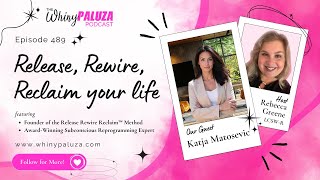
In this episode of the Winey Plousa Podcast, host Rebecca Greene interviews Katya Matoshevich, an award‑winning subconscious reprogramming expert and creator of the Release‑Rewire‑Reclaim method. Katya shares the personal health crisis that sparked her journey—from a series of misdiagnoses and a near‑death experience to the development of her Golden Bridge program. She explains identity realignment, describing how early‑life beliefs solidify before age seven and why traditional affirmations fail, positioning hypnosis as a way to bypass the rational mind. Katya introduces a four‑layer model of the self—physical, mental, emotional, spiritual—and illustrates how somatic recalibration and energy work complement subconscious work. She discusses the "survival code" inherited from childhood, how it drives adult patterns such as over‑achievement, people‑pleasing, and fear of visibility, and why generational trauma matters. The core of her method, Release‑Rewire‑Reclaim, is presented as a three‑stage process likened to clearing weeds, nurturing soil, and planting seeds, followed by reclaiming a true identity. Katya outlines her flagship 12‑week Golden Bridge program, which combines tailored hypnosis recordings, daily somatic practice, and individualized coaching. She offers listeners a concrete first step: adopt a non‑judgmental observer stance, write a compassionate letter to oneself, and use meditation to become the observer. Finally, she provides practical ways to connect—her website (minddive.life), a starter pack, one‑on‑one sessions, and a community group on the Chatter app. The conversation emphasizes that healing is both personal and generational, aiming to break the cycle of passing down survival patterns.
Chapters
Hello everyone, this is Rebecca Green for the Winey Plousa Podcast, and I am super excited today because I get to talk to the smart, beautiful, wonderful Katya Matoshevich. Katya, thank you so much for being here with me today.
Thank you, Rebecca, for inviting me. I'm so happy and glad to be here with you and with your audience as well.
Well, I'm going to tell you about this fantastic lady. We started talking and I stopped her and I said, no, wait, I have to record that. You're gonna love her. She is an award-winning subconscious reprogramming expert and the creator of the Release, Rewire, Reclaim method. With over a decade of experience in hypnotherapy, subconscious transformation, and somatic recalibration, Katya helps women move beyond survival parent patterns and step into into grounded, confident self-leadership. She believes true change isn't about thinking differently, but about being different, rewriting the subconscious code that shapes our identities, not just our thoughts. Katya's work guides women out of cycles of self-doubt, overachievement, or overwhelm, and into a fully aligned life built on truth instead of trauma. Sign me up for all of this. Oh my goodness. I mean, you're amazing. I don't even know where to begin because there's so many questions I want to ask you about all of this. But I mean, I want to start with— you talk about identity realignment. Okay, let's just start there. What does that mean?
Well, let me start with something that you didn't know.
Okay.
Let me start with why I do what I do. Okay.
Yes, start there.
It will be an intro to, to your question. So I remember it was 12 years ago. I was sitting at the doctor's office and I was frail. My eyesight fading, and I was hearing yet another label. Fibromyalgia, Lyme disease, autoimmune disease, mercury poisoning on a cellular level.
Oh my goodness.
And then, yeah, and then cancer to the end. So they were sticking those names like a dictionary on my body.
Oh my goodness.
None of them gave me my life back. And that's when I realized, Rebecca, something that no doctor had ever told me, that my body was screaming what the soul had been whispering for years. My trauma had gone unspoken for so long that it carved itself into my cells.
Yeah.
And see, that was the breaking point. That's where I had to help myself because no one could. And then I immersed myself in the study of the subconscious mind, somatic work, energy therapy, meditation, everything to heal at the root. And see, when I crossed that threshold, I just knew I couldn't keep it for myself. And that's how the Golden Bridge program was born. You know, it's Golden Bridge, why? Because I walked across survival to the freedom on the other side. And see—
Amazing.
My identity at that time was illness. I was sick. And I was actually slowly dying. My organs started to fail. And that was my identity.
Oh.
When I say identity recalibration, it means a deep, deep work. How many times have you said, oh, I'm just like this, or I'm just like that, oh, I'm a nervous person, or I don't have luck, or whatever. You are stitching to yourself an identity that it's not yours. Someone repeated that to you so many times. That you made it make yours, and it's not. It's just learned.
Makes so much sense. It makes so much sense. I'm just thinking about things people have called me. So, okay, so you're sitting there with all of these labels, and you took a deep dive to, you know, through, through all of these. I can't even list them all. Hypnotherapy, somatic recalibration, subconscious transformation. So you went through all of those things. Can you tell us things that you learned in each of those things along the way?
All right. Of course. So the mind itself. Well, the mind is the most powerful engine in the world. Everything you see in the world that exists, from the banks, from the roads, every concept you see, someone had to imagine it first in their mind, right? So that's the power of the mind. In order to access our most deep crystallized limiting beliefs that are usually shaped till the age of 7. Till the age of 7, why? Because our rational mind gets full development around 7, 9 years old. So what we call subconscious today, it was everything we had till the age of 7. So no rational filter. So everything that was told us, we accepted as the ultimate truth.
Yeah.
We had nothing to compare with. Imagine you are a 3-year-old child and someone repeatedly say to you how ugly you are.
Right.
You will feel bad, but that will not change the core belief that will be rewired at that age. And the thing is, after the 7th year of our life, our subconscious mind closes its door and we cannot access it. We are just now adults with specific issues that we cannot actually remember when it all started. So that's why affirmations do not work at that stage. Affirmation will make you feel good in that moment.
Yeah.
And while you are repeating it, and if you're doing that every day, every day of your life, you will feel good, but you will not move the needle because there is a resistance from your subconscious mind. And that's why hypnosis. Mm. Okay. That's why hypnosis, we bypass rational mind. And we go right there at the root. Since, see, the child's brainwave till the age of 7 are in theta, theta brainwave. And hypnosis uses the same brainwaves.
Gotcha.
Okay.
Makes sense. That makes sense. Okay. So then let's move to somatic recalibration because I have no idea what that is.
Okay. Let me ask you, when you feel fear, where do you feel it in your body?
I mean, probably my stomach.
Okay, perfect. Your stomach.
Yeah.
When we get scared, what we do? Exactly, right? So every emotion is stored in our physical body, in our muscles and in our nervous system. Now, our nervous system molds around it. That's why that component is crucial to combine with the mind work, with the subconscious work. Another one that it's less known is our energy field. So you have to know that I have done all my studies first on myself. I was like a laboratory rat for myself.
Perfect.
Exactly. And I realized if I work only on the subconscious, it's perfect. It works. But in year and a half, some things are bouncing back. Then I introduced the somatic work. You get, you teach your nervous system another story, to relax, to not fear, to believe, to feel safe. And then I encountered that the energetic part part is crucial as well. See, we are, I call it, we are like a house with 4 rooms. So you have your body and you work on your body and that's one room. You clean it, it's clean, it's tidy, you open the windows for the fresh air and it's wonderful. But the other rooms are in the dark and are dusty and are filthy. So what will happen? In time, it will corrode the room that you kept so clean. The walls of that room that are nearby, adjacent, they will start to intact it. So we have those 4 rooms. One is physical, one is mental, one is emotional, and one is spiritual. You have to work on all those layers. We are Beings with 4 layers. And if you omit to work on one of it, it will eventually bounce back. Because everything that you are feeling, living, it's encoded in your energy field. And in time, if you don't erase that memory, from there, it will in time inform your other layers. And the physical layer is the last one. So with my illness, and if anyone has any health problems, believe me, this is the last chain It means that you have had alerts before your emotions, but you just didn't listen. So the physical, the physical thing is the last, last thing that just screams, hey, hey, now are you listening to me? 'Now you have to because you feel the pain.
You cannot ignore me anymore.' That's very sad and very true.
Exactly.
Oh my goodness. Well, I mean, you hit on so many things, so many things. I think that, um, it would probably be helpful if you could explain how can— like, I'm sitting here thinking, how can I make sure that I'm working on all 4 rooms? Can you give us examples of that?
Well, I usually say when, when, when people ask me, how can I know, for example, if I have any subconscious limiting belief?
Doesn't everybody?
Exactly. And the answer is pretty simple. Just imagine to be in a house. You open the window and out there is your life. Watch it and tell me. What part of your life are you happy with? Which part is itchy a bit? Which part you don't want to look at all? So it's very easy, but we have to be raw and honest with ourselves.
Yeah, for sure. Well, and I think that the most common thing that I hear from women I would say it's mostly moms that are gonna listen to this and they're going to tell us that they feel in most days that they're in survival mode. And to me, that's not a happy mode. That's a let's get through our day. So they would say that they've tried and keep repeating the same patterns. So can I ask you, how can we help them get out of, I'm in survival mode every day as a mother?
Hmm. There is a work that has to be done.
Yeah.
And I always say we are all 4-year-old children wearing grown-up suits with a credit card and a mortgage.
It's true. I know.
Yes. And the thing is that, um, This is it. The survival code of childhood runs our adult life. So by the time that we are 5, 6, 7, our nervous system is already wired to one primary question, and that is, am I safe with the people I depend on. And for a child, that means parents. And safety doesn't mean just food or shelter. It means emotional approval. So if my parents smile when I succeed, but withdraw when I cry, my nervous system learns that I must earn love. And if they only hold me when I'm quiet, I will learn that my needs are too much. And if they get angry when I am angry, I will learn that my inner fire is dangerous and I have to hide it. It's shameful. And that becomes the survival code. And the child doesn't outgrow it. This is when I come to your parents. So they carry it in the adulthood, where suddenly they are a CEO that still chase a parent's nod. Or a partner that is still trying not to be too much.
Yeah.
Or a leader still afraid to use their voice without apology. So the part that I like to put an emphasis on is that that's not any kind of weakness. That's history. For thousands of years, being approved of by the tribe wasn't optional. It was survival.
Yeah.
And if you were cast out, you didn't just feel lonely. You died. So your nervous system evolved to keep you safe.
How?
By belonging at all costs. And that is the code that is still running today. And that's why, Rebecca, so many adults like you and me betray themselves, like silence themselves, overgive, overwork, all to avoid The original wound of rejection. And the child inside is still trying to earn safety through approval.
Okay, so, so the mom listening who wants to change this pattern, where does, where does she start to do this?
Well, first of all, there's a part of the awareness when I said it before, look at your patterns in a very honest way, without judgment, without judgment. Because the real truth is that we all do the best we can. Right? In the moment that we are with the information that we have and with the tools that we have.
Mm-hmm.
So maybe if they see a pattern, they will feel it. When you are with your child and you exaggerate or you overreact in a way. You will feel it. You know it. Some parents become ashamed of it. There's no need to be ashamed. We, you know, we are all living this life for the first time, at least consciously, right?
Right. Right.
So there are trials, errors, trials, errors. So everything is fine. But If you want to break through those patterns, you will see that somewhere in your past you have learned them. You have learned that pattern of behavior, of bursting out maybe, or you have learned it and you Burst because you primarily don't feel safe in your own body. Your nervous system is not regulated.
It's true.
Yeah. Yeah.
It's true. And, and not only do we need to regulate our own nervous systems, then we have to help our children too.
Exactly. Exactly. And that's the part that I really do care so deeply. And I'm writing a book also for helping parents to work together in a playful way to regulate the nervous system of their children. And it's all sorted by age.
I love that. Very needed. Very, very needed.
Exactly. So now, go ahead.
No, no, no, you go ahead.
Wanted to say, just imagine the children growing up with parents who modeled emotional literacy and parents saying, hey, your anger doesn't make you bad, that your sadness doesn't make you weak, that your joy is not too much. And then approval wouldn't be survival anymore. Belonging would feel natural. And we would really raise a generation who doesn't waste decades on rewiring because they were never told to abandon themselves. In the first place. And I will be out of work, and that's fine.
No, you're never gonna be out of work. Unfortunately, it's very, very needed. Well, and I, um, you don't know this about me, so you know my name's Rebecca, which is R-E. So I love R-E names. So I mean, R-E words. So whether it's rewind, release, You know, restart. I love our E names. So, and so you have a method.
Exactly.
My favorite letters, um, Release, Rewire, Reclaim. Okay. I mean, I don't think it could have a better title. So could, could you tell us about your awesome method?
Exactly. So that method involved, as I said, it's called Release, rewire, reclaim. Those are stages of healing and rewiring. Because first we have to release the old survival patterns. We cannot rewire, do the deep work. The best example, the best metaphor is always the soil, right? So if you want to plant beautiful flowers and you just have that soil that it's full of weed, it will not, well, it will not work, right? First, we have to pull out the weed and then we have to nurture the soil and then we can plant the seeds and then That part is the rewiring. Then we give it water, enough sun, enough shadow, everything that needs to that seed to bloom into those beautiful flowers. And then reclaim. This is also an important part. We are teaching our nervous system that new identity to reclaim our new identity. And when I say new, it's actually, it's not new. It's been covered by all the layers that weren't ours at all. So we are coming back to ourselves.
It sounds beautiful and wonderful. It sounds amazing. I wish we could all do it today.
I wish too.
So, you know, you're talking about the trauma that gets passed down from all the generations, and we don't realize that it's in our subconscious. So the trauma is part of how we're believing and feeling, and you— and that is what, what the part of the root of what you need to get to. Is that what you're telling us?
Exactly. So some people think that trauma has to be something big. Mm-hmm. Yeah. It's not that. It's just when our needs, if our needs were not met in our early years of childhood, that's trauma too. Because we are creating deep crystallized beliefs that are errantly wired. Errantly wired. So we cannot change facts, but we can change how we see, feel, and identify. With those facts. And that's, that's enormous.
It is.
That shifts.
So obviously without names, any success stories coming to your mind that you can share with us?
Oh my God, so many. So many. I once worked with a CEO, had everything on paper. The funding, the vision, brilliant mind. Every time she got close to visibility, she shrunk. And she thought it was the fear of failure. But really, her nervous system didn't feel safe being seen. It was like, like driving with one foot on the gas and one of the, on the brake. And no matter how hard she pushed, the brake would always win, right? And then the moment we restored safety and she stepped into visibility without spiraling. So see, no amount of strategy could do that. What safety, feeling safe did. And there are so many, you know, the best part of my work is seeing my clients remembering who they really are. And See, I work internationally. I work with Europe, I work with Canada, USA, and sometimes my hours shift a bit. Sometimes I'm working at 4 AM here just to meet my client. And I wouldn't change it. For anything. I wouldn't. I wouldn't.
You're incredible. Absolutely incredible. So what is really the ultimate goal is for your nervous system to feel safe. So what kind of work— I mean, you've told us so much, but what kind of work did you do with her so that she felt in such a better place?
Golden Bridge program. So that program is my flagship. And it's created with the theme of release, rewire, reclaim. It's 12 weeks and it's tailored individually. So no one can just access my program. It's tailored on you, on your story, on your needs. And there is a part that you, I do for you, and it's on my platform in your own tailored program. So you listen to the hypnosis, you do your somatic work every single day for a week, and then we have one-on-one.
Wow.
We talk about, we recalibrate again, and then you have the second week. So it's all building up.
Amazing.
Yes, it is. I have to say, really, you know, when people say, well, have 80% or 99% of satisfaction. I don't want to, how to say, it will feel maybe too much, but I don't have one client that didn't get results. So one, because And that's the part I don't work with everybody, and that's why. You have to be ready. You— I just don't want anyone to have a program that stands there. No. You have to be ready, willing to give all of you, because I'm giving all of me to you.
Oh, wow.
So, and I don't want you to come back to me. Not after the Golden Bridge. I don't want to see you if not for coffee or for chatting or for just working on stabilizing things and doing all beautiful stuff that we can do, but never again for the same reason. So this is my aim and goal, and till now I'm succeeding in it.
Absolutely amazing. So to the listener who's feeling in a really bad place right now, can you give them one step that they can take today to feel better?
One step.
One step, if it's possible. Okay. Because I know it's a 12-week program.
Exactly. It's a 12-week program. Well, I think the first thing is being non-judgmental. That's the first thing. We all then go into that hole, like, oh, you know. Beating ourselves up. No beating. Just— and you know, this is where meditation is great. When you learn to be the observer of yourself. Just the observer. I would say whatever comes up, whatever issue comes up, Write it down, but write it like a letter to your best friend, someone you love really, really much. Write a letter: I've been realizing that I'm this, that, that, that, that. And then I want you to sit into another chair and be that best friend that you love and write back.
Oh, I love this. That's wonderful advice. That's beautiful.
It is.
So I asked you, I told you I was going to ask you a ton of questions. I asked you so many questions. Do you feel like there's something that I didn't ask you that you would like to share?
That you didn't ask me.
Hmm.
Oh, well. Hmm. I would say that healing is not just personal. It's generational as well. So every survival code you rewire in yourself, you'll just stop passing it down. So when I look at my clients, I don't just see them, I see their children, even their unborn children, because one person's rewiring rewrites an entire bloodline.
That's amazing. Incredible. Well, I mean, we all want to know how we find you. How do we sign up? How do we find you? Tell them all the things.
All the things. Well, first of all, you can go to my website. It's called minddive.life. And you can learn about it. Just learn. I have also a starter pack for people who are not ready to get involved so deep, but just to feel the shift. Okay. To feel the shift. It's also individually tailored as well. So We always have like 45 minutes to 1 hour one-on-one on camera talk about them. I need to know them. I ask some questions that reveal me much of their subconscious patterns. So then I can create their path. And plus, Have you heard about Chatter social app? No. Well, on that Chatter social app, it's an audio and video social app. I have there a group called Mind Dive, of course. And every week, 2 times a week, I do have rooms where I talk about many things about subconscious, emotional literacy, and all those things around. So there, that is a good place to find me as well.
Wonderful. Wonderful. Well, I absolutely loved meeting you and getting to talk to you and getting to learn from all your amazing wisdom today.
It was my pleasure. You are a wonderful host, Rebecca.
Oh, thank you.
You are.
Thank you. This is Rebecca Green, and I want to remind everyone to spend every day laughing, learning, and loving.










