Episode 491: Stop Fighting Start Reconnecting Again
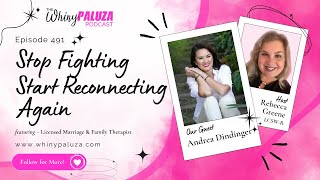
Rebecca Green and marriage therapist Andrea Dindinger discuss how couples reconnect after becoming parents. They cover the "never/always" language trap that escalates fights, anger as a physiological signal you can respond to differently, and practical tools like weekly team meetings and a "sexy logistics" bedtime listening exercise where partners take turns speaking and listening.
Chapters
No need to whine, it's whiny palooza. Have some wine and join us on the whiny palooza podcast with Rebecca Green.
Welcome to the whiny palooza podcast. I'm your host, Rebecca Green. I'm a wife, mother of 3, and licensed clinical social worker. I also have 3 fur babies at home too. My passion has always been to help children and their families. I always dreamed of being a wife and a mother. Parents are always learning through their struggles, failures, and successes and joys. I am no stranger to this wild ride of parenting, and I know behind every great parent lies a team of supportive friends and family. I want to be part of your support system. I want you to know that you are not alone. We are in this parenting world together. Join me every week for insightful discussions with experts on parenting and marriage, as well as other parents who have found the secret to successes in parenthood. You'll learn tips and tricks to make life with your family better than ever. I hope you will follow along with me while we dive into what it takes to achieve a happy family.
Hello everyone, this is Rebecca Green for the Whining Fuza Podcast, and I am so excited today because I get to talk to the wonderful Andrea Dindinger. Andrea, thank you so much for doing this with me today.
Oh, thank you so much, Rebecca. I'm excited.
I love this topic. So Andrea doesn't know this, but this is one of my very favorite topics. Um, I'm going to tell you about her so that you can find out why I'm excited. Andrea is a licensed marriage and family therapist with over 20 years of experience helping couples break destructive patterns and rebuild stronger connections. Specializing in communication breakdowns, trust repair after betrayal, and navigating the relationship challenges that come with parenting, she offers practical tools and somatic-based approaches to heal relational trauma. Her grounded, empathic approach has resonated with over 15,000 Gen X and millennial women seeking real-world relationship wisdom. So now everyone knows why I'm so thrilled to talk to you. Can't thank you enough. This is so needed.
We need this.
We're, we're We're busy parents and, and we, we need this. But I want to start with— there's so many questions. What do you think the most common relationship mistake that you see couples making after they become parents?
Hmm. Well, I, I don't know if I can— let me see, I might wind my way there. But yeah, I think the, the thing that happens once you become a parent is you recognize that you are now the bowl that's holding yourself, holding each other. And I think that's a really challenging transition. And it's not just like the physical bowl, which is exhausting from restocking diapers and figuring out breastfeeding or bottle feeding or right? Like, that— like, there's that piece which is really tricky. Yeah. But then it's like, it's the time. It's the, um— I think people just don't really understand how transformative it is to bring a child into this, into the marriage, and that there is going to require a lot, a lot more emotional maturity.
Yeah.
And it's the thing that's really missing. And I think that's where, like, couples therapy can be really helpful to a new set of parents or a set of parents who have— it's their second or third, uh, third child, because it almost feels like as the, as the couples therapist, I'm able to, like, hold the parents who are holding the family. And I think generations and generations ago, when our families were so much more a part of our everyday life, I think we naturally had that, like, those nesting bowls experience. And now we don't have nesting bowls in our families. Our families could live across the country.
No, I know it's not meant to do by ourselves. We can't do it by ourselves. That's what I say.
So hard.
You know, and my, my fabulous parents live down the— live 5 minutes from me. So I mean, if I didn't have that, I don't know how— I don't know how I would do it. I don't know how I would do it. I'm very lucky.
I'm so jealous. It is such— it's like such an invisible privilege, um, that like, I'm so glad that you recognize how lucky you are.
It is Oh my gosh. Well, when the kids were growing up, you know, when they were tiny, it was, oh my God, like, you have— like, I'm gonna lose my mind, you have to come over. And she just knew to run over. And now, like yesterday, she was like, okay, so if you and Seth are going to these places, am I driving people? Is that what I'm hearing? What am I doing? Like, she just knows that I need her to help. Leave it to your mother, right?
Yes. Oh, thank God for her.
I know, exactly. So I think that, um, we have the same arguments, all of us. This— the— I think couples have the same arguments. I can even hear myself as I say that, having the same argument with them. So why, so why do we do that, and how do we break this cycle?
This is a great question. I've recently created, um, a course, like a really short, like, it's like 30-35 minute course around breaking the loop. I call it the loop. I also call it a dance. We all have that same dance, and every time it comes, you're just like, again, again. Yes, again. And it's so exhausting.
Yes.
And it's so destructive, and it becomes dangerous because over time, that dance creates a lack of respect a lack of, um, desire, a lack of interest, caring, maybe even love after some point. Um, I don't, I don't think it is love because I think love's always there, but there's all these other barnacles that get layered upon it. Um, but that, that looping fight is truly an invitation for connection. And it is never ever seen that way. It is always seen as the big problem. And those two words, never and always, I use them purposefully because they're, they're in every one of those fights. You always forget to be on time for the kids. You never listen when I'm telling you how important this work meeting is to me. It's always my fault. It's never your fault. That is, I would say, for the majority of people, it is part of that loop that people do.
That's true. So do you feel like if we remove those two words, that's a step in the right direction?
I think— I mean, that's interesting. I haven't thought about that. I think the person who's uttering those words, it's really hard for them to remove them. But let me just see if I can come up with that as an example. Yeah, it would change things. It would absolutely change things. Because if it's like, it's always my fault is the looping track that happens. I really feel like it's my fault. And, or I really feel like you think this is my fault, and I don't actually think it would actually— that would change it massively. But the reason I don't ask the person who's saying that it's always, it's never to drop that word, I don't know if it's possible in those moments, because when somebody articulates it's never, my— it's never your fault. It's always my fault. When they're articulating that, they're in such a dysregulated state of emotional state that I don't think they have really the capacity to get rid of those two words in the sentence.
Yeah, that's a good point.
But as the spouse, when you are the person receiving those words, you can go, oh, my partner is emotionally dysregulated. They're not in a grounded, present state of mind. And so now, because I know that, I can respond differently.
Oh, I love that. See, I'm already going to have my husband listen to this episode.
Oh, I'm so excited. I love that. I would love to hear what he has to say too.
Oh my gosh. Oh, I'm loving this already. Well, and I'm just telling you that because he really does not like those words. So I try really hard to avoid those words. And he knows sometimes I'm successful and sometimes I'm I'm not. But you're right, it's the whole regulated thing. So when we're, when we're inviting our spouse to fight about the same thing, or just a thing, it's really an invitation for connection, is what you're saying. And I don't think any of us look at it that way.
Of course not, because it's so unpleasant. Oh my gosh, so unpleasant. But basically, when you, when you say that to your husband He needs to know, oh my God, Rebecca loves me and she needs me right now. Yeah, she needs me to listen. She needs me to pay attention. Something's happening for her and I love her so much and I'm so curious about this magnificent being in my presence. And so let me see if I can really turn my hearing up and find out what her heart is really needing in this moment. Because that's exactly what you need, is for him to get really curious and lean in towards you. But the way you're saying it is like porcupine quills coming at him, and he's like, yes, move really far away.
Yes, yes. Well, and I think a lot of women and couples in general are going to understand this when I say this, that, um, it's hard for our spouse when we're angry. And I think that a lot of times they're looking for like, what's the sadness, what's underneath? And anger is what's coming out and what they're running away from. So it's, it's hard.
Oh, I mean, I don't want anyone to be mad at me. No, I don't mind being mad at people. Anyone mad at me, right? It's just, it's so unpleasant to recognize that I am a human. I am not perfect. And when you get angry with me, I have to navigate that dynamic that I'm not perfect, even though I really try. And I think that's what's hard. And with anger is such an interesting emotion within a marriage, within a family.
Yeah.
I think the majority of people in this country are running really low in terms of, like, on that depression scale, I think there's a lot more depression out there, like that low-grade kind of malaise than people are really conscious of.
Yeah.
And I think that's where the coffee comes from. Like, I'm going to boost out of this low mood, right? Or that's where, like, oh, I'm going to have this glass of wine because I'm going to slough off. This bad mood. But I think the— I don't know, I haven't read research about this, but I have this felt sense that on a whole, there's a low-level sense of depression that we're experiencing across the US for sure. And when anger comes forward, it's so brilliant because what it does is it gives you a boost of energy, a boost of adrenaline, a boost of dopamine, and it and that feeling of power, even though you're feeling powerless underneath it. And I often ask my couples, um, to next time they get angry, to actually check in with your body and notice what you feel, because there's going to be pleasure, and I mean real pleasure, and there's going to be a rush. Like, when I feel angry, I feel it through my arms, like almost like You know, like Star Wars needles.
Like, yes, yes.
And when I'm angry, I'm either scared— I'm usually scared because I don't want to— I don't want to feel— I don't want to be afraid of something. I don't— it feels dangerous. So anger is my first thing. But I can feel the volcano come. I can feel the needle start to come. And when you can feel the sensations is when you have a choice. To do something different.
I love that. It's like the warning.
And so when you recognize, like, oh, I get pleasure when I shout at my kid, when I shout at my husband, when I shout at my wife, it gives you an opportunity to go like, oh, that's really hurtful. Nobody wants to have that kind of volume. Nobody wants to have that. Kind of energy. So is there another way I can communicate what's happening on my end that doesn't have to include this, this anger response? I can still feel it, but I can make a choice as to how I communicate it instead of just blasting people in order to get that dopamine and serotonin and adrenaline just boosting through my body.
Well, and, and you are referring to a pause button that I find that sometimes people are successful with, where they pause and do the right thing, and sometimes they're unsuccessful and they still plow forward.
And that's okay. I mean, that's where you're like, I'm a human.
Yes. And we keep trying.
And that's when you can say, like, I knew, I, I knew I was going to be really loud. I knew I was gonna, I was really mad and I should have walked away and I didn't. What I said is still really important to me, but I could have said it in a different way.
Yeah.
Just that accountability piece changes the destruction of it.
That's wonderful advice. And I know that unfortunately, a lot of people listening probably have some trust issues and there's been some betrayal. And I know that there is a process to rebuilding that trust. Can you talk about— so they have a more realistic picture of like how long this rebuilding process takes?
I think it's kind of an ongoing dance that needs to be consciously entered into again and again and again with an invitation to enter into the dance. You know, you can betray somebody's trust in a million different ways. Yeah. But let's just take the most cliché one when it comes to infidelity and the couple wants to stay together, whether it's for the children, for themselves, financially. It's like, we can't afford to get divorced. Yeah, I hear that a lot.
Yeah.
And so when that happens, I think the person who left the relationship for their— to meet their emotional needs, really, even though they acted out in a physical way, they need to understand what was going on for them, what they weren't actually expressing in the marriage, whether it's like, hey, I don't feel like you like me anymore, or I really need some closeness. I really need you to listen to me. I need you to hold me and hug me. I need you to give me the sense that I matter to you. And that's why people leave relationships or cheat in relationships because they don't feel like they are the shiny object anymore. And of course they aren't, because these little babies and children are very shiny and very noisy. And gorgeous and adorable and delicious. And so the, you know, the spouse is not so shiny, not so, you know, and then people start stop taking care of themselves. Um, it's just like there's so many pieces of it. I don't ever want somebody who has cheated to feel a sense of that I, that I'm judging them at all. Like, I totally understand it. It just, it's a, it's kind of an immature way of taking care of your feelings. And so when that's happened, the person who's, you know, cheated has to recognize like, oh, what I did was really hurtful, really immature, and there's probably another way I could have gone about this. So just that piece. And then it has to go back to, I acknowledge that I cheated on you, and I either cheated on you one time or I cheated on you 10 times. Um, when it's prolific in that way, it's much, much harder to repair from. Um, but so I did this. Here are some of the factors that were going into it. I was stressed at work. I was drinking too much. I felt like you hated me. You were really distracted with work. Um, I was hating myself. I was really lonely, and I didn't know how to articulate that. And I am incredibly, incredibly sorry and apologetic, and my heart aches that I've hurt you this much. So it's like that accountability piece, then the like, what, what was going on for that person underneath. So often what happens is we say, well, I mean, we hadn't had sex in 4 months, so of course, or like, the last— that you are so uninterested in sex. So, um, yeah, and that, that's probably true, you know, that's true. Um, but the opportunity comes when you can say, hey, it's been, it's been a month, it's been 2 months, I really miss you, tell me what's going on for you. And that invitation in to connect leads to that physical intimacy, but that emotional intimacy needs to be invited in.
So also true. I mean, you hit everything perfectly. And I think that you have a really interesting point to get to that, in that you mentioned weekly or annual check-ins. And I think annual is You know, obviously we need weekly check-ins. So I think if we were doing that, I mean, can you talk about that? Because I love that you say that.
Yes. So I call them team meetings. I have two. So a weekly team meeting, which you do if you're in a job, you sit down, you know, with your team and you kind of go through the projects and what needs to get done and who's in charge and updates on what's happened. Um, so it's the same thing in a marriage. It's like, okay, what do we have going on this weekend? What do we have going on next week? What are some of the things we need to be preparing for in advance? It's really high, high logistics, especially when children are involved. Yeah. And in those team meetings, then that's the opportunity for people to take ownership of what they're going to be in charge of. And so often I find mothers just be like, I'm just going to do it all, and then they just get resentful. But when you sit down and have that meeting, you give your spouse an opportunity to say like, okay, I'm on groceries and meals all week. You've got too much going on. And then they own it and they do it and they do it well. Um, and so that's the opportunity with the team meeting. And you can do the 1 week out, 2 weeks out, 1 month out. And then I like to do like 3 and 6 months. Um, because like 6 months or like, right, 3 months, we're like at Thanksgiving and Christmas. Um, are we going anywhere? Do we need to buy tickets? Um, you know, let's get our Black Friday list together so we make certain that we're getting the deals that we need. Like, all of those kind of conversations and can be ex— those things can be executed if we have those conversations in advance.
Yeah, I mean, there's so much logistics that goes into a marriage. And I was thinking, I mean, what about emotional check-ins? Do we do that too?
Yes.
Do we add that in?
How are you doing?
How is our marriage doing? Those kind of things.
Yes. I think it's super important just to— I like to say, how connected are you feeling?
I like that.
How connected are you feeling to me? And it can be like, I feel like I could be your roommate. I could feel like I could be your neighbor that you're friendly to, but there's no nothing there, right? And it's like, or I feel like you're mad at me all the time and I don't understand what's going on and I'm scared. It could be, I love you and I appreciate you so much and I just wish we had more time together, right? Like, there's a whole spectrum of feelings. And what's interesting I like to use the metaphor of the ocean and the tide and how sometimes the tide is in and we feel cozy and connected, and then sometimes the tide is out and we feel distant and sad and lonely. And then if we watch, the tide comes back in. I think we get afraid that it's going to be out all the time.
Yeah, I like that. That's really good. We joke around with each other that there's his marriage her marriage, our marriage. How's your marriage? How's your marriage? And we joke around.
That's a great— that's such a great way to have that conversation. Yeah, because it keeps it light, it keeps it fun. And when you're saying like this, you know, this is what's going on in my marriage, it's not about you doing this wrong or right. It's about like, oh, over here in my marriage, we're not having sex, uh, that we're not throwing out the garbage, I'm like struggling under all the summer camp planning. Yeah.
Yeah.
Over here in my marriage, it feels like I'm kind of skating along. I'm happy. I could clean up the garage. You know, like, it's kind of funny. It's a playful way of sharing your experience. Then this is the key piece that I really love in terms of these check-ins is every year I suggest people do it on their anniversary. But to sit down, I've got on my website a list of different questions to go through that I call it the annual relationship review. And it's these questions like, you know, what have we done this year? Like, where have we gone? What have we seen? What vacations? What dinners? What have we done? What are some of the things we wanna do next year? What's one way or a few ways I've like, here's a few ways I've shown up really well that I'm proud of this year. Here's some ways I've seen you show up really well that I'm proud of this year. Here's some ways that I feel like I've dropped the ball. Here's some ways that I feel like you've dropped the ball and here's what I'd like us to do going. This is my intention going forward. And it's, you know, you first have to take on the ownership of what you've done well, as well as what you've, you know, we're all human, the ways you've kind of, um, had some missteps.
Yeah, that's so good. Oh, I gotta go check that out. That's awesome.
Mm-hmm.
I love that. So unfortunately, there are definitely silent, uh, resentments that everybody tends to hold in their relationship. So how do we identify it? Stop that pattern? What can we do about it?
You know, that kind of— I think of the silent resentment as kind of like black mold that just kind of— if the longer you don't talk about it, the more lethal it becomes.
Yeah.
And it's really, really hard to talk about it. Um, and then what happens is, oh, it's like, oh, that's no big deal, right? And you're just like, oh, that irritated me, but I'm going to kind of sweep it. And then some life goes on, and life is busy. There's not a lot of real opportunities to sit down and talk about what's happening, um, and how pissed off you are, how hurt you are. Um, and so to I think that's where people have the benefit of starting early on, or even after their first child is born. There's some couples that it's like, I resent that you didn't take any paternity leave. I felt really alone. And our kid is now 16, and I'm still holding this resentment from 16 years ago.
Oh, my goodness.
And there's nothing that can be done. Right? You cannot rewind the clock and take that paternity leave.
No.
And so ideally, you're not going to wait 16 years to communicate that. But it's this place of going back as quickly as you can, addressing this thing that happened that you're building up resentment. And I like to— Brené Brown has this practice of turning her bracelets or her watch and saying, I'm going to choose discomfort over resentment. I'm going to choose discomfort over resentment. She does it 3 times, and after the 3rd time, she says, hey, I'm, you know, I'm building up a little bit of, um, hard feelings around, um, me having to remind you to take the trash out, and it feels stupid, and it feels stupid that I have to remind you, and, um, I don't like how it's making me feel towards you. I feel like I'm being disrespectful to you. I feel like I'm losing respect for you, and it's— I just need you to own taking the garbage out and that that's yours. And so, which is a hard thing to hear, right? If you're like, oh my God, I cannot believe I've forgotten the garbage. Um, but once you hear that, you can say like, you're right, this is— I'm owning this. Um, yeah, I missed the garbage the last couple of weeks, and you know, it messes everything up. The garbage just starts building, and, um, I under— I understand why you're upset about that. Um, I, I'm, I'm actually upset about it too, and I'm even embarrassed. I'm gonna set an alarm on my phone that said— and I'm gonna have there be several reminders every Tuesday night At 5:00, I can say, pull out the trash cans. At 7:00, I'm going to say, are the trash cans pulled out? At 9:00, I'm going to have an alarm that goes off. Are the trash cans out? I had one couple. This was really funny. But do you know that old '50s song, take out the papers and the trash?
Yes.
Are you getting us? So I had— this was a real-life couple that was having this issue. And so he downloaded that song. As a ringtone for his alarm.
I love it.
Every, you know, whatever day of the week it was.
Perfect.
But it was such a great way of hearing the resentment that was being built up on a small— it's like often small things, right, that just kind of grow like this black mold. And it became fun. Like, the family started singing that song. The garbage was always getting taken out.
I love it.
But he was really responsive to hearing this, this pain point that his spouse was experiencing.
That is perfect. A perfect example. And I love that they made it fun. I swear humor is the answer to so many things.
Do you want to know what the main answer is? Dancing in your kitchen.
I love to dance in my kitchen.
It is the number one thing people should do once they have kids.
It's great. It's great advice.
It's good for the kids. It's good for the parents. It gets you moving.
Yes.
It moves the anxiety and the stress. People are laughing. It's, you know, I love— I love music, but I think it's fun to, like, play all different types of music.
That's great advice.
And the fastest way to fall in love is by dancing.
Oh, I love that. Okay, I'm gonna play some music. So if you could give us one practical communication tool to take with us, what, what would you give us today? There's probably so many.
Yeah, but I'm trying to think of like what would be when you're communicating and you're on the receiving end of somebody's communication, instead of listening for your rebuttal, actually seeing if you can just listen to listen, like really taking in. When you said, you know, what's the number one communication tool you would like to leave people with? Really sitting with that question. Like, people are hurting. What's something of value? And then it was like, oh, if people could actually really listen, right? Whatever it is, whether it's about the bad day, about the fear, just really listening and not having to talk somebody out of it or have your answer at the ready. Just really letting your heart hear what the other person is saying, from the funniest things to the saddest things to the meanest things.
Yeah, I mean, that's excellent because we're usually thinking about what we want to say. That's usually what we're thinking about. Mm-hmm. Yeah, that's fabulous. And, um, I also think a lot of people feel disconnected, feel totally disconnected. So any advice to help them take steps towards connection?
This one's kind of cheeky, but it's amazing. Um, I call it sexy logistics. And what it is, is after everything's done, everyone's to bed, both partners get in bed naked, and one person says— one person says, I'm going to be the listener. The other person says, I'm going to be the speaker. So the listener just listens. There's nothing at all to do. They may be taking mental notes but there's nothing really to do. It's just really giving that person your heart. The person who's the speaker gets to share all of the things that they're thinking about, from their jeans aren't fitting well to, you know, this birthday party next week to what am I going to buy for Christmas? What's happening at work? You know, my friend's got skin cancer. My other friend is going through a divorce. I'm worried about, are their friends being nice to them at school? All of the crazy shit going through our heads.
That was a good female brain impression.
Yeah, it's like just dumping it out. And most husbands are like, wow. Oh, yeah, that much is going on, right? Like, no clue.
Nope.
Right. It's much simpler in their brains. But to have that feeling of being listened to and being really vulnerable of sharing what all those thoughts are, it brings that connection. And so when people do that when they're naked, they're more likely to pay really close attention. And then that it becomes kind of sexy hearing all of the things somebody's worrying about and thinking about. And then you could, like, the, the partner who's doing the listening is like, can be really sexy about, like, wow, you are really worried about Johnny's friendships. I can see where that— right? And then there's like this dynamic of fun and play that's there. And then I don't like to tell people they have to have sex because I'm not in charge of that. That's their bodies. But I do like the idea of saying, like, I'm open to it.
Yeah.
And after I've shared, like, Maybe we can do a little kissing. Um, and you start kissing while you're naked, like, and you've just shared everything in your heart and mind. That reconnection is there. And if you do it on this kind of regular ongoing basis, your partner knows all the things you're doing. So then they're more able to jump in and take ownership of some of the things to take it off your plate. You're feeling more open and less resentment because You've shared all of the things you're worried about and thinking about and planning and doing, and then everybody's happier.
I, I like that. I love, I love that there's a playfulness to it because we all, we're all so serious all the time. I swear all he has to do is make me laugh and the whole thing shifts. That's all I'm gonna say in my relationship. I can be too serious and he makes me laugh and the whole dynamic changes.
I mean, it's the best feeling in the whole world.
Yes. Yes. Well, I mean, I could go on and on. I just think you're amazing. I love talking to you. I love all of your answers. You're obviously very good at what you do. Um, thank you. Anything that I didn't ask you, that you think is important to share?
I guess I just want people to have a little bit of understanding that it's really hard being in relationship and we aren't given permission for or the expectation that it should be hard. We see it so fake on Instagram, in movies, you know, even at a dinner party, um, nobody ever knows what's happening in somebody's marriage, but everybody needs to know that something uncomfortable is happening in everybody's marriage and not just yours. And that sense of like not feeling so alone in it, um, and I also just want people to know like if they want more support from me, like they can check out my website, um, therapywithandrea.love instead of.com.
Oh, I like that.
And they can check me out on my socials. I've got a couple of courses that will help break that loop and help people kind of reconnect with each other.
And do you meet with people from all over the place?
I do. I do. I either, like, in person doing actual relationship therapy in the state of California, or I'm a relationship coach and I work with people in Europe and the Middle East and Asia, like all over.
Wow. Incredible. Well, I have loved talking to you and I can't thank you enough.
Rebecca, this has been awesome. Thank you. Thank you. Thank you.
Thank you. This is Rebecca Green, and I want to remind everyone to spend every day laughing, learning, and loving.
Thank you for tuning in to the Winey Palooza podcast. If you like what you heard, Please be sure to subscribe so you never miss an episode. While you are there, leave a review. I love to hear your feedback. Thank you so much for listening. Until next time.
This show has been produced by Market Domination LLC. To discover how you can have your own show completely done for you and turn it into a real published book and become the authority in your marketplace, go to www.marketdominationllc.com/podcastoffer.










