Episode 517: For the Moms Who Carry Everything and Keep Going
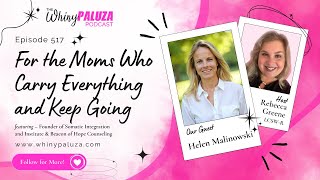
This content was created by Rebecca Greene. This content was uploaded by Rebecca Greene. This is a YouTube podcast episode titled "Episode 517: For the Moms Who Carry Everything and Keep Going" (recorded/created 2026-01-30). The excerpt is an interview-style conversation hosted by Rebecca Greene (introduced in the excerpt as a wife, mother of three and licensed clinical social worker) with guest Helen Malinowski (founder of the Somatic Integration Institute and Beacon of Hope Counseling, licensed clinical social worker and group practice owner). The discussion covers parenting and marriage support, clinician burnout and recovery, somatic experiencing and nervous-system regulation, building a sustainable 27‑clinician practice with strong retention, human-first leadership, boundaries, community and practical self-care tips for busy parents and clinicians.
Chapters
No need to whine, it's whiny palooza. Have some wine and join us on the whiny palooza podcast with Rebecca Green.
Welcome to the whiny palooza podcast. I'm your host, Rebecca Green. I'm a wife, mother of 3, and licensed clinical social worker. I also have 3 fur babies at home too. My passion has always been to help children and their families. I always dreamed of being a wife and a mother. Parents are always learning through their struggles, failures, and successes and joys. I am no stranger to this wild ride of parenting, and I know behind every great parent lies a team of supportive friends and family. I want to be part of your support system. I want you to know that you are not alone. We are in this parenting world together. Join me every week for insightful discussions with experts on parenting and marriage, as well as other parents who have found the secret to successes in parenthood. You'll learn tips and tricks to make life with your family better than ever. I hope you will follow along with me while we dive into what it takes to achieve a happy family.
Hello everyone, this is Rebecca Green for the Winey Pluza Podcast, and I am very excited today because I get to talk to the amazing Helen Malinowski. Helen, thank you so much for being here with me today.
I am really excited to have— to just be able to have this conversation with you. You have such a great show and you offer so much to all of your listeners, so thank you.
Oh my gosh, we, we have mutual admiration. I, I, I just can't even believe everything that Helen has accomplished. Let me tell you about her and you're gonna see why I'm so impressed. Helen is the founder of the Somatic Integration Institute and Beacon of Hope Counseling. Helen is a licensed clinical social worker, trauma-informed counselor, and group practice owner who has built a thriving 7-figure practice with an extraordinary retention rate of clinicians. While many therapists burn out while scaling, Helen has grown a 27-clinician practice with only 2 departures in 5 years. By centering nervous system regulation, sustainability, and human-first leadership. Through her work, Helen helps clinicians build practices that support their clients, their families, and their own well-being without sacrificing one for the other. So now everyone knows that we are going to learn so much from you. I mean, this is incredible. You know, therapists dream of building thriving practices. Few are able to do it without burning out. So tell us, what did you notice early on that changed your path for away from burning out to thriving, amazing practice?
I really wish that I could say I had one wake-up call, but I had, I had a couple wake-up calls. And my first wake-up call was when I was pregnant with my son, my second child, who's now 7. I was a clinical director at an addiction treatment PHP program. And I, I wasn't feeling well. I was having so much stress. It was the— it was the pregnancy was so much more uncomfortable than my first, a lot of morning sickness. And around about the end of my first trimester, I just decided I can't do this anymore. This isn't a role that suits me. I didn't identify it at the time as burnout. I didn't Oh, I'm sorry.
No, that's fine.
No, it's okay. It's terrible. I just— yeah, I didn't identify it at the time as burnout.
I—
what I thought was just that I couldn't handle it, that the job wasn't, wasn't suiting for me, or that, you know, I'm a preg— I'm, I'm, I'm pregnant, it's just too much stress because I'm pregnant. And I just didn't put the pieces together. Something that was actually like how I was balancing and living and making decisions in my life and in my role at work. So I left that job very abruptly and I opened a private practice 4 months pregnant.
Oh my gosh. Oh my gosh.
I, I wanted the flexibility. I decided I, I need, I need to be able to, my, I had a 3-and-a-half, 3-year-old at the time, and I am having another baby coming along. And I recognized, you know, kids get sick, I get sick, daycare closes, things happen. This was before 2020, thank goodness. And I just went out and I said, I'm, I'm like hanging my shingle, as we say in the, in the industry, and I am going to, I'm going to see clients. And I filled my schedule so quickly I bet. I went on— I know it was, it was very, very quick. And then I went on maternity leave, and I came back from maternity leave maybe 4 months after my son was born. And I felt the financial pressure of being in private practice. I felt I don't have vacation time, I don't have benefits, I don't have— you know, if I, if I take time off, I don't have income coming in. There wasn't there wasn't the cushion of working for an organization. And that, that worked to a degree because I needed the flexibility, and I appreciated that I could take time off and I could adjust my schedule. And, and then COVID happened. And I think a lot of people in our industry experienced this, and I know a lot of parents experienced this. All of a sudden, your world's, your world's flipped upside down. You You used to be able to have a little bit of, you know, if you were, if you were a working parent, you would have a little bit of time and space where you would, you would go to work and you would have these like adult interactions and then you would come home and you could be a parent and there was a community and there was a support around you. My parents live about 10 minutes away from me, so they were a resource. And then, you know, COVID happened and all of a sudden everyone's home. And you're transitioning clients that you've seen in person to remote, but you have your family in the next room and you're juggling and you're navigating nap times and bedtimes and schedules. And it was really, really hard. It was really, really hard. And it came to a point later that year where I realized this wasn't sustainable anymore and I was missing something. And I, at that point, was very— sort of serendipity is a word that I believe a lot in. Things happen for a reason. People come into your life for a reason. I met, I was introduced to someone who was looking for a clinical supervisor. And I thought, this is great. This is different. This is something that's going to, it's going to be different than the trauma work that I'm doing. It's going to be supportive. It's going to be another adult that I'm connecting with. And that was the beginning of the growth of my group practice. That was the beginning of me realizing that community is what's the essential missing piece in my life at that time. And it was what I needed to protect myself against that level of burnout that had been accumulating and building in my system. I also discovered Somatic Experiencing at about the same time. Again, serendipity, a lot happens. Sort of overlapping. Yeah. Yeah. And that, that learning of how to regulate my own nervous system was another key component in recovering.
I mean, you, you unpacked so many things. I have so many questions bubbling. So a lot of people listening don't know what the whole somatic experience is. Can you explain that to them?
Or so I would say in the layperson's, the easy terminology is it's connecting with the experiences that you're— the sensations that you're experiencing in your body, connecting with them, being with them, and allowing them to, to guide your choices in your decision making. So I think at a very basic level, that's what it is. Now, it's used in a lot of trauma therapies, because Trauma often disconnects us so much from our body. We separate from those physical sensations of stress or anxiety or fear or sadness and panic. We disconnect from them and we experience, you experience hypervigilance and we experience dissociation. And so those are the trauma symptoms. But that's not to say that they don't show up in those sort of experiences, don't show up in a person's everyday life. Parents who are parenting children with neurodivergence, parents who are neurodivergent will absolutely resonate with that sense of being overwhelmed and suddenly unable to think or unable to make decisions and feeling very stuck in that place. Somatic approach supports a person in connecting with those bodily sensations, building capacity to experience them, without overwhelm and allowing integration so that we can then process and make sense of what's happening.
I mean, it sounds amazing, and you and I know how hard this is to learn. So, you know, I'm thinking about— I don't think there's one person who goes through their day without a sense of overwhelm at some point. We're juggling so many things— work, kids, whether you're a clinician or a mom at home, we get overwhelmed and our nervous system is like, rrrr. So can you give us some tips, whether we're at work or home, how to just regulate ourselves?
Right. So the first thing that I always do for myself is what's called grounding and orienting. So grounding can be as simple as something we're doing when we're sitting here right now. We're really just noticing our seat in the chair, the support of the chair behind us, our feet on the ground, and bringing our awareness to those supportive connection— connecting points allows our nervous system, allows our inner experience to just take a little bit of a breath. I'm being held. My chair is holding me. The ground is supporting me. Another strategy that I find really helpful is taking in my space. I might be very overwhelmed. There might be a lot of noise. There might be a lot of chaos. But there's going to be something in my environment that feels steady. And so I'm going to look around the room for that. And often, I look outside of the room. I'll often find myself looking outside the window and catching an animal. Or I think you're in upstate New York, right? Yes.
Yes.
So there's not a lot of animals probably out right now. It might be the weather, it might be the look of, you know, I look out my window, I'm in Massachusetts, and there's something about the color of the pine trees next to the bare branches that is just, ah, like, that's just the nature that's happening out there. And it's saying, there's really, there might be a lot going on right now, but it'll be okay. The world is just continuing to spin around. And so finding that one thing that lets you just take a breath.
I love all of that. My, my son recently went away to school to a gorgeous campus, and he was telling me one of his coping strategies is just observing the gorgeousness around him. It really grounds him. Mm-hmm.
Yeah, absolutely. I actually have started— this is a little bit more of the therapy world, but I've started doing some nature-based therapy.
Oh.
So I'll go for walks. I go for walks with my clients.
Oh my God, I love this.
It's beautiful. And this morning before coming on here, I was out at Cranberry Bog with one of my clients. And we were going for a walk. And we were looking for different animals and just reflecting on the different tones and colors. And it doesn't feel like work. You know you're doing work. You're doing nervous system regulation work. And funny, because I went for a walk with my son at the same place yesterday afternoon, and it felt very similar. He's running around, the dog's running around, and I'm like, oh, so nice to be out here.
That's amazing. That is probably the best therapy that you can have, is taking a walk while, while talking to your therapist. That sounds magical. You've got the perfect formula right there. So you're You're running the practice and you're still seeing clients.
Yeah, I'm seeing— it's a much smaller caseload. When I first started bringing on clinicians, I was going full tilt, seeing 30, you know, 30-something clients a week. And that became— I quickly realized that if I'm going to supervise and I'm going to run a practice and I'm going to be a leader, I can't have all of my time dedicated to dedicated to one-on-ones with clients. I needed to make some adjustments. And so primarily that just happened through attrition— clients who, you know, just really, they were now being seen twice a week, now once a month, and just sort of doing much better. I also realized that even with that reducing of my caseload, there are certain things— and I think that this is really important for, for a lot of us in our world to think of as, as moms and as parents, to say, I think I can do it all. I think that I can do it all. I can carry all of these responsibilities and all of this decision-making. And the reality is there are some things that I am just not good at. It is a— I want to call it a running joke, but it— I am not— I do not enjoy cleaning my house, and I am not very good at cleaning my house. And there came a point when I said, this is something that takes up not just my time, and I'm not good at it, not just my time. I'm a little embarrassed saying I'm not good at cleaning my house, but I'm just gonna let that one go.
I'm not either.
But no, there's also this mental energy that goes into thinking about the fact that I need to clean my house. And so finally I said, we're going to find someone to come in and help us clean the house because—
brilliant—
it's just not, it's not benefiting, it's not benefiting our family to have this level of, you know, stress and discomfort and, you know, happiness that it's bringing, um, to moms. So it's not— that's a home life example, but I think the same thing applies when you're thinking about your work and your business and growing your practice. There are certain things that I should not be in charge of, even though I'm the business owner. I should not be in charge of them. So finding people to help you where you need help and asking for that help, and then trusting into your intuition with people, that this is a person that I can build some trust, that they're going to take the ball that I'm throwing at them and they're going to run with it, and they're going to come back with answers that are the answers that are going to be in the best interest of the business. So yeah, it's kind of learning, learning your strengths and learning how to ask for help.
Yeah, I mean, none of us can know everything. I mean, I'm not going to be my own accountant, I'll tell you that.
No, I'm not either.
No, that's just one that I just give right away. I'm not gonna do that. Well, and this kind of goes along with my next question because, you know, you have this big team to support and you don't wanna sacrifice yourself in supporting them. And I think that goes for mothers at home too. We don't wanna give everything to our kids and sacrifice ourselves. So how do you support them but not give all of yourself?
That's where boundaries come in. I talk a lot in my work about what I, what I call embodied boundaries. And so it's not— I think that there's a narrative out there, a social media narrative out there about boundaries as being something where it's like, if this isn't working for me, then I'm just going to say no to it. But Boundaries are much more fluid and flexible than that. I think of them a lot more like a cellular wall. We have to decide what we let in and we have to decide, you know, what's not good for us, not good to let in. And that's something that needs to be felt and embodied. It's not the words that are coming out of our mouth. It's how we operate in our interactions on an everyday basis with people. And that's something that is a skill and a felt sense that you can build with practice and with support. Often, I don't think it comes naturally for many of us. I think it's actually trained out of us in childhood, quite frankly.
Yeah, I think you're right. I think you're right. I think people don't know what it really means.
They don't think they do either.
No. I mean, I see people doing things and I'm like, oh my goodness, there's got to be a limit, people.
At some point, at some point you need to say no. And I think it's really hard with our children. I, I think back, I think about what I have a hard time saying no to, or areas where I find myself bending and caving. And then I reflect, well, what was my own childhood like? What were those needs that were being met or not being met? And how am I trying to adjust and accommodate? I do think that boundaries are something that we we need to just continue to work on. And I've been a huge fan of the word boundaries. It's an embodied sense of what I'm responsible for and what I'm not responsible for.
And we can't do it all. We cannot. Nobody can do it all, even though we think that we can sometimes. Yeah. Yeah.
We'd like to be able to do it all. That would make things easier, wouldn't it, to not have to trust that you can have to hand something off to somebody else or that they are going to handle it the way that you would like them to handle it. They're going to handle it the way that they're going to handle it.
Yeah.
And as especially our, our kids, as they get older, we, we lose, you know, incrementally more and more control over how they're going to handle things. They go off to middle school and they're navigating friendships, and it was so much easier when they were 4 or 5 and we could help them figure out how to navigate these, these interactions. And we We want to be protective, but at the same time they need to experience challenges and how to overcome these challenges. So as a team, when it comes to, when it comes to the household, that's, that's, I would say I apply that similarly to my team. I, I have to trust that I've brought the people on that know what they're doing, and my clinicians are really skilled clinicians, and then I build in a a system of support. So we integrate group supervision and individual supervision and team meetings and quarterly all-staff meetings. We have one this afternoon. I'm excited about those things because these are opportunities for us all to make sure that we're on the same page and that our values are still aligned with the business values. And I can see, I can watch these different layers of support building out and growing over time.
I mean, it sounds like a dream to me. And I think that one of the things that you touched on is that I think when we're working alone, you know, I was telling my husband this because, you know, I get to talk to you, but I don't have, you know, a community. And I think that when you work in a community, when you're a mom at home and you have a community, the stress goes way down, way down.
It goes way down. About 2 years ago, was it 2 or 3 years ago? I like to run, and one of my coping strategies— I don't run as much anymore, but one of my coping strategies during COVID was that I would go for these runs.
Yeah.
And I would, and I would, I would do them by myself because it was this opportunity for me to clear my head and get some space and get some exercise. And then about 2 years ago, I realized I don't want to run by myself anymore. I want to run with other people. And I reached out to some friends that weren't close friends at the time. I just knew that they liked to be active, and we started a running group. And for about 2 years, we met every Thursday morning, and we would go for a run before, you know, at 6:00 AM, before our kids had to get up and go to school. And it was— it's just a great support system. We would joke that who needs therapy when you have a running group of moms?
It's so true. It's— I mean, that is such a good idea. I mean, whatever it is, you know, I have a book club, like, whatever brings you joy, bring other people into it, right?
Bring other people into it. Build the community. You don't have to find the community. You can build it yourself. You just have to know what it is that you're passionate about, and those people are gonna— they're gonna come, they're gonna show up, and they're going to everyone's going to benefit from it.
Agree. I totally agree. I do think somehow along the way burnout has been normalized. It's like I see people, they think it's like a badge of honor. So, so how, how do you think that we got there and how do we shift people to know this is a warning sign? This is not a badge of honor.
Exactly. How did we get there? That's probably the million-dollar question. I— societal. It's societal. It's something about the way that we are, we are taught to pull up your boot— pull yourself up by the bootstraps and work harder. You know, you're gonna, you're gonna be more successful if you put in more hours. I know that that's something that is a message in the even in the therapy world where we should know better. I don't want to say that in any sort of, like, judgy kind of way, but we do that. We work so hard with our clients on recognizing these things. How do we miss them in ourselves? But I hear this all the time. I hear, like, the only way to make more money is to work more hours. Or I'll hear, I have to work harder because my clients have so much need and I have so much to offer them. So there's this this feeling of, of maybe scarcity or a sense of responsibility towards the work that is in excess of what's necessary. And in fact, I think it's in excess of what's actually beneficial to our clients. There are ways to be successful without overworking yourselves. There's ways to ask for help and to figure out how to balance how to balance all of the different things that you need to do in your day. And balance is not the best word, but how to, how to bring in resources and supports. Because quite frankly, if you're asking for help from someone, they're at some point going to turn around and ask for help from you, and you're going to be so happy to offer it because it's been given to you. And so it becomes this reciprocal, these reciprocal relationships that we've lost I don't remember the last time we've had good societal reciprocal relationships. It just feels like the communities have sort of disintegrated, and it's going to require a lot of effort on an individual people's parts to try to rebuild them.
Yeah, I mean, I definitely was one of those people that thought I was supposed to go full throttle all day. And then you learn that you're showing up for whether it's your clients or your kids. You're showing— you're not showing up as your best self. You're showing up as you're, like, exhausted. Depleted self.
You're depleted and you don't have the energy to, to actually engage in a focused, present conversation. Or you're playing— my son loves to play games, so you, you say, I don't have time to play a game, or I don't have the energy to play a game, or I'm too tired. Or you sit down and you play a game and then you get distracted. Because what do we do as, as Right now, when we get overwhelmed and distracted, we often turn to our phones because that seems to give us this sense of relief and escape. And that's not present. Mm-mm. And I recognize these things. I say all this stuff and I'm like, you know, this is a work in progress. I'm still struggling with some of these things and trying to work on them and recognizing that I'm working too late or I'm picking up my computer at a bad time. I think my husband said the other day, he's like, work has boundaries too. And I'm like, it does, it does, it does.
I know, I know. I felt so bad because I was trying to print at 9 o'clock at night, and there's, there's my husband with all my stuff up that I have to print, working with the printer and my computer. And I'm like, oh God, I just gave him a buttload of work at 9 o'clock. Oops. Thank you, husband.
Thank you so much for helping me.
I'm like, I can't fix the printer. This is your job.
Printers are— printers are like the bane of my existence.
Oh my God. Oh my gosh. Yeah, we've gone through a lot of printers. But I have to ask you, what is human-first leadership?
Ooh, human-first leadership. I— human-first leadership is is leading from— it's leading from your heart. It's leading from a place of recognizing that we have— clearly there's business goals and requirements and necessities. But when you're leading, whether it's at home— and that could be like household goals and requirements and the necessities. We can compare these two things. But when you're leading from your heart, what you're doing is connecting with the person and really trying to understand where it is that they're coming from and what it is that they need to be supported and to succeed. And it's not that you're doing it for them. It's this recognition of who they are.
I love that. That's really important for anybody's success. That's the support that they need. I love it.
With our kids, that my child's having a hard time right now, and as much as I would rather they stop having a hard time and get their shoes on and we can leave the house and go to school, that's not what they need right now. What they need right now is for me to meet them where they're at, and then we can lead them through whatever it is that needs to happen so that we can finish the morning and get off to school. Yeah, and that's hard to talk about, requiring an ability to regulate yourself. That's so hard. That can be so hard.
I think leaving the house is probably what moms need the most help with. When, when all 5 of us are in the car at the same time, every single time— I mean, they're older. I mean, my oldest is 18. I still get this sense of accomplishment We're all in the car.
There are moments I look back on and I can say, man, I wish I knew what I know now then because I would have handled that so much differently.
Oh my gosh. Yes. I think about, you know, the 1-year-old having a fit that she wanted to put her own shoes on and I was rushing her out the door. I would have handled that so differently.
Differently.
We just learn as we go.
We learn as we go, and we try our best, and we apologize and repair, and yes, try to do it differently the next time. And yeah, modeling that ability to repair when something has gone wrong is— that's, that's important. And that, and that's important as a parent. It's also important as a leader and an employer.
Yes.
And as a clinician with your clients. I mean, it's probably foundational in building strong relationships.
I agree with you. It's something that I'm trying to teach my children. So as you look back—
Listen, it's something you just are kind of, I think, always learning how to do a little bit better.
I hope so. We just hope we're doing a good job. We— listen, we show up and we try every day, so we're successful. That's success right there.
I agree 100%.
So, you know, you have such sustainable success. I mean, when you look back at your journey, you're looking back early compared to now. How does sustainable success look different to you now versus then?
That is such a great question. I've had this, this, I, what I would sort of describe as growth in my view of how I see myself as a leader that has shifted from this— I feel a responsibility towards the success of my clinicians working with their clients, the success of my clinicians feeling supported and as though the job is meaningful to them. Like, I want to create this environment where our clients are having their needs met, where the clinicians' needs are being met as employees and as clinicians, and where the business's needs are being met. And I think there was a period of time where I prioritized the people over the business, and I have found in this sort of shifting leadership dynamic a balance. That feels so much more sustainable that I, I don't have to— it's not at the expense of one if I'm focusing on the other, because they all work together. They're like the three, the three legs of a three-legged stool. Like, you can't remove one and expect the stool to stand upright. And so feeling that balance and being much more grounded in my responsibility towards that entire system has been a shift that I think has really led to more sustainability in my business and more sustainability in my own role as a leader. I feel more confident, I feel more centered and grounded and ready to navigate or discuss or explore whatever it is that might— we might— the challenges that we might be facing. And it's a shifting landscape. We're an insurance-based practice, so there's constant shifts and things to be paying attention to and regulations that are changing. So it's, it's, uh, but, but being grounded, being, feeling like I, feeling like my feet are really firmly planted, I would say, is, is the big shift that has led to a sense of real sustainability.
Well, and I want to tell you, from sitting on the other side of this interview, just your you're very calm and grounded to talk to. So, like, I can see whether I'm the clinician coming to you, the client coming to you, whoever I am, I can see that you have the ability to really stabilize people.
That's what I've been working on for quite a long time. And I will just— I don't want people to think that this is something that just comes naturally. I don't, you know, this is something that is that you work on and you practice and you get help with and you talk to people. One of the beautiful things about the Somatic Experiencing program, and a lot of major training programs like IFS and EMDR, they require you to learn how it works as the client.
Yeah.
So you go through these personal sessions and these case consultations, and so much growth comes from those practices comes from this, like, learning. And it's not growth that I just have new tools and new skills. It's growth that I'm making changes internally that help me to feel more centered and grounded and able to be present even when things feel kind of chaotic.
Grounded in the chaos is a very amazing skill.
Well, it's like I said, it's a work in progress. There's always our moments. Nobody— I don't think there's anybody out there that handles this, handles everything perfectly. So I have my moments. We all have our moments.
Yes.
Yes.
And I'm trying to teach moms not to beat themselves up when they have those moments.
Don't beat yourself up. Again, you can just say, wow, I did not handle that the way that I wanted to handle that. I was a little bit in too much of a panic. And I can just put my feet on the ground and take a deep breath and look around and realize that The sky is not falling right now. We're going to figure this out. And do I need to apologize to anybody?
Excellent question. So, so I think that we just discussed part of what the answer is to my next question, but you have an excellent retention rate. Your clinicians stick around. So what do you think the secret of that is?
I think that it's, I think that it is the supportive system that we put in place in terms of our supervisory structure. I will say that I did just have 2 clinicians give notice because they are independently licensed, moving on to the next stage of their career. And one of the things that I view as our organization is that we are an organization that wants to support people in learning. How to be a clinician and learning how to be a therapist. And we do have a number of pre-licensed professionals or lower licensed social workers. And so I expect, yeah, that there's going to be people that are going to say, I just got independently licensed and now I'm opening my own practice. And I am supportive and encouraging of people to do that. So in terms of the retention, we have a very strong— like, I think I already mentioned, we We provide weekly group supervision. You have a cohort of people that you're meeting with, with an independently licensed supervisor. We have individual supervision. We had a retreat. We have an annual retreat once a year. So we had ours in October where everybody gets together and we did yoga and we played games.
Oh, I love that. So there's—
I think it's this building of a community around the shared values that we have as an organization of determination and dedication. Collaboration, I would say, is like one of our, one of our really big values as an organization, that we're going to work together, we're going to learn from one another, we're going to ask for help, we're going to offer help. And that community is—
it's harder.
It's easy to leave a job. It's a lot harder to walk away from the community.
Yeah, sounds fabulous. You've really built something wonderful.
Yeah, I hope everybody feels that way.
I think they probably do.
We, we will run— we'll send out a questionnaire and see how everybody's doing. But no, we, we like feedback and we want to hear from people, and we're, I think, very just open to everybody's growth.
Love it. So in your day, in your busy, busy day, You know, and I didn't realize you have young children, so I'm even more impressed with you. So you're working, you're juggling the kids, the day is busy. How are you— tell us about self-care practices that you're integrating into your busy days.
Absolutely. So one of the things, my kids are both— my kids are in middle and elementary school, so I have really restricted my— to the best of my ability, I've restricted my face-to-face time with people to the 9:00 to 3:00 timeframe when they're in school. It's not 100%. Sometimes I'll have meetings when they're at gymnastics practice or various other activities. But I think that that's been really important because I, I don't want to be busy when they're home. And that doesn't mean that I don't have other things that I need to do. But in terms of self-care, I try to go for a walk after I drop everybody off in the morning. Morning, so I'll take my dog for a walk with us, with a client, which is actually self-care for me as well. Or if it's just me and the dog going for a walk, I will spend that time— and this is like the working mom who also has an animal— I often, I may spend that time also checking emails or listening to voicemail messages or thinking about things, you know, what do, what do I want to— what's been going on in my life that I want to share with people, whether it's through a newsletter or a meeting with a clinician or preparing something. I do throughout the course of any given day, and this is something I think everybody should figure out how to weave in, I call them micro, micro-regulation moments. And it could be, it's stuff that I can do even while I'm sitting here talking to you, right? It's paying attention to the back of the chair. It might be wiggling my toes on the carpet. And it could be at the end of a call or at the end of a, a meeting or a difficult moment, just kind of like brushing the day off.
Mm-hmm.
Changing my clothes at the end of the day if I wanna get out of washing my face. Things that are self-care but don't take a huge amount of time that just feel, make me feel a little bit more fresh, a little bit more like I'm not carrying what I was just doing into the next thing that I'm doing. I'm able to put it aside. I'm able to compartmentalize— not compartmentalize in a bad way, but to say, I'm gonna take that difficult conversation and I'm just gonna put it right here for now, and I'm gonna come back to it, and I'm gonna see if it's something that I need to revisit, but I'm not going to let it stew in my system. And so, yeah, so that shaking, dancing, music, Music, listening to music, that's a big one. We are always listening, especially when we're driving places in the car with the kids. We have got so many different playlists and we're listening to all different kinds of fun stuff. Fun, weaving in ways to have a good time. And I will say the other thing, and not everyone's going to agree with me on this one, I don't pay attention to the— I don't watch the news. I know what's going on in the world. Yeah, I know enough of what's going on in the world, but I don't consume the news. In any kind of deep way. I've, I've curated my social media so that I'm not getting inflammatory information. I'm very aware that when I see videos of things that are bad and scary and dangerous and hurtful that are happening out in the world, the videos are— they stick with me. It's like they, it's like they get themselves into my system and I have a much harder time shedding them. I, the images will get stuck with me. So if I know that there's something that's, that's tough that I need to know about, I'll try to find an article to read rather than watching it. And yeah, so that's, that's a big self— I think that's a big self-care. That's a boundary really that I've set for myself. That's, that's protective. I don't need to be carrying the weight of the entire world on my shoulders. There's, there's things that I have control over and there's things that I don't have control over.
Yeah. Well, and I love what you're saying because, you know, for you, the news does not work. So I think people need to figure out what is not working for them, what's not working for them, what—
and I, and I encourage people to take a look at their day and be, be curious about what activities, what events, what people give them energy, what, what fills their cup, what makes them— they leave that whatever it might be, they walk away and they say, ah, I just feel like, like a fresh glass of water. Like I feel so good and light. And, and what things make them feel heavy and tired and drained and what's neutral. And then if the things are making you— neutral's fine. There's gonna be some things that just don't affect us one way or another. But yeah, fill your cup with the things that fill you and try to just be aware of minimizing or cushioning the harder the harder things, you know, provide some window around it. Make sure you're taking care of yourself afterwards.
Very good advice. So I'm going to have you leave us with some— you're, you're super successful and there are people listening who are not feeling successful, whether it's at home, at work. Can you give them some last-minute advice to help them feel more successful?
I think that we have so many moments of success in our life that we do not give ourselves credit for. We are— and I don't know why this is, it's a negativity bias if you want to get psychological, but we tend to pay attention to the things that we didn't do well or that are upsetting to us.
Sure.
Someone criticized, right? I would say if you, you know, give yourself a—
it's called—
someone used this term, and I think they called it glimmers.
Mm. I love that word.
Yeah. Make a note when something feels good. Make a note when you're successful. Make a note to yourself and write it down. If you have to write it down and you have to say, I'm going to look at this again at the end of the day because I know that I had a successful day, but I'm getting stuck in the things that didn't go well, go back to it at the end of the day. Look at it in the morning. I have a, I have a someone I know who, whenever she gets an email that's like a praise of some sort, that's like, oh, like, I am so appreciative of X, Y, and Z, she stores it in a specific folder in her email, and she'll go back to that folder and she'll open it up if she's having a bad day. I'm like, that's amazing, that's such a good idea.
That is such a good idea. I'm thinking about the cards that I saved, and I need to put them in a special box or something. I love that. So anything that I didn't ask you that you think is important to share before I let you go?
I don't think so. I do have— I invite people who are curious about their own burnout and whether it's something that's actually happening for them. I'd invite them to go to my website. We do have a free burnout assessment, and that's, I think, really informative. It helps them. It helps to tease out different areas because we all experience burnout in different ways. So it looks at things like your social interactions and your emotional state and your physical state. It looks at these different categories of your life, and it'll, it'll share, it'll tell you, you know, this is an area that you should work on, and these are some things that maybe you could do that would be helpful. So I'd invite people to go to my website, somaticintegrationinstitute.org/burnoutassessment. And I will email that to you so you can share the link and, and people can go and they can just take it. It takes a couple of minutes and, and see if there's something that they wanna do differently or integrate into their life a little bit differently. And they could also follow me on Somatic Informed Therapies where we're on Instagram where we provide, you know, tips and tricks and tools and ideas and strategies. Awesome. Or just taking care of yourself. Yeah.
So is your practice— do you guys see people from everywhere? Do you see people just in Massachusetts?
Beacon of Hope Counseling is Massachusetts-based.
Okay.
Massachusetts-based practice. Yeah. Yeah. But we have referral networks out there, and I think there's a lot of great programs. And if people had questions about how to access— maybe they're interested in, oh, this somatic thing sounds really interesting, but I live in Texas. Reach out and I can provide some direction on where to find local therapists who, who practice in that way. Yeah.
Well, I knew I was gonna love talking to you and I just really appreciate your time and your expertise today.
Thank you. It was wonderful, wonderful talking with you as well.
This is Rebecca Green and I want to remind everyone to spend every day laughing, learning, and loving.
Thank you for tuning in to the Winey Palooza podcast. If you like what you heard, please be sure to subscribe so you never miss an episode. While you are there, leave a review. I love to hear your feedback. Thank you so much for listening. Until next time.
This show has been produced by Market Domination LLC. To discover how you can have your own show completely done for you and turn it into a real published book and become the authority in your marketplace, go to www.marketdominationllc.com. Podcastoffer.










