The Whinypaluza Podcast with Rebecca Greene Episode 116 Handling COVID Stress
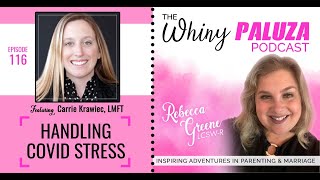
In this episode of the Whiny Palooza Podcast, host Rebecca Greene (a licensed clinical social worker, mother of three) interviews Carrie Krawick, a licensed marriage and family therapist who specializes in communication, problem‑solving, and the Parent Management Training Oregon (PMTO) model. The conversation centers on the myriad ways COVID‑19 has amplified family stress. They explore how couples and extended families negotiate differing risk tolerances, the importance of setting clear boundaries, and the impact of excessive information consumption. The hosts discuss children’s heightened anxiety and separation issues, offering practical strategies such as monitoring media intake, using time and space as personal boundaries, and applying a 5‑to‑1 positive‑to‑negative reinforcement ratio to reshape behavior. They also address the post‑lockdown tendency to over‑schedule children’s activities and the need to find a balanced middle ground. Carrie explains how virtual therapy expanded during the pandemic, while also noting state licensing limits. Throughout, the dialogue blends personal anecdotes, clinical insights, and actionable advice aimed at helping parents protect both physical health and mental well‑being during and after the pandemic.
Chapters
No need to whine, it's Whiny Palooza! Have some wine and join us on the Whiny Palooza Podcast with Rebecca Green.
Welcome to the Whiny Palooza Podcast. I'm your host, Rebecca Green. I'm a wife, mother of 3, and licensed clinical social worker. I also have 3 fur babies at home too. My passion has always been to help children and their families. I always dreamed of being a wife and a mother. Parents are always learning through their struggles, failures, and successes and joys. I am no stranger to this wild ride of parenting, and I know behind every great parent lies a team of supportive friends and family. I want to be part of your support system. I want you to know that you are not alone. We are in this parenting world together. Join me every week for insightful discussions with experts on parenting and marriage, as well as other parents who have found the secret to successes in parenthood. You'll learn tips and tricks to make life with your family better than ever. I hope you will follow along with me while we dive into what it takes to achieve a happy family.
Hello everyone, this is Rebecca Green for the Whiny Palooza podcast, and I'm so excited to have Carrie Krawick with us today. Carrie, thank you so much for spending time with me today.
Of course.
Um, Carrie is a licensed marriage and family therapist at Birmingham Maple Clinic in Troy, Michigan, and formerly the executive director of the Michigan Association for Marriage and Family Therapy. Carrie specializes in treatment of individuals, couples, and families with a special focus on communication, problem solving, and improving relationships. Kerry is specifically trained in a model called Parent Management Training Oregon, a behavior management technique for parents to utilize with children to prevent and reduce behavior issues in school-aged children. Kerry is herself a married mother of two, a 7-year-old and a 7-year-old boy and a 4-year-old girl. So you are in it with us.
Yes.
And you know what we're doing every day.
Yeah.
Oh my goodness. So I would love to start with what inspired you to become a therapist?
Oh, you know, it was just a really great class at my undergrad at Michigan State University. And I was approaching, you know, my junior or senior year and what am I going to do next? And, you know, had the fortune of having a guest lecturer who is himself a licensed marriage and family therapist, which really opened my eyes to it as a discipline separate from psychology or social work or those other, you know, mental health professions, and it was one that really clicked for me.
That's awesome. Well, there— we just talked about this before I hit record— there's so much COVID stress right now, and as we discuss this, my husband is upstairs working. He has COVID right now.
Oh no.
So it is just everywhere and everyone is talking about it. Everyone is stressed about it. And I know you can help us.
Oh, good.
So I'm going to give you just some scenarios people are giving me and we're just going to see if we can help people.
Yeah.
So I had one woman, woman reach out to me and, you know, this is so typical of what's going on right now. She has some health issues. And wants to stay home a lot and is, you know, protecting herself, and her husband is much more extroverted and wants to go out and see people. And I mean, this is a typical disagreement.
Sure.
So I mean, how can we help people through these differences of opinions?
Absolutely. I mean, I think it is exactly that, you know, is like, what, when are they opinions and when are they like life or death health issues? You know, like I think that That is a really, really important distinguisher, right? But I think also is, you know, we're of course protecting our health, like in one regard with COVID but are we protecting our relationship health? Or are we also thinking about the long-term health consequences of our relationship conflict, right? And so, you know, yes, yes, we should be protecting ourselves from the virus, but are we also taking other actions to protect and stabilize our relationships, our mental health? And are we weighing these things all equally, or is one getting maybe unfair undue attention? I mean, I do think, you know, one piece of advice I've been giving is to monitor the information you're taking in. So just like the virus, you know, they say people get more sick when they get more viral load, right? Is that like sort of your more exposure, the more sick you're likely to get? The same is true with the conflictual information. If you're getting a lot of information that you know, the virus is out there and it's scary and a lot of people are getting it, it might be okay to pause and not, not watch so much news or not, you know, to take, you know, to take a break from social media or those things because, because you might be getting too much information that makes the world sound quite a bit scarier than perhaps it may be.
Well, that is such good advice, and I will tell you that social media can really stress me out, so I know for myself sometimes I need to just put it away. Just walk away. You know, families are not agreeing within families on so many things. Families are fighting about this one wants to be vaccinated, this one doesn't want to be vaccinated, this one wants to have Christmas together, this one doesn't want to be around. I mean, this is really affecting family and friend relationships.
Yes.
So how do we, how do we navigate the differences of opinions within our family and still maintain relationships?
Right, because those are also good for you and healthy to have. Absolutely. You know, we're hearing the same thing, you know, in the couples that I work with or even families, people I know, you know, in my own real life where, you know, maybe a couple says, well, my parents said, you know, they won't see us or our kids if we're seeing your parents too. And it's like, well, how unfair is that to, you know, boycott one set of grandparents and not the other? Or, you know, that people are even giving their siblings or family members what we see as this person as a safe person and then these people as unsafe.
Oh, you've heard it all.
Yeah, we've heard it all. And it's really unfair. I know adult siblings where one is pregnant and the other has a baby, but now they're, who does the mom get to see? And grandma's stuck in the middle having to pick between her own daughters and grandchildren. And it's such an unfair situation for everyone. So I mean, I think, I mean, it's hard because who it brings to attention, you know, who has the most control, you know, in a family. It might accentuate some roles that have already been at place, you know, like who gets enabled, who gets the attention, you know, and it might just magnify that even more. So I mean, I think certainly, you know, if the conflict is severe enough, having a, you know, unbiased family therapist to help navigate that. And now with Zoom and everything can be done easier than ever. You know, even kids who aren't even in this— or adult kids, you know, families that aren't even in the same state can, you know, meet with a professional and problem solve and talk these things out. I think if you're the person with the stricter rules, you know, to evaluate, like, are you being entitled or resentful or, you know, overstepping boundaries, right? Like, are you trying to enact rules for another household? You might be outside of your realm and really evaluating, is that good for you? Spending a great deal of time worrying and, you know, wondering about what's going on in someone else's home is really not for you. You know, you need to sort of take a— take control of what you can control, which is really only you and your household.
Oh, I love that advice. I think that boundaries is the best word that you brought up because I think that the boundaries are getting blurry within extended family members.
Sure, sure. And I love it because, right, part of— so what I, what I always educate people is that our two most, our two most important boundaries we have with us at all times are tools that we're always able to use, our time and space. So, you know, if there's something going on in the moment that's conflictual and you need time or space to take care of yourself, or time or space to process, you know, to go by yourself, think, reflect about what you may need, or some ideas or solutions you have, and then come back. Another thing I always notice, an indicator about boundaries, is resentment or guilt, right? So if you're feeling a great deal of resentment, that might be that, like, you're trying to influence some other people's boundaries. You might be pushing a little too hard at places. If you're feeling a great deal of guilt, it might be a sign that you're getting pushed, you know, by someone outside, someone else. And so to really evaluate where you stand on an issue, guilt or resentment might be an indicator you're in a space you don't belong in.
That's such good advice for everyone. And I know that that's going to help so many people based on all the families that I've talked to. It's, it's so interesting. It's very similar in each family.
We're all here.
We're hearing similar stressors in each family.
Yeah.
And one of the stressors that, you know, made me want to cry was I had a mom say, my daughter is having such anxiety. She doesn't want to go to school. She doesn't feel safe.
Yeah.
So how can we help parents with their stressed out children?
Yes. Well, I think, yeah, absolutely. And I, you know, I've seen this even with my own kids. My now 4-year-old at the start of COVID was just an outgoing 2-year-old who was out in the world talking to everyone, you know, and now we've really seen now she's got, doesn't want to go to preschool because we held her back one year because we didn't know the status of what school would be like and the difference The difference between starting at 3 and starting at 4 means that she knows it's optional and she doesn't have to be there, so she acts like she doesn't want to be there, you know, whereas at 3 she would have just thought this is what kids do and scooted on her little merry, merry way. So, and in my, my older one, we've, we've also dealt with a great deal of separation anxiety. Same thing, he was a kindergartner when this started. Now he's in second Yeah, and they were doing, you know, different forms of hybrid and virtual. And so again, he feels like the best option for him is staying home with me, you know, when I know the best thing for him is going to school. And once he gets there, it's fine. But, you know, so I think, you know, with kids, especially now we're coming off of, you know, holiday break and stuff. And so, you know, you expect to see a little more separation anxiety. The routine has changed. They have been home. They haven't had the demands of their school day. We haven't had the demands of our work day. So you'd expect some separation anxiety. You'd accept— expect some resistance. So it's really the intensity, right, is like— and the duration. How long does the separation anxiety exactly last? How big does it get? And do you— if you don't— if you're not seeing it diminish over time as the routine is going, then it's probably a sign they need to see a therapist or psychologist or get properly evaluated and treated. But yeah, you expect to see it a little, and even like, you know, Mondays after a nice weekend or something. But you know, what you want to hear from the teachers in the school is like, once they're there, you're out of sight, out of mind. And the truth is, is really as a parent, being encouraging and supportive and optimistic too, right? Like, you're— you can get through this, you can do hard things, as opposed to caving, right, which really reinforces the behavior.
Oh, such good advice. And I think they're modeling us. I think some parents are just so stressed out and they're not seeing that they're feeding into their children's anxiety.
Sure.
Right.
Sure.
And I also think, you know, just based on what I'm seeing at school is when they're connected to someone at school, don't you think it's so much easier for these kids?
Yeah.
Just to have someone that they're feeling so connected to at school because some kids don't have, some kids don't have that.
So I think Well, right, and nor could they really very easily develop it. You know, I think of like the little kindergartners and first graders on Zoom, you know, they're not texting their friends or anything. They're really just seeing their little, you know, faces like Hollywood squares and, you know, not really able to yet develop those relationships. And it certainly does make a huge difference. So my little guys, my little guys' school, they're socially distancing even the playground. So like fewer kids on the playground, which means all the second graders don't play together. So if you have a little buddy in another class, there's a chance you won't get to see them even at lunch because they're, you know, doing recess by, by class. So we, that's what we spent the Sunday night after break kind of brainstorming. Whom are we— because, you know, my little guy was upset, like, I don't know who I'm gonna play with at recess. And it's like, okay, well, let's start tonight and think of who we might use as options and how we might ask them and You know, what, what do these kids like versus those kids? And where do you think you might fit in well? And we got through it. It's working.
And I love that we're talking about this because I think that people are so focused on physical health, which I love. I want us all to be physically healthy, but we forget about these mental health issues.
Absolutely.
It's like coming second to health, which, you know, I understand our health comes first, but yeah.
But they are all connected. People with healthy relationships are physically healthier. That the stress, even managing stress well and, you know, deep breathing and all those things are so good for both our physical and our mental health. And right, like, right, what masking provides safety from the virus may reduce our ability to do deep breathing. People may be experiencing like panic or shortness of breath in ways they don't even realize. That are also contributing to their health. Yeah.
Oh my gosh, it's all connected. It's such a good point. And I think that women that I have talked to who are staying home more, you know, we all used to see each other more. And I think the contact is just so good for us. And I don't want us to lose that.
Yes. Yes. Yeah. Well, right. Even, you know, yeah, absolutely. I work part-time and part of the week I'll also do things like take my kid to dance or gymnastics or whatever. And now, you know, parents are waiting by themselves in their cars as opposed to when the moms and grandparents and whatever could just chill together, nod or share. Yeah, which is so important and a huge loss is to what, yeah, you know, for, for the moms themselves and for, for the kids even to witness that too, you know, and be seen by their parent while they're—
I know, I know. So, so many things we could talk about. There's so many things going on right now. Well, and I think the other thing is, is that kids are having some behavior issues, you know, and it could be, you know, it could be for so many reasons. Can you give parents a couple tips? You're, you're a behavioral expert. Can you, can you help them?
Absolutely, I'd love to. So, you know, one thing I always tell parents is shine the light on what you want to grow. So, you know, so often as parents, you know, we see the problem behavior and it takes all of our attention and it takes all of our focus and time. To address that perhaps we neglect the times that go successful or smoothly. And it's so important for our kids to also get that positive reinforcement and feedback. So to be— to really kind of shift your gaze to what are the things I want to see and how often am I seeing them and how often am I congratulating them or thumbs up, high five, sticker, whatever it might be. And so I think that's like really the first step to behavior change is trying and trying really. I like the 5-to-1 ratio. So trying to find 5 times something went well or positive for every 1 time something goes negative. And so that— yeah, so that's like really the, the math equation for balance. Otherwise our homes just become way too negative.
Yes. And I think that goes— I think that goes for every relationship, including our marriage, right?
Yeah, yeah, absolutely. And yeah, and the data and the science really holds up, right? So 5 positives for every 1 negative, whether that's about your own self-esteem, whether that's about your interactions with your partner, even in the workplace or with your children. 5 to 1 really seems to be the positive, even if our own worries, you know, all the stuff we've been talking about, even with COVID is okay. So like if our fear is I could contract COVID, so that's our negative. Okay, well, what are 5 positives? It's good for me to be around friends and people. It's good for me, for my spouse to be happy being around friends and people. It's good, you know, so like, can we find our 5 to 1, you know, and if it doesn't if it doesn't balance, right, then you need to evaluate again. But can you at least try?
Good number to remember. Very good, very good number for us all to remember. So not to be negative, but from what you're seeing, what do you think the biggest mistakes parents are making right now?
Oh gosh, you know, in some ways probably in this sort of, you know, for a very brief time I was using the word like post-pandemic, but I understand now we're not there. We're not in post-pandemic, but I do think, you know, there was this after, you know, when I'm here in Michigan. So we had pretty substantial lockdowns at this, you know, in the spring, start of summer 2020. And then I think what people did is they overcommitted as soon as we could get back into baseball and gymnastics and swimming and karate and the dentist. I mean, we were going to everything, you know, and I think perhaps that was too much. So really, even my daughter yesterday was going to start karate and she said, I didn't want to sign up for this. So, 4 years old. Yeah. So, you know, that was, you know, so it's like, right, is she giving the message that this was too much, you know, too much too soon? We were excited to get back into the world and maybe we've gone too far and it's okay to not do every activity. And, you know, I did hear more this year than probably any other year where parents were saying, last year the opportunity to do stuff was so exciting. We did everything, everything for Halloween, every trunk-or-treat, every, you know, haunted house and hayride and whatever. But this year we just picked, you know, the one Zoboo and called it a day. So I mean, I think people are realizing that there needs to be back to that idea of boundaries, you know, that they're, they're we were too restricted and then we get too out and needed to find just a space that's in the middle is good for us and good for our kids.
We were so hungry for it that we all jumped right in.
Yeah. And it might've been a little too much. And, you know, frankly now with the, the new variant and its, you know, ability to spread is like maybe that the sort of the natural consequences of that people needing to take space or quarantine or whatever will help us kind of see We don't have to go all out and then get all back in. If we're a little more moderate, things could be a little more consistent.
I hope so. I hope we can find that balance and that these variants stop coming.
Yeah, same. Right.
What do you think the best advice is that you've ever gotten?
The best advice I've ever got? The best advice I ever got, believe it or not, came from my mother-in-law right as I had a newborn baby where I was very anxious and uncertain about, you know, what to do and what to do next. And my mother-in-law said to me, to get the kind of information you have access to at any moment, at any given day, I would have had to move with my newborn into a college library and it would have taken me forever and been impossible. And it was really, it was great advice because it was like I didn't need, you know, I thought I needed all the information that I was looking for, seeking, getting. And it was nice to have but it was of course too much. It was contradictory. It put a lot of pressure on me as a new mom to be doing everything right. And it's like sometimes you just need to take some space from that, even if it's available to you, and trust your own instinct as opposed to just overdoing it with information.
That goes for— that's such good advice. It goes for every single topic because I found myself online yesterday reading about COVID like reading stuff and reading stuff. And I was like, stop, stop, stop reading too much, too much information.
Yeah, yeah, exactly. It causes, it causes fear. Like I said, it causes unreasonable expectations. It's just a lot to carry, you know? So sometimes, yeah.
Yes. Very good advice. What do you like best about what you do?
Oh, so much. But I really do love that I never have 2 hours of work that are exactly the same. So yeah, I'm not stuck at a job, you know, doing one thing from start to finish. There's some variation, especially now that I'm back in, in the office. And so I'm doing a mix. So I have some people who are virtual, some people who are in person, which helps make, break up the day and stuff. And, you know, even, even my work-home balance, I can do some work from home now, which I was never able to do, and some some from the office, which just means that there's just so much, like I said, so much variety in my day, which is something I really appreciate.
Oh my gosh, you're speaking my language. I'm laughing because before this we were doing math homework. And after this we're making an egg drop.
Oh, fun!
Right? And then I have to go do a vlog. So I'm like, the variety speaks to me. I I couldn't agree more. I need variety every day.
Yeah. Yeah.
So I think we all need to find jobs that give us what we need, right?
That make us happy. Yes.
So what else do you want to share that I didn't think to ask you?
Oh, goodness. No, I thought this was awesome. I don't— nothing is really coming to mind. I think we touched base on a lot of stuff. Thank you for this time.
This was wonderful. I loved talking to you.
Are you—
are you seeing clients like, can people contact you from all over? Are you seeing virtual clients everywhere?
Yes and no. So, um, at some point during the start of COVID there were some orders, um, that allowed for therapists to practice with any patient in any location. Um, since then, some states have made rules. So, because technically I'm, I'm a therapist that's licensed in Michigan, means I'm only licensed to practice therapy in Michigan. So if I went out of state on, say, for example, a trip, I could still treat Michigan patients because that's where they're getting the service. Um, but for, so for treating, yeah, for treating other people, there's the chance that like I may not be considered licensed in Arizona or Florida or somewhere else. So like I said, they, they'd afforded the opportunity, especially since like some people were leaving their state and going elsewhere during, you know, um, COVID and during some of the lockdowns or, you know, like especially here in Michigan, like spend your lockdown in Florida or somewhere, you know, else. But like, um, they've kind of scaled back on that. So it's really state-specific.
So if people live in Michigan who are listening, where can they go to find you?
I am at Birmingham Maple Clinic. So we're at www.birminghammaple.com. We're located in Troy, but like I said, we're, you know, service all the surrounding areas. And like I said, there's always the chance that, and it would, I would, it would just contact your state health board or licensing board to find out if there's reciprocity. Some states offer it and some do not.
Well, awesome. Well, thank you so much for your time today.
Thank you. Lost my headphones. Oh no, that's great. It was great to be here. And if any other topics come up in the future that have to do with relationships or families, I'm happy to contribute.
Thank you so much. So nice to meet you. So nice to talk to you. Thank you. This is Rebecca Green reminding everyone to spend every day laughing, learning, and loving.
Thank you. Tuning in to the Winey Palooza podcast. If you like what you heard, please be sure to subscribe so you never miss an episode. While you are there, leave a review. I love to hear your feedback. Thank you so much for listening. Until next time.
This show has been produced by Market Domination LLC. To discover how you can have your own show completely done for you and turn it into a real published book and become the authority in your marketplace, Go to www.marketdominationllc.com/podcastoffer.










