The Whinypaluza Podcast with Rebecca Greene 100th Episode Special with my Amazing Brother
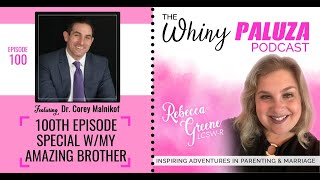
In the 100th episode of the Whiny Palooza podcast, host Rebecca Greene interviews her brother, Dr. Corey Mielnikoff, a chiropractor and founder of the Palmer Care Chiropractic network. The conversation begins with Corey’s personal health story—severe childhood asthma that improved after chiropractic care—leading to his decision to pursue chiropractic medicine. He recounts his education at Palmer College, where he excelled academically, took on leadership roles in the Student American Chiropractic Association, and met his wife Viv. Corey describes the challenges of moving to Virginia with little money, taking a night job, and living in shared housing before establishing his first practice. He then outlines how he grew the business to 18‑20 clinics, emphasizing the importance of hiring great people, cultivating a fun, mission‑driven culture, and implementing repeatable systems. The discussion shifts to chiropractic philosophy, explaining how spinal adjustments influence the nervous system, which in turn regulates hormones, digestion, sleep, and overall self‑healing. Corey addresses common fears about chiropractic care, noting that adjustments are typically low‑force, non‑painful, and that malpractice costs for chiropractors are far lower than for medical doctors. He shares personal advice on work‑life balance, prioritizing family, and applying the same affirmations and goal‑setting practices at home and in business. Mentors such as Larry Martin and Tony Robbins are highlighted as key influences on his personal development. Corey also talks about his book, “The $4 Sandwich,” which recounts a moment of financial hardship that motivated his entrepreneurial drive. He offers practical tips for aspiring entrepreneurs—seek mentorship, work for an established practice before opening your own, and persist through inevitable setbacks. Finally, he reveals ambitious future plans to open 30+ clinics within the next year, underscoring his vision for scaling the brand.
Chapters
No need to whine, it's Whiny Palooza! Have some wine and join us on the Whiny Palooza podcast with Rebecca Green.
Welcome to the Whiny Palooza podcast. I'm your host, Rebecca Green. I'm a wife, mother of 3, and licensed clinical social worker. I also have 3 fur babies at home too. My passion has always been to help children and their families. I always dreamed of being a wife and a mother. Parents are always learning through their struggles, failures, and successes and joys. I am no stranger to this wild ride of parenting, and I know behind every great parent lies a team of supportive friends and family. I want to be part of your support system. I want you to know that you are not alone. We are in this parenting world together. Join me every week for insightful discussions with experts on parenting and marriage, as well as other parents who have found the secret to successes in parenthood. You'll learn tips and tricks to make life with your family better than ever. I hope you will follow along with me while we dive into what it takes to achieve a happy family.
Hello everyone. This is Rebecca Green for the Winey Palooza podcast, and I am over the moon excited today because I got my fabulous brother on the podcast today because This is my 100th episode, which is super important to me, and I said, who better to have on today than my brother? He is an amazing chiropractor, fabulous businessman, wonderful husband, um, father, uh, fabulous brother, son. I could go on and on and on, but he's going to tell you all about himself. So, Dr. Corey Mielnikoff, thank you so much for being here today.
I don't know if I'm laughing because you and I are doing this or my mustache, but you have to smile looking at it, right?
My brother is doing a mustache challenge this month, and I am giggling looking at his, uh, beautiful mustache.
Yeah, I laugh looking at it, so you're allowed.
He's still very handsome. He always looks handsome no matter what facial hair he has.
Okay, so first question.
First question: tell everyone what inspired you to become a chiropractor.
I couldn't think of anything better to do.
I know that's not true.
No, I mean, long story, so I won't go too, too detailed. Obviously you know them, but, you know, I was an unhealthy young kid I think I was 4 years old, bad asthma. And, you know, we got exposed to Dr. Ali at a really young age, both of us. And, you know, I had 2 weeks, from what I hear, my asthma spontaneously disappeared according to the medical docs, but chiropractic helped me there. And, you know, then I got to play sports because I could breathe and high school sports and college sports. And my chiropractors were always my witch doctors that got me back on the field. So when it came time for professionally, had dad in the health field and mom in the health field and Uncle Harvey in the health field and Jafari in my back. It just, it, it made sense. And I met, I met one doctor too, Dr. Liekman, who, man, when he spoke about the idea of chiropractic and whole body health and nervous system, I was like, yeah, I'm in.
So, well, I'm so glad that you're doing what you're doing. You know how strongly I believe in, in chiropractic care. And I think that all— I think it's mostly mothers who listen, and my goal is by the end of this for them to understand more about it. So tell us about your educational experience. You— what school did you go to? And tell, tell them, because you had so many accomplishments there and you met someone very special.
Who's that?
Come on now, tell us.
Uh, no, chiropractic, you know, is the first time I think I ever, uh, hit my groove, right? So, you know, I I never liked school that much. I studied a lot to get good grades because Mom made me, uh, but chiropractic school, man, I hit my stride and I just, I got a lot of A's because it was really great and really fun. I enjoyed learning about the human body and I enjoyed philosophy. I enjoyed all of that. Um, it was my first leadership role. I mean, even in football, I think at one point they actually offered me to be captain. I said no. Uh, but at chiropractic school, I took on, uh my first leadership role, the Student American Chiropractic Association. I got to be a class rep and then a vice president and then a president. And I got to travel to DC and meet congressmen and senators.
I remember.
Got voted into a cool leadership role at the school. And chiropractic school was just a groove for me. I just, I loved every single thing about it. So it just, it was the perfect fit.
And this was Palmer College. Yep. And he met his—
go ahead.
Yeah, and I met Viv, uh, my, my wifey, uh, wonderful wife, in semester, and she was in her first. And so Viv and I were pretty much together most of school, and she was from Virginia and I was from Buffalo. And as much as I, I love being a Buffalo kid, I always will be, uh, I came out and tried out Virginia and been here since.
Okay, well, that was my next question. So you moved to Virginia to begin your career. You had no money to your name. How were you able to do this?
Uh, well, I moved to Virginia to try it out, so I will say that I wasn't like, you know, gung-ho, I'm moving there, my life is going there. I was, hey Viv, why don't we see if this is really going to be something and I'll come try out Virginia. I was lucky, you know, I did a preceptorship, which is, you know, like a residency with Dr. German, who was a really great guy, taught me a lot. And so I decided to stay. And yeah, it's, it's an interesting thing being in a state where you don't know anybody because Viv was still in school. Yeah, we don't know anybody and you don't have any money. That, that was an interesting situation. So I lived in a house with, uh, 3 other guys I didn't know. Shared a bathroom. And I just, I don't know, I just decided I wanted to stay and I wanted to open. And, you know, I think when you make a decision like that, you just— that's it. For me, it's, it's, you're in. I mean, hard to say. I mean, everything we've ever done in our lives, I mean, you know, you and I are both like that. I think once we start, we're just, we're in. And, you know, I had to take a night job and I had to stamp cards at, at Dulles Expo Center, and I had to make whatever money I could make to pay whatever bills I had to pay. And, uh, and it sucked, but it was a means to an end.
I think it's pretty amazing that you moved somewhere not knowing anyone, and you know that I would never do that.
Well, it was for a girl.
It was for the fabulous Vivian. Yeah, who we, who we all love. So I found a trick. So my brother just keeps opening clinics and we're gonna talk about how many he has, but I found a trick so that I don't have to keep asking him cuz I can't keep up. So now I just go on his website, Palmer Care Chiropractic, and I can just count myself instead of constantly going, how many now? So how many clinics do you have and what do you think is the key to your amazing success?
Uh, okay, well, that's a loaded question. Uh, there's 18 clinics open. There's one opening two weeks maybe, and there's—
that's 19.
There's one opening next month, so that'll be 20.
Holy moly.
And then we have 5 we're working on for February, so we're getting there. Uh, Right now, I will tell you the reason that we're able to do what we do is we have a lot of great peeps and we have really great systems. Um, I mean, like, it's, it's hard for me to swallow, but even like these next— this next clinic that's opening, um, I'm not going. Uh, it's the first time I'm not going.
Wow.
I can't go. I won't get into why, but I can't go. And so there's, uh, 3 people Uh, and you know Casey and Paul. Uh, Casey, Paul, and my new assistant Lisa are literally gonna fly out Saturday morning and spend Saturday, Sunday, Monday, Tuesday getting the clinic ready to open up December 1st.
Wow.
Uh, but yeah, I mean, for me, man, for me it has always just been the people. Uh, I always just hired great people. Uh, I think everything we do is about our culture. I mean, yesterday we had this meeting that was just just off the charts. It was amazing, you know. We had 75 people in a room, and we had, uh, I picked maybe like 10 people to get up and talk spizz, to talk chiropractic philosophy. We had all the clinics in Buffalo, Atlanta, Colorado, Texas on Zoom, all tuned in, jumping up and down and screaming. And then there's just so much energy and so much fun.
That's, that's amazing, you know.
I just, I teach them all that work should be fun and we should be having a blast, and if we're not, something's wrong. And so I think that's why we attract good people.
That's really good advice. So we need to love what we're doing. That— I think that's the, that's the key right there. And so we have the same mother and father, and we had— let's just say this, How do you think that your childhood and mom and dad have contributed to your success? What do you think? You knew I was going to ask that.
Something along those lines. Uh, sure. Um, mom, mom always made me do everything I didn't want to do, right? Made me clean my room, made me do my homework, made me get good grades. Um, wouldn't really accept less than that. She worked very hard, very strict. Um, and so those qualities all show up, you know. I don't, I don't shy away from a challenge, and I know that doing the things I don't want to do is what makes me grow now, and so I'm, I'm always doing it. Um, and Dad, I mean, Dad ran his own business and worked hard. But I honestly think that the things I got from Dad had more to do with sports, you know, the things that he told me. I think I put that in the front of my book, you know. One time I was nervous to get up to bat, and he's like— he literally said to me, he said, always want the bat in your hands when the game's on the line. And I was like, oh damn, oh damn, I didn't know that. And so that kind of changed my perspective. Uh, that was a big one for me.
That is some good advice. He's full of good advice. I think they both are full of good advice, and I text the three of you all the time for advice because the three of you give amazing advice, and I'm very blessed. So I know the women in my life that I talk to regularly I try to educate people about the chiropractor, but people listening, they're not going to realize that they need to regularly go to the chiropractor. Can you tell everyone why we regularly go and why it's good for our health?
Yeah, yeah. You know, it's funny because, uh, Paul, uh, who was an actuary, so very statistical, did a talk yesterday. He was throwing up statistics about the number of people that see chiropractors. It's pretty low. Uh, somewhere around 10% of the population, which is a really low number.
Yeah.
And you know, things like yoga are catching on and growing fast, meditation catching on, growing fast. Chiropractic, not so much. I think one of the big reasons is there's so many chiropractors doing so many different things. Um, it's hard to know exactly what we do, but I think what people need to learn and what we need to do better as chiropractors as a profession, association, organization. Um, chiropractors look at the body as a whole. You know, if we look at the fact that your body is supposed to be self-healing, self-maintaining, self-correcting, self-regulating— your hormones are supposed to regulate themselves so that you don't have anxiety and depression and thyroid issues, your digestion is supposed to self-regulate so you don't get IBS and constipation. You know, your parasympathetics, sympathetics are supposed to regulate so you can sleep at night. You hurt yourself and cut yourself, your body's supposed to heal and self-regulate. And so when the body's nervous system, which is in control of all of that, your nervous system controls all of that self-regulation, the nervous system controls all your body's ability to self-heal, self-maintain, self-correct. When the nervous system starts to diminish, like starts to get tuned down, when there's interference to it in any kind, we have too much emotional stress and chemical stress, physical stress, and our nervous system starts to turn down, then our body loses that ability to adapt to stresses, and then we lose the ability to regulate. So our chiropractic clinics are focused on getting our doctors to find where the nervous system is turning down And the adjustment, the adjustment is literally only us using the spine as an instrument to turn your nervous system on. And we turn it on, we just, we see the most amazing things. And obviously people with symptoms get better.
Yeah.
But why you should see someone on a regular, why do I still get adjusted every week? Because I'd like my body to just always function at an optimal level, right? I know that once my body's broken, Fixing it is much more difficult. I know that if I just keep myself firing on all cylinders all the time, my immune system will be regulating, my hormones will be regulating, my digestion will be regulating, my musculoskeletal system will be regulating. You know, if I want to go exercise and work out, I can function at an optimal level. And so there's just no reason not to make sure— I mean, even once a month— just make sure my nervous system's functioning. You know, we live, we live in, we really live in one of the worst places for overall health. We have the best medicine surgeries in the world, we have the worst healthcare. Um, I mean, it's just sad. I'm not going to get into it, but parents putting their kids on— I mean, you see babies now that are getting put on things like Prevacid and reflux meds and all this crap. Yeah, most of you, most of the new, um Pediatricians know not to give antibiotics for ear infections at first. That's only going to cause worse things to a kid. But a chiropractic adjustment, garlic drops, supplements— there's just so many better things that can be done now. You know, our people don't know it, but, you know, we're, we're one of the worst industrialized nations when it comes to overall health. We were ranked 37 years ago. I think we're ranked 42nd now.
Not good.
We get all the drugs, we get half of all the money spent in the world on, on healthcare spent on us, and we still suck. Uh, yeah, there's got to be a different approach. That's my point. I don't be depressing. There's got to be a different approach. That's why yoga is getting big. That's why meditation is getting big. That's why people are learning about acupuncture. But chiropractors need to step up to be part of this, this league, right?
I agree with you.
Yeah.
Now the way that I was raised and the way that Corey was raised is, you know, my friends make fun of me, but when I'm sick or not feeling my best I run to my chiropractor and I will tell you that I went with a fever and he saw me and the next day, and I don't even think it was the next day. I think it was that day my fever went away. So for me, my doctor is my chiropractor and he has helped me with every single symptom I've had my whole life. So yeah, you know, I'm a believer. So the biggest complaint that I get You know, because you know me, I want— everyone tells me their stuff and I say, go see the chiropractor, go see the chiropractor. And the biggest complaint that I get is that they're afraid. And I don't know if you know that and I don't know if you get that, but how can we help people be less afraid to go?
Well, you know, I think the people that are afraid are typically the people that have never been. Right, because they've never experienced it, because they're scared, because they see that it's like a crack or a pop or something like that. But, you know, I mean, the easiest thing for me to say is just simply this. It is typically not painful. That doesn't mean it never is, but it is— it's a high-velocity, low-force impact. So it's something that's really quick and with low force. And the other thing I'll say is this, right? If you look at a medical doctor's malpractice, how much it costs. Something around $100,000 a year. Yeah, that's because if you go see your medical doctor, the chance of them doing something to make you worse is pretty bad, pretty high. If you, if you look at my malpractice for the year, it's about $1,500.
Wow, I didn't know that.
Why is it so cheap? Because we don't hurt people.
That's good.
Uh, it's, it's, I mean, it's just basic common sense, statistics, math, you know. You're not— you're scared of going to a chiropractor with a $1,500 malpractice, but you'll go to the medical doctor with a $100,000 malpractice because of the odds of them harming you.
Yeah.
And I love medical doctors, lots of my friends. I love medicine and surgery, by the way, but I just love it as a last resort, not first.
That's good advice. That's good advice. So you're successful both at home and at work. Why do you think that is?
Vivian?
Okay, fair enough.
You talking about my kiddos and my wife, my home home? Yeah.
You balance, you balance. You definitely make sure you're home for important things. So how are you having a successful career and a successful home life?
Well, I mean, lots of answers to that.
Okay, give us, give us one answer.
I mean, priorities. I mean, I don't, I don't miss kids' stuff. I mean, I just went to Tony Robbins I flew out to Florida, stayed for a day, and flew back because I didn't want to miss my kid's game. Oh, um, I love it. I don't miss stuff. That's just— it's not a— not an option. I, I missed, um, one day once. I got my first paid speaking gig years ago at one of the top places to speak for chiropractors. They wanted me to speak on Halloween, and I wanted to say no, and I literally was kind of told that if I didn't go speak, that the board was not going to have me back ever. Oh, boy. I went. And I missed Halloween once. And Vivian sent me a picture of my kids dressed as Mario and Luigi. It's funny. With Dr. Misak and Dr. Eric dressed as Mario and Luigi. And I saw that picture, and I was like, nope, nope, never, ever, ever, ever again. So I don't miss things with my kids. And, you know, I think the same things that make me successful in work make me successful at home. You know, I teach our clinics affirmations, visualizations, goal setting, prioritizing. I teach my kids affirmations, visualizations, goal setting. And I just think everything I do here, I do at home. It's just the same, you know, I, I treat everybody here like they're family. Everybody knows I care about them. Everybody knows I'm there in a second to do whatever needs to be done for them. I mean, they need to borrow my car, borrow my car, they need me I need to get them a hotel for 2 weeks because they're coming out of their house, I do it. And it's the same at home. I mean, I just have the same heart in both places. And so it works. But I mean, at the end of the day, it is really just priorities. I mean, Vivian's name in my phone is Queen Hottie, right? Because I'm supposed to treat her like a queen.
Oh.
So I put her and the kids first. And it works.
Oh yes, you have the best heart. That's why you're so successful. It's that wonderful heart of yours. So tell us the best advice that someone has ever given you that is not our parents.
Yeah, I mean, I mean, my mentor, you know, my mentor is, uh, Larry Martin, uh, I mean, Larry's statement is, "Who you are determines how well what you do works." Mm-hmm. There's nothing that— I mean, that's like mic drop. Yeah. I would say that the only times I failed with doctors or staff, which, knock on wood, I don't think it's happened in a minute, is that I think that there's two types of peeps. There's one that understands that everything in my life— my health, my weight, my wealth, my success, my relationships— everything is because of who I am inside and what I'm attracting. Hmm. The second person is the person who says, you know, my wealth, my relationships, my success are like this because of the world. And so if someone's not willing to say it's me, it's me, um, then forget it. And so Larry taught me that because, you know, I have, I have all these clinics running the exact same systems, the exact same marketing, the exact same procedures, and I have one doctor seeing 300 visits a week and one doctor seeing 100 visits a week. It's the exact same procedures, right? The difference is the doctor's a different person. Mm-hmm. That's the best advice so far because that's all I've done since I met Larry is all I do is work on me. I mean, I'm back to Tony Robbins. I've gone to UPW. This is my third time going. And every time I've gone, it's because I know there's a next level and I'm not— I haven't built myself to be big enough yet. You know, when the world starts to scare me a little bit because of the success that's growing. And people should know that when you start getting more successful, it's almost as nerve-wracking as when you're unsuccessful, hoping successful. Yeah. The difference is I recognize that I'm getting to that point of, wow, this is big, I got to be able to hold this up.
Yeah.
And then I work on me and I get myself to Tony Robbins, I change my affirmations, I read a new book that I know I need to program myself with. I find someone that's even more successful than what I'm about to become, and I start following them around. Mm. Right hip.
That's a— that's really good advice. Yes. All such good advice. I would love for you to tell everyone about your book.
My book. My book's The $4 Sandwich. Terrible, terrible title.
It is not.
It's terrible. Uh, it meant a lot to me when I wrote it. Uh, I should probably go back and, and work on it again, but it just talks about my story, right? So I— when you talked about me moving to Virginia and not having anything, obviously people hit a bottom before they hit— realize they need to start working. So I, I went to buy a $4 sandwich and realized I didn't have $4 left to my name. Uh, and Vivian was on the phone and got to hear that terrible experience. And I just got pissed off enough to recreate me and just start doing all the things that everyone said I needed to do to be a better me. And so that book is from the moment I couldn't pay for it. And then everything I did to reprogram myself to get to be, you know, what I would call successful. Yes.
Awesome. Awesome book. Awesome title. So to the person listening who is afraid to start their own business and they really want to, Can you give them a tip to get over that hurdle?
Yeah, that's tough. That's tough because it really just depends on what world, but, you know, I think that if you want to open a business, you need to go find that business. Go find someone who already has it. And you gotta go hang out and you gotta learn from them, uh, because there's just no point in reinventing the wheel if you're going to be opening a business that somebody has the ideal business you want. And you know, if somebody has an ideal business, they're most likely going to want to want to mentor you anyways because that's the type of people that they're going to be if they're successful, uh, but if someone That's what I would do. I mean, I tell— yeah, I tell Kyros that all the time. But in all honesty, I tell chiropractors not to open right out of school like I did. I tell chiropractors go work for a chiropractor for a couple of years.
Yeah.
Um, but if you do open a business, um, you know, I will say that things will probably go really bad at some point. And it's right when you're gonna quit, right when you're gonna quit is always that world's test of you, because the next moment after you're gonna quit is when it finally gets successful.
Yeah, yeah.
I sat down in my DC clinic, that was my fourth clinic. I remember I sat down in the reception area, they were closed that day, the lights were off, and I was just sitting there debating if I was going to go ahead and fold up and close if I was going to attempt to push through. I had no doctor, no nothing, lots of bills, but I, I would say I could have easily quit and closed it down, but I— it's that one more step. I took one more step. Washington's a multi-million dollar practice now.
Amazing. You're amazing. You know, I think you're amazing. Tell us what's next. What are you excited about?
I can share that.
You don't have to share it. You don't have to share it if you don't want to.
There's a lot going on. I, I, I have a crossroads coming up that I have to make a decision on. Um, so my future has two very, very big possibilities. But I will tell you for sure, uh, we're gonna be opening a lot of clinics. So our goal this next year, we're gonna open 5 clinics 4 times and then open 10 clinics 5th time.
He's creating an empire.
We're gonna open 30 clinics next year, but oh my gosh, that could be coming. I can't talk about—
okay, well, maybe at some point you'll tell me privately.
Well, so, so I'm gonna flip the script and ask you— I'm allowed to ask you a question here?
Of course.
So I would say the 2 things that I tell everyone make people successful, right? The two characteristics that I think most, most successful people have is discipline and consistency. So this is podcast 100. Yeah, so a lot of discipline and consistency to get to number 100. Yeah, why, why did you do it and, and how many times did you want to quit doing it and why are you doing it?
Oh my gosh, it's such a good question. So, you know, my fabulous husband and his marketing business, and it was his idea, and I said no, and I was a nervous wreck, but I felt this pull to try something new and give it a go and see how it went. And then I started talking to people. I mean, I can't even tell you, I, I try to only interview women. For my own reasons. And I mean, you, you and you and Seth and Dad don't count. You know, the three of you don't count. But I've had a couple of men on, but I mostly talk to women and the connection and what I have learned and the growth in me this year has been the most growth of my whole entire life. And it's from all of the women that I have spoken to this year. And, and I have wanted to quit several times for several different reasons and have this pull to do it. And it really is the people and the self-growth along the way. So that's my, that's my answer.
Well, I think that's a killer message for, for everybody out there and families. And I, I mean, I, I know, I mean, I was there when you had, you had some haters as you were growing, uh, you deal with a lot. Yeah, you got to have a thick skin, and it's really cool. I hope everyone listening and watching is, uh, understanding that to do 100 podcasts is a lot of work, a lot of energy, a lot of effort. And they, they don't see, and I didn't, I haven't seen it, but I absolutely know without asking that you must have at least had a dozen times that you're like, screw this, I'm not doing it.
How do you— how are you reading my mind?
Yeah, I just— this is what I do. But you know, the fact that you didn't and you got to 100, I just, um, that's very hard to do.
So, well, thank you, and thank you for being my 100th guest. It means more to me than I can ever tell you. You're the perfect person to do this with today, and You— a lot of my inspiration and determination comes from you, and I don't know that you know that, but I'm going to tell you that now. So my brother's amazing. I love him more than I can ever express, and thank you so much for taking time out of your very busy life.
Congrats, 100!
Um, thank you. Can you just tell everyone where to find your, uh, 18, 19, 20 clinics.
Wow. Website's always the best, right? PalmerCare.com.
Yes.
Virginia, Texas, Atlanta, Buffalo, Colorado. We're around.
So look them up. They're amazing. All of them are amazing. And if they're not near you, I bet you they're coming soon.
I hope so.
So this is Rebecca Green reminding everyone to spend every day laughing, learning, and loving.
Thank you for tuning in to the Winey Palooza podcast. If you like what you heard, please be sure to subscribe so you never miss an episode. While you are there, leave a review. I love to hear your feedback. Thank you so much for listening. Until next time.
This show has been produced by Market Domination LLC. To discover how you can have your own show completely done for you and turn it into a real published book and become the authority in your marketplace, go to www.marketdominationllc.com/podcastoffer.










