The Whinypaluza Podcast with Rebecca Greene Episode 005 Evidence-Based Mommy
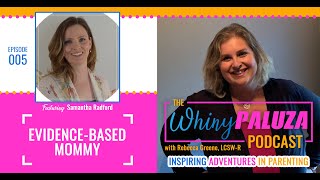
In this episode of the Whiny Palooza podcast, host Rebecca Greene interviews Samantha Radford, a PhD‑trained exposure scientist and founder of Evidence‑Based Mommy. The conversation traces Samantha’s journey from academic research on pesticides, lead, and chemical exposures to a parenting‑focused practice that blends science with everyday wellness. Key themes include: the shift from reactive to responsive (gentle) parenting; practical strategies for reducing toxin exposure in food, home products, and personal care items; a “Declutter Master Plan” for managing children’s toys through rotation; self‑care advice for sleep‑deprived parents; navigating homeschooling and pandemic‑era parenting; and balancing a growing family‑focused business with four young children. Samantha shares resources such as her toxin‑free living handbook and her online course “From Reactive to Responsive,” and offers encouragement for parents to give themselves credit and practice patience.
Chapters
No need to whine, it's whiny blues. Have some wine and join us on the Whiny Blues Podcast with Rebecca Green. Hello, this is Rebecca Green for the Winey Palooza podcast. Today we have the pleasure of having Samantha Radford with us. Thank you so much for being here. I appreciate your time. Yeah, I just want to read this awesome bio about you. I love your website. She's the mommy behind Evidence-Based Mommy, is a mom with 4 kids. Holy cow. She uses her PhD in chemistry and public health to combine science and wellness to help parents and their kids thrive. Sounds wonderful. I'm going to jump in because I have so many questions for you. And the question that is like screaming at me is probably something that you're asked a lot. You have a PhD in chemistry and public health. So can you tell us how you went from that into helping mothers?
Yeah, so my— even before I had kids, my research that I did was about pesticides and about, for example, you know, are pesticides in baby food? Are pesticides in foods that parents eat, parents or kids? What happens after we eat those pesticides? What do they do to the human body? Do they pass through breast milk? Do they pass to a child when you're pregnant? So even before I had children, even before I thought I would ever have children, because I was convinced I wouldn't, and now I have 4, which is a whole nother—
Yeah, that's a bit— you know that you just opened yourself up to that question, but go ahead.
We'll get there too, I'm sure. Like, I've always had that kind of maternal child health thing even before I realized I would go down this path. So even, you know, there for a while. I was a professor teaching chemistry for about 8 years, and my research was still kind of tangentially related. Like, I looked at lead, you know, lead paint, how that can get into people's homes and how kids are affected, how we can remediate and, you know, cover up that lead. So it's all been sort of related, but yeah, as a mom, you know, with a bunch of kids on my own, Like, it's been important to me, you know, to look up all that stuff and keep up on parenting research.
Absolutely. That's actually a more natural progression than I expected you to say, because I was like, how did she go from chemistry to parenting stuff?
So technically, like, technically what I'm called is an exposure scientist. How are people exposed to stuff and how does that affect us? But no one's really heard of that. So it's kind of easier to say chemistry, public health.
Well, and that's so funny that you corrected it from chemistry, because what I was going to tell you is that I wish that you were my chemistry teacher, because I'm going to admit to you that I slept through chemistry because my teacher was so boring. Oh no! I'm listening to you talk about chemistry and it's so interesting, and I'm over here thinking, I wish she was my teacher.
Oh my goodness, I would love to have been your teacher.
I did not have a good chemistry teacher.
It's so important, but people don't realize, but that's a whole nother, whole nother thing. So we'll just let that go.
So before I move on, can we back up to your statement? Because that's huge. So you went from not thinking you would have kids to having 4. So can you tell us about that?
I mean, they're kind of like Lay's potato chips. You know, once you have one, you can't. But I was an only child. I was the kind of person, you know how when you're in your early 20s, people just assume that if there's a baby in the room, you want to hold the baby because you're like of childbearing age. Like, someone would hand me a baby and the baby would start crying and I would be so stressed out and I hated it. Um, but my husband wanted kids. If we're being honest, my husband wanted kids and I talked to my graduate advisor right about the time I was graduating and I was like, how do you have kids when you're doing this, this path? And he's like, we'll have them in the summer. So I was like, okay. And so I agreed with my husband, I would— we would try for like this 3-month window. Then I was like, there's no way I'll get pregnant in that time. And then I'll have another year to like—
Yeah.
It, but I did.
Oh man.
And so, you know, I had her and even, I mean, right before she was born, like I was in the hospital crying like, I can't have kids. You don't understand. I don't like kids.
Oh my gosh, this is hysterical.
And the nurse was like, I'm going to give you a minute and just turned around and walked out. So I'm sure she just went to like crack up. But yeah, I had her and then I just, I fell in love. Like I felt myself fall in love with her. And then like I said, after that, just, you know, babies are fun and adorable.
So exactly. I, I would have had 4. I wanted 4. My husband wanted 2, so we compromised and had 3.
Okay, there you go.
You're making me think of him and the dog because I wanted a dog. I wanted the dog. I wanted the dog. And he said no, no, no, no. And we finally got a dog. And guess what? He loves the dog. So you have the children.
The last I heard was I wanted a dog. Unfortunately, it's frozen up some.
Okay, I will back up. Let me know if that happens again. So you were saying that you didn't want kids, you had your daughter, and you fell in love. And I was saying that my husband had the same experience with our dog and didn't want the dog, and then we got the dog and then he fell in love. So we did have a semi-similar experience. So I want to move on to a term that you use called gentle parenting. Right. And you talk about going from reactive, a reactive parent to a responsive parent. Can you, can you talk a little bit about that? Because I think that's such an important topic for parents to hear about.
Yeah, and it's hard. And it's, it's one of those things where you get the chance to practice every day and you probably mess it up every single day. But the nice thing is you get to try again the next day. But there's so much, you know, we automatically feel like something is an emergency. If something goes wrong, like if, you know, your kids are fighting, for example, in the backseat, like that just pushes your buttons, right? And you automatically feel like you've got to shut that down right now. But if you can take a moment and, you know, kind of think through how am I going to respond to this, you know, what's the best way to actually help them grow instead of just be like, be quiet, you that's going to be better for everybody. And even when, you know, my big example is like, you've got one daughter trying to show you how she can do a cartwheel, one daughter getting into the pantry when you're trying to make dinner right now, and then a toddler clinging to your leg because they're— you know, that's so stressful and so hard. But if you can stop and tell yourself like, this is okay, like nothing bad is happening, it's going to be okay. You know, that's kind of the heart of that from reactive to responsive is learning how to step back from these things and learning how to not judge yourself when you do make those mistakes, you know, seeing yourself in a different light as well as whatever's going on around you.
Yes, and we all know that our kids don't like when we yell So, it's always one of my goals. My kids make fun of me every New Year's because they say, "We know, we know you're not gonna yell." And I'm like, "Well, I can't promise you that I will never be reactive, but I will continue to work on it." And you said something so important that I wake up every day and I say, "Okay, today I'm gonna do better." And I say that to myself every single day.
Yes, yes, yes. Yeah, I've been focusing on— I've been— I have a course, you know, From Reactive to Responsive, and I actually just focused on revamping it over the past few weeks and adding to it. And just even having that reminder has been challenging me just from day to day.
Yes. And, and you coach mothers, correct? You're a coach? So do you find that that's one of their biggest challenges is this reactivity piece?
I think so, yeah, or just how you see things. For example, I had a woman the other day asking me, she's like, what are the best punishments for 2-year-olds? And so it's like, which, you know, bless you, and then your child will turn 3, but we won't even go there yet, you know. And I was like, well, let's not think punishment because punishment is you did this bad thing, you deserve this bad thing. Let's think discipline. So I mean, the same root for the word discipline is the root for the word disciple. Like you're guiding someone and teaching them a different way.
Yes, that's such a better way to look at it. I'm huge on, and my husband makes fun of me because he's such a good disciplinarian, but I would rather give them a reward and I would rather, and I don't look at it as bribing. And I always say to them, if you do X, you can earn X. And it's easier for me to give them a reward than it is to discipline. But you are absolutely right. Discipline is the right word and so important for them to learn.
Thanks, yeah.
Yeah. So you talked about toxins. And I feel like my whole life, so my parents have a health food store, so they have always raised me to, you know, eat organic and to try to have, you know, cleaning products that don't have chemicals in it. And I noticed that you talk about a toxin-free living handbook.
Right, yeah.
So can you tell us about that?
Yeah, so toxin-free might be a little bit of a misnomer because there is no such thing truly it's toxin-free. There's no such thing as chemical-free. Water is a chemical, salt is chemical, everything's made of chemicals, but we can minimize these things. For example, you mentioned eating organic. Eating organic is a great way to avoid pesticides, but that's not to say that organic food is 100% pesticide-free.
Right.
For that matter, there are some foods that, like for spinach, for example, it really matters. That's something that has some of the most pesticides pesticides on it. So if you can go organic for spinach, do it.
That's good to know.
Other foods like, I think onions, I know avocados, they don't carry—
Oh really?
They don't carry as many pesticides. So you don't have to go out of your way so much to get organic on those. So knowing these tips and tricks kind of helps you get more bang for your buck as far as avoiding toxins, but still protecting yourself. And this, it's all over your home. Like I said, if you're in a home that was built before 1978, there's a decent chance that you should do testing for lead. We hear a lot more now about personal hygiene products and shampoos and all that having—
Yeah.
—phthalates or parabens. And so all the different parts of your home, even food packaging, what you choose, like pots and pans you use to cook your food in, So I've just kind of like, I've taken all that stuff and I've used my background. So I mean, that's exactly what my PhD was in. It was that kind of thing. But I've also tried to make it to where it's like actually helpful because I feel like a lot of the information that we find on the internet is just kind of there to freak people out. I hate that because that doesn't help. Like stress, stress is a toxin too, basically. Yes. Yeah. And so, you know, what can we do to minimize those dangerous exposures but still keep, keep everybody safe, but then like let the rest go? So, yeah.
Yes, because it can be really overwhelming. And, and I just— I'm trying to do my best. I'm trying to do more and more. You're talking about shampoo, right? And I'm realizing I'm not really doing a good job. So I might be doing a good job looking for organic food. But I'm trying to move into, you know, what kind of makeup am I using, what kind of shampoo am I using. I mean, it's everything and it's everything kind of overwhelming.
It is, yeah.
So we, we can all just do our best, right? Right. Yeah, but I love, I love this. I'm gonna check out your handbook because I saw that you have a handbook and I also am fascinated By the Declutter Master Plan. So I want to tell you that my friend told me, I said to her, we were talking about clean houses, and her house is always clean. And what did you— she has two kids. I mean, they're, they're both right, they're both 13. So, so it doesn't count as much as my little 7-year-old who's making a mess. But I said, you know, we were talking about how her house is always clean. And I'm always struggling with that. And she said that she spent 3 years uncluttering her house and getting rid of stuff. So I wanted to talk to you about clutter and what your unclutter declutter master plan is.
Okay, well, don't look at my house right now. But, you know, but I'm— it is also better. So the Declutter Master Plan is specifically about toys. So, because, you know, sometimes it's like somehow we just end up with so many toys. Like, everyone gives us stuff for birthday and for Christmas, and it's like the grandparent or, you know, Aunt Sally or whoever gives you like the most obnoxious toys that make all these sounds and, you know, all this stuff, and you like secretly hate it. Feel bad to get out. So it's about kind of like what stuff to keep, what stuff to get rid of. And then once you figure out what you do want to keep, how to use it in such a way that like your kids actually play with it. Because I mean, how many times all of us, like our kids will go into a room full of toys and say that they're bored and there's nothing to play with. All the time. All the time. All the time. Doing things like toy rotations and toy strows will really help, you know, to minimize that kind of thing and to refresh toys and make them interesting again.
That's a very good idea. I have found that when I go in the basement, I see that my husband has brought more and more boxes into the basement. And the girls— I have an 11-year-old and a 7-year-old girl and The two of them are like, he keeps putting all of our toys in the basement. How are we supposed to play with them? So you're making me realize that I'm not rotating. Right. Yeah. Right. So instead of just leaving them down there, I guess I should be bringing— I'm looking at my playroom. I should be bringing stuff in the basement and swapping.
Yeah. So once it gets to the point to where they're starting to act bored and like not doing anything with the toys they have, put all that stuff away, get other stuff out, and you'll be amazed. Like, you'll actually get to sleep in for like a morning or two because they'll be too busy playing, and it's beautiful.
Yes, yes, that's excellent advice. You talk about mindfulness and self-care. Can you tell mothers some of your self-care tips?
Yeah, so it's hard. First of all, I know it's hard, and that's one of the things I talk about in From Reactive to Responsive, because, you know, there's only so much you can do about being responsive when you're running on 4 hours of sleep. Yes. My— probably my biggest thing is get more sleep, especially if you have little kids, you know, because mine like to get up at like 6:30 in the morning and that's just kind of how it is, you know, and so I go to bed early. Like, that's just, that's what I have to do to be able to function, you know. Yes, yes. Right before I got on here, I was reading something from a former colleague and she was talking about that she got up at 4:30 in the morning every morning to get work done. Before she started her day, you know, with her newborn and her 7-year-old. And then I don't think she went to bed until 10 at night. And I was like, oh my gosh, you're going to burn yourself out. Like, yeah, she's a rock star. She's a dean at the college. I had been teaching with her before. So I mean, she's— but she's a busy lady.
But that is way too early for me. Yeah. Like, yeah.
So I mean, get more sleep, whether you have to go to bed earlier or get up later, like whichever one you need, you need to do to get at least like 7 hours a night, you know.
Yes, that's very good advice because we're definitely crankier and more reactive when we're not sleeping. Mm-hmm.
Yes, one of those things, you know, if your child, like if you have a baby who's going through a sleep regression or teething or whatever, like during that time, you know, just be like, this is only for a few weeks, maybe a few months at worst, like, just go to bed at 8:30. It'll be okay. You know, you can watch Netflix another week instead.
So, well, and that's another good point because I get sucked into— I don't tend to get sucked into Netflix at night. I tend to get sucked into a good book and it'll be, it'll be 11 o'clock and, and my husband will be like, I'm so tired and I'm like, but just a few more pages. Yeah, it's just, you know, it's my me time and I have to remember that I also need to put it down so that I'm rested. So that's a very good point. It's hard.
I've started reading more lately and it has been harder. Like time will kind of creep up. I'd be like, oh, but so good.
I just feel like before I blink, it's 11 o'clock at night and I think, where did the day go? That happens almost every day. You'd think I would learn from it. Now, you have 4 kids. How old are your kids?
So I've got 7, 5, 3 and a half, and then 9 months.
Okay, so how are you sitting there looking so good right now? I just don't understand. I don't understand.
I don't know. My husband is graciously keeping the 3 downstairs. 3 of them downstairs watching a movie. The baby's in bed. I'm praying he doesn't wake up right this moment. Oh no, okay, I'll hurry up.
No, you're good.
He should be fine. He's usually good until about 8:30. We've got another— we've got a little while.
We're good. What would you say your biggest challenge is right now?
Oh, um, hmm. So especially, you know, like, I don't know how many other people in your, in your community are building businesses. I know that's something you're doing right now too. But I have so many ideas, like so much stuff I want to do. And it's just, you know, your time's limited and trying— and I'm excited about it. Like, I love doing this. I love writing. I love helping people. So trying to balance wanting to do all this stuff with having the reality check that I'm not going to be able to get it all done, like, because that's just how it is. But also make sure I enjoy my kids because that's like the point, right? So that's the whole point of building this business so that, you know, we can stay home and stay with the kids. So yes, yes.
And I remember when my youngest turned 10 months old is when I started writing. And And I would say before she was 10 months old, I didn't even see the light to having any sort of business because the younger they are, the more challenging it is. So your kids are a lot younger than me and I give you a lot of credit for everything you're doing because it's, it's so hard. I mean, my youngest is 7 now, so I'm definitely at an easier stage. So It does get easier. I definitely, you know, I definitely see that they let me, they'll let me sleep in. You know, they know that mommy is nicer when she sleeps. There's definitely changes as they get older. And it's funny that you're talking about sleep because gosh, I don't even know how I functioned back when they were as little as your kids are.
Yeah, I wonder. When my first two were toddler and baby, neither of them were sleeping. And so I would just like spend all night like bouncing back and forth between rooms and I was working full-time outside the home and like, I don't know how I—
That's too much. It was too much.
And I was a wreck.
I bet you were. I know. I always think about the parents who are working full-time out of the house and managing the kids and do it. It's just, it's all, it's a lot. It is a lot.
So I've told my husband that, cause I've been since January, since the fourth one was born, I've been staying at home and I told him, I was like, I don't know how I ever had time to work outside the home cause it's still a full-time job just doing all this, even though I'm building this business part-time.
So yes, definitely parenting is a 24-hour-a-day job. Yes, it is. So how do you think that you've adjusted your parenting in today's pandemic?
I mean, I was working towards— I knew once the summer came, because so before this I was working full-time outside the home, right? And my husband's parents keep the kids a couple days a week, which I'm very grateful for. Bless them.
That's wonderful. Yes, it is.
But, you know, back in January, February, like I had most days of the week, it was just me and the baby and it was so sweet and lovely. And I was working towards like, I knew, you know, once the summer came, I would start having days with all 4 kids at home by myself. And I was just like, I don't know how I'm going to do that. You know, like, it was terrifying. As much as I love them, it was still—
Yes, I understand.
And so, you know, March came and like all this news keeps coming down. Eventually they were like, and we're stopping school. So I was like, I can do this. I guess I'll just be like doing the complete stay-at-home mom thing a couple of months early. So it was, It was a mental adjustment. Yeah, being like, I don't know why you're getting upset. And I'm like, I just need to process.
I know, I know. It's, it's been a lot of adjusting since March, right? Constant.
So, and then we chose, we chose to homeschool this year. So, okay, two daughters are doing that, which has actually been fun because that's letting me still kind of use the education background. I was, you know, teaching college.
So you're teaching your kids too, among everything else?
Well, Troy helps too. So he was a music educator in a past lifetime, so he's enjoying— like, we team tag team on that. So it's been fun.
That's impressive. I don't think— I don't have an education background, so I am not homeschooling my kids. That's fine. I don't think I can do it.
So, I mean, like, it's definitely kind of gotten to the point, because we've been doing this for, I guess, 4 or 5 weeks, it's definitely getting to where, like, the magic is over a little with my daughter. Yeah. Do we have to? And I'm like, yes, you have to, but you can make it fun too.
So that's good. I'm glad you're having fun with it and enjoying it. That's the most important part. So what do you think the best advice is you've ever gotten?
Oh my goodness, um, I'm thinking. I feel like there's some really good advice out there that's just like, it's left right now, but basically just like to enjoy them and like even when it is tough, realize that it's not always going to be. And I think even like what I said about, you know, looking around and being able to say like, this is okay, even though it feels stressful, it's okay. Because there's very few times that whenever we get caught up and feel like something's an emergency, you know, there's very few times that it actually is, like short of, you know, like some— somebody, an accident and someone really getting hurt. Most of the time it's just people are keyed up. So if you can kind of take a breath and tell yourself like, this is okay, I feel like that's kind of the biggest—
Yes, that's very good advice. It helps us through tough moments. My mother always says, this too shall pass. Yeah, exactly. She always tells me that. It's good advice though, because sometimes we forget that it's not going to be like this forever.
I know, well, because I was just talking to someone the other week because, you know, my 3-year-old is being a 3-year-old as they do.
Yes, yes.
And so I was telling her about the stuff he was doing, how he's, you know, pushing boundaries. And she was like, weren't you telling me a couple years ago about how, you know, your younger daughter was doing this stuff when she was 3? Oh yeah, I remember now. I was worried to death about her.
So I know, I know. And it's— what does my husband call it? Selective amnesia. He says that I forget things so that I want to have more babies. And he's like, how did you forget that?
Yeah, so much of it. I mean, not everything, but there's so much that is just kind of like developmental, you know, even though it makes you want to tear your hair out, that's like what they're supposed to do at that age. So if you can kind of keep that perspective. Yes. Some. Yes, yes, very true.
What do you want to share that I did not ask you tonight? I don't know.
I mean, like I said, I think, you know, we've been talking about being responsive and not being reactive and not yelling and all that. But seriously, like, you know, I've written this course on it, but I still struggle with it and all of us struggle with it because it's hard because something about like kids can just, you know, push those buttons and just especially right now, like they're always there. So yeah, which is great, but also it's a lot. So I think what I would say is like give yourself credit because you're probably doing better than you think you are. I think what we all need the most is like to be able to give ourselves some credit.
Well, and do you find that at the end of the day, I get upset with myself because we will have done so many good things, but we'll remember the thing that we didn't like that we did.
Yes. Yeah, that's so true.
So yes, I need to work on giving myself more credit. So I'm going to take that advice. Good. Can you tell everyone where they can go to find you?
Sure, so I'm at evidence-basedmommy.com. There's a hyphen between evidence and base, for what it's worth, but I'm also on Facebook, so you can look, you can look me up on Facebook and then find my page that way, or just go straight to my site. And yeah, I would love to see you.
So yes, I think I found you already today. I think I friended you. I will go look and make sure, but I'm pretty I did. And it was such a pleasure spending time with you and getting to talk to you, and thank you so much for, for joining me. I know you are so busy with 4 kids, so I really appreciate your time. Yeah, it's been fun. So this is Rebecca Green for the Wine Me Palooza podcast, and I want to remind everyone to spend every day laughing, learning, and loving.










