The Whinypaluza Podcast with Rebecca Greene Episode 118 The Narrative Method
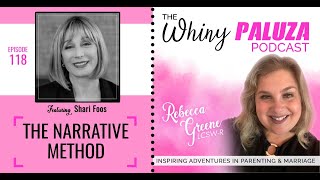
In this episode of the Whiny Palooza podcast, host Rebecca Greene (a licensed clinical social worker, mother of three, and parenting advocate) welcomes Sheri Foos, a marriage and family therapist, adjunct professor, and creator of The Narrative Method, a nonprofit focused on fostering authentic human connection through storytelling. The conversation begins with Foos’s personal background and the origins of her work, then delves into the core principles of the Narrative Method: moving beyond superficial small talk to share genuine stories, which creates empathy and a bridge to mutual understanding. They explore relational mindfulness—being fully present and establishing safe, mutually‑agreeable timing before important conversations. Foos describes the “cult of culture,” a pervasive set of negative internal narratives driven by societal messages, and offers practical steps for recognizing and interrupting these thought loops. The discussion turns to applying these ideas in professional settings, highlighting the 12‑Minute Connection program and story‑card tools that foster staff retention, camaraderie, and deeper workplace relationships. For families, Foos suggests using story cards, imagination prompts, and brief daily rituals to encourage open, meaningful dialogue. Throughout, she shares personal insights on humility, self‑compassion, and the importance of aligning one’s work with personal values, encouraging listeners—especially parents—to trust their evolving life phases and pursue purpose at any age. The episode closes with resources (thenarrativemethod.org) and a light‑hearted wrap‑up.
Chapters
No need to whine, it's Whiny Palooza! Have some wine and join us on the Whiny Palooza podcast with Rebecca Green.
Welcome to the Whiny Palooza podcast. I'm your host, Rebecca Green. I'm a wife, mother of 3, and licensed clinical social worker. I also have 3 fur babies at home too. My passion has always been to help children and their families. I always dreamed of being a wife and a mother. Parents are always learning through their struggles, failures, and successes and joys. I am no stranger to this wild ride of parenting, and I know behind every great parent lies a team of supportive friends and family. I want to be part of your support system. I want you to know that you are not alone. We are in this parenting world together. Join me every week for insightful discussions with experts on parenting and marriage, as well as other parents who have found the secret to successes in parenthood. You'll learn tips and tricks to make life with your family better than ever. I hope you will follow along with me while we dive into what it takes to achieve a happy family.
This is Rebecca Green for the Whiny Palooza podcast, and I am so excited to have Sheri Foos with me today. Sheri, thank you so much for being here.
Thank you for having me. I can't wait to wine.
Sherry has me laughing hysterically already, so this is going to be a good one. I can tell, I can tell. She is a fabulous lady. She is a marriage and family therapist, adjunct professor, and the creator of The Narrative Method, a California 501(c)(3) nonprofit organization, part of the Human Connection Movement TNM creates programs, products, and experiences that address the growing isolation and need for real connection through sharing stories. Foose also co-founded The Bridge in 1999, a free humanities program for low-income adults at Antioch University Los Angeles. She received a MS in Narrative Medicine from from Columbia University and a MA in clinical psychology from Antioch University Los Angeles. And there's so much more. As a sought-after expert on the subject of relationships, remote group dynamics, and meaningful connection, her writing and commentary have appeared in a range of online and print publications and podcasts, including Real Simple, Huffington Post, Women's Health, KBLA, Fatherly, Thrive Global, Shondaland, the LA Weekly, Sparks and Honey Culture Briefings, Saundership, Let Pleasure Be the Measure, and Bustle. Ms. Foose serves on the board of the City Kids Foundation and is the recipient of the New Directions for Veterans Community Hero Award 2015, and the Antioch University Los Angeles Lifetime Achievement Award in 2016. Holy moly, that is quite an amazing resume.
Thank you. I'm old. You're my age, you'll have a couple more things too.
You are not old, and you are so fun, and you're going to teach us so so much, but I really want to start with what inspired you to become a therapist.
I think what inspires a lot of people, which is, um, a crappy childhood. It just does wonders, you know, because, you know, when you're a child, even if you have, um, wonderful parents and, you know, just a lovely experience, you can't help but notice injustices in the world. And it could be just something like, where's where's my piece of candy, or you witness things. And we have seen from, um, really incredible experiments, um, with fMRI machines and in videotaping even infants, that you can see that even infants have a sense of morality. So just extrapolating that to your question, when you as a child see something either wrong or really inspiring, it's not uncommon to say, "That? I'm going to do that," or, "I will never do that as long as I live." And I think we all have at least one thing. And so for me, it was, I'll never do that to my child. I will never, you know, I don't want to be that person. I believe in possibility and hope and all those things. So.
Oh, I love that. Well, it brought you here and to the work that you're doing, and I know that, um, you do the Narrative Method. Tell us what that is.
Well, the Narrative Method is really a culmination of all of this work I've done over the years, not just as a therapist, but I used to host lots of live events, and based on that, I really discovered this wonderful dynamic that happens when you bring together people in a very safe and fun environment that invites like depth. Like, in other words, you don't really need this stupid small talk stuff, but if you go right to your story, oh my gosh. One of the things that people sometimes believe about feeling uncomfortable in social situations is not knowing like kind of like the social rules and it feels weird. And I have to tell you like what I do and all this, but all that is the BS small talk stuff. When you cut to a story, anybody can connect. When we're telling our truth, whether it's joy or sadness or anything in between, because it's real, everybody has those same emotions. They may not be attached to that particular kind of memory. So we teach people how to put themselves aside while they're listening to someone else's story. And in doing that, you can come so much closer to feeling it the way they feel it. And that empathy is the bridge to mutual understanding and accompaniment. You're not alone in the world if somebody gets you.
You're, you're hitting on a nerve that we were just talking about. Mothers were just talking about on Facebook that we're putting up a facade and we're not always being real and giving the honest truth. And I think the authenticity and the honest truth is where we're all truly connecting. So I couldn't agree with you more.
And I would also say to the extent that we don't tell the whole truth, let's look at why. Is it because, you know, we're a jerk? No, it's because we've been wounded and judged and put in a box. And, you know, if you are just a normal mother killing yourself to take care of your kids and make ends meet, That's one thing. And then you see this one over here who's also working out 2 hours a day and, you know, making all this other stuff happen, and you feel like less than. So it's really important to not be put on the defensive. And the only way we can do that is to deconstruct our own thoughts and realize we are all victims of this thing I call the cult of culture, which is just constant onslaught of noise and lies and negative Negative messages. So it doesn't take long to learn you're not good enough. Every child knows, every child knows, not pretty enough, not tall, white, rich, cool, smart, whatever those, those things are. And as we get older, we come to understand the mechanism behind advertising. And you know, it's not that you have B.O., they're trying to sell soap, but it's already done its damage and it continues to do its damage. So the trick is How do we separate ourselves from the things that have happened to us and the negative things that have been told to us? And when we can do that, and it's an ongoing process, then we discover who we really are. And when you're connected to your real self, it's very clear what you want to do, what you feel you are charged to do in the world. And, um, how to go about doing it. And so believe me, I'm not saying this because I think it's just that easy. I think it's really hard. But when you get to do it with other people, even one time, you know, you, you, to have that experience of sitting in a group with strangers and somebody's talking about something personal, you don't know the person from Adam, you never would have met them, you don't— they don't look like somebody you would like, But oh my gosh, now they're opening their mouth and telling your feelings. And suddenly, as other people nod and they get, yeah, I feel like that too, oh, that's so such a drag, or wonderful, whatever. And then all of a sudden, something is lifted because we've realized it's not just us. You're not the most screwed up person in the world. We all are. We all have fun.
We all have stuff. Is— are you describing relational mindfulness? I love those terms.
Yeah.
Is that what you're describing?
It's part of relational mindfulness. Relational mindfulness is a practice, just like mindfulness is a practice, or meditation, or yoga. These things we do to center ourselves, to get clarity within ourselves, to calm ourselves. Well, they're extremely important, but So is relational mindfulness. And that means that before we enter into an important conversation, you know, you can try and practice it 24/7, but good luck.
Right.
You know, when you're in a hurry, but when you're having an important conversation with someone, first establish that this is mutually a good time and a safe enough environment, and you have enough time. It's amazing how many conversations go off the rails just because of that. So if you both are able to devote yourselves to this period of time and are willing to put aside your individual needs and feelings and hurts to take turns really taking in other people's thoughts and feelings from their perspective, it's not easy because we have a tendency to think, well, I'm going to— oh, you're— that's blah, blah, blah, blah. Stop. Stay connected to the bigger picture. In the bigger picture, at the end of your life, you don't win because you were right. You win because you loved and you were loved. And most of this stuff that we argue about, and I, I do it as much as anyone else, is just stupid egos. So what, you were right? You know, were you so right that you told that to everyone else and now they can't stand you? And I— you could be right all by yourself.
That's a really good point. I always say that to me, life is about our relationships. That's what it's all about.
It's— that's everything.
That's everything.
It's, it's pretty hard to, uh, cope with the complexity of life if you have love in your heart and there are people who are willing to receive it. And if you're lucky enough to receive their love Beautiful.
Amen to that. You, um, talk a lot about staff retention and staff satisfaction. Can you help the people listening, the employers listening, how can they help increase their staff's retention and satisfaction?
I think it's, it's what you said. It's about listening. It's about caring. It's about making the time It doesn't have to take lots of hours and minutes. It's how we go about it. If you're a leader running a company, you probably don't have a lot of downtime, especially, you know, during your workday. So you more than anyone need to create moments for yourself to just release. However you do that, whether you do meditation or writing, you know, because of the work we do, I'm such a fan of the power of writing. You can work out so many things and save so many arguments arguments with other people and arguments with yourself. But I would say to a leader, consider that every relationship is a, is a real relationship. And the potential of getting to know people that you work with and having them get to know each other in a deeper way leads to greater camaraderie and understanding. And it's not that anyone, particularly in a work environment, should be pressured to reveal any personal information they don't want to. It's not ever about that. It's just about being invited to share your real perspective or a story that speaks to whatever idea might be on the table. In sharing our humanity, our foibles, and our strengths, we create a bond that doesn't develop in any other way. And so when we have the capacity to do that within a business, it, it, it changes it very quickly. We offer a program called the 12 Minute Connection, in which over a period of time, every single person has a one-on-one with everyone else. And you can imagine without a hierarchical goal where people are just sharing stories for the CEO to get to know the new hire who just looks like, you know, it's just a part-time job. They don't care. This kid's a genius in trying to do such and such and such. It starts to break down our preconceived expectations about each other to discover, you know, immeasurable possibilities for ways people can participate in our company and, and that we can work together to grow new ideas and improve old ones.
I can't wait to share all this with my husband. I don't know if you have talked to him yet. I don't know if he's had you on his podcast, but he is the CEO of his company, and, um, I can't wait to share this with him. This is good stuff. He needs to hear this. He's a fabulous CEO, but he needs to hear this. So You talked about the cult of cultures. You touched on that. Can we go back to it? Can you help, help us combat those negative messages? How do we combat that?
The best way to do it is to make a deal with yourself to become hyper-aware every time you realize you're, you're in some sort of negative thought loop. Or sometimes these ideas don't come to us in fully fleshed out words. Sometimes you just feel like, I shouldn't have said that, or, oh, that person, what they said just pushed my buttons. Or it's not always laid out. It's invisible because it's so familiar and we're just talking to ourselves, we have code. So if you can slow things down and be able to realize that in the midst of thinking, oh, I am— I can't wait to finish that because I'm going to meet with— and then all of a sudden, in the midst of a positive thought, you hear, who do you think you are? Well, stop. Literally stop. Write that down and talk to that feeling. Because what happens is in a very immature way, like a child, if we hear something that is traumatic, and obviously there's a huge scale of trauma, there's profound trauma, and there's just, you know, things that are more in the world of hurtful, but if they don't get dealt with, sometimes they fester. So let's say, you know, the, the thing you realize you're saying to yourself is, who do you think you are? Every time you have an idea to move beyond What's in front of you. So deconstruct it, because no child is born saying that to themselves. Child is just pure curiosity. Oh, I want this. Look at that. What is this? There's no no until somebody puts it into you. So if you can understand where that came from, you can edit it. You can say, you know what, I can, I can identify that my mother used to say that to me, that I was too big for my britches, or, and and then try and understand, well, what made her say that? Who said that to her? Whatever it takes to sort of try and unwind this stuff. However you do that, whether it's something that you take time to really write about and discover, or you just identify and say, no, that's not who I am. Those are not my thoughts. That's negative. And I'm not going to let it permeate my optimism. So however you do that, just stop it. And then proceed. But as long as you stop it, you're telling your unconscious, this won't fly.
Yes. And I think it's so hard at first, and, and I think the more we do that stuff, the easier it becomes, don't you think?
Absolutely. Yeah. I mean, some things that become second nature start off being even hard to understand. And that's another thing— what did people tell you about your capacity to learn, to learn something new? Uh, were you put in the dummy group? Were you put in the dummy group because you're dyslexic? Were— you know, when you look at kids that are in special ed classes who don't have special physical needs, you very often just see kids who are extremely creative but don't have any direction. Whatever it is, nobody, even the person with the lowest IQ, is dumb. Every brain is so much more complex than any computer anybody has ever met. We have endless creativity to survive, to think of new things, to put together things that were never, you know, seen in the same spot together before. And I'm here to offer you that confidence that if you stop comparing yourself to what success is for other people and try and separate yourself from the negative thoughts and the cult of culture and the limitations other people put upon you, you can start to really get clear on who you are, what your purpose is, what you want, And then there's room for that because nobody else has that menu, just you.
Oh, it all sounds so wonderful.
It is wonderful. As confident as I am that this is powerful, I also can never overstate that that doesn't mean it's easy. That doesn't mean that, like, exactly, it's just like, uh, you know. But knowing that should give you strength.
Yes, definitely, definitely. I love that you talk about working for places that aligns with our own values.
It's really important.
I, when you, when I read that about you, I was like, wow, that is powerful. But how do we do that? How do we make sure we're working somewhere that aligns with our values?
I'm going to say sometimes gradually. Don't quit your job unless you have another way to support yourself. I mean, I've done— I probably pick a mistake and I'll let you know if I have one or two on my— under my belt. Yeah, there are times when we can afford to stand up for exactly what we feel, but don't get confused by somebody who either has the financial means to do that or otherwise is set up elsewhere. It's not easy to work someplace where you don't respect the values of what the company is doing or the people who are running it. But if you do notice that, and there's no way to affect change within your particular position, then yeah, of course, try to work towards developing whatever you have to do to appeal to a company that you would rather be at.
For sure, for sure. I do think, you know, I don't want to give out false hope or anything, and I don't want anyone to get fired listening to me, but I do think that employees can have positive influences on the company.
If we have seen nothing else these last couple of years, hasn't the great resignation taught us a little something about workers who don't get paid much If they could be invisible before, they're not now. And I think people are just too busy to organize around it. But this country was always built on the voice of the people. And regardless of, you know, forces that may try and silence them, we're all the people. There's nobody that's, you know, nobody's like the grown-up here. We're all the people, including the people that have power. But they too have issues that they are struggling to overcome and achieve. And sometimes when you give an ear to somebody who looks like, you know, all this person is, is the power person and they're controlling everything, sometimes they need some self-compassion also to move beyond a negative position that they may feel that they have to be in to protect themselves. So it's— nothing is all it's cracked up to be. No influencer making a zillion dollars a year is boom happier than you. There's no— it's the— there's only one thing that is guaranteed to make you feel whole most of the time, and that is being on your own path. And you know, when you're on, it doesn't always feel satisfying or anything, but if you think you're living your, your real life to the best of your ability, it's easier to sleep. If, if you love, if you love people, if, if there's room for people to love you, it's good. So at the same time, I believe in holy lala complaining, and whining, of course. I think, you know, throw a little gratitude in there for the things that you have accomplished, for the things that you've overcome, because the things that you have overcome are no less of a win than the things you accomplish, and oftentimes far larger.
Oh my goodness, I need to rewind that and play that a few times.
Well, you can.
I have that ability when we're finished. Um, how can we apply your practices within our own family?
Well, um, in addition to what we— first of all, we sell, um, cards, um, that have all of the 12 core concepts on them, and within that there are inspiring ideas and prompts. And they can be used over and over because they're meant to evoke a story or a memory or a feeling about something that is open-ended and profound enough that you could continue to delve into it. So that's, that's a tool that you can use where you can do these cards with your family, with your business, uh, friends, whomever. But if you want to just talk about what you can do just within your own four walls in the next 5 minutes, Clear the decks, unplug, and ask people, like if you have a child, ask your child something imaginative. If you could be anywhere in the whole world doing anything right now, what would it be? And just watch their eyes travel into their imaginations. And sometimes children are a little better at this than adults who've been taught not to wander their thoughts, that that's off the point, that you're being flaky. When you invite people into their imaginations, they start to open up to themselves and to each other. So I would just say imagination exercises.
I'm picturing families around the dinner table. They always talk about how we need to eat Dinner as a family.
Yeah.
And I'm thinking about how so many families go around the table to share about, you know, their day, whatever. And I mean, you're talking all about connection. I think we just have to make time to connect, whether it's people we live with or people we work with.
It, it, and it's not that hard. We're already there talking about BS, you know?
Yes.
But in terms of a a conversation starter. Really anything except the weather, you know, because everybody can look outside. But everything's interesting. What's, you know, and if you have children, what's the silliest thing you saw all week?
Oh, I love that.
Try to not make questions in the ultimate because that's too much pressure— the best, the worst, blah blah blah. But really anything. And following something someone has said, just pick up on it in real time. You know, if you could play with any toy, any person, if you could do any sport. I mean, just picking up on what's real in the moment. And when it comes to adults, to reconnect each other with our deepest and often forgotten dreams opens up channels that have maybe sat behind closed doors for many years because they have felt to be too vulnerable, too impossible. I can't try again. And sometimes what we discover when we look at things anew is that, yeah, maybe the way we were approaching this thing didn't work then, and maybe it's not going to work now, but there is something in the core of it I'm still passionate about. How can I reconstitute it?
Mm-hmm.
Right? How can I recycle it? How can I infuse what I've learned since then to make that thing viable now? And that's what The Narrative Method is. It's been an entire lifelong path of honing all of these different formats from, uh, performing to comedy, to music, to psychotherapy, to group experiences, to this. And you know, you can't always know where your passions will lead, but you better trust them because you're the only one who can.
You're speaking to so many women right now. I mean, men too, but it's mostly mothers who are going to listen to this. And I think a lot of mothers have spent time home. There's mothers who have continued their careers and there's mothers who have been home for a while and put their dreams aside. And you're making me think that it's never too late, that they can go after it now.
First of all, yes. Second of all, even as you say that, we all have the picture— women who have continued their career, mothers who've continued their careers, and mothers who've stayed home. Mothers who've stayed home not interested in careers, not capable of careers, those who can do, you know, all of these negative tropes. I think it'd be hard-pressed to find a person who said, "I hate that my mother stayed home with me. I hate that she made me lunch." Come on, everybody. Let's look at the bigger picture. There are times in our lives where we have to attend to things. And there are also times in our lives where we have to attend to things that make it impossible to pay enough attention to the parts of ourselves that we long to manifest. But, you know, there are different eras in our lives, and we are not allowed to say to ourselves, never, or it's too late, or I can't, because those are other people's words. If you are doing the holy job of being a mother, whether you're home or at work, or overseas, uh, thank you. And let's take back our right and our responsibility to define our lives ourselves. Nobody gets the right to tell your story.
Those are some powerful good words. You have so much good advice. Tell us the best advice you've ever gotten.
That's a really good one. Um, you know, I can't say that I was a good listener to advice when I was younger, uh, because I knew everything. So by the way, it's too bad you meet— you're meeting me now because I could have answered any question you had. And you know, this was a defense mechanism because what I heard instead of advice was, you can't. Who do you think you are? You'll never be nothing. That was my— that was what was told to me every day. It was a little bit more in-depth than that, but, um, so I had to— or I had to— the way I adapted and survived was to not take in from adults. I was very rebellious. Um, and as you get older, you get a little humbler. You don't have to try, don't worry, it'll happen. And you start to realize, oh, well, maybe A, I don't know everything. Maybe some of these people that I just assume are stupid because I don't know why I don't like their shoes or some other stupid, you know, reactionary juvenile parts of ourselves sort of taking over. But I think in terms of the best advice, Once you let go of thinking that, you know, your life could even be perfect— ain't gonna happen, but that's okay— let go of that. Give yourself strength. Reward yourself with appreciation for the things that you have done, because you can't rely on other people appreciating you in the ways that you kind of need to be. You can do that. And once you start doing that, and once who you really are starts getting more and more prominent and you feel connected to yourself, you do become more humble. And in a state of humility, you are hungry for a, what, so what do you think? What should I do with Narrative Method next? You know, it's a matter of having enough comfort inside to make yourself small and vulnerable enough to say, hmm, I don't know, what do you think? And I see so many people who are young capable of doing that. I am so blown away when I see people, whether it's because of their religion or the respect they learned at home or whatever, but modesty, which I never had, uh, because I was just offended against all that stuff, but modesty is the key to learning.
So true.
If you can let yourself not know, there's a ton of space to take in. But if you know, there's no room.
I think it's very hard to— personally, for me, to feel like I 100% know anything, right? If, if we even just see that there's a little room to learn a little more Do you know what I'm saying? Um, it's impossible for us to know everything. It's impossible.
But I think also as women, I mean, you just nailed something that we do because we've taken it in. It's not deep down inside we think that, but how many messages have you gotten and how many pay stubs have you looked at to show you that men are valued more than women? And in part of those messages are that We don't really know what we're doing. We're just like flighty, or we're whatever, whatever that language might be that we have internalized. So we have to remind ourselves, no, we are really serious and we can divide ourselves into a lot of different parts and commitments during different periods of our lives, but we can't always do everything at once. And it's a hard pill to swallow.
That is something that every single one of us needs to learn, like, this instant. And I think that one of the hardest lessons for me was realizing I couldn't be everywhere that I wanted to be. So, right. Well, you have shared so much with us, so much to take in and appreciate. What else do you want to share that I didn't think to ask you?
Oh my gosh. Well, first of all, I could talk to you for a very long time about a lot of things. I love your sense of humor, your big picture. Um, I don't know that I can identify one thing. I think what if I could upload into people something from my heart, from my suffering, and from my relief. And of course it's ongoing. Don't ever think you're going to get there and then you're there. It's not like, oh, I just have to finish No, um, don't effing give up on yourself ever. At the end of the day, you are your best friend. I don't say that like to demean your best friend, but you're going to be hanging with you to the bitter end. Yes. So the better you can have loving rapport with yourself, not only will it give confidence to the fearful parts of yourself to start expressing themselves but it'll teach you better relational mindfulness skills because you will have practiced on yourself. Oh honey, I'm sorry, that was really disappointing. Then you can say that to the next person. But if you say to yourself, look, you didn't pay attention and that's what happened, then it's really easy to say that to the next person. So cut yourself a break. You go, girl, mommy. Uh, come to our Zoom-ins. They're free. They're, um, on our website. Thenarrativemethod.org. You come as you are. We share stories both in the form of conversations, and we do two, two nights a week where we share stories in writing groups. And you don't have to be a professional writer, but you can start to learn the tool and the power of writing as a way to stay connected to yourself, to better understand yourself, and to even work out problems with relationships.
Sounds wonderful to me. So narrative.org, is that the best place?
No, thenarrativemethod.org.
Okay, so that's where they can go find you.
Go find me.
Well, I can't thank you enough for your time today. This was so much fun.
You're a doll. I loved it.
Oh, I think you're fabulous. You had me laughing from the start. We could definitely talk all day, but I just want to say thank you.
Thanks so much, Rebecca.
This is Rebecca Green reminding everyone to spend every day laughing, learning, and loving.
Thank you for tuning in to the Winey Palooza podcast. If you like what you heard, please be sure to subscribe so you never miss an episode. While you are there, leave a review. I love to hear your feedback. Thank you so much for listening. Until next time.
This show has been produced by Market Domination LLC. To discover how you can have your own show completely done for you and turn it into a real published book and become the authority in your marketplace, go to www.marketdominationllc.com/podcastoffer.










