The Whinypaluza Podcast with Rebecca Greene Episode 072 Building Confidence in Children
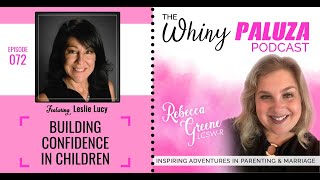
This content was created by Rebecca Greene. This content was uploaded by Rebecca Greene. This is a YouTube podcast episode titled "The Whinypaluza Podcast with Rebecca Greene Episode 072 Building Confidence in Children" (created 2021-08-20T13:00:12+00:00). It is an interview-style podcast hosted by Rebecca Greene (who opens and closes the show) with guest Leslie Lucy, founder of Orange Tree Corporation/Orange Tree Teaching System. The conversation covers parenting and early childhood education topics — building children's confidence, the Orange Tree Teaching System (teacher-directed, practice/repetition/mastery), classical vs. modern education, operant conditioning, common parenting mistakes, and scaling preschools. The transcript also notes production/marketing credits (Market Domination LLC) and provides websites referenced by the guest.
Chapters
No need to whine, it's Whiny Palooza! Have some wine and join us on the Whiny Palooza podcast with Rebecca Green.
Welcome to the Whiny Palooza podcast. I'm your host, Rebecca Green. I'm a wife, mother of 3, and licensed clinical social worker. I also have 3 fur babies at home too. My passion has always been to help children and their families. I always dreamed of being a wife and a mother. Parents are always learning through their struggles, failures, and successes and joys. I am no stranger to this wild ride of parenting, and I know behind every great parent lies a team of supportive friends and family. I want to be part of your support system. I want you to know that you are not alone. We are in this parenting world together. Join me every week for insightful discussions with experts on parenting and marriage, as well as other parents who have found the secret to successes in parenthood. You'll learn tips and tricks to make life with your family better than ever. I hope you will follow along with me while we dive into what it takes to achieve a happy family.
Hello everyone, this is Rebecca Green for the Whiny Palooza podcast, and I am so excited to get to have Leslie Lucy on my show today. Leslie, thank you so much for being here.
Thank you for having me.
While raising 3 children, Leslie realized that her passion was to be in childcare. She took a leap of faith and started her own home daycare. When she realized her true calling to change the way we do preschool, she went to Saddleback College to get her education in early childhood development. In 2003, Leslie was led to launch a pilot program at Calvary Chapel of the Canyons, where the Orange Tree Teaching System was put together. Soon after, Leslie launched Orange Tree Corporation in Lake Forest as its first location. In 2011, Orange Tree opened its second location, Newport Beach, and is currently extending the third branch in Costa Mesa. I'm not, I'm not pronouncing these places right. Plaza Mesa. Thank you. I didn't go over that with you beforehand.
Okay.
So the third location is slated to open in September 2021, which is so exciting. You are just branching out everywhere.
We're, we're excited. We're loving it.
Well, I love what you're doing and I want to learn more about it. So let's jump in and start with what inspired you on this path because you didn't start out with with preschool?
No, not at all. We— I actually was very happy working in the medical field, and, you know, that was my career, and I never anticipated that I would change paths so late in life. And, you know, when you have 3 kids and you're 35 years old, you just don't even think, well, maybe I should go back to school and do something different. But, but that message that Bruce Wilkinson Gave about how God puts a dream in our hearts, just really made me stop and think, you know, like, I love what I'm doing, but is this what I'm called to do? Is this my life's work? Is this what is going to leave a legacy for me? And the answer was no. And when I started pursuing what I love to do, you know, people always say, do what you love and you'll never work a day in your life. Well, Children is what I love. I come to work every day and I see their little faces and it just brings me so much joy. So I knew, I knew as soon as I saw the kids' little faces that that's what I needed to be doing.
I was just talking to my daughters about what they wanted to do and my 12-year-old, since she was 5, said, I'm, I'm acting. That is my passion, and I'm acting. And I said to my other daughter, you know, most people don't figure out their passion when they're 5 years old.
True. That's wonderful. Good for her. She's ahead of the game.
I know, ahead of, ahead of both of us for sure. Can you tell us what the Orange Tree Teaching System is?
Yes, it's actually, um, Oh boy, you know, a lot of schools are promoting new and fresh, and the Orange Tree System is saying no. Practice, repetition, mastery. So we're just doing all of the things that kids need to know how to do to be prepared for life. And we're just making it fun. So that's the trick is you have to make whatever you're teaching fun. But they're, you know, they're very predictable things that kids need to know and they don't always need to be entertained. They just need to learn how to practice and how to persevere for mastery. And that's probably it in a nutshell.
That's a very good summary. So you basically were, you were seeing like new innovative things in preschools and you said No, I think that this is the way we should be going.
Well, we see the result of new and innovative, you know, kids. I, you know, I think I'm going to probably get myself into trouble by saying this, but, you know, kids have ADD at such large numbers right now, and we have to go, why is it so prevalent right now that A lot of kids have ADD. Well, if you think about the neuropathways in the brain, if you're practicing something and you have a good neuropathway for that skill or that thought or that subject, then you're not going to be like this all over the place all the time. But if everything's always new and there isn't that repetition and there isn't that practice, then how do you have the neuropathways to support thought. You have to practice things. And so I think, you know, that's probably a big contributor to ADD.
That makes a lot of sense. And you're kind of explaining this as you're talking, but I know that you combine classical education and skills training. I know that's what you believe in. Can you— do you mind giving us an example of this?
Well, uh, classical education, a lot of people don't really even know. They've never even heard of what's the difference between modern and classical. And I kind of do my preschool age summary of classical versus modern. So, um, it, you know, there's a whole history behind it that dates back 2,000 years. But, um, the idea is the— there is a God who created the world and everything in it, and that there's a way that everything functions as part of that creation. And so for many, many centuries, that was the foundation of the, of the education, was that there's an empirical truth. And in the early 1900s, um, it became in question that anything that cannot be proven in science couldn't be proven scientifically is now under scrutiny for not being true. And that springboarded to empirical truth and everybody's— and the thought that everybody, everybody, whoever has a thought, is— that is their truth. So it kind of was a process of wrapping truth and making it as anything is true instead of everybody having the same belief system and operating under that understanding. So when we have no empiric— when we have no truth, then how do we function as a society? Everybody has their own way, everybody has their own idea, everybody has— everybody's right. Yeah, that's— if that's the way we're going to function, it's going to be really hard to lay a foundation in children's brain for understanding how the world works. And so we teach classic classical education and we teach skills training, and that's what I explained. And by doing that, we're giving them skills that are going to set them up for all of life's challenges. They're going to be equipped to deal instead of just floating around, not really having any foundation or, or basis for their, for their thought process or their belief system.
Well, and there's so many skills to teach these kids from a very young age. And, you know, it makes me think of confidence. Okay, we want to teach these kids confidence. What do you, what do you think is one of the key ways that we can help our kids become more confident?
Well, we, we experience it every single day when a child starts to learn how to do something for the first time and they go, "I can't do it." That's their first response, "I can't do it." And then they learn, "Here, here, let— the teacher's going to help you. Let me show you how. I'm going to teach you." They begin to appreciate that dynamic of, "Oh, I have somebody that cares enough about me to help me learn how to do it," and it becomes a wonderful dynamic where the teacher is scaffolding and helping the child to practice. So when you scaffold, you're not doing it for them. You're just explaining or showing or maybe meeting them where they are. I have a classroom full of 2-year-olds that I'm training the teachers right now. So as the teachers are learning how to help them potty train, The kids have to do everything themselves and the teachers just help them to where they can't do it. And then pretty soon the kids are learning how to do it themselves and then they're just potty trained. It doesn't have to be a big giant thing. It's just part of the natural learning process. But that's why scaffolding and helping them empowers them because when they learn how to do it themselves, they become empowered.
Absolutely. You know, my daughters couldn't be more different. One of them wants to do everything herself, and I have to calm myself and be like, you don't, you don't need to hurry. Let her figure this out and take her time. And the other daughter would let me do everything if, if, you know, we do it. But I have, I have realized over the years that letting them figure things out and standing by instead of doing for them helps them so much to build their confidence. But we, but we as their mothers, I think a lot of us want to just jump in and do it.
I see it every day and I have to tell the parents, let him do it. I know it's hard and I know he's struggling.
I'm guilty. I'm guilty. I mean, even like helping our children overcome challenges. Okay. That was my next question. And you basically answered it is as they're learning things, they're learning to overcome challenges, correct?
Absolutely. And that's why, you know, the first time that I realized this was when my now 30-year-old son was 3 months old and he was trying to turn over. And I, I saw the struggle, and the struggle was real. And he was a baby, and he was like, oh, trying to get in. And he was almost in tears because it was so hard for him to turn over. And I so wanted to just push him over and do it for him. And then I realized, you know what, this is important for him to learn how to do things on his own. So I got in front of him where nose to nose where he could see my face and I was going, come on, you can do it. And I was encouraging him. And that was kind of like the, the aha moment where it's like, you know, this is a great relationship. It's not me doing it for him, but it's me encouraging him. So that he appreciates the struggle and he appreciates the victory. He owns it. It's all his. And that's how we want to raise our kids.
That is the perfect example. It starts right at the beginning.
Right at the beginning. Exactly.
Well, and see where I'm answering all my questions, so I need to stop doing this. But when I ask you about the biggest mistakes that you see parents make, what else do you see besides us doing things for our children?
Um, then another huge, huge mistake that is so common is that parents ask their children what they want too much. So one of my parenting workshops is Who's in Charge? Because we absolutely know more than our 2-year-olds.
Yes.
And our 2-year-olds are absolutely running the show across the board. It's what do you want to eat? What do you want to watch on television? Where do you want to go today? What do you— and they get to choose everything. And what ends up happening as a result from that is the kids are overburdened with responsibilities and decisions that should not be put in their hands. And you can hear the passion in my voice because it's heartbreaking when you see the meltdowns and the breakdown, emotional breakdowns of these kids. And it's so simple. They should not be having the burden of all this, of the responsibility of making these decisions. We should be telling them, this is what we're going to do, this is how we're going to do it, and I'll be right here in case you need any help.
That's really good advice. And, and we all do that. I have seen all of us, all of my friends, myself included. Just the other day I was like, hmm, where do you want to go on vacation? I'm like, why am I asking my children that question? Oh boy. We all make mistakes every day, that's for sure. So as far as challenges go, what are, what are you experiencing as your biggest challenge right now?
I think that the biggest challenge is really getting people to understand that there are a few things that we need to unite to be able to accomplish. One of them is just having that, that teacher-directed in education interaction. So let me say that in a different way. Have our teaching system is called teacher-directed. And it mirrors a kindergarten classroom. And most preschools aren't teacher-directed, they're child-centered developmental. And what that means is that the child is in charge, and developmental refers to the way that they learn. So developmental is learning through doing, right? So it sounds like a great idea because the child gets to self-initiate where they're going, what they're going to do, and how they're going to do it. And then the teacher responds to them. And it sounds like a great idea until you see what the result is. The result is that children don't get to learn the things that they're not interested in learning. They don't get a balanced education from just only doing what they want to do. They also aren't set up for success in school because when they go to kindergarten, they're going to be expected to listen and follow directions, which is the exact opposite of what they've been doing for the last 5 years. And then they're gonna— they're not going to love school and love learning because they're now going to be in an environment that they're not equipped for. So to me, it makes more sense to run your preschool ages the same as you would run a kindergarten class. This is what we're going to do. Let me explain it to you, and then I'm going to teach you how to do it. And yes, some things are going to be hard for you, but that's okay. You'll get it. Don't worry, you'll learn, you know, and you encourage them. So the biggest challenge, I think, is really making people aware that this is something that if we don't change the way we're doing it, we're, we're going to have just continued problems with our kids with not just ADD but also emotional regulation, with conflict resolution skills, with not being equipped socially and having social anxiety and depression and just all of the things that our kids are struggling with right now. It can be solved by Starting at the beginning and equipping them for life. And it's— yeah, it's more work. It's way more work. It's hard work for the parents, and it's hard work for the teachers. It's way harder to do, but it pays off in that your child will be equipped for life instead of struggling for life.
Yeah, that makes so much sense. You explained that so well.
It's a, it's a big ask, but it's necessary. It's important, and it, it will, it will really, really change, you know, this generation if everybody were doing it.
Well, and preschool by preschool, you're spreading this message and reaching more and more families.
Absolutely. Yeah, and teaching the teachers.
Yes.
Yeah, teaching the parents. Everybody's gotta put their part in.
Yes, for sure. What would you say the best advice is that you've ever gotten?
Uh, probably to be transparent, to be honest. I think truth and transparency is, is the best way to live.
Totally agree. Truth is, truth is my button. I told my, I told my husband when we started dating, I said, As long as you're honest with me, all will be well.
Yeah, because you know that old saying, the truth always comes out.
It's true. Yes. Oh, it's totally true. It is true.
So truth is probably the best thing that we can all do.
I agree. What, what do you like best about what you do?
I think the interaction with the kids. You know, when I think about my, my day and, and what makes me happy, you know, it's little Luke going, "Miss Fousey, I'm doing it! I'm doing it!" Oh my gosh! His little face, and he's so happy because he's, he's successful.
That's wonderful.
You know, so fun.
Your job sounds so much fun. I want to come work with you.
It's so fun. I love it.
Well, you have learned so much along the way. Can you tell us who inspires you and any books that you would recommend? Because I know you've had very inspiring people along the way.
Well, I am so fortunate to belong to a mega church, Saddleback Church in Lake Forest, California, and Pastor Rick Warren has been my mentor for 20 years. I started, I started way back when, and serving in the church and learning how to live the biblical way has greatly impacted my own life personally, but also it's really interwoven within everything in the Orange Tree teaching system because it's all based in truth which comes from the Bible. So, you know, it is what it is. Yeah. So, so Saddleback Church and Pastor Rick Warren, and then of course Bruce Wilkinson, who wrote The Dream Giver, that absolutely changed my path to fulfilling what my calling in life is to change the way we do preschool. So two, two big, big names.
Well, and it sounds like they led you in the perfect direction for you.
Absolutely.
Well, what else do you want to share that I didn't think to ask you?
Well, I think that all of the questions that you asked me really have given me the opportunity to share that it's really, really important how we raise our kids, that we have to work as a community with teachers and parents and friends. And, you know, the old saying, it takes a village, is true. It's absolutely true. And we're fighting against division right now. And so if, you know, if, if I can just send the message of unity and love and acceptance, um, when we have that in our heart, then we can do anything.
It's so true. I love that so much. And the divisiveness is so sad, and it is— I don't like seeing it either. Can you leave us with one action step for parents to take? They were going to take something today, what would you tell them to do?
Well, the first thing that pops in my mind is study and learn operant conditioning. Operant conditioning is the, the simple, simple thing that we can understand that will be life-changing for not only raising our children, but we use it in everyday life all the time in our marriages, in our relationships with our friends, in our relate— in our business relationships. We all operate under operant conditioning. It's the way that we live. And so if you don't know what that means, Google it, learn it, and then use it to to create better relationships. Great advice.
You're full of so much good advice. Can you tell everyone where they can find you?
www.orangetreechristianpreschool.com.
Well, I can't thank you enough for your time. I know you're at preschool. I know how busy you are. So thank you so much for spending time with me today.
Thank you, Rebecca.
This is Rebecca Green reminding everyone to spend every day laughing, learning, and loving.
Thank you for tuning in to the Winey Palooza podcast. If you like what you heard, please be sure to subscribe so you never miss an episode. While you are there, leave a review. I love to hear your feedback. Thank you so much for listening. Until next time.
This show has been produced by Market Domination LLC. To discover how you can have your own show completely done for you and turn it into a real published book and become the authority in your marketplace, Go to www.marketdominationllc.com/podcastoffer.










