The Whinypaluza Podcast with Rebecca Greene Episode 060 What’s in a Name
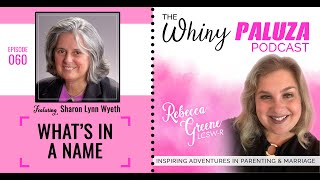
In this episode of the Whiny Palooza podcast, host Rebecca Greene interviews Sharron Lynn Wyeth, an international name expert and founder of Nameology science. Wyeth explains how the placement of letters, vowels, and consonants in a name encodes a person’s life purpose, personality, timing, and relational dynamics. She describes the system’s seven sub‑categories that together form an individual’s “umbrella” purpose, and how first, middle, and last names each convey distinct information (essence, stress response, and attraction). The conversation covers cultural naming traditions, the impact of name length, the significance of vowels versus consonants, and how name analysis can be applied to parenting, marriage compatibility, hiring, legal cases, and business naming. Wyeth shares anecdotes from her teaching career that led to the discovery of the patterns, outlines practical tools (free first‑chapter, newsletters, free third book) available at knowthename.com, and promotes personalized consultations. Throughout, the tone is conversational and enthusiastic, with a supportive sentiment toward using name insights to improve relationships and personal growth.
Chapters
No need to whine, it's Whiny Palooza!
Have some wine and join us on the Whiny Palooza podcast with Rebecca Green.
Welcome to the Whiny Palooza podcast. I'm your host, Rebecca Green. I'm a wife, mother of 3, and licensed clinical social worker. I also have 3 fur babies at home too. My passion has always been to help children and their families. I always dreamed of being a wife and a mother. Parents are always learning through their struggles, failures, and successes and joys. I am no stranger to this wild ride of parenting, and I know behind every great parent lies a team of supportive friends and family. I want to be part of your support system. I want you to know that you are not alone. We are in this parenting world together. Join me every week for insightful discussions with experts on parenting and marriage, as well as other parents who have found the secret to successes in parenthood. You'll learn tips and tricks to make life with your family better than ever. I hope you will follow along with me while we dive into what it takes to achieve a happy family.
This is Rebecca Green for the Whiny Palooza podcast, and I am so excited today because I have Sharron Lynn Wyeth with me today. And she is an international name expert. She is the founder and creator of Nameology science, the study of the placement of the letters in a name. After 15 years of research followed by 3 years of testing in over 70 countries— wow— she has evaluated thousands of names since 1995. Her best-selling book, Know the Name, Know the Person, is the first in the sequence followed by Know the Name, Know the Spirit, and Know the Name, Know How to Connect. You may have seen her on Good Day LA, New York City's Fox News, Good Morning Arizona, and in various other cities on NBC, CBS, and ABC, or have heard her interviewed on any one of hundreds of radio shows. Today she is hired by human resource departments in choosing appropriate candidates to interview, lawyers in how to present cases to judges, and individuals who wish to know themselves better and maximize their ability to connect with others. She also assists nationally and internationally in naming new businesses, new products, and when people wish to change their names. Thank you so much for being here with me today.
Rebecca, I'm excited to join you. Thank you for the invitation.
What an impressive, uh, bio you have. I am so impressed with you already. And I told you I love names, so when I heard what you did, I said to my husband, I have to talk to her.
Well, you know, everybody has a name. It's not like anybody can be left out. There's even a law that says that everybody has to have a name. It's literally illegal not to have a name.
Yes, and they don't let you leave the hospital until you name your child, right?
Right. Well, and just think about when Prince, um, lost his rights to his own music for a while. He had to go by a name, and so he just went as— his name was the, the person formerly known as Prince.
Yes! Oh my gosh, you're absolutely right. I forgot about that. Very cool. Well, let's start at the beginning because I'm fascinated. How did you become an expert on names and how did you come up with this system?
It was in my 7th year of teaching and I was doing the seating chart and we always just put down the kids' names randomly. And so I was doing the seating chart and as I got to the 4th class, all of a sudden I realized what my brain was doing. And Rebecca, it was saying, don't put Joshua next to Julie because together they're going to be clowns. And Stephanie's going to be stubborn, put her over on the side where you don't have to change your seat much. And Derek, Karen's going to need extra help, put them up close. And, and I was going, wait a minute, this is what I do when I know these students, but I don't know these kids yet. So I went back out of curiosity and I put down my first impressions of every single name, like what my brain was telling me. And I put it aside till winter break because I said, no, I want to get to know the kids for who they are. So when I read it at winter break, I went, oh my gosh, this is so accurate. So my brain you know, has picked up something that now how do I make it conscious? So my brain's thoroughly trained in patterns because I'm a math major in college and I have my master's degree. And so I went, okay, let's figure out the pattern. Now that took me 15 years of trial observation, you know, trial and error, whatever. Then when I thought I had it, I wasn't— I was already speaking on other topics around the world, so I just said, can I add NEMology science? So I ended up talking on NEMology science in over 70 countries And everybody said, where's the book? Where do we find out more? And that's when I came back and it took me 2 and a half years and I wrote the book. And then it just kind of bloomed from there.
It's amazing. And it makes so much sense because when I was naming my children and thinking about the clients that I worked with and thinking about the people in my life, in my life, I mean, I'm not going to say anything because I don't want to insult anyone, but I would be like, oh gosh, this name. Is trouble. I'm not using this name.
And what's trouble for one person is not necessarily trouble for another. And think about it, as a teacher that literally I've taught over 5,000 students in the classroom, you know, when you go to pick a name, it's like you do, you look at every one of those students and you think, oh, what am I going to name my children? You know? Yes. But it's, it's different because I think we get an impression on what we ought to name our child. When there were still only 7 religions on the planet, before I jokingly say they multiplied and divided and everybody made up their own, okay, they all agreed on some basics. And one of the basics was that the incoming soul impresses upon the one naming them what they want to be called. So actually, we name ourselves, and that's why it works.
Oh my gosh, that— wow, wow. I've always said that Ella sent me her name. Before, before I even knew she was a girl, she had sent me her name. And I said, she's going to be Ella Rae, and I knew it. And I didn't even really feel like I came up with it. I did feel like it was sent to me. So that makes so much sense.
Well, and the thousands of stories I've heard around the world, you know, and how they name things around the world is different. Like when I was in Turkey, I was saying, well, what's your naming thing here, you know? And it's the oldest male relative gets to name, you know. And in Russia, the middle name is always the father's name, the female version of it or the male version. And I mean, in Indian cultures, it's the shaman or the, you know, the person that's the— that looks at the religion for the whole tribe. I mean, every culture has a different naming, you know. Like here in the United States, it's primarily— it's your parents. You know, but, but that's not the same around the world. And so literally the soul knows who's going to name me, let me tell them.
Well, and in the Jewish religion, we aren't allowed— I'm in quotes— we aren't allowed to name after living relatives. We're supposed to name after our deceased relatives. So the naming traditions are interesting.
Yes, they are. And the other thing is, is that there's certain— like in Norway and in Sweden and those areas, there's certain names you're not allowed to have. You've got to pick one from this huge massive list. You cannot be creative and make up your own. Interesting, you know. And then some names, like all of my grandchildren, have very Jewish names. You would hear their name and you would recognize right away it's Jewish. And same with the enunciation of Sharon, that I am Sharon. It's anybody who knows the Hebrew would immediately say, oh, that's a Jewish annunciation.
Absolutely. I should have thought of that. I should have known that. I should have known that. What's wrong with me? I'm too excited to be thinking clearly. Can you explain how our name says something about us as a person?
Well, your name says what your purpose is in this lifetime. So you have an overall purpose, what I call the umbrella. This is the arc of why you came. Okay, that's your purpose. And then it breaks down into 7 subcategories, and it literally says if you can accomplish these 7, you've accomplished your overall goal. And it literally— your name says how to go about it the easiest way. So like, you can do it the hard way, you can do it the easy way, but your name literally gives you clues. Now, your name also says your personality and how you're going to go about that contract. So whatever is on that birth certificate That locks in and lets you know your contract with God. Then as you change your name, as you go by nicknames, as you go by abbreviated names, whatever, that says how you're going about your contract, but your contract itself never changes.
Okay, so how does that apply to like me going from Malnikoff to Green with when I got married?
Okay, so your last name indicates who you are attracting into your world. Okay, so that's when you change into a married last name and you're dropping your birth last name. It's now saying you're attracting the same types of people that your mate is attracting into the world. So now you're in harmony because you're both attracting the same kind of people into your worlds.
Wow, okay, that is so fascinating. I wanted to ask you, when Seth and I were naming our children I'm laughing at how, um, difficult it was. I, I had these like long beautiful names for our girls and he kept shortening them and he wanted it to be, you know, like an example is, um, I wanted Liliana and he wanted Lily. So is— I, I just wanted to ask you selfishly, is there a difference between like the longer, shorter? Like, what does that mean? Anything?
Well, it just— every letter and every combination of letters shows you what your gifts and challenges are.
Okay.
Okay. So as the name gets longer and longer, right, you give yourself more gifts, but you can also give yourself more challenges. Okay. So as you're keeping it short, it's simple. On the other hand, when you have a really long name, the space between the names, okay, that gives you the years that are going to be the most difficult for you throughout your life.
Oh, okay.
Because every letter has a number, and that gives you your most difficult years. So if you have a longer name, then you've given yourself like 2, maybe 3 at the most, difficult years. If you have a shorter name, you've given yourself 3, 4, 5, even 6 difficult years. So the shorter names are simpler, but you hit roadblocks more often, where the longer names may be more complicated, but you don't have those really tough years as often as the others.
So interesting. This whole thing is so fascinating. So you had said— I was going to ask you about if we grow into our names or if parents have the intuition. But I think you touched on the fact that we send our parents our names.
Yes, but however, when we say, do we grow into our name, it's— it literally has where our personality develops and where our timing is, and it tells us when we're going to take on different attributes or when we're going to have different challenges. The timing is all there in the name. It's all been pre-planned.
This is crazy, you know.
So I look at it that that is our guideline, you know, and that the majority of our free will choices happen before we're born because we're choosing our name and therefore our timing. We're choosing, uh, why we want to come, what's our purpose, what do we choose to experience. So the soul already has a lot of knowledge So for an example, the soul knows that E equals mc squared, but do we know where to get the numbers that go into that formula? How to solve the formula? When do we apply the formula? When do we have to tweak it? When is another formula more appropriate? We don't have the experience to go with that piece of knowledge. So the soul comes down and says, I have this wonderful group of knowledge and I don't have the experience to fully comprehend that knowledge, so I'm going to come down and I have these 7 subsets so that when I get this experience, then I will comprehend this umbrella of knowledge that I already hold.
So fascinating. This is, this is my language right here. I, I obsessed about names my whole life and what I was going to name my children and what I would have named myself.
But you did name yourself.
You know what, um, so that's an interesting question. I wanted to You know, I don't want to get too complicated, but, you know, it's— I'm going to try not to cry. My parents did have a baby girl before me who did not survive, and I have her name.
You really have your name. If you look at all of the, the Torah and the Zohar that it came from and all of those texts, it literally says that sometimes the soul comes in or the soul plans to come in and something happens and they realize that the timing is not correct. And therefore it withdraws. The soul withdraws and it comes back at a better timing. So the reason that you have that same name is because that was you who changed her mind on the timing.
Oh, it makes so much sense. I joke, I joke with Seth because Seth was born 7 months, 9 months after me, and I joke with him that he realized I was serious and coming to Earth and was like, oh fine, I'll come.
Well, and again, I think our choices, a lot of our free will choices come before we're here. I mean, I can tell you that besides just the name, that you get to go— I look at it as a strip mall, okay? And there's eyes and there's ears and there's noses and there's facial shapes and whatnot. And you get to see the combination, you get to choose your parents First of all, okay, so anytime that you're upset with the parents, the parents can turn around, say, hey, you chose me, I just said yes, you know, get over it, okay? And then you go into— I just imagine it like a strip mall, and you say you get to see all the possible combinations from your parents' DNA, and you could say, oh, I could have any of these sets of eyes, I want that one, and I could have any of these noses, I want that one. You know, and you get to pick literally your physicality all before you come. There's so many free will choices that happen before you're ever born that that's the power of free will that we were given. We are literally creating our reality, and it starts before we get here.
This is, this is so special and amazing, and it all feels so right to me, everything you're saying. You touched on this a little bit. Um, it's funny because my name's Rebecca and my mother was adamant that everyone call me Rebecca. So every time someone said Becky, she said, no, it's Rebecca. So for the people who go by their nickname, let's say that there is a Becky out there, or, you know, or they hate their name and say, no, call me this, how does that impact our name and our meaning.
So when somebody honors you by calling you your full name, it really is an honoring because they're saying, we accept every piece of you exactly how you are. We're accepting it. We're helping you support what you came to do. We're calling you by your full name. When you call somebody by a nickname, often it's other people that give us nicknames. It's not that often that we give ourselves a nickname. And they're saying, this is the part of you I'm willing to see and to deal with, and please don't show me that other piece. You know, that other piece may be difficult for me. Look at how many parents nickname their kids with a Y at the end, like instead of William, it's Billy. You know, I mean, there's so many where they just switch the name around and they put that Y at the end. And names that have a Y at the end are chameleons. They they learn right away how to get along with anybody. So when a parent does that to a child, they're literally saying, you need to change so it's easier for me to like you.
How does that impact— so Lily is usually L-I-L-Y, okay? So my grandma was Tilly, so we spelled it for Tilly with the I-E at the end.
Okay, so it changes that need to be liked where you're going to be the chameleon and you're going to keep adapting to fit every situation. And instead, with the IE, it says we're independent and we have a generous heart, but now we have time issues and time challenges because we give away our time. So at the end of the day, that other person's work is done because we've helped them, but now we've got to stay late because our own work isn't done.
Oh wow. Oh, that's so That's so Lily. Lily and time, let me tell ya.
Exactly. However, there's solutions in the name to every challenge if you know what the name says. So a solution to the time thing is to say when somebody comes up and says, hey, can I help you with it? You know, can, can you help me with ABC? Your answer is, I would love to help you with ABC because they have a generous heart. Once I finish XYZ, And then you listen to hear what comes next. And if what comes next is, okay, I'll see you later, then you're never done with XYZ. That person is looking for anybody to do their job for them so they can get out of the work.
Yes.
At the end of the day, when they come up and they go, hey, how come you didn't come by and help me? You just shrug your shoulders and you say, I'm so sorry, I didn't finish XYZ. Totally understandable. Now let's say the person comes up and asks you to help them with ABC, and you say your standard line, I would love to once I finish XYZ. And they say, how can I help you with XYZ? Now you've got a person who's willing to give back, who needs your specific knowledge, not just anybody's knowledge, and they're going to be the one that's there for you if you need extra help down the road. So those are the people you make time for. And I think that's part of the teachings that don't throw your pearls before swine. The first one is looking for anybody that's stupid enough to go do their work for them. And the second one honestly needs help and is willing to learn from you and willing to give back.
I, I cannot wait to teach this to her. And honestly, it's a good lesson for me too. That's a great lesson.
You know, well, that's the coolest thing about the name is it literally says, here's the challenge, here's a solution if you want to do this the easy way.
So I have— we, a lot of us have more than one name. So first name, middle name, last name. Does each name have a different significance?
The answer is yes. So the first name is the essence of who you are. The middle name is where you go under stress and how you change your morph under stress. Now, if you understand that there is reincarnation, which some people don't, but if you understand there is, your most immediate past life is totally given to you, the information on that lifetime, in your middle name if you have one. Okay, and then your last name is who you attract to you. So let's say you don't have a middle name. Okay, that means one of two things. One, you're not bringing any issues that are unresolved, whatever, you're not bringing it into this lifetime because you died so quickly the last time around that you're redoing that plan over again.
I got it.
Okay, or you were on the great— you were in the great beyond for such a long period of time that the last lifetime is irrelevant now. You've already solved it on the other side, you've learned that piece, and now you're coming back with a brand new plan.
So fascinating. I am so glad I found you. I'm so glad Seth found you. Am I allowed to be selfish and ask about my name, or should I move?
So, so your name, Rebecca, says that it's important to you to be liked. So you made yourself likable, but you're not going to change who you are and able to get somebody to like you Okay, so that way you're, you're the same for everybody. And if somebody doesn't like you, oh well, their problem, not your problem. Okay, you've already made yourself likable. It says that you've got a rebellious spirit. You don't like to be told what to do. Don't mind being asked, but by golly, don't tell you. It's how something is said, it's not what's— how it's said.
Oh my gosh, so true.
Okay, now I love to see rebellious spirits in people. Okay, and you've got this great rebellious spirit. And the reason for that is people that have rebellious spirits gain discernment over time, and they get really good discernment. When people are missing those letters, that would give them a rebellious spirit, because that rebellious spirit says, hey, I'm just not taking it because you said it. I gotta figure it out for myself. I gotta see if it works for me too. And if you don't have that rebellious speaker, then you're gullible. And I don't know how people do it in this world without that, because that means that they're not developing good discernment over time. So you have that. You also have competition in your name, that you're competitive. You want to be the best. You want to be the one out there. You want to be the one that shines. It says that you want to be in charge of you. You don't need to be in charge of somebody else, but by golly, don't put me underneath your thumb. I'm not listening. I'm not going to stay down, you know. I need to be in charge of me. Your name says also that you're a detective, that you love to get to the bottom of everything. You love everybody's backstories, and you can get people to tell you things that they just don't tell other people. And very quickly, you get to know people. It also says you have quite a sense of humor. So that's a good beginning. I literally can talk 2 hours on a name.
Um, so, so I'm kicking myself that I didn't find you before I named my children.
No, it's a good thing. It's a good thing because when people say, hey, let's devise the perfect name for my kid, I go, oh, I don't do that. You have to wait till your child impresses upon you the name that they want, then call me and I'll help you spell it so you're having the same learnings that the soul wanted the experience in. But now let's make it come easier.
Oh, that makes a lot of sense. Makes a lot of sense. Can you tell us the difference between vowels and consonants in the meaning of a name?
Yes, your vowels represent your emotions, okay, and we connect with one another through our emotions. So you want to have similar vowels or compatible vowels, okay, and then the consonants are attitudes.
I'm totally taking notes.
You know, Rebecca, the, the first chapter of my first book that explains the system and how it works, okay, is absolutely free on my home page on the website knowthename.com. And then on any page other than the front page, if you sign up there— if you sign up on the first page, you also start getting the newsletter that comes out once a week, and it has a little blip on something about names. But then if you sign up on any page other than the first page you get my third book absolutely free. You get access to it.
Wow, I'm, I'm getting all of your books. This happened too quickly for me. You know, Seth mentioned you, I contacted you, and boom, here we are. Or trust me, I would have read all three before we met.
Well, the third one, unless you want it in a physical form, is absolutely free. I put that out there, and it's the thin one. The other ones are fat because they teach a whole system. But I looked at the third one and I said, if you just wanted to connect, if you just want to know the key first vowel and the first name, you know, that's the book for you because it just helps people. That's why it's called Know the Name, Know How to Connect. It says, what do you have to do or understand and able to stay long-term with a friendship for this person? You know, what's required? What's their style of teaching, you know, and of learning? What do they like as gifts? You know, the whole, the whole bit. Because like the majority of women, I think we create our own problems so that we have the experience to solve them. But when we share them with our partners, they want to solve them for us. Well, then we have to create another problem to get that same experience. So we don't really want them, you know, solving that for us. We want them listening. And, and one of my friends, when I will say something, he'll always start with He looks at me and he goes, did you just want me to listen or do you want me to help fix? Do you want me to make suggestions or did you just need a sounding board? Yes, smart man. You know what they learn?
They learn and they learn the difference of when we want help and when we don't.
Exactly, exactly. But you know, I always like just different ideas. How would you go about this? Or how would you know? I want a bunch of variety. Of how different people would go about something, and then I'm going to make the decision for myself what I'm going to do. Yes, I just like the input.
Yes, and that's good advice for our kids too, so that we don't just problem solve for them, right?
And then our words are very important. Like, you just use the word advice, and I always jokingly say I do not add vice to anyone's life. I simply make suggestions. Use them, don't use them, and that way I'm not attached to them.
Love it. I love that so much. Can you give us an example of how Nameology science works using one letter?
Yes, so let's look at the letter A because it's the first letter in the alphabet. Okay, if the A is the first letter of the first name, okay, it's also the first vowel, and it has the characteristics of You know, the majority of those people are workaholics, but they go forward so fast and they put out so much energy that by the end of the day they just drop. And then they make great couch potatoes. And then if you want them to get up, they'll go, ah, listen, I, you know, could you go to the bathroom for me? I really don't want to have to get up. You know, I mean, it's like an all or nothing. They're just worker bees and then they drop. They're also quite observant. They don't miss much. But at the end of the day, they're saying, how did I miss that 4%? What was wrong with me? I missed that 4%. You don't hear them saying, woo-hoo, I got 96% today. Okay. And so I always say, just be curious about why was it that 4%, not a different 4%. And it's their way of reflecting. So they're constantly attempting to improve themselves. So that's some of what's there at the first vowel or the first letter of a name. Okay, either way. Now let's say it's the middle letter of the name. Okay, so it's, it's further along in the name, it shows up as a middle letter. Then it says, I'll get the work done that needs to be done, but don't ask me to do anything extra. I'm just going to do exactly what I need, that's it. Okay, and then let's say it's the last letter of the name, like yours. Then it means I've made myself likable. If you don't like me, there's something wrong with you. I'm not changing. And so it depends on the placement what that actual letter means. So you learn the alphabet 3 times: first, first letter position, middle letter position, last letter position. And then you have to learn the first vowel of the name, and that's it.
So interesting.
And it's simple.
I, I just—
oh, it's simple. It's just— well, you made it figure out the patterns, but I literally teach it in 15 hours. It's Simple. All right, go ahead. Sorry.
Um, no, it's funny because I say that everyone is just not gonna like me. Like, that's okay. I'm not gonna be everyone's cup of tea. And it's funny how you're describing me because I'm not like, oh, I have to work extra hard to get this person to like me. I'm like, eh, I'm not everyone's cup of tea.
Yeah, exactly, because that's what that A means at the end. And so what I really like is when I am meeting somebody new, because everybody spells their name so uniquely, or a lot of people spell their name so uniquely these days, that I— when somebody introduces themselves, I always say, 'And how do you spell that?' And as they're spelling their name, I'm analyzing it. By the time they're done, I know who I'm speaking with. I know if that person is safe for me, if that person is honest or not, if that person lies a lot or not, if that person's a psychopath or not. I know if that person's going to have commonalities with me, we're going to have common interests, you know. Um, it's really kind of cool. So you never meet a stranger.
I love this.
And I love doing the names for the kids when parents call me and they want their names of their kids done, because I go through and I say, this is why this soul chose you as a parent. This is what they want to learn from you. And this is where their you know, their tough spots are going to be. So if you teach them ahead of time these concepts, then they'll get through those rough spots easier. So it's literally like a guideline to parents, you know, it's like a manual. This is what my kid needs from me as a parent.
Well, and I was going to ask you about that, and I was going to ask you about marriage too, because I'm assuming that you could help marital couples because their names say so much about themselves.
Well, what's really cool about that, Rebecca, is marriage couples don't have to say a word. I just look at the names and I go, this is what ticks this one off, this is where the problem is with that one, this is what bothers each other. And if you just tweak it— I'm not saying change who you are, I'm saying just tweak how you present it, same, still being you— and you won't be pushing buttons. It also can look at the name and you can give a guesstimate of how long that marriage is going to last. So if the marriage for life, or if it's going to last so many years. You know, I was giving this workshop the very first time that I was asked to teach the entire thing. I was out in Sacramento, and because it's the first time, it really sticks in my head. And I was out in Sacramento, and I was trying to figure out how to explain how to compare names. And it was like the third time I was trying to explain this because I wanted to put it in the book, and I didn't know how to explain it where it'd be fast to learn. Okay, because like when you're a school teacher, you try different methods, and after a while you go, this is the way that most people catch on quickly, and then that you stick with that method for that concept. So I was searching for that. And so anyway, um, the people there, it was this entire real estate people, uh, and they wanted to learn so they could greet their people and sell to them better, and everybody would want to come buy for them. And it did up their sales, okay, knowing this stuff. But at the end they said, okay, you know, we have extra time. And I said, do you want to learn how to compare names? Because see, I wanted the practice of explaining it. And so they said yes. And I said, we can pick, you know, actors' and actresses' names, we can make up names, you know, what names do you want to use? And this one couple there said, no, use ours. 3 times I said, there's no secrets once I do this, are you sure? 3 times they said yes. And I went, oh, here we go. So when we got through showing them how to compare the names, I said, okay, now it comes to interpretation, right? And I said, when he is looking at her from his point of view, he has married the perfect woman. She's fabulous. This is the perfect mate for him. When she is looking at him, it's his way or the highway. So when they agree, it's her 50%. When they disagree, it's his 50%. She never gets to win, or she never gets, you know, some compromise there. And there were some real struggles that I went through, and I literally said, I give this marriage 12 years and she's going to be tired of it. And this woman jumped out of her seat, pointed her finger up like, er, like pointing like this, I'm going to point this out, and looked at her mother-in-law who had hired me and said, this is the best workshop you've ever made us take. And then she pointed her finger at her husband and said, 'Are you listening to her? Are you listening to her?' And, and I said, uh, 'Can I ask how long you've been married?' And she goes, '9 years, and I'm already getting tired of this.' Wow. You know, and so hopefully he listened and will adapt and change to save his marriage.
Yes, yes. I mean, this is so— I'm a social worker, so this is— this would be so good for me in therapy with people. To understand them better.
Well, you know who they are before they come in. You already know where the issues are. And if they're having problems with somebody else, you can compare the names and you already know where those problems are.
Huh. Yeah, because you will find in your life, and you know this, that someone comes into your life and they're this like magical friend and you get along so well. And someone else will come into my life and I will see other friends getting along well, and I'm like, how? What? I, I just don't jive with this.
Well, we all have what I call the greatest teachers in our lives. They are opposing us. I put a wheel out and I put the vowels on a wheel, and whoever's opposite your vowel on the wheel is the hardest for you to get along with. There's the most misunderstandings. However, they also become our greatest teachers, and it also says on the wheel whose responsibility is to adapt to the other person. So like, for an example, Rebecca, my name and your name is in conflict with the vowels, okay? We are opposite each other on the wheel. However, it's my responsibility as an A to learn how to speak to an E. It is not your responsibility as a first vowel E to learn how to speak to an A. I have to do the adapting. When I was figuring out all the vowels, the E took me the longest. It was like, oh, I'm just not getting this one. I worked so many months on trying to figure out that E, you know, and there's a long story how I actually did it. And it was from a friend, you know, that literally told me, ah, I'm so frustrated with you, you know. And I go, why, why? I think I'm doing good. Why? You know, I've been there for you. Why are you frustrated? And when she explained it all, I went, oh my God, that's the E. That's what I'm not seeing. And then I literally had to ask her, so how did you need to hear this? Because she told me what she needed, and I couldn't even imagine how that comes out because I'm an A. And she had to give me an example. She says, instead of saying it this way, say it this way. And I go, give me more. I mean, I had her literally saying teaching me how to talk to an E. And that's when I went, I now got the E. Now I know how to do this. Because if not, there's misunderstandings. Not because somebody's not nice or somebody doesn't want to be congenial. It's just our nature. So like, for an example, as an E, Rebecca, you're going to start your conversations with, hi, how are you? You really want to know how are they doing. Tell me what's going on. You know, let's connect. I'm going to start my conversations with, what do we need to get done today? Let's get our workload done. You know, if we have extra time when we're done with our work, we'll see how we're doing. But in the meantime, the work comes first.
Interesting.
But if you don't connect first, let's say I come right in and I say, okay, let's get the work done. Then you're going to say, what was wrong with me? She didn't even ask how I was. Doesn't she care? And then all day long, you're not working. You're worried about how come I didn't connect first.
Oh my gosh, you nailed it.
Okay, so every— like, the I's have the challenge with the O's, the Y's have the challenge with the U's, you know, the most misunderstandings. Okay, so it's the O and the Y that has to learn the— and the A's that have to learn the other one's communication style. It's up to those three to learn the other ones. The other ones are not going to learn coming up. I mean, there's so much. All of that is in that free book.
I, I'm on it, trust me. So if Seth and I have the same first vowel, that's good.
It means that you're communicating the same way, so you really can understand each other because you have the same needs in your communication styles.
So interesting. I love this stuff. What do you like best about what you do?
I love seeing people grow. I love seeing people go, oh my gosh, that's why I do that. Like, some people, when I say this is why you have clutter, they go, oh my gosh, if I would have just known that, I wouldn't need so much clutter. I'm still going to need clutter, but I don't need the whole house to be clutter, you know. I mean, it's, it's the understanding of why we do what we do.
So yeah, it makes so much sense. Sign me up, sign me up for a consultation. When are we doing this?
Well, the easiest way is to go to knowthename.com, go to the services page, and you can sign yourself up. You can see what's available, you can see what's offered, the definitions of, of what you get in a half hour versus an hour or whatever. All of that is there, so you have all the information to make the best choice, and then you can pick your own time that works in your schedule.
Fabulous, fabulous. What else would you like to share that I didn't ask you?
Oh, I love that question. Thank you, Rebecca. Um, When you know how to interpret a name, one, you don't meet a stranger, but the other thing is you know how to get along with everybody in your life. And then the choice becomes, do you want to? Do you want to put forth that much effort, however much effort it's going to take, or is it not worth it to you? But you stop wasting time. It's like when I became a single parent when my kids were very young And I didn't date for years. And when I started dating, my kids would say, what's his name? It has to have passed the name test, you know. You know, what's his name? And there were so many times the nicest people would ask me out and I'd just go, hey, we can be great friends, but this isn't going to go anywhere because I can look at the names, you know. So you're not wasting somebody's time even though they're a great person. Yeah, because they're not the right person for you for the role that you would like them to fulfill.
Makes it all make sense. It all comes together and makes so much sense. Where were you when I was dating?
You know, I always say call me before you fall in love, because once you fall in love, you don't want to hear what I have to say.
It's true. It's 100% true.
You know, so I mean, just like, I just got an email yesterday from a lady that 2 years ago I said, it looks like you guys are headed for a divorce. This was a 2 years ago reading, and I said, this is what needs to shift if you're going to save the marriage. Because I always want to say you can save it, you always can, but it takes willing people. And I go, this is what needs to shift, and if not, it looks like you've got 2 years and you're going to be headed toward divorce. She goes, no, not us. Just yesterday I got the email, and she goes, you know, 2 years ago you warned me about this, and you We're now getting a divorce. And she goes, so now I need to know how this is going to affect my kids. Look at my kids' names. Talk to me about how we help our kids through this, you know. And I feel badly they're going to head for divorce. I don't wish that on anybody, especially because I know that you can tweak your behaviors, just like ask, don't tell, you know. Ask somebody to empty the dishwasher, don't tell them they have to empty the dishwasher, you know, that type of thing.
Right.
It's so simple what we need from each other. And as long as we're learning from each other, we stay in a relationship. It's when the learning stops, then we could become bored and we go, uh, don't need this one anymore. I mean, it's that simple. And, and people are basically very simple, at least guys basically are. Women are more complicated. But in a male's relationship If you want to keep your male around, they want to be appreciated. They like the thank-yous. They want to— their— your approval. They don't need you judging them. They're working hard on your behalf, so they want appreciation, they want approval, and they want some physical attention. That's it. That's pretty simple.
That's a good formula.
Okay, now women want all of that plus about another 37 things.
We're so complicated.
Women are complicated. But again, for all the men out there, you can look at that woman's name and you can say, these are the highlights of what she needs the most if you want to keep her happy. And I remember a conversation not very long with my son when he was asking me, Mom, my wife wants me to do this. I would rather do this because I know you need help right now, but I can't do both. What do I do? And I said, you know that saying, a happy wife makes a happy home? And he goes, I hate that saying. And I said, well, it's true. So you go satisfy your wife first.
I'm fine. I said, that's good advice.
Your wife, you need to make her your priority. I know you love me. I appreciate you wanting to help me. She's now your priority.
Very good advice.
Again, not advice. I just said Here's my suggestion, if you're asking.
I need to tweak that word. It's a much better word for sure. So I love what you're doing. I love the work you're doing. I love that you're helping people improve their relationships. I know you mentioned knowthename.com. Is that the best place for people to find you?
It is the best place. And if people forget that name, I always say know the name. So if you, if you're not able to write it down and you go later on, oh, I need to remember the name of that website, I need to know the name, and you go, oh, that's it, Okay, um, or you can just say the Name Lady.
The Name Lady. Awesome. Well, thank you so much for your time today. I have absolutely loved talking to you.
Same here, Rebecca. You're a joy. Thank you.
Thank you. This is Rebecca Green reminding everyone to spend every day laughing, learning, and loving.
Thank you for tuning in to the Winey Palooza podcast. If you like what you heard, Please be sure to subscribe so you never miss an episode.
While you are there, leave a review.
I love to hear your feedback. Thank you so much for listening. Until next time.
This show has been produced by Market Domination LLC. To discover how you can have your own show completely done for you and turn it into a real published book and become the authority in your marketplace, go to www.marketdominationllc.com/podcastoffer.










