The Whinypaluza Podcast with Rebecca Greene Episode 008 Undefining Motherhood
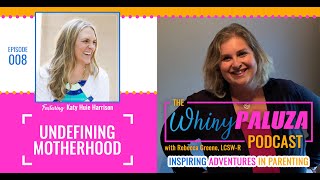
In this episode of the Whiny Palooza podcast, host Rebecca Greene interviews Katie Huey Harrison, PhD, author and founder of UndefiningMotherhood.com. Katie shares how her decade‑long academic research on motherhood, combined with her personal experience of infertility and four pregnancy losses, led her to create the Undefining Motherhood community, a miscarriage journal, and a comprehensive pregnancy‑new‑baby planner. She explains the philosophy behind the name – rejecting rigid definitions of "good" motherhood and embracing inclusive, self‑defined parenting. Katie discusses coping mechanisms that helped her through loss, including intensive research, therapy, and building a supportive sisterhood online. She reflects on the biggest lessons she learned: relinquishing control over outcomes and finding healing by helping others. The conversation moves to present‑day parenting during the COVID‑19 pandemic, where Katie describes emotional challenges, the importance of self‑care through regular Peloton workouts, walking the dog, and other physical activities, as well as strategies for managing grief and validating emotions. She also outlines her ongoing projects: a 126‑page Expecting and Organized planner, a forthcoming book, regular Instagram content, and continued community engagement. Throughout, Katie emphasizes gratitude, resilience, and the value of connecting with other women navigating diverse motherhood journeys.
Chapters
No need to whine, it's Whiny Palooza! Have some wine and join us on the Whiny Palooza podcast with Rebecca Green.
Welcome to the Whiny Palooza podcast. I'm your host, Rebecca Green. I'm a wife, mother of 3, and licensed clinical social worker. I also have 3 fur babies at home too. My passion has always been to help children and their families. I always dreamed of being a wife and a mother. Parents are always learning through their struggles, failures, and successes and joys. I am no stranger to this wild ride of parenting, and I know behind every great parent lies a team of supportive friends and family. I want to be part of your support system. I want you to know that you are not alone. We are in this parenting world together. Join me every week for insightful discussions with experts on parenting and marriage, as well as other parents who have found the secret to successes in parenthood. You'll learn tips and tricks to make life with your family better than ever. I hope you will follow along with me while we dive into what it takes to achieve a happy family.
Hello, this is Rebecca Green for the Whiny Palooza podcast. Today I have Katie Huey Harrison joining us. She is a PhD She's an author, storyteller, and mama to Jack. She has a website, undefiningmotherhood.com, and you can find her work on CNN, Headline News, Romper, and Love What Matters. Katie, thank you so much for joining me.
Thank you for having me there, Rebecca. I'm so excited to be here. Me too.
This is so exciting to me. And you have— so I checked you out online and had some— you had so much interesting that I want to talk to—
talk about.
So I'm going to dive right in.
All right, I can't wait to find out what you found.
Can you tell us, I'm just going to start at the beginning, can you tell us how you, how you got started?
How I got started with Undefining Motherhood? Yes, absolutely. So long ago, before I had a website or a tiny human in my life, I was actually an instructor. I was teaching at Georgia Tech, the Georgia Institute of Technology, and I had been researching for almost a decade motherhood and what it meant to be a mother. And I had been really interested in mothers who didn't meet the traditional terms of motherhood.
Interesting.
Then during my time at Georgia Tech, I actually started experiencing infertility followed by recurrent pregnancy loss. And so one Mother's Day, I told my husband, we just have to disappear because people keep asking us to do these things, assuming that I'm gonna cater to the moms in our lives. And not recognizing that I'm a mom, that I have children. They just don't happen to be here in my arms. And so I decided then, you know what, we need to work on the way that people understand motherhood. I've been researching this for a decade. Now I'm living it. We need to do something about that. And so I actually, when I finally had my son, we, I had maternity leave and I kind of brewed the idea then. I bought the Doe May name. I did all those things. And then, um, I went back for one more semester and then I left that position. Um, I only had one year left in it anyway and said, you know what, I'm just going to dive headfirst into this world, which isn't necessarily advice I would give to someone to leave their job to try to start an online business. But for me, it was the right decision. Um, and so this, You know, Baby became a reality where I get to help so many women who are going through all sorts of different struggles. And so it started with that real heavy infertility and pregnancy loss bent to support those mothers and work on helping people recognize mothers as being mothers, even if they didn't have the child in their arms. And then it has really expanded since then. And now we cover everything about the physical and emotional health and wellness of moms. Through the entire child rearing and process.
That's amazing. So you kind of touched on this. Can you tell us how you grew the name? Your name is so cool.
Thank you.
I had to read about where you got that name from. Can you explain to everyone where Undefined Motherhood came from?
Yeah, it really came from the idea that we have all of these things that we tell moms they're supposed to do. There are ways you're supposed to behave. You should do this to be a good mom. You should do that to be a good mom. And let's be honest, it's all conflicting information. You can't do it all right. It's just, it's maddening. So I thought, you know, we need to get rid of this concept of good motherhood, and we need to get rid of this concept of a mother as being someone with a child who you can see on her arm. And we need to look at all the ways that women are parenting in their lives and really open that up so that it's more inclusive, so that women aren't so heartbroken when they're excluded from these definitions, and so that moms don't feel like they're constantly failing because they can't live up to all the crazy expectations placed on them. And so when I first started, I told my mom about it and she said, why undefining? Why not redefining? And I said, well, Because redefining still places restrictions on people, and that's what we're trying to get rid of. We want to say, you know what, you can do this your own way. I love it. And as long as you're caring for yourself and your family, that's great. You're winning.
I, I love the title that you came up with. I thought it was so unique and had so much meaning behind it. And you're making me think, did you see the movie Bad Moms?
Yes, so I have to tell you that as much as I loved the movie, I hated the title. Exactly, right?
Because they were all good moms, and I thought to myself, they're all doing it differently, but that doesn't make them bad.
Absolutely, yes. And I mean, that was the point. The point was to say like, hey, look, these women are just being women and doing things that we all kind of wish we could do. They're not bad, you know, they're poking fun at the idea. But I agree with you, I still wanted it to just be like, This is Motherhood.
Yes, that's a much better title, and I would love to write to them and tell them to come out with a new movie.
When you cover this one, this is your title.
Maybe you and I will make a movie.
Let's do it. We have so much free time.
Yeah, right. So I read on your website, this made me so sad for you, that you lost 4 pregnancies before having your son, which I can't imagine. And I give you so much credit for going through that and for keeping on going. How did you get through that?
Oh, that was definitely a very dark time. Um, and you know, at first I really just, it was just shock. It was kind of just walking through the steps of life because I went into the entire trying to conceive process with a lot lot of naïveté and I didn't really believe that this was something that could happen to me. And obviously it was. It is something that can happen to any of us. And so when I lost my first and my second pregnancy, it really was just, I mean, just brought me to my knees. My world felt like it was shattering around me. And then I kind of I did what I do. I'm a researcher. I have a PhD in English because I love to read and I love to research and I love to understand what research means. And so I really started at that point digging into just learning everything I could. And you would have thought that by talking to me that I was pretending to be a reproductive endocrinologist, the fertility specialist that people see. But I just learned absolutely everything I could because I felt like that's the only way to move forward for me. I, you know, I, I guess I coach really a lot of women through loss and I have a journal for women who are going through pregnancy loss. It's a guided journal with a private online community that's called Morning Retreat. And what it really focuses on, because this is what helped me, is the idea that this is a sisterhood. And it's a sisterhood no one wants to be a part of. No one would have gone to midnight for this sisterhood, but since they're a part of it, there are a lot of things we can do to support each other. And what I really like to focus on now is what I was looking for then. So included in that, I have a lot of things like the therapy that I went through. I've been in therapy for 10 years for anxiety, so it just worked out beautifully that I was there for pregnancy loss. Um, and so I've taken a lot of the things that I did in therapy, but also what I really wanted to sort of recognize during that time was that there are ways through it and there are different endings of how things can look like. That it's a journey and you're not trying to get to just one spot. Um, and so, you know, the problem with like online miscarriage groups is that once people finally have the baby they're trying to have, they disappear. And so you have all these women looking for stories of hope. And they're not able to get them. And so I've made a real point to stay in those groups and to tag women who have remained in them when I see something that, oh, they went through this 5 years ago, and really want people to be able to see there are stories of hope. I mean, 4 losses, a lot of people feel like it's never gonna happen. Actually, your chance is still over 70%. And that helped me a lot. Yeah, that's wonderful to hear.
I didn't know that.
Knowing that your chance is still over 70%, the problem is it's kind of a roulette game. You're just playing it not knowing which one's gonna stick, because at that point there's likely a reason. It just may or may not be that our science understands the reason yet. And so if you're one of those unfortunately 50% of women never get an explanation. And so for those women, it's kind of just this constant crapshoot, which is horrible and unfortunate, especially when doctors just say it's bad luck and they're like, this is not bad luck, this is horrible. But that really— research just became my outlet. And that's why I can spew these statistics to you now, because that's how I really got myself through all of the rest of it and pregnancy afterwards, because pregnancy, when you only know negative pregnancy outcomes is hard. I can imagine. And having all of that data and understanding where all of the research lay was just really integral for me.
I am super impressed that you were able to be logical at all through that. I don't know that I could have done that.
It came in time.
Right.
And to learn the statistics and what your chances are. It sounded like that's what kept you going.
It really was. It was what kept me going. And it was also just, I had decided we were going to grow our family somehow, some way, someday. We're going to grow our family. And when you're going through something like that, your options are basically keep putting yourself through it, try an egg donor or a sperm donor. Use a surrogate or adopt. And I have actually always wanted to adopt. I still kind of want to adopt. But when I was going through that, I vehemently did not want to adopt because what I told my husband was, I've learned this heartbreak. I know this heartbreak. I know how to prepare myself for this. The heartbreak that comes with adoption is an entirely new thing. And I can't learn something right now. I don't have that in me. I don't blame you. Exactly. And the others are just, well, just like adoption is. Adoption is expensive and it's time-consuming, and so are the other options that are available. And so, you know, for us it was really just a matter of we're going to keep trying until we have exhausted every possibility for our bodies and what could be causing this. And if we don't figure it out, then we'll try one of the other options. Um, but we were going to get there somehow, some way. Um, and we also just kind of made a pact with each other. Like, we want one, and if we have more than that later, great. But like, our goal is one. That doesn't negate it for women who have one or two or three or five, and they're going through it now. It's still valid to want more, but we just got to a place where we said, we're gonna work until we get our one, and then we'll figure it all out from there.
Well, I'm so, I'm so glad that you achieved your goal. Thank you. I'm so happy for you. And I'm curious what you would tell everyone your greatest lesson is from that whole experience.
My greatest lesson from that experience. Uh, honestly, I don't think I can pick one. I have to pick two. Can I pick two? Yes, of course. Um, so one would be, you just have to relinquish control where you can't control things. And that's so hard for me and for a lot of other people I know. Just understanding I couldn't control it. It was not my fault. It did turn out it was my uterus's fault, but it was not my fault. I did not make my uterus have a problem. Other women going through it, it's not their fault. We do everything we can And beyond that, we just have to know that there's only so much we can do. And I think if we went into these really scary unknown situations like pregnancy recognizing we can't control things, um, that would be beneficial to us all from a mental health perspective. Um, the other thing that I really learned from this that I just have to say is you can find healing through helping others. You can find something productive to do with your grief that is extremely healing. And that doesn't mean that everyone who's going through grief needs to quit their jobs and start a website. It just means, right, you know, when I announced on Facebook what we had been going through, I had a ton of women reach out to me to tell me they'd been through the same thing, and they then were using their grief to help me heal. And I had other women reach out saying Oh my gosh, you just had my first loss. I'm so— I'm sorry, but I'm also glad you're in this club. Talk to me. And being able to help those people was so healing for me. And that's something that I really want people to know is you can take your grief and you can help others with it. And that in and of itself is a real memorial to whomever it is that you're grieving or whatever it is that you're trying to overcome.
I love that idea and I love that you did that and I bet you are helping a lot of people.
Thank you.
I'm sure you are. You already answered my next question about how you help others. You already talked about that. Tell us what else you're doing besides this website. Oh wow.
Um, so I'm sure there's more. Yes, there is more. There's always more. Well, the website is, um, so Undefining Motherhood is a major portion of kind of my life.
I bet.
I bet it is. It's huge. You know, it's not— yes, most websites are very niched at this point. You're told, oh, you need to have— okay, if you're a parenting site, you're a parenting site that is humor-based and it's for children between the ages of 2 and 6. I mean, you know, they really want people— the advice tells people niche down, niche down. I'm the opposite. I am everything from infertility to parenting and all the spectrum in between. So it does take a lot of time.
That's amazing.
Yeah. But other things that I'm doing, I am always writing on the side for different media outlets. I'm writing on the side for myself. We actually are launching— by the time this is published, we will have already launched, we're launching on Monday, a something called Expecting and Organized: A New Baby Pregnancy and New Baby Planner. And so it's a really amazingly detailed, tabbed, and lovely 126 pages. You need those tabs and dividers of all the things that I wish I had known when I was pregnant and that my team wishes that they had known. So That's just, you know, everything in one place. Where were you when I had my baby?
Exactly.
That's like why we just need to build what we all wish we'd had. And so that's been the really big pet project recently. Of course, running the Miscarriage Journal, the community that comes with it is always a big undertaking. And then, yeah, I'm, I'm writing a book. And I'm excited. Yeah, it's It's a slow process when you're building a business on the side, but it's happening. And then of course parenting my little love and being a friend and a wife and a daughter. And I spend a lot of time on my Peloton. It's, it's a lot.
Just parenting. Just parenting. I was, I don't want to say I was yelling at my husband because that's terrible. I was Try to—
people yell at their husbands, it's okay.
You know, he doesn't understand me because he goes to work and he shuts the door and he'll say to me, I did 10 podcasts today, and I get so mad at him because he did it by himself at work with the door shut.
Yes.
Oh my gosh, of course you did 10 podcasts.
I know, that's so familiar. I get so just overwhelmed with this work from home thing right now. It's so hard on parents, but I think especially moms. Like, even when my husband was working from home, which he's not anymore, it was just understood that Jack didn't bother him during the day.
Right.
But he's jumping on that bed behind me a lot. Yeah. But you know what, if you're live with somebody like me, I would love—
I would be so entertained.
It might happen. Don't, don't count it out as a possibility.
Oh my goodness. What would you say your biggest challenge is right now?
Right now it really is just managing all of the emotions. You know, we all talk about being stressed and being overwhelmed and being stuck at home and there's too much to do with school and childcare and whatever that looks like in your area. But for me, it's really just the emotional pull. Of all of these things, the constant decisions we have to make. What's safe? What's unsafe? People judging whether or not our choices are correct.
So true. Yes. Yes.
I'm just really struggling. I said I spend a lot of time on my Peloton. That's why I like, I ride out my emotions as many days a week as I can because I just feel like overly full. A lot of the time. Like, you know, if your body were a cup and every time something happened, it just a little more liquid is flowing up and at some point it's all going to overflow. And I feel like that's everyone's everyday right now. We're constantly overflowing. And that's definitely my biggest struggle at the moment.
So would you say that exercise has become your greatest coping strategy right now?
Absolutely. Absolutely. I did not exercise before COVID I've had a Peloton basically since it came out. And before COVID I did occasional yoga and I went for an occasional jog and that was it. And now I just, I, if I am not on my bike at some point, at least 4 or 5 days a week, just really hammering it out. Mm-hmm. Then I'm going to yell at my kids. I'm gonna yell at my husband, I'm gonna cry while I'm trying to make Jack go to bed, you know, it's gonna come out in a way that doesn't make me feel good about myself. And sometimes that happens anyway, like it does for everyone, but on the whole, I do a lot better using that outlet to just release adrenaline. We all have so much adrenaline right now.
Yes, you're making me take deep breaths.
Yes. I know. That is a huge compliment. Thank you.
Well, I walk my dog a lot and I find myself leaving and saying, I'll be back and just going for a walk. But you're making me realize that jogging on the treadmill is what really does it for me. And I don't think walking is doing the trick.
Right. Well, you know, for me, walking the dog does a different trick. Walking the dog gives me time to either, either let go of all the things I am thinking about or to process some of those things that are spent. But then the hard workouts, like you are working, I am intentionally going so hard that I cannot think and it feels like a way of getting out some of the angst and the energy and the adrenaline without actually repressing. I think that combination is so important. Because you don't want to repress all the emotions that are happening or they're going to come out in other ways. But if you can do that to get out some of the angst and then go walk the dog and—
Yes, yes.
—move through them, you're really— I mean, that's a lot of self-care in the days of COVID Yes.
So I need— so what I was doing was jogging and then walking Tanner. So I'm going to go back to that because I'm noticing that I'm more stressed out without the jogging. And you're reminding me of that.
It's been remarkable to me the difference that it has made. My Instagram stories are constantly full of me exercising. It's so funny because I am not a fitness person. I am health and wellness in terms of mental health, but not in terms of physical health at all. And luckily, people have been on board with seeing it. But I'm like, I just, I'm finding so much benefit from this mentally that I want to show it to you, even though I am not trying to say, oh, look at me and my big biceps. No. Or my amazing abs. Wait, no. Hey, this is really helping me mentally. I think anything we find that helps us mentally is good to share because the same thing doesn't help everyone, but man, if you can help someone in some way or when someone mentions something that is right for you, I mean, it is a game changer.
Oh, absolutely. And I'm sure people are saying to your Instagram photos what they're saying to mine when I was posting that. They were saying, thank you for reminding me to get up and go do something. Yes, absolutely. It definitely works. I agree with you.
Absolutely. It really does. And, you know, it's also, again, feels like a sort of paying it forward sort of thing. So I actually was not working out, as I said, and in the beginning of COVID I was having so much stress and someone I know started organizing Sunday morning Peloton rides where when you are on the bike at the same time, you can see who is there and you can see their stats. I love that. A small group of us would just ride together and we haven't done it in months, but I realized when we started doing it how much better it made me feel. And so again, it's, yeah, that kind of pay it forward idea. Like, hey, I found something that works for me. I'm going to take 10 seconds of my time and share it with you. And you can click on through because it's not going to work for you, or you can try it.
I rode on one. My brother has one in Virginia. I don't live in Virginia, so when I was visiting him, I tried it and I loved it. So now you're making me want to go buy one.
I know, I know, I love it. But I think that's the thing to realize is there are so many different things that people love and that people can do. It can be just going for a walk. It can be running outside. I love yoga, but I don't like doing it at home. I like doing it in studio. So right now it doesn't work for me. But a lot of people find yoga classes on YouTube and love it. And I think that's the thing for people to consider is like, what's your thing that gives you a release? Maybe it's reading a book. I love reading books.
Yes, me too, me too. Are you reading anything good right now?
You know, I'm not. So I— Jack is in— well, he just recently turned 3, and he also just recently turned all forms of 3. So I'm basically trying to read anything I can find that helps me understand the psychology of a 3-nager. Which means it's random and boring and not at all interesting, but it helps me cope when he's like screaming at the top of his lungs for no good reason because— oh, I didn't even— because he wants to. Yeah, because he wants to. He wants to. Oh my gosh. And trying to understand why, like, that's what I'm reading right now is like toddler psychology.
Yes, yes, you're doing your parenting research right now.
I'm doing my parenting research right now, but I like to hope that soon we'll be back to reading fun things. I really, before all the COVID madness happened, had gotten to a place where I was able to read like a book every 2 weeks. Yeah. And it was, oh, it was so gratifying.
Agree, agree. I love to read. So I am not telling you that this is going to be the same for your son. But I just want to give you hope. Please. My son is 13, and when he was 3, I was often found in tears. And I want you—
I'm so serious. I believe it.
And when he turned 4, I swear he started to calm down. And I'm not saying that that's going to happen for your son. I'm just throwing out some hope.
I appreciate that. You know, it's so funny because my Jack is really an amazingly easy child compared to other children, at least up until this point. I feel like I'm a little bit like I have less of a right to complain because I was kind of gifted years of a little bit easier than a lot of people are, but I also feel especially ill-equipped to deal with it because it's coming out of nowhere. So easy. Yes. Yes. I'm like, wait a minute. Just 3 months ago, people were complimenting the fact that you were so polite and sweet and quiet. And where'd that kid go?
Oh, I know. And then I figure out the new phase and then they move on to something else. And then I'm like, why are you perplexing me again? Now you're on some new phase that I have to figure out.
Yes. You know, something my therapist told me before I ever had Jack, it was when I was pregnant with him. He was talking to me about that lack of control and relinquishing, you know, the need to control everything. And what he said, and this has stuck with me, and I think this for the rest of my life will be some of the best advice I have ever been given, is he said, "Just keep in mind every day you have never lived this experience before. You have never lived having a child at this age, at this stage doing this thing, and if you have a second or a third or a fourth, they're different humans, so you've still never lived it.
And I was like, yes, yes, that's— you're—
I'm always a novice. Like, that's really empowering, actually.
Such good advice. I love that advice. I'm gonna store that.
I know, we just need to know. Like, we feel like we're supposed to fix things and be expert, and everyone tells us what to do. Every day we wake up a novice at that day.
It's so true, and I can't believe how different every single child is. So there's never a cookie-cutter way to handle it.
Exactly. Exactly. You—
I think you touched a little on this. Can you tell us how you've adjusted your parenting in today's pandemic?
Anything you're doing differently? Yeah. We're— it's getting easier. He actually starts back to school on Friday, which I'm really excited about. I bet you are. Yes, I'm so excited. So I actually have an immunodeficiency. And so at the beginning of this, we were 100% at home. Like, we were the— we don't go anywhere. We lice all the groceries before they come inside. We were those people and it was terrible. I bet. So a lot of our adjustments just became like really sweet snuggle time and honestly a lot more TV. Yeah, you have to. Yeah, when he can't go places, he can't see his friends, he can't do anything. And I'm thankful that he's young enough to not recognize the extent of what he's missing, but still he knows he was pulled out of school all of a sudden and he didn't He left for spring break and he never went back and it's been almost 6 months and he's like, "I'm— no." I know. And so he knows he's going back on Friday and I've told him, he doesn't understand it won't be the same teachers, he doesn't understand it won't be the same classmates. Two of them will be the same and I keep showing him pictures of those two in their masks so he's like, "Oh, I'll wear a mask." Because his school started in mid-August, and we waited to just watch. They have so many protocols in place, it's crazy, but helpful. And so we've been watching that, and there have been zero instances of classroom transmission. But because of my immunity, we didn't feel safe at first. Now we do. So that's been really helpful. And, you know, what we've also just been trying to do is find special things for him. Are there places we can go driving distance where we're staying in a house and he can spend more time outside? Are there places we can take him? I mean, Atlanta really is— I live in Atlanta and Atlanta has a lot to offer as a city. And so, you know, before we knew much about this virus, everything was shut down. But now that we understand transmission better and we understand that outdoors are safer, you know, there are a lot of places where you can go. In a mask outdoors and do things. And so we've just really been trying to focus on, all right, you're gonna watch a lot more TV than you did before. Yeah. But also we're gonna work extra hard to find special things that you can do so that he has things to look forward to and get excited about and remember. But day to day, it's just, I mean, it's hard.
It's hard for everybody. I know it is. I know it's been a long 6 months. Been a really long—
oh boy.
What would you say inspires you to get up in the morning?
Everything. I really, I love my life. I don't always love what has to happen that day, but I'm so thankful for the life that I've been given and also for the life that I've worked to build. And, you know, each individual day, not necessarily a day you're looking forward to, but on the whole, you know, I just think there's so much to be thankful that we can get up for. Also, this is going to sound weird, but part of my immunodeficiency makes me exceedingly lethargic, particularly when I'm— I infuse medication into my stomach every Tuesday night. But without those infusions, this was new. This started— I found out about it right before COVID And so I'm so thankful, one, that I know, and two, that I'm medicated through it. But it's so much harder for me to actually physically get up than it is for some people to. But it's also just exciting to say, you know what, I can. I can get up, I can get out of bed and I can do this. And there are people who can't, whose bodies physically won't allow that. And that really helps me on the hard days is knowing my body went through a phase of not allowing it. And a lot of people are still there and a lot of people are going to continue to be there. And you know what? I can. So that's really helpful. I'm actually glad you asked that because I have to get up especially early tomorrow and I'm gonna remind myself of that when I do. It's like, your body is able to get up. You can do it.
You know what, it's an excellent point and I'm just thinking that my morning routine, I can be so negative about it and I'm trying to every day and every morning say, I get to do this. I want to do this. Yes. And I'm trying to just change my, because the mornings can be be so tedious.
Oh yeah, oh yeah, but those thought processes really matter. I mean, you know, words that we're using, they send different signals to our brains. That's not crazy hoo-ha. It matters how you talk to yourself. It really does. True. It's so true.
So I'm gonna think of you when I wake up tomorrow, and I'm gonna smile and say, I get to do this.
I get to do this.
You know, you almost answered All of my questions, you, you kind of touched on this too. What do you like best about what you do?
I love connecting with other women. I, hands down, I just, I love that I get to connect with other women who are in all different stages and phases of life and we get to support each other and that's so amazing.
I love that answer so much and I couldn't agree more. Yes. What else do you want to share that I didn't think to ask you?
Oh my goodness. You know, I guess just right now, really giving people the idea of like, life's hard. And one thing I do really like to give a sort of message of hope of like, hey, you can do productive things out of what's hard. But I I also really want people to know, because I think this is a problem we're falling into, especially right now during COVID your feelings and emotions, when they're negative, when you're grieving, when you're sad, they're justified. It's okay to feel the way you feel. It's okay to grieve what your kids are missing. It's okay to grieve what you're missing. And then of course, I mean, at this point we pretty much all know people who have been touched by this virus. Many of us know multiple people who have lost their lives to it. And so, you know, there is a lot of just grief in the entire world that we're a part of right now. Yes. And I think it's important to recognize that we're not alone in it, but I think it's also really essential that we recognize that just because what we're dealing with might not be as severe as what someone else is dealing with doesn't invalidate your grief in any way. It doesn't invalidate your experience. You get to feel and you deserve to feel the way that you inherently do. I'm hearing that a lot from my pregnancy loss moms right now is it's such a hard time because everybody is grieving and so many people are grieving worse things. And I'm like, girl, don't compare your grief. You get to feel this way. So that's always—
You're allowed to feel grief. Yes. Yes. Well, thank you so much for sharing that. Can you tell everyone where to go find you? Yes, please come find me.
UndefiningMotherhood.com is my website and I am most active, I would say, on Instagram @undefiningmotherhood. I love Instagram stories, so you can find me there all day, every day.
I'm gonna go follow you right after this. Awesome. I want to tell you how much I loved getting to talk to you and getting to know you. This was so much fun. This has been so much fun.
I really appreciate the opportunity. It's just been a breath of fresh air getting to speak with you tonight.
I totally agree, and I want to thank you so much, and I want to thank everybody for joining us. This is Rebecca Green for the Winey Palooza podcast, and I just want to remind everyone to spend every day laughing, learning, and loving.










