The Whinypaluza Podcast with Rebecca Greene Episode 090 In Support of Families
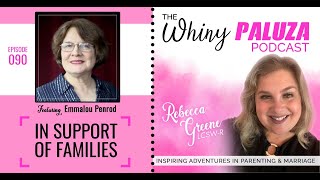
In this episode of the Whiny Palooza Podcast, host Rebecca Greene (licensed clinical social worker, mother of three, and author) is interviewed by Emma Lou Penrod of the In Support of Families podcast. Rebecca shares the origins of her Whiny Palooza brand—starting as a personal blog during her maternity leave, evolving into a vlog, a weekly Facebook live series, a podcast, and two books. She discusses her parenting philosophy, emphasizing children’s mental‑health over academic achievement, the importance of modeling vulnerability, apologies, and calmness when parents lose their temper. Rebecca reflects on the shame many parents feel, the “super‑woman” pressure on mothers, and the need for self‑care and community support, including help from extended family, neighbors, and appreciative societal attitudes toward parents. Practical strategies are described, such as taking deep breaths, using timeout for parents, teaching children coping skills, and evaluating each parenting moment for future improvement. The conversation also highlights the value of a therapist’s perspective, on‑the‑job training, and the role of partnership with a supportive spouse. Finally, Rebecca provides concrete resources: the Whiny Palooza website, Facebook page and Mom group, the first book (Whiny Palooza) and upcoming second book on Amazon, and the weekly podcast schedule.
Chapters
No need to whine, it's Whiny Palooza! Have some wine and join us on the Whiny Palooza Podcast with Rebecca Green.
Welcome to the Whiny Palooza Podcast. I'm your host, Rebecca Green. I'm a wife, mother of 3, and licensed clinical social worker. I also have 3 fur babies at home too. My passion has always been to help children and their families. I always dreamed of being a wife and a mother. Parents are always learning through their struggles, failures, and successes and joys. I am no stranger to this wild ride of parenting, and I know behind every great parent lies a team of supportive friends and family. I want to be part of your support system. I want you to know that you are not alone. We are in this parenting world together. Join me every week for insightful discussions with experts on parenting and marriage, as well as other parents who have found the secret to successes in parenthood. You'll learn tips and tricks to make life with your family better than ever. I hope you will follow along with me while we dive into what it takes to achieve a happy family.
Hello everyone, this is Rebecca Green for the Winey Palooza podcast. Today is going to be a little different than my normal Friday episode. Today I had the pleasure of being interviewed by Emma Lou Penrod. Let's say it right, Emma Lou Penrod, on her podcast In Support of Families. So go find her, she is a wonderful lady and I loved getting to talk to her. She is a wife, mother, grandmother, retired school teacher, author, and owner of the business Healing Your Families. I had a fabulous time having her as a guest on my podcast, and now I got to be a guest on her podcast. So I thought that you would enjoy hearing it, so we are going to share it with you. I hope you will enjoy it. I hope you'll listen. I hope you'll learn something, and I hope you will go find Emma Lou. Emma Lou Penrod, P-E-N-R-O-D. R-O-D, and her podcast is In Support of Families. So go check her out. She is such a knowledgeable lady, and I hope that you enjoy this episode today.
Thank you for joining us today. I'm talking to Rebecca Green, and she is an author, blogger, and podcaster, and I love her title, Whiny Palooza. Rebecca, welcome!
Thank you so much for having me today. I'm so excited to be here.
And I'm really curious about that title, Whiny Palooza, and I need to tell you, I love this book. What I appreciated about— what I appreciate the most about it is you're, you're talking very real, very realistically about motherhood. But you're keeping it positive. It isn't just a negative, you know, venting. It's, it's overall your tone is so positive. You're showing motherhood for the grand adventure that it is, and yet being very genuine.
So thank you so much.
Tell us about that book, how you got started.
Yes. Well, I was working prior to my children. I have my master's in social work and I was doing therapy with families whose children had severe behavior problems. And I absolutely loved it. And I had so much time and so much energy for my families that I worked with. And then I had Max, my first baby. And you know, everyone is so different. I don't judge anyone. We all have our own journeys. I did not predict this, but I looked at Max and I cried for my whole maternity leave and I begged my husband to stay home. And he was so stressed out. He was like, we need your income. I'm like, my income is going to go to daycare. Like, we don't need my income. We're just going to pay for daycare. So I pled my case for, you know, the however many weeks of maternity leave. And he took me seriously. He said we would make it work. And I had had the privilege of staying home with all 3 of my children. But at first, well, not at first, we all know parenting can be stressful, but I was really overwhelmed. You know, new baby, then another baby, then another baby. And when they're young, it's them. I think it's overwhelming different now, which we will talk about. But back then, my coping strategy became writing it out. Get it out onto paper, write it down. And my husband Seth kept reading it and he was like, this is a blog. Now mind you, I knew nothing about blogging, knew nothing. And my wonderful husband started this blog, which evolved to a vlog, which is a video blog, and which now evolved into a book and a podcast. So it's been a wonderful journey.
So you're just sharing your very real experience combined with your background.
Yes.
Yeah, sounds like you understand a lot about children behavior and how to help behavior improve or be more positive.
Yes. And as I was writing it down, as I was getting it out, it was relieving the stress and it was making me look back on, you know, the therapist. I would go into the writing and it would look at the therapist in me, would look back at how I handled certain things. And I would learn through my writing and I would share that like, this is how I wish I would have handled it. These are the good things I did, this is what I could have done better, and then tried to use that the next time the same behaviors or new behaviors came up or new challenges came up. And you will see, because book 2 is going to come out, but you will see from book 1 page 1 to book 2 last page, the writing has evolved and changed over the years. So the journey through starting with them as babies to now a couple of them are teenagers. So it's just been, you know, a learning experience for me that started for me that then other mothers were reaching out to me and going, oh my God, I'm not alone. She's going through this too. And I love hearing about this because it makes me feel so much better and it gives me some tips.
You know, I think that's one of the hardest parts of parenting is that feeling of isolation, of feeling like no one else understands, you're in this alone, and it is rewarding and challenging.
Well, and it's the hardest job we will ever have, and it's the most wonderful job we will ever have. And I think that the mothers that I have had the privilege to talking to over the years, I've noticed a lot of shame in revealing innermost thoughts. And we all have the innermost thoughts of, you know, I'm not doing a good job, I can't do this, this is too much, you know, this child is driving me crazy. And we all think that we have to be, you know, these happy parents all the time, but that's not the reality. And I want us to share our realities with each other and help each other. So the Therapist and Mom together, I put the two together and really just want to show moms that they're not alone. We are all doing the same things. We are all having similar challenges and we can help each other and guide ourselves, guide each other through this.
I think we're even more effective as parents when we let them see, I'm not perfect, I made a mistake, and now here's how I'm going to correct it, or here is how I will improve. We're modeling that for them, and I think it's our genuineness. I think about what endears my mother to me, and it's her humanness.
Yes, yes. And, and I will get angry. I think over the last 14 years, the thing that has upset me the most is when I lose my cool with my kids. That's what upsets me the most, and that's what I try to learn from the most. And I tell my kids, you know, I'm really sorry that I got upset with you. I feel really bad. I wish I would have taken a timeout, taken some deep breaths before I responded to you. And I'm going to keep working on this, and I'm going to keep trying, and I'm sorry that I screwed up. And I want them to know that I'm— I acknowledge that I screw up. And my 8-year-old, who you and I have talked about, has a lot of me in her. And now when she gets upset, I notice she comes back to me and does the exact same thing and says, I'm really sorry that I got upset with you.
You know, you are teaching her such valuable life skills.
I'm— we're, you know, I am so much more concerned with their mental health than what they're learning in school. And I know that sounds— some of the teachers who are going to listen to this are like, what is she talking about? I care so much more about their state of being every day than I care about math and social studies and all of that. But, you know, that's me.
I'm going to agree with you there. It truly is how they feel about themselves. If they believe in themselves, how they feel about the world around them, can they trust other people? Skills they can learn. Yes, we talked about in the job, on the job, in the marketplace, people are more likely to lose their job because they have trouble getting along with others when they don't understand the jobs, they can't do the job skills. So it really is that mental health part is huge.
Well, and I feel like if our children are in a good state all day, and it's not going to be all day, there's going to be moments. If they can take care of their brain and have the, the positive thoughts, the encouraging thoughts, the I feel good about myself thoughts, then the learning comes so much more easier than when they're struggling with a situation in school. So I want to take care of their mental health so that they can be a better learner.
I think we're really on to something here, Rebecca. Can you realize how much more smoothly our society could run? I firmly believe that families are the foundation of society, and you are raising children who will be good citizens. They'll be honest. They'll be problem solvers. They'll be looking for ways they can help. Can you imagine? Just imagine how much our crime rate could go down, violence, vandalism, if everyone could be raised with feeling good about themselves, confident, capable, and feeling a desire to connect with others and to serve, we could just raise the whole vibrational level. I love this, Rebecca.
It would be— well, and it stems from, it stems from things that we have learned through our life. And, you know, I relate to my kids so much when they talk about their worries and their anxieties. And I remember being in school and being so much more concerned concerned about, what I was anxious about, than what the teacher was saying. So I know then if I can help them be less anxious and more confident that they're going to have such a better experience and they're going to actually listen to what the teacher is saying.
Exactly. Yeah, I think you're really on to something valuable, and I love the way you are helping so many parents So one by one. Yes, one by one. That's, that's my motto, making the world a better place by strengthening families one at a time. And you start your own, and then you start to look out for how can I support my neighbor, how can I support members of my extended family. Sometimes it's as simple as offering to watch their children so they can have an evening out or take time for some self-care.
I love that. I will tell you that women think that we have to be superwomen, superwoman. And I will tell you, when I started writing, you know, many years ago, I thought that I had to be superwoman, and I thought I had to do it all. And I was crumbling inside. I couldn't keep up. I was stressed out all the time. I was overwhelmed and I was modeling this for my kids that they needed to be super people who were doing things all day long. And through the years I have realized that that is one of our biggest problems as women is thinking we have to do stuff all day. And I didn't connect with the being part. Just be. I would sit down on the couch and I would instantly feel guilty and think I had to get up and get something done. And now I can sit and I can relax. And I know that that's part of being a good parent and being a good wife. And I think that's one of our biggest issues as women is just thinking we have to do, do, do all day long. So that's something I have learned over the years.
It isn't realistic. It isn't healthy. Now my heart goes out to the single mothers who do have to do it all.
Yes.
And ironically enough, self-care becomes even more important for them, even more critical.
Yes.
How much— this is where the neighbors, the extended family can come in. I would love to think that there are men in the neighborhood who are going to volunteer to fill in for that father role.
Yes.
And offering support and encouragement.
Well, and we have to be brave enough to look for it and ask for it because we can get trapped into the, you know, my family unit has to do everything. And my husband will say, I have to work late, you know, and I have 3 kids in lot, 3 different activities and I can't be in 3 places. So when he says he has to work late, I can feel the stomach clench inside of me and go, oh my God, why does he think he can work late when our kids are everywhere? So I have to be brave and say to my parents, my friends, my community, I need help. I need you. And that, you know, everybody needs help. None of us can do it by ourselves. It's not possible.
I love that point. Even if we have what we consider the ideal two-parent family, and actually studies have shown that in terms of physical, emotional, mental health, the best setting for children is being raised by both biological parents. But that isn't what's happening. That would be wonderful, but that isn't what's happening. So we need this help, this support from our community because— and parents get a lot of criticism. My heart aches for sometimes they're, they are almost afraid to take their children out in public for the disapproving, you know, ah, flares they'll get. But this is the future of our society, our nation. So why not support parents? Everyone responds much more favorably to appreciation than criticism. Why not show parents some appreciation for raising our future generation? We think military personnel in uniform. When we see anyone in a military uniform, it's common to say, thank you for your service. Why don't we do this with parents?
Oh, I love that. Yes, such a good point. I will see a woman struggling in the grocery store, you know, out wherever. We all see parents struggling with their little kids, and You know, I think that one of the best things that we can say is, I understand. I understand. I have said to so many mothers in the store, oh my goodness, that was my kids at that age. And, you know, I know it's hard. I understand. Not, oh my God, her kid is screaming. Shut your kid up. Not that. Just like, you know, empathy, understanding, and You know, I've been given some such good advice lately. Um, somebody said to me, I wish I could remember which podcast this was, but somebody said to me, it's not how the child is acting that makes the parent a good parent. It's how the parent is acting. And I like, you know, you get these light bulb moments and I was like, oh my God, we gotta tell everyone this because our children do something and We get embarrassed. Isn't that a natural process of childhood? Do we expect our children to be perfect every day? No way. We're not perfect every day. We have temper tantrums. We have emotions. So when my 8-year-old is having a temper tantrum about something, I have totally turned it around from, I have to get this under control. She needs to stop right now. I need to help her with her coping skills this instant. To, okay, focus on yourself, focus on your own state, keep calm through the storm. And if you keep calm through her storm, you're going to help her through it, versus focusing on controlling her right now and making it explode.
You just said something very profound right there. Focus on yourself, keep yourself staying calm through the storm. I remember being so concerned about what other people would think of me as a mother.
Yes.
That I didn't focus on what was best for my child. And that's one thing I regret is if I had been able to focus on what my child needs, what is best for them. And I love that, staying calm through the storm.
She's been my greatest parenting teacher, let me tell you. And we learn every single day. I always tell myself I've taken it from expecting myself to be perfect every day to what have you learned today that you're going to do even better tomorrow? And the, you know, it always presents itself to me as an opportunity because I remember back when Lily was like refusing to join in at a birthday party and she was just melting down, hiding her head in my lap, just exhausted, didn't want anything to do with it. And I was so embarrassed. And I was like, Lily, just go play with your friends. Just go, just go. And I made it worse because I was frazzled and embarrassed. Well, the opportunity presented itself again. And there we were at a bounce place and it was dark and it was loud and she had just had a long day and she was hiding herself in my lap, not wanting to engage with her friends. And I said to myself, here we are. Here is your opportunity for growth right here. And I rubbed her back and I talked to her calmly. I know you're tired. I know it's dark. I know it's so loud. You let me know when you're ready. And I was just quiet with her, holding her as all her friends were running around. And I'll tell you, within minutes, She was off and running, and I was like, oh my God, that worked!
You met her needs.
So we learned, we learned we don't do something right the first time. And then I always tell parents, let's evaluate it. Let's look at what are we going to do the next time. And I really try to practice what I preach. So I did it wrong the first time. So what am I going to do the next time?
You didn't do the same thing. Would you, would you say that parenting is def— or parenthood is definitely on-the-job training?
Oh my God, well, it's funny because Seth jokes with me, my husband jokes with me, because, you know, you probably totally understand this, I have a therapist in my head at all times. Yes, is it on-the-job training? 100%. However, I will tell you that the therapist in my head almost always is telling me what the right thing is to do, but the mom in my head does not always listen.
You sound human, Rebecca.
Yes, so the, so the therapist and the mom discuss afterwards. So I will continue to make mistakes. We will all, you know, continue to make mistakes, but I really, I really wanna be the best version of myself for my kids. And it's so motivating to me to do a good job for them. So I just keep trying and I just keep growing as a parent.
Now, I like what you said about being the best version of yourself. When you become a better person, you become a better parent. So you take time to work on you, take care of your needs, become— and you're always looking for ways to improve. You're very open to feedback and getting better. And I think that is what makes you an outstanding parent.
I certainly am trying. For sure.
We learn every day.
We absolutely do. It's been such a wonderful 14-year journey. And my son started high school and, you know, I had my moment of sadness, like, where did my baby go? Like, where is he? And I know you understand this. And then I pulled up to high school to pick him up from soccer And I had this moment of, there were athletes everywhere, people running track, people, the golfers were waiting for their bus, the soccer players were getting on a bus, the football players were practicing. And I had this amazing feeling of, oh my goodness, we've arrived at high school. And this feels like such a fun new adventure and I'm so excited. So do I mourn having babies? Oh my God, I loved having babies. But every new, new, every new journey is just so exciting. So I'm excited to see what we learned in high school now.
I would remind myself that my objective is to raise an independent adult contributing to society and just accept they are going to choose, make their own life. And be happy for them. And I'm at the point where all of my children are grown, they're raising their children, and it is with fascination I visit their homes. And even though they all grew up in the same home, the same environment, they have made very distinct lives for themselves that suit them.
That's wonderful.
It's really a cause of celebration. To see your child raising their children.
Oh, I can imagine. I bet you that's amazing.
It's rewarding for sure, and you still get to be involved because now you're the grandparent. You can still be involved in that child's life. You can support your children. I set a standard to give them a date and I would— at the time I started this, I had 4 children who had children. So every Friday I would rotate and babysit for one set so they could have a date, and I would remind them of how important that marriage relationship is. The parents need to be on the same page. You're blessed to have a husband who really supports you. Have that teamwork. That's a precious, precious relationship.
So, well, and you know, you know that who we marry— I tell everyone, I tell my kids this all the time— who you marry is like one of the biggest decisions that you make in your life, and it's one of the most important decisions that you make. And I picked someone who really complements me. We are very, very different. And we were just talking the other day about how we need each other and we need each other's differences, but we can— the differences can annoy each other.
Oh yeah.
So, you know, so we're talking about college and I'm— I mean, you're not going to be surprised by this, and I'm like choking talking about college and I'm like, okay, Seth, there's going to be a radius for questions requirement, and I'm going to be happy. I'm going to have to be able to drive to them to get to them for safety purposes. And Seth looks at me like I am crazy, and he was like, Rebecca, they can go wherever they want to go. Let them fly. And I was like, oh, I'm going to kill him. And I was like in the car and I was like, OK, calm yourself. Don't respond when you're angry. And then I had that moment of you need him. Like, this is perfection. Like, you want to hold them and love them and keep them, and Seth wants them to be independent and fly and grow. I'm like, what an awesome combination you two are.
Yeah, yeah, brilliant observation. I love it.
So I didn't yell at him.
Good, good job.
And I, you know, I told him, I said, I know that you're right and you're gonna help me adjust when we get to that stage.
And he will.
Yes, even though I would like to keep them within a radius of my home.
Yeah, yeah, and, and that is needed. It is appropriate for parents to protect their children. Parents will get a lot out of listening to your podcast. You have a Facebook page and a Facebook group. I'll have the links on my website, but you want to just go ahead and say what they are.
So, yes, I would, I would love to. So you asked me, I'm going to tell you quickly where the name came from, and then I'm going to tell you all the ways you could, because I forgot to answer you. So back when I started my blog and Seth was like, this is a blog, let's go, and I was like, what are we going to call this thing? And he was like, well, they're always whining and you're always taking them to a party. They're there was always a birthday party when they were little. And he got the whining and the party and he made it Whiny Palooza. And I thought it was hysterical. And I will tell you, a few years ago I was like, no, I need something more positive. Like I need something like, you know, heart and soul parenting. Like I need something more true to me. And he was like, no way. He was like, you have branded yourself. You are sticking with this title. And I have asked so many people about it and they tell me it's unique and funny. So I have kept it.
It is one of a kind.
Yeah, it is one of a kind. So My Children Whining and Going to Birthday Parties is where the title came from. So it started as a blog that is released every Wednesday morning. On my website whinypalooza.com and on my Facebook group, whiny— on my Facebook page, Whiny Palooza. And it is a new parenting or marriage topic every week. So people will ask for topics, or it's a topic from what I'm experiencing with my own family. The topics come from so many facets of my life, and every week it's a new topic. And then at 9 o'clock at night On Wednesdays, we go live on Facebook and we talk about— my family talks about the topic as a video blog. So that's called a vlog. And then every Friday there is a Winey Clues podcast aired, and that is me getting to talk to parenting and marriage experts. And I am having the best time talking to people about So many different topics. So that is every Friday morning at 9 o'clock. And what am I forgetting? The book? Should I talk about the book?
Yes, yes.
So the, so the book, the first book, Whiny Palooza, is out. The second book is coming soon, and you can find that on Amazon. And I did one more step recently And I started a Whiny Palooza Mom Facebook group because I wanted another way to help these moms that I'm talking to, to not feel alone. And I wanted to form a group where people could talk about tips, challenges. I wanted to do, you know, contests and challenges to give away prizes because I love giving presents. So, so you can find the Whiny Palooza Mom group on Facebook. So I think that's everything.
Wonderful. Yes, yes, valuable resources. And I remember I had the honor of being one of your guests and enjoyed that very much.
That was so much fun. I absolutely loved learning about you and talking to you, but I'm kicking myself for not asking you how many kids that you had during the interview. So if we ever do it again, I will not forget that question.
Rebecca, it is a joy to talk to you. Thank you so much for how you are strengthening families, supporting parents, and sharing your valuable experience.
Well, thank you so much for having me. I absolutely love getting to talk to you.
You have a great day.
You too. Thank you so much.
Thank you for tuning in to the Winey Palooza podcast. If you like what you heard, please be sure to subscribe so you never miss an episode. While you are there, leave a review. I love to hear your feedback. Thank you so much for listening. Until next time.
This show has been produced by Market Domination LLC. To discover how you can have your own show completely done for you and turn it into a real published book and become the authority in your marketplace, go to www.marketdominationllc.com/podcastoffer.










