The Whinypaluza Podcast with Rebecca Greene Episode 088 Thriving Working Moms
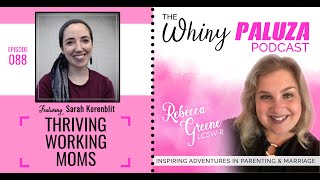
In this episode of the Whiny Palooza Podcast, host Rebecca Greene interviews Sarah Kornblatt, a licensed clinical social worker, mother of four, and founder of the Thriving Working Mom brand. Sarah shares her personal journey as a working mom and explains how mindfulness can serve as a game‑changer for busy parents. She redefines self‑care from a spa‑day concept to everyday micro‑nurturing across physical, social, emotional, and spiritual dimensions, emphasizing intention. The conversation moves into stress‑management mindset shifts, encouraging listeners to view stress as a normal part of life and to reframe to‑do lists. Sarah tackles mom guilt by distinguishing internal pressures from external expectations and outlines her upcoming course on guilt reduction. She discusses work‑life balance, highlighting the importance of recognizing why one works—financial need and personal fulfillment—and staying present in each role. The pair also explores narrative reframing, suggesting a gratitude‑focused answer to “How are you?” as a way to shift personal stories. The episode concludes with Sarah promoting her resources: the Thriving Working Mom podcast, a practical self‑care guide, a forthcoming guilt‑reduction course, and her coaching/therapy services, noting licensing constraints. Throughout, the tone remains conversational, supportive, and encouraging, offering actionable advice for working mothers seeking balance and well‑being.
Chapters
No need to whine, it's Whiny Palooza! Have some wine and join us on the Whiny Palooza Podcast with Rebecca Green.
Welcome to the Whiny Palooza Podcast. I'm your host, Rebecca Green. I'm a wife, mother of 3, and licensed clinical social worker. I also have 3 fur babies at home too. My passion has always been to help children and their families. I always dreamed of being a wife and a mother. Parents are always learning through their struggles, failures, and successes and joys. I am no stranger to this wild ride of parenting, and I know behind every great parent lies a team of supportive friends and family. I want to be part of your support system. I want you to know that you are not alone. We are in this parenting world together. Join me every week for insightful discussions with experts on parenting and marriage, as well as other parents who have found the secret to successes in parenthood. You'll learn tips and tricks to make life with your family better than ever. I hope you will follow along with me while we dive into what it takes to achieve a happy family.
Hello everyone, this is Rebecca Green for the Whiny Palooza podcast, and I am so excited to have Sarah Kornblatt with me today. Sarah, thank you so much for Sarah, thank you so much for being here.
I'm honored to be here.
How did I do with your name? Okay.
Yeah, I mean, I didn't notice it, so that must have been perfect.
I did my best. I did my best. I want to tell you a little bit about Sarah because she's fabulous. She helps busy working moms feel proud of their parenting, satisfaction at work, and engage in their personal wellness. As a working mom of 4 kids, she knows firsthand how many pressures and challenges working moms face every single day. As a social worker for almost 10 years, she has personally had the privilege to guide many clients through challenges and witness life transformations. Her primary focus is on teaching practical parenting, stress management, and mindset adjustment. Ultimately, she aims to be a role model for what her students are capable of. She's known for her down-to-earth approach, natural teaching style, and authentic sharing of personal struggles. Through teaching a combination of principles based on her professional training and experience, along with insights gained along her journey, she helps her students feel hopeful, validated, and a greater sense of clarity. She has a private practice where she provides virtual and in-person therapy or coaching sessions. Through her practice, she has started a branch called the Thriving Working Mom, and she is excited to use that as a channel to motivate and support working moms everywhere. And we will talk about this more at the end. She just added a podcast, Thriving Working Moms, and she has a course for moms that we're going to end with to make sure that you can find her and get all of her fabulous resources. Sarah, you're offering so much, so much goodness, and I'm so happy to get to talk to you about all of it.
Yeah, thank you so much. I'm really excited to be here, and I'm excited to share whatever I can.
Well, and I really like to learn about people and start back at the beginning, and I would love to know why— like, what inspired you to become a social worker?
I knew that I loved helping people. I knew that I loved supporting friends with their challenges, and I also knew that I was able to help people without taking on their problems. So like, I, I feel like I just had that good boundary. I knew that I wasn't gonna come home so overwhelmed with everyone else's problems, and I, I felt like it was the right fit.
Well, it sounds like it's the perfect fit, and that is very impressive that you don't bring it home with you. So that benefits your family.
And I can't bring home some. I bring home some of it. But I, but I mean, like, you know, people who, like, when their friend is struggling, you would think they're going through a crisis.
Yes.
And that's, it's more, more like that. So it's not like it doesn't have an effect on me, but it's just, it's just different. I knew that I could handle it better than many people.
Well, and it's, it's hard because we have kids at home. You have 4, I have 3, and we want to be able to come home and be present with our kids. So I'm happy that you're succeeding at that. And I want, I want to move on to all of the great stuff that you talk about to help moms. And we're going to start with mindfulness because you call mindfulness a game changer. And I loved that you said that. I, Totally agree with you. Can you tell us more about this?
Yeah, absolutely. I think that sometimes we are zoomed out of our own lives where we're kind of just like watching it and seeing our circumstances. I work and I have this many kids and I have this many extracurriculars that I'm bringing them to. And this— like, we see our life as this big picture. And sometimes that makes it more overwhelming than if we just zero in and live in the moment that we're at right now. It's, it's less overwhelming when you just focus on this moment, right? This moment you and I are speaking to each other and none of the other big picture stuff needs to worry either of us right this moment, right?
Yes. Yes. And you're bringing me to the present moment because I think that what we do is we have lists constantly going in our head. Like I'm picturing myself picking up my son at school today and going, okay, now I have to go take Lily to dance and then I have to run home and feed them. And then, you know, and then, and then, and then, and, you know, our minds race. So how do we then say, no, be here now? I mean, is that what we need to do?
Absolutely. I think the only, you know, Thich Nhat Hanh, the amazing mindfulness teacher, from Vietnam, Buddhist monk from Vietnam. He, I mean, I totally recommend his book, Peace Is Every Step, to everyone because it's really short and it just gets you right into it. But he talks about how life really just is this moment, you know, when we're focusing on past worries or what's going to happen, you know, in the future, then we're not living what life actually is. Life is right now, right? And our relationship with our kids, yes, there's a big picture of the relationship with our kids, but our relationship is also right now. You're with your kid. You know, I had this memorable experience where I was doing homework with my 8-year-old son, and he was having to read out loud to me, and I was looking at my phone. And I was just like, wait a minute, let me just look at him. And while he was reading, I looked at his face and I just looked at it. And it hit me. I'm like, when's the last time I even just looked at his face? Like, just looked at it, you know, not just— not, not in conversation or telling him what to do or what, you know, just look. And it was— it struck me that there are so many beautiful moments all day long that if we stop, we can really capture it and feel it.
I love that so much. And I'm, I'm picturing my daughter telling me that I'm always busy or a friend telling me, I know you're busy. And I have to tell you, I hate when people say that because it makes me feel so bad. And I'm just like taking a deep breath, listening to you and thinking, no, I have time for you. Like I'm looking in my daughter's face as you're talking, thinking, tell her you have time for her. So I think that, you know, you're absolutely right. I don't stop what I'm doing and just focus on them. And I'm going to go do that today.
Because the thing is, you're doing— we're doing it anyway, right? Like we're doing— we're going through these motions. It doesn't even take any more time. No, just a shift of focus.
It's shifting our focus. That's a perfect way to explain it. And I know how busy women are. I see there's that word again. I know how we all are with our schedules. I see it all day with my friends, with, you know, all the moms that I see at pickup, and we need to take care of ourselves. And you talk about fitting self-care into our days. And I know that I've had women tell me that they don't have time for it, which I have many arguments for. But can you talk about the importance of self-care and how to fit it into our day?
Yes, this is one of my favorite topics in the whole world ever.
Me too, me too.
And I think that when we say the word self, you know, the phrase self-care, people think of a spa day. They think of going for a mani-pedi, and they have these like grand notions of what self-care is, and The truth is, is that's not like what a day-to-day self-care— that's not realistic day-to-day self-care, right? Especially for moms. That's not, you know, I call those grand— that grand gesture self-care. Um, so when you shift away from that and you think, what is self-care? Self-care is nurturing myself. So there are different parts of myself I could nurture. I could nurture my physical wellness, my social wellness, emotional, spiritual. There are different parts of ourselves. And so take away that broad feeling of, oh, self-care. I want to take 5 minutes right now to nurture myself. That could be from, you know, for me, things that I do, it could be turning on the radio and singing along to a song when I'm on my way to pick up my kids from carpool. But, and it's with the intention, right? And I'm thinking, I am doing this. I'm nurturing myself right now, letting out the stress, just enjoying singing, feeling like a teenager again. It could be taking, taking some time and having a brief phone call to a friend in the name of my social wellness and nurturing that, because one of the biggest strengths we have is our support systems. So that's self-care, right? And it's really about shifting from the spa to realistic day-to-day things where we say, I'm going to just invest in myself a few minutes, invest in myself.
Yes. Yes. And I love the words you're using, putting intention to it, labeling it. I mean, I'm doing a lot of those things, but I'm not labeling it.
Huge difference, right?
Yes. Well, even this I was just going to tell you this. Doing this with you is self-care. This is for— this is for me and my soul. And I want— obviously, I want us to help tons of women listening to this. It's for me too. This is good for me. And I've never— I don't know that I've ever labeled that before. So I'm labeling it now.
I love that.
Wow. Well, and we're so stressed out. I'm going to be— be honest with you, um, myself, my friends, the— my mother just stopped by earlier, she was stressed out. Everyone is stressed out and I don't like it. And it's something that I work on every day for myself and my kids. Um, we've talked about a couple great pointers, but any more stress management tips for women?
Yes, absolutely. So I, I'm a big believer that when we shift our mindset, even if our activities are totally all the same, our responsibilities are identical, it could make a very big difference. And so here, these are some mindset things that help me with stress. So first of all, you know, I'm a, I'm actually a single mom with 4 children. One of my children has special needs, so that's like a whole nother set of stuff. And so there, there's our cha— I have challenges, things that, that can definitely be seen as stresses. Instead of labeling it as stresses, I label it as it's normal that with these circumstances I'm gonna have a lot of stuff going on and I'm gonna have a lot of competing, you know, think little different things competing for my attention. And that's okay because that's natural, you know. For moms out there listening, You're a mom, you have so many different responsibilities. And it's okay to have that thought, I have so much going on, because that's natural. And I think sometimes we have this feeling that it shouldn't be this way, or, or maybe we're not managing well enough. And that's why we have so much going on. But it's, it's, it's normal to have a lot going on. And it's back to that mindfulness stuff. When you still have all that stuff going on, but you can just kind of be in each moment instead of living with the whole to-do list on your mind every second. Live in this item, right?
Yes. My husband cracks me up because I'll talk about my list and I'll be like, oh my God, the list. And he'll say, you'll have no list when you're dead. And I know that sounds ridiculous, but it shifts me. When he says that and laughs, he's right. Like, this is life. Like, you're normalizing it. We're going, we're alive, we're living, we're going to have things to do.
Absolutely. And the to-do list, by the way, is totally skewed, right? Easy tasks never make it to the to-do list. And so the to-do list ends up being a list of things that for whatever reason you procrastinated and didn't wanna do. And so when you look at a to-do list, it's not just like, oh, okay, how come I can't get through all this stuff? It's because these are all, for whatever reason, really hard things to do for what— for different reasons. And so most things in our day never make it onto the to-do list, but it doesn't mean we're not achieving. And so if we only look at how many things we checked off on the to-do list, we're totally undercutting ourselves and the amount of achievement we have every single day.
Such an excellent point, and I really have never thought about that. It's so, so, so true. And I want us to work on mom guilt. Can we, can we shift to mom guilt? Because I want to take it away. We have busy working moms, whether you're working or not, I know that you have some mom guilt. So let's help people reduce some of their guilt. So how can, how can we do that?
So I, this is, you know, such a huge passion of mine that I'm creating an entire course around this topic. And the way I think of the guilt, it's really taking a step back. It's the pressures that are around us and within us, and then not meeting whatever those expectations or pressures that are that we're experiencing, which then leads to that feeling of guilt because we feel like we're falling short in some way. We are not being there enough for our kids. We're not being there enough for our partner. We're not being there enough for— we're constantly feeling like we're falling short, and that's where the guilt is. And so the way I think about it is we have those external pressures. Our kids could be pressuring us, or we could feel pressure because other moms seem to have it all together, or pressure because maybe we feel pressure to like be more involved in the kids' school or, you know, other community stuff. I think that starting with internal pressure and working on what pressure are we putting on ourselves, the other stuff really all falls away because we are our most harsh critics, right?
Yes.
It's us. We're the taskmaster. It's, you know, yeah, those, those pressures exist. But within ourselves, if we're saying, you know, a mom, we have this ideal, a mom should be, let's say, let's say our ideal is that a mom should be peaceful and calm all the time. Yeah, we're gonna feel guilty because who in the universe is going to be peaceful and calm all the time? So when we reduce those internal pressures, right, that pressure, it can be a game changer. Like, I know for me, Sometimes I snap at my kids. Thank goodness it's not all day long. And I've worked hard to have a more calm presence, but sometimes there's everyone at me and they're, you know, maybe someone I think is old enough to realize not to do a certain thing. And it pushes me over the edge and I'm like, whatever, whatever I say. And instead of beating myself up about it, of course I wanna stay calm and that's my goal. I'm like, yeah, that was a really stressful situation. Okay.
Yeah.
Like that happened. That's okay. That's realistic. Everyone was on me at once. That's fine. Right.
Yeah.
That's my internal voice.
Yes. My daughter said to me, um, I like my nice mom. You're nice some of the time. And I said, no, Lily, I'm nice most of the time. Like sometimes I'm not nice. I'm not going to be nice 24 hours a day.
That's so funny. That reminds me the other day because I was like, am I too nice to my kids? I asked them, I was like, I was like, hey guys, do you think I'm strict? I was like, if you think of 1 to 10, how strict I am. And like, my son was like 4, and I'm just like, oh my gosh, I need to make more rules. You need to think of me as stricter, right? But then so my other son heard that, that I I wanted to be seen as strict. So then he made me this birthday booklet where he wrote all my traits. And one of the traits is he wrote, my mommy is strict. And then it has him playing on the iPad and me saying, get off now. And then he wrote in parentheses, but not too strict.
Oh, I love that. That's adorable. How cute is that? Oh my gosh. Yes, we want to be strict, but not too strict, right?
And that's— and And that's the, the balance, right, of parenting is that there's always a push and pull. And there's no such thing as arriving at that perfect balance because right the second we think we're getting close, our kids get to the next stage and all of a sudden, total everything switched up.
Total game changer. We think we have them figured out and then they change, right? So I think what I hear women say, what they say to me is When I'm at work, I feel like I'm not giving my kids enough attention. And when I'm with my kids, I feel like I'm, I'm not giving my work enough attention. And I feel like that's like the guilty head that I hear so often, trying to feel like you're enough at home and trying to feel like you're enough at work. Does that make sense?
Absolutely. Absolutely.
So how can we help them feel more enough.
I love that. I mean, I think that's such an important piece here. And I think like the perspective that we have about the role working even plays in our life, why we do it, what value it is, you know, if we haven't thought that through, then we can definitely fall into that. But for me, let's say I definitely need it, you know, financially, not a question. And also I get a lot of personal fulfillment from it. And I, I know for myself, I'm not cut out, you know, to be a full-time stay-at-home mom. And, and so recognizing that, right, I need it financially, I get personal fulfillment from being a social worker, then I'm able to say, realize that I'm actually, it's helping me be a better, my better self. And when I'm with my children, I'm able to feel just, you know, for me personally, not feel like mom is my only role or self and, and feel that balance. So that helps me. So in this case, I guess taking that step back and looking at the bigger picture of what, what value or why am I doing this work? And if let's say it wasn't personal fulfillment and it was just financial, That's important too, right? And so I am providing for my children. I— my children are wearing these clothing or doing these activities or, you know, whatever, whatever they have because I'm providing for them. And so once we can really come to terms with why we work, then it's back to that mindfulness stuff, right? I work. This is why I work. And so I'm at work and when I'm at work, I'm gonna be at work and I'm gonna focus on my work because that's the only moment you're in when you're at work, right?
Yes. Yes. I think that is very helpful. I think that people are going to find that so helpful. And I think that we continue to learn to balance our lives. And I think that's one of the most challenging words as a mom. And you have 4 kids. I, you know, I stumble over that. I have read 4 kids, 5 kids, 6 kids, 7 kids, and anything over 3, I'm like, oh my God, I'm struggling with 3. So let's talk about the work-life balance.
Yeah, sure.
How, how are you balancing having 4 kids and a job? And what advice do you have to women about this?
That's great, a great question. And you know, like, like I was saying, this concept of understanding why I work. Yes, it gives me so much fulfillment. And my kids know what I do, right? They know that, you know, even in their birthday card, they write you are a thriving working mom. That's what I want. They know that's, that's a big compliment for me. You know, my 8-year-old son likes watching my videos that I make for moms, you know. So then now I could be like, oh hey, Noah, I'm using that, that, you know, that stress relief technique I was talking about in my video. He's like, I was like, guess which stress relief? He's like, it's the go outside one. I'm like, you're right.
Oh my gosh.
And so I like I like that my kids know what I do so that even when I'm off limits to them and I'm in a session with a client or I'm doing work, like, it feels good to me that there's, you know, it's not like two totally separate pieces. Um, and therefore they can even appreciate that I'm doing something that I love and they know that I love what I do, which is cool. That, that helps me. But also back to the self-care, I need to do a lot of self-care. I need to, I need to basically invest in my wellness.
Yes.
And so I do that without feeling guilty. And I actually did a poll on my social media where I said, what gets in your way of doing self-care? Is it not having enough time or is it feeling guilty? Guess which one won?
Guilt.
Guilt. People, they felt that if they have that extra time, they should be doing something for their kids or something for work, right? Or why, like, why would they be in, like, doing it? They felt like, why would I do it for myself right now when I could— the to-do list is there, I could do something else, right? And so for me, letting go of that and just being all in on my wellness. And, you know, if I feel like, especially now I'm in a circumstance where I get to make my own hours, thank goodness. I, if I want to take an hour and read a romance novel, I am going to do that definitely with no guilt, but also with an intention. I am doing this to just fully nurture myself and relax and just let go and be in the moment, you know. And so I am very, you know, that's one of my secrets, I think, to like staying as calm as I guess I am.
Well, and this is a huge shift for me this year because I used to be that guilty mom who thought my kids needed every second that they were home because, you know, they're at school during the day, I'm taking them to activities, and they're very busy. So when they were home, I felt the guilt like it was their time and I had to always be present for them, which is not realistic. And I learned that self-care is not selfish, which I used to think it was. And I think through doing this podcast and talking to so many wonderful women like you, I have learned that taking care of myself makes me better for them and less stressed out. And I, and I think that we need to tell every single woman this, cuz I want this for everyone. And I know it took a lot for me to shift. So hopefully today we have shifted a few more people, right?
That would be, I mean, that would be amazing, right? Because when you are able to really have that shift, it's like, it makes such a big difference. And one more thing that I did want to share.
Yeah.
For me, that helps me a lot. And it actually ties back in when you were talking about like, I'm busy, I'm busy, right? That kind of feeling that everyone feels like they're busy. Is I used to be, you know, I've been through different, you know, challenging circumstances over the last few years. And like when people say, how are you doing? I'm like, oh, so much going on. And I shifted my answer. And so when I, when I, when people ask me how things are going, I say great. And you know why? Because when I'm thinking about it, I'm thinking about the things that I, that I'm so happy about in my life. I have an amazing, amazing like family, like my siblings, my parents, who are such a strong and solid support system. And I mean, my kids bring me so much joy. My daughter with special needs has great— is connected with great services. And so when I answer, I think about those things, not about the to-do list. So when— and, and I, I couldn't have even imagined what a big shift just changing my answer, because it's basically changing my story. It's changing how I see my— what's going on in my life. I see it as it's going well. And thank goodness, I'm so grateful for everything I have versus I didn't do 75 things from my to-do list and it's crazy and I'm overwhelmed and I'm drowning. Because if you would look at my to-do list, you could— someone could feel like I'm drowning from the amount of things that I need to get done, the amount of things that fall through the cracks, the amount of emails I don't respond to, right? Like you could see my— I can imagine someone seeing my circumstances and feeling like they're drowning.
Yes.
But I don't have to, right?
Yes. Yes. I'm just thinking about my father-in-law asking me on Saturday how I'm doing, and he caught me in like a stressed out moment. I was like, I'm really stressed. And I was like, oh, that felt terrible saying that out loud. And I'm not going to say that again because it did make my story that I'm stressed out and I didn't like it at all. You're right. We have to think about how we answer that question.
Mm-hmm. Totally.
I like that. I like that. Tell us what you like most about what you do.
That's a great question. I love so many different parts of what I do.
That's awesome.
I love being able to teach, you know, different, like, mental health concepts or relaxation, emotional wellness, but also from the vantage point of like, I'm here, I'm in it too, right? And so I love that ability to share from a place of authenticity because I'm not like, saying, oh, why don't you do this? Try this, right? I'm in it. My kids are 3, 5, 8, and 10, and I'm, I'm right here with these moms, right? And I, and, you know, my child's special needs, even though she's not a baby, she is like a baby in certain ways. And so she sleeps in my bed, like I'm up all night with her sometimes. Like I, so even the moms of babies, I sometimes can relate to that. And I love that. Like, I love being able to share from a space of being in it too. And I feel like I've seen my message come across so strongly because of that. And so it just feels like this really, really beautiful melding of my professional goals and strengths. I love presenting, I love teaching, and also just that sharing of my own personal successes and wins and, and inspiring people through that.
I love that you walk your walk, walk your talk. You know what I'm saying? I love that you're walking it with us. You're doing what we're doing, and it makes it even more valuable to listen to you because, you know, before children, I was a great social worker, but I did not understand what I understand today. Raising kids. So I think it makes us even better for sure. 100%.
Absolutely.
What is the best advice that you have ever gotten?
Hmm.
I don't know. You don't have to know. You don't have to know.
I don't know what the best advice I ever got.
Totally okay.
I guess for me, the best advice that I get is really through self-help books, um, self-improvement. I really, really love, um, The 7 Habits of Highly Successful People. I love The Success Principles, um, that I'm reading right now. And so a lot of times these messages really resonate for me, and I go through and I highlight these messages, and I know The Success Principles, which I'm reading right now, the advice was about there, you know, no blaming or complaining, like kind of making that a rule and shifting from thinking that other people are doing stuff to us to really thinking this person's behaving this way, how am I reacting or how am I allowing something to continue and really just taking your power back. And so that kind of advice and that messaging, I think, along the years has really been just the best advice because, you know, I see so many people in, in circumstances similar to mine, just by different, like, social groups I'm in, who are really stuck in the, in the blaming stage of, of, you know, how they ended up in their circumstances. And I just, I just feel like You know, when we can look past that, right? And for different people, it's different. Blaming could be this feeling that, oh, if only my husband made more money, I wouldn't have to work, right? Or complaining, you know, that this person is being difficult or complaining that I didn't get a rate, like, raise or whatever it is. When we're able to shift to like taking that out, no more blaming and complaining and back into like Action. What am I gonna do?
Yes.
Mindset. Am I gonna shift? And that for me has probably like been one of the most important things that has changed my life and helped me be in the peaceful space I'm in.
That is amazing advice. See, you're full of good advice and you have so many things to offer. So tell everyone about your course, about your podcast and where to find you. Tell us all the good stuff.
Oh, okay. Awesome. So my podcast is called The Thriving Working Mom, and I also, I have a video version on YouTube with like cool effects and everything. I have a video guy, which I feel like super excited about.
That's awesome.
Yeah. Um, and then I also, you know, my website at thrivingworkingmom.com where you can sign up. To get my practical self-care guide. I made a guide which really walks through these different pieces I was talking to you about, shifting from seeing self-care as a spa day, understanding the different parts of wellness and how we nurture those different areas, and with 30 ideas for self-care in 5 minutes or less. So I made a guide. So that's on my website. And I hope to be able to help people through that. And I also, um, in the next few months, I have a course called Tackling Working Mom Guilt that's coming out where really just walking through just from point A to point B of that journey of shifting from the space of guilt and overwhelm and pressure to feeling peaceful and, you know, joyful in the different areas of your life. So I'm really excited about that.
Well, it all sounds awesome. And I know that you take clients, correct? Do you take clients online for anyone anywhere?
So for— I'm licensed in New Jersey, so I take therapy clients in New Jersey, but in all other places I will take coaching clients. So I would have like a call with someone and just make sure that they wouldn't be better off with like a licensed therapist in their state. But, you know, I'm able to really also do this one-on-one coaching with moms and getting from point A to point B. I love it.
Well, I can't thank you enough for your time today. I just loved talking to you.
I loved it too. It was really amazing.
Well, go find Sarah and all her good stuff and her course and her podcast, and I'm gonna go find her myself. I missed some stuff when I was researching you. What the heck is going on? So I have some research to do too, but this is Rebecca Green reminding everyone to spend every day laughing, learning, and loving.
Thank you for tuning in to the Winey Palooza podcast. If you like what you heard, please be sure to subscribe so you never miss an episode. While you are there, Leave a review. I love to hear your feedback. Thank you so much for listening. Until next time.
This show has been produced by Market Domination LLC. To discover how you can have your own show completely done for you and turn it into a real published book and become the authority in your marketplace, go to www.marketdominationllc.com/podcastoffer.










