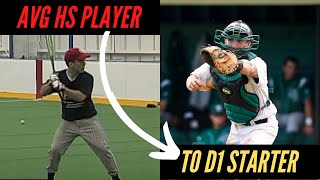
Alex Swenson went from below-average high school player to D1 starter and three-time captain. He outlines five steps: develop position-specific skills and strength, keep grades up, make highlight videos and hit showcases, talk to coaches directly, and get experienced help. Start sophomore year.
Chapters
Hey, how you doing? Alex here. Thanks for joining me. In today's video we're going to be taking a look at my journey through the college recruiting process and how I went from a very average to below average player, especially starting off to a Division 1 starter and three time captain that went to three regionals and just had an amazing career. And I'm not talking about statistically because honestly I was very average player at the college level. It wasn't elite by any means, but the experience that comes college baseball and being a student athlete at that next level gave me and that there were so many things that I was able to carry on after I got done playing that has helped me in so many ways, from leadership to life skills to friendships and mentors. All of those things that again, I was able to carry on and that's really why I do what I do today is help high school athletes go through this college recruiting process and really help them find the best college fit for them so they can get those experience and hopefully carry it on with them after they're done playing then. By the way, if you're new to my channel, my name is Alex Swenson. I'm a former Division I college baseball coach, scout and recruiter. Once I got done playing, I got in the coaching world and recruiting world and was at Jacksonville University where I played in Georgetown and Ole Miss. And again now what I do is help high school athletes go through this college recruiting process. But when I look back to my high school career from a lens of a college scout and a recruiter, I was getting very, very average. I'm actually going to pull up my numbers right here. Freshman year in high school and still freshman, still young, but I was below average. I had a lot to work to do and as a scout and if I'm looking and evaluating myself and being honest with myself, I did. That's exactly what I would say. Like, hey, we have a lot of work to do from a strength standpoint, from speed program to arm strength to hitting, all of that. And luckily I was blessed with a good work ethic. I worked really, really hard. I had good coaches around me, actually had somebody, a good family friend that was a previous college recruiter and player and helped me go through this college recruiting process and really just helped best position me. I've kind of come full circle and now I'm doing that now. But man, there was peaks and there was valleys through this. There's a lot of doubts through things, of going to showcases and camps and getting evaluated and getting Silenced. I got. I got a lot of no's going through this process, but you only need one and it was a perfect fit for me. So I want to also talk a little bit about a roadmap for you or your son that's going through this college recruiting process. And I want to pull up that right now. All right. There are five things that I want to cover with you that's going to help you get to the next level, the roadmap, if you will. And stay with me, especially 3, 4 and 5, because not a lot of people think about this going through the college recruiting process. But number one is the foundation of the college recruiting process is skill and strength development. We have to have skills to play at the next level. The beautiful thing is they're all different type of skill levels at the next level from Division 1 and tiers within Division 1, tiers within Division 2, tiers within Division 3, NAIA and JUCO. So there's all these different tiers here, but skill and strength development of what these college coaches are looking for at your position, the skill sets and the strength that they're looking for too. So skill development and strength, which is obviously in the weight room, being in the weight room and starting this as soon as possible. Number two, academics. All right, hey, this is a huge separator from a recruiting process because there is a comparable athlete out there just like you or just like your son. And they will always take the player that has the better academics. So don't let the academic side separate you in the negative way of like they take the guy with the higher academic. So stay focused in the classroom. Number three is maximizing exposure through your highlight video, through social media, through camps and showcases and tournaments. And this is where it gets tricky because there's a lot of showcases and camps and even tournaments that are not worth it. And you need somebody with an experience and know which ones are worth it so you're not wasting time, money and energy. So whether that's your high school coach, your travel ball coach, or a guy like myself helping you through that, just have somebody help you there. Of maximizing exposure when in person and making sure your target schools that are recruiting your position. Number four, communicate with college coaches. You being proactive in this process, you communicating with them whether it's at a showcase, whether it's at a camp, whether it's on social media, whether it's through email, communicating with them, and lastly, get help and be proactive in this process. So going at this blind, it can be really, really tough. Has it been done before? Absolutely. Usually it's the guys that are. It's very easy for them. You know, the guys that are getting recruited freshman or sophomore year super, super early that are throwing 95 already, you know, those are exceptions. It is easy for them. But if you're an athlete like myself that is a good athlete but is not elite, get some help through this process. Whether, again, doesn't have to be me, but it could be your high school coach or your travel ball coach guiding you and directing you and you doing your part, because you have to do your part too. These college coaches want to see you, they want to talk to you because you're going to ultimately be with them for the next four years when you get to college. And then from a timing perspective, get started sooner than later. By the time we were getting into our senior year, recruiting is pretty much done. So that the kind of the golden time is from sophomore year to junior year. That is definitely when you want to get started. I would recommend sophomore year because that's when college coaches really get started and get guys on their radar and even freshman year, from a skill and developmental standpoint of making sure you're locked in. But hopefully you got something from this video. If you did, smash that, like, button that thumbs up and subscribe to my channel. I put out a weekly video on college recruiting and highlighting different colleges going through. I'll see you in the next one.