Big Changes to the Baseball Recruiting Timeline
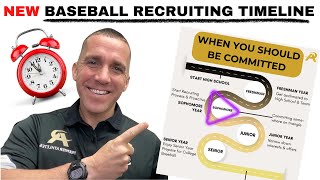
Alex Swenson, a former D1 coach, walks through how college baseball recruiting has changed and what high school players should do each year. He breaks down three timelines: early commits, typical commits, and late bloomers, then explains the new rules around when coaches can offer scholarships and how to prepare for college.
Chapters
Hey, how you doing, Alex here. Thanks for joining me. Today's episode, we're going to be talking about the new college baseball recruiting timeline. There's been so many changes over the last really few years. I did a video like this two years ago, and it definitely needed updating about the new college baseball recruiting timeline to help kind of paint a picture of where you are and things to look ahead of and to prepare for and. And three scenarios that you could find yourself in. All right, we're going to talk about player one, player two, and player three. I'm going to explain more about that. This again, is going to help kind of paint a picture. And if you're new to my channel, my name is Alex Swenson. I'm a former Division 1 college baseball coach, scout, and recruiter with 11 years of experience. And now what I do is help high school baseball players and their parents navigate this college recruiting process and help help them find the best college fit, really. Over the last just 60 days, we've had over 50 commits at Premier Athletes, which is a super exciting time. And if you get any value from this video, please smash that like button and subscribe. I put out a weekly video and also podcast. You might be listening on the podcast in case you want to listen on the go. You can find that Premier athletes wherever you find a podcast here as well. With that said, let's go on and dive in. It's important to note that everybody's on their own personal recruiting timeline, their own personal college baseball recruiting process. And it's really important that you keep your blinders on on what you need to be doing. And I know it can get super loud, like on social media and commitments here, commitments there, and you can get some unease. But it's really important that you follow a good strategic plan and stick to your plan plan and don't get distracted with all the other stuff going on. I know that's a lot easier said than done, but that helps just so much, focusing on your plan and whether you fall into the early commit or the common commit or the late bloomer, it doesn't matter what bucket you are. All right, you again, you just focus on your process as you go through this. And I'm going to pull up a graph right here, and I want to talk a little bit about the college recruiting timeline. And when does it technically kind of start as we go and when does it end? Well, technically starts when you get into high school, when you start freshman year. And there's things that you can be doing freshman year and then sophomore year and junior year and senior year. And it goes all the way until you step on campus. Because even when you commit, there's things that you can be doing to help yourself and prepare yourself as you go through this recruiting process and to set yourself up for success when you step on campus as a freshman and you are ready to go to contribute to that team. And I have the saying is, proper preparation prevents poor performance. The five Ps, proper preparation prevents poor performance. Be prepared. Whatever we're doing, you are prepared. Now, there's been a lot of rule changes over the last few years. College baseball recruiting and college athletics in general. It's been crazy. Things are changing all the time and it's part of my job to stay up with this stuff. So the early commits. I actually did a video of this a couple years ago of the recruiting process timeline, and the early commits were happening freshman year in some cases 8th and 7th grade. There were literally freshmen, 8th graders and 7th graders committing okay there then at that time, which is just insane to me. And, uh, I'm just so glad that these new rule changes has kind of pumped the brakes on the commitment side of things, of when you could commit, which is August 1st going into your junior year. So technically you're still sophomore, but August 1st. So the end of your sophomore year, that's the earliest that you can pit starting August 1st there and then from there on out in your high school. But there's things that you can be doing. So with that said, let's go on. We're going to pull up the early commit here and I'm going to go on. Scroll down. So the early commit. I am a big advocate of freshman year. When you get to your freshman year, when you're starting freshman year in high school, it's just, hey, get acclimated with your high school. Get acclimated with your high school baseball team, your coaches, your players. What does your coach want? What is he expecting from you at your position and as a team? And what are the goals? Get acclimated there and then you can start thinking about, hey, the recruiting process, possible schools and things like that and things. Should you start picking up sophomore year, you start the recruiting process. I usually recommend starting the recruiting process. Sophomore year is again, starting putting together a good school list or thinking about what you want to study. You don't have to have it all figured out. Trust me, you don't have to have it all figured out. But hey, start reaching out to college coaches as we go through this, because a lot of college coaches and why I recommend starting sophomore year is really college coaches start getting guys on their radars sophomore year, in some cases as early as freshman year. Now, again, they can't offer you until August 1st, going into your junior year and finishing up your sophomore year there. But if you are going to commit and in instance this player one early commit here, and if you're going to commit August 1st around that time, okay, they are doing a lot of work prior to that. It's not just like they just Hear about you August 1st and see you and then they commit to you. No, they've done all of their homework prior to that sophomore year, in some cases freshman year, they maybe got you out to camp, they can talk to you at camp. And by the way, you should be communicating with them and sending out your information sophomore year as well to get on radars. But this is where the early, early commits happen, is around that August 1st time frame as you see here in the junior year. You're kind of just enjoying your junior year because you're committed at this time. Again, this is player one, the early commit. And then senior year, there's things that you could be doing to prepare for. Hey, what's coming freshman year, your strength test, your conditioning test, the four on ones, individuals, all that fall ball, winter ball, spring ball, all that academics, all those things that you can prepare. So again, when you stop step on campus, you are ready to go. So that is player one. Let's talk about player two, the common commit. All right, this is the common commit again, getting acclimated freshman year, sophomore year, starting the recruiting process. We don't commit around August. We go through August, maybe in through the fall and the winter and commit around spring or summer of junior year. You could commit as early into that junior year. I put junior year anytime in this triangle, which is the beginning of junior year or the end of junior year. And typically I'm saying for the common commits, it's like that spring and summer there is where the common commit is. So you're committing in again that spring or summer and you're doing all the things that you need to get on radars, get exposure, communication with college coaches, going to the right camps and showcases, avoiding the bad ones, all that good stuff, going on a college visit, visit and things like that. So The Common Player 2, the Common Commit, again I would say is around that spring and summer of their junior year finishing up and then the next commit. Player 3 is kind of the late bloomer is senior year, fall, senior year, going into the spring. Is that. So this is kind of that right into your senior year. And if we are there in our senior year and we are not getting any interest from maybe some Division 1 school schools, we need to be focused on the D2s, D3s, and juco routes. Okay. Fall, going into winter and spring of our senior year, most Division 1 schools are going to be wrapped up by then. There will definitely be some spots available, but it's going to be very, very limited. So if we're a senior and we're a late bloomer and a commitment hasn't happened yet, make sure this is important when we're going through this recruiting process, that we have schools on our list that are a variety of different levels. Not only Division 1 level, but D2s, D3s, JUCOs, possibly NAIA as well. But this is the late bloomer. The bloomer commit here as we go. So those are really kind of the scenarios that we could see ourselves again. The most important thing that you can be doing, though, as you're going through is being proactive. It doesn't matter if you fall in the first bucket. The second bucket are. The third bucket is just you staying focused on you and finding the best college fit for you, not only athletically, but academically, geographically, culturally, socially, all that good stuff. If you have any questions, please comment down below or reach out to me and I'll see you in the next video. Take care.
More from Alex





Most families are not missing scholarship money because their athlete is unqualified.



Two families DM’d me this week with the exact opposite problem. Same answer for both. 👇

Thousands of families are on a waitlist for something that does not open for another week.

