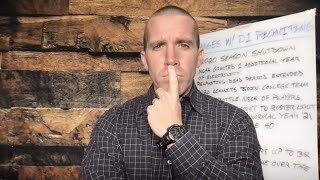
Alex Swenson breaks down how COVID disrupted baseball recruiting: the NCAA's extra eligibility year created a bottleneck of returning college players, dead periods blocked in-person scouting until April 15, and rosters swelled to 45-50 before shrinking to 40 in 2022. Recruits need video, direct outreach to coaches, and to cast wide across all levels—there are 1,600 college baseball programs, not just 299 D1 schools.
Questions this video answers
January 13, 2021.
April 15 (year implied 2021).
Around 45 to 50 players on a team (examples cited).
40 players (active roster limit for 2022).
35 players (normal active roster limit).
Chapters
Hey, how you doing Alex? Here I want to go over the big changes that have happened with recruiting and how they have impacted you or potentially going to impact you, especially if you're 2022, 2023 or even 2024, just to help you navigate this recruiting process. Because nobody gives you a playbook to this. And if you like the video, please select like that would appreciate that so much and subscribe. I put out weekly videos on recruiting and if they're not recruiting, they're self improvement just to help you in life, whether it's weightlifting, nutrition, how to deal with social things as we move forward. So I'm here to add value, that's what I want to do. And if you have any questions specifically for this video and with recruiting, my emails down in the description, please email me and I'll get right back to you. So let's go over these changes and in 2020, as with everything, the season got shut down, the NCAA season got shut down, the high school season got shut down. And what happened next after that was really the snowball effect as far as how it's impacted high school recruiting. Is the NCAA granted one additional year of eligibility to all those college players that missed that season that the season got canceled. So for example, if I was a senior last year in 2020, well now I'm still a senior as far as baseball specifically, okay? So I'm coming back to play while the 2020 high school graduates are coming in, okay? So there is a big influx of roster and roster management, if you will, while the dead period got continued to be extended and extended and extended, okay? And it's gone all the way up. We're not even at the end of it. April 15th is the last date as far as when the dead period ends. And what is the dead period? It's, it is basically coaches cannot go out and watch players play games or have face to face contact. So they can't invite them on campus and show them around and they can't go watch them play. That's a big deal, especially for high school baseball. They need to go out and watch these players. Okay? But the biggest thing that happened was that bottleneck of players this year, this year happening. All right, so this 2020s came in, okay, While everybody at the college level stayed where they're at, whether they're freshman, sophomore, junior or senior. So there's teams and college teams out there that have around 45 players and some even 50 players on their roster. Teams where normal years, you can't have a max of 35. So you can only have an active roster limit as far as 35 players on your team. Okay. This year they have basically taken the seniors out of the picture. Okay. They don't even count to 35. And depending on the team, every team's a little bit different. But I've seen as many as 45 to 50 players on a team, and in 2022, they're making the limit 40. Okay. But those teams that have 45 to 50 players, they're going to have to cut off. And the whole point of this is, well, if they don't need any more players, they're not going to be recruiting. It's just making that recruiting process that much harder. Okay. Because there's not as many spots available at the next level and it's going to take a couple years to really flesh this out as we move forward. So, I mean, the impact could be all the way to 2024's graduates. The brunt of it got hit with 2021. They got hit the hardest. And I mean, if you got in and got recruited as a 21, I mean, that's, that's amazing and that's, that's awesome. But so many good players got left behind and are not playing at the college level when they very well could have. Okay, it's going to get a little bit better for 2022, no doubt about it, and even 2023, but it's not going to be normal. Might be all the way to. For the 2024s, where we're back to normal, where schools are recruiting eight to 10 players a year, that's usually on average. And some are more, some are 12 or 15, but I would say around 10 is the average of recruited players coming in to get each program. So we've gone over that and then some other rules changes. The 25% scholarship rule. So the past few years, if you got a scholarship, an athletic scholarship, the school had to give you at least 25%. So 25% enough, they have nullified that, meaning they've canceled that out. They can give you any amount, essentially. They can give you 1% all the way up to 100% as far as a scholarship. Okay. And then some. Since the rosters are going up next year to 40. The 27 scholarship, that's the normal scholarship there. You can only have 27 scholarship players. Out of that 35. That is normal. Well, now they've upped it to 32 because they've upped the roster, active roster limit to 40. Okay. And then I just talked about the changes will continue over these next few years. NCAA has already kind of talked about that, that the rosters are going to change. I'm hearing rumors for 2023 they're going to bring it back down to 37 or 38 and by 2024 it's going to be back down to 35. As far as roster management, so I'm hoping that makes sense. Again, please ask questions as we go and basically what I'm all just getting down to is there's less spots available at the college level and that's what's made it so hard for recruiting. So how can you help yourself through this recruiting recruiting process and get yourself exposed and put yourself in the best possible position? You need to be proactive. Do not wait for college scouts and recruiters to come to you. You need to have good video. You need to be reaching out to them. You need to expand your horizon. As far as schools, there's 299 Division 1 schools in a total of 1600 college baseball programs across the country. That's D1, D2, D3, NAIA and JUCO. There's so many different opportunities and I still believe if you're a starter on your high school team and a really good contributor to your high school baseball team, there is a place for you. But you need to go out and be proactive through this process. Let me know if you have any questions. I hope you got some value and this makes sense to you. I know we kind of got into the weeds right here, but that is all the changes that have happened and how it has impacted recruiting. I'll see you in the next video.