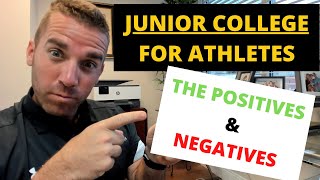
A short YouTube presentation by Alex Swenson (former Division 1 coach, scout and recruiter) about considering junior college (juco) as an option in the college recruiting process. Swenson defines junior college (up to two years, possible transfer of credits/associate degree) and lists positives — 1–2 years of athletic and academic development, financial savings versus four-year colleges, stronger scholarship availability, more playing time (often two seasons), and smaller classes — and negatives — losing NCAA eligibility years for each juco year and needing to repeat the recruiting process after juco. The video closes with a call-to-action to like/subscribe.
Chapters
In today's video, we're going to be talking about junior college and why you may want to consider junior college. As we go through this college recruiting process, we're going to talk about the positives, we're going to be talking about the negatives and just general information about junior college. To help you go through this college recruiting process, I think it's really important to create an open mind of looking at all of the levels, not just Division one or the Power five school, but there's a lot of amazing opportunities not only at Division 2, Division 3, NAI, but also junior college. There's a lot of amazing stories out there. Guys that just had such success at the junior college level and really saw improvements not only on the field but off and helped them set themselves up to play at a Division 3 or Division 2 and yes, Division 1s because Division 1s recruitment out of junior college, all the divisions do. And if you're new to my channel, my name is Alex Swenson. I'm a former Division 1 college coach, Scout and recruiter. And now what I do is help high school athletes go through this college recruiting process. So if you get anything from this video, please smash that, like button that thumbs up right down here and subscribe to my channel. I put out a weekly video on the college recruiting process and how to just get better on and off the field. All right, let's dive into it. Some positives or reasons to consider junior college or community college or juco and those are really the three terminologies used out there. I'm going to be just using junior college. They're all the same thing. And in case you don't know, junior college is for two years or up to two years because you can transfer after the first year to a four year institutions or of course after the second year of your junior college. And you may have your associate's degree that can transfer over those credits can transfer over to that four year school, which is a big benefit. A lot of different reasons which I'm going to get to here into a second. The first big positive is it can give you up to one to two years of development on and off the field. Meaning on a. If you need to develop your skill set a little bit more, you need a little bit more time to develop certain skills at your position. It gives you that time to develop and then you can transfer to a Division 3, a Division 2 or Division 1. And it can also give you time academically if you need to improve your academics or test scores or GPA you can do that in a junior college. So it can help you develop on the field and off the field and even maturity wise. Right, right. Maybe physical maturity. Maybe we're kind of a late bloomer physically and we need to put on more weight getting into the weight room. Junior college can definitely be a big benefit to that. The second positive or benefit of junior college is financially. It is no doubt cheaper than a four year public or private. Definitely private because they are super expensive. But you can save a lot of money of getting, getting credits and taking classes at junior college than you would spending four years at a university. Okay, you can save money, especially year and definitely two years. If you see junior college or community college all the way through, the next thing is scholarship money. Typically there's a lot more scholarship money and closer to 100% scholarship than you would find at Division 1 or Division 2. And remember, Division 3 doesn't have athletic scholarship, so junior college, there's more scholarship money, which is always attractive. The next positive is there's typically two seasons in junior college and basically you're playing more. There's not as many restrictions because they're not bound by ncaa. They have really their own restrictions as far as the junior college level and they're a lot less. Meaning you are going to be be able to develop in a game setting, in a coaching and practice setting a lot more at the junior college level than you would at Division 1 or Division 2. And lastly, junior college classes are smaller academically. So the classes that you'll be going into to study a particular subject are going to be smaller, which is going to typically help you academically because you're able to develop a relationship with the professor. It's easy, easier for you to ask questions and to get help. So that is definitely a positive. Alright, let's talk about the negatives of the junior college route. If we decide to go the junior college route or why we're considering this. And really I have two for you. The first one is for every year that we stay in junior college, we lose a year of eligibility at the NCAA level. So that's Division 1, Division 2, Division 3. So at the NCAA level you have four years of eligibility that you can play. But every year that you stay in junior college you're going to lose a year. So if you stay in junior college for a year, you'll have three more years left to play at the NCAA level, whether it's D1, D2 or D3. If you stay two years, of course you have two years left at the NCAA level. So that's number one. Number two is you have to go through this college recruitment recruiting process again whether it's after year one which if you're after year one it's pretty easy honestly because somebody's kind of picking you up out of junior college to come to their school. But year two is you have to go again through this college recruiting process. That said, it is easier than out of high school because you have already established yourself as a college athlete because you are a college athlete at the junior college level and typically the junior college coaches do a really good job of helping you play at a Division 1 or Division 2 or Division 3 of school going through that. So the negatives are losing the year of eligibility and then also going through the college recruiting process. So I hope you got something from this video and if you did please smash that like button and subscribe and I will see you in the next video. Take care.