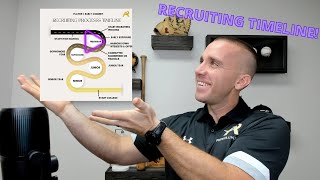
Alex Swenson, a former Division 1 coach, breaks down when high school baseball players get recruited. Most commits happen junior year or the summer after, but early commits (5%) are rare and risky. Swenson recommends starting to actively recruit yourself sophomore year and being realistic about which schools to target.
Questions this video answers
11 years
October 21, 2021
About 5%
Chapters
Hey, team. Alex Swenson here. Hey, thanks for joining me today. And if you're new here, I'm A former Division 1 college coach and recruiter with 11 years of experience, and I'm here to help you or your son play at the next level. And in today's video, we're going to be talking about the recruiting process timeline and the three that you could fall into. So we're going to dive into those, and I'm going to explain how each one of those works. So if you get anything from this video, please select that, like, button and subscribe to my channel if you haven't already. I. I put out a weekly video on recruiting and how to better ourselves on and off the field. All right, let's get into it. So what's the definition of the recruiting process timeline, and what does that mean? I'm going to pull up a graphic right here, but basically, it is the period of time it takes a high school student athlete to commit to a college and then step on campus. So in the most simplest terms, it is the start of high school when the high school student athlete starts high school all the way through graduation and then steps on campus. Okay, so we're gonna go over three players and three most common timelines. We're gonna use player one, player two, and player three today and go over those timelines and see what that looks like. Let's dive into player one. It's important to note that there is no correct way to get to college baseball. It doesn't matter if you're Player 1, Player 2, or Player 3 today, as long as you get there. So with that being said, let's go over player one, and that is the early commit. This player, this student athlete, this recruit gets recruited and commits super, super early. This is the rarest of the commits in high school. I would say it's around maybe 5%, give or take. And whether you agree with it or not, I'll leave that for another video. But it is very, very risky to commit that early. You basically had three more years of the recruiting process that you could have gone through to find a good fit. And I guess I'm kind of giving it away right here, but, hey, there's some instances where it makes sense. But this is where we've seen where the transfer portal this past year, where a lot of kids are leaving college because it wasn't a good fit, and they made a decision four years before they really went to college, which is. Which is wild. So now let's go over this process Right here and we see high school starting and then over on the right hand side, they start the recruiting process. And this is really just off of the coaches, the college coaches. It's kind of not forced, but it's just automatically started because they're super talented. These kids that are get taken and committed their freshman year, they are super, super talented and they get early exposure because coaches hear about them. People like myself talk about them or the summer ball coach or high school coach makes a phone call and gets early exposure and then they have interests and they narrow down those interests and then they ultimately commit and they commit in this triangle here. Okay, so this triangle is just representing somewhere in freshman year, during freshman year, even before freshman year. I have over in this corner would represent that maybe the summer after freshman year. These are the early commit timelines. This is player one, player two is what we see the most and why I labeled common commit. And this is your traditional path through the recruiting process timeline. And what this athlete looks like is, hey, starting freshman year, they're getting acclimated to high school. They're not worried about college yet. I recommend this timeline as we go through is get acclimated with your high school and your high school team and your high school coach and work on development and focus on improving your skill set at your position or positions and then go through this recruiting process starting sophomore year and being proactive. And why I suggest that is that's honestly when most colleges and most college coaches, coaches especially Division 1 level, start the recruiting process, yes, some of them scoop up some of that small percentage of guys freshman year, but most of their commits are going to be coming sophomore in junior year, the summer after junior year, that's where the bulk of the commits are going to happen. So if you see this triangle, I tried to put it in as far as somewhere in this triangle, somewhere on the line, that's where commits happens. Okay? The junior year is where interest has built from these college coaches. If you do the right steps in the recruiting process starting your sophomore year, you're going to garner interest, whether it's sophomore year, junior year, and your interest is going to be coming. Then there's going to be some offers that you're going to want to consider, see if it's a good fit for you, not only baseball wise, but academically, geographically, financially, all of those things. So again, around sophomore years and see the north tip of the triangle and then it wraps around into junior year or the summer after junior year and then senior year, you're enjoying and preparing for college and college baseball in that transition. This is player two. Player three is the late bloomer commit and commits around senior year during senior year. And this is the very end of the recruiting process and we want to try to avoid this as much much as we can. But sometimes, hey, if we're developing late then you might fall in this category. But if it's self inflicted, meaning you just don't go through the recruiting process and you're not proactive in doing again the right steps, you could fall in this category and you could risk of being missed and not playing at the next level. But in the sense of a player 3 I like to think of this as from physically the player is just a late bloomer. From an arm strength or hip hitting or speed wise they just really start picking it up senior year and start figuring it out. And if we see on their graph they go through freshman year again getting acclimated. Sophomore year they are being proactive but physically and development they're just not there yet. Okay, in junior year, hey, not getting much interest up to this point, but they're still pressing forward, still reaching out. Recruiting video they're getting better though. They can feel themselves getting better. Then senior year they hit a jump as far as their development and where they could fit at the college level and find a good college fit here and they get interest and they get an offer and then they ultimately commit somewhere in the fall, winter or spring. If it's super late as far as senior year, that is Player three. But the thing is if you can control it and the things that you have the skill set to play at the next level, it shouldn't be really late senior year where you commit it should be a the summer before your senior year, after your junior year is where you can fall in to that commit. So if you can control it, control your recruiting process now if it's developmentally, hey I totally get it. Continue to work on your development, your arm strength, your speed, your exit velocity, your skill set, your measurables, your projectability and your physicality being in the weight room. Get after it then. And if you're up to this point and you are a senior, one thing that you need to look at as well is are you going after schools that just not a good fit for you athletically or even sometimes academically and they're just not showing interest. You need to create a new school list and target other schools. So if you're going after the floor, Florida's and Vanderbilts of the world and you're not getting any interest. Hey, you need to change to Mid majors, D2s and D3s and see where your interest is from those schools. All right? Hey, I hope this helped. I hope you got something from this video. And if you did, please click that, like, button and subscribe, and I'll see you in the next video. Take care. Bye.