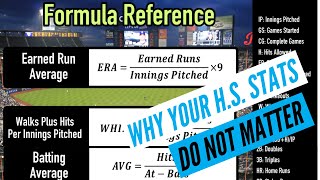
Former Division I coach Alex Swenson explains why scouts ignore high school stats. They care about raw tools, physicality, and measurables instead. A 2.3 GPA minimum gets you recruited for D1 or D2.
Chapters
We're going to talk about the five reasons why college coaches do not pay attention to your high school baseball stats. And hey, what you should be focusing on. Hey guys, Alex Swenson here. I was Division 1 coach at Ole Miss, Georgetown University and Jacksonville University. So I've been around a little bit and I talked to these college coaches today. The current college coaches on what they're looking for said, hey, if you get anything from this video, please click that like and subscribe button. I put out a weekly video on recruiting and just how to better ourselves on and off the field. Do you know how these college scouts are going to evaluate you and your particular position? It's important to know going through this recruiting process. For example, you would want to know how a teacher is going to evaluate you during your class. Right? And it would be important to know whether you have a job or your future job, how your boss is going to evaluate you. It's the same thing with the recruiting process. We need to understand, and I only bring this stats up because too many parents and students athletes over emphasize stats in the recruiting process. Sure, there are some coaches out there that will use some stats to confirm or verify their evaluation on you. Okay? The important things that they evaluate. But it's not very important in the recruiting process. Okay? And again, we can overemphasize this. I did this as a high school student athlete. I overemphasize my stats going through this process. And I overemphasized it in my recruiting process to college scouts and coach. And I overemphasized it in comparing myself to peers around my state, around my region, around the country, or the perfect game rankings or the PBR rankings. And that is dangerous. Guys, you need to have blinders on in this recruiting process and focus on what you're doing your own personal recruiting process. Okay? So let's get into the five reasons why college scouts do not focus on your high school stats. Hey, real quick, before we get into number one, I don't want to take anything away from stats. I want you to get the highest batting average you possibly can. I want you get the lowest era you possibly can. I am just trying to convey to you all that stats are not heavily used in the recruiting process. Okay? With that said, let's get into number one. Number one, your stats depend on your competition. And there's all levels of competition across the country. Okay? I think you know that from Washington to Florida to North Dakota to Maine to Kentucky, there's just all different types of competition good and frankly bad okay. And the competition in high school does not compare to competition in college. A hit in high school might very well be an out in college or a swing and miss pitch in high school might very well be a hard hit ball in college. Okay? So important to know that. Okay? And that's number one. Number two, your high school stats don't necessarily translate to college stats. So what do I mean by that? Hitting 400 in high school against pitchers that throw 75 to 82 miles an hour isn't hitting.400. Okay. At the college level. Okay. Hitting 400 at the college level against guys that throw 85 plus depending on your level is dramatically different. And good college scouts can determine your skill set by looking at you, which we're going to get into here in a minute, and whether your skill set is going to translate over to the college level. Number three, your stats don't tell college coaches about your raw tools, which ultimately is a big thing in the recruiting process of what college coaches care about. Number four, your stats don't tell college coaches about your projectability. And we're going to get into projectability here in a minute, but it is a very important part in the recruiting process. And number five, your stats don't tell college coaches about who you are, about your character, about how bad you want to win, about how good of a leader you are. Okay? So those are five things of why stats aren't and shouldn't be overemphasized. Okay, so let's get into what you should be focusing on. We're going to hit five quick points here of what scouts are look at in the evaluation process and what you can be focused on. Okay? Number one, we're going to hop right into it. Physicality. What do you look like? Do you look like you've been in the weight room? Do you look like you put in hard work as far as getting stronger, getting faster, just getting better? Okay. Have you ever seen a Division 1 baseball player? These guys are physical. Okay? They've been in the weight room. They are in the weight room. They're in the weight room a lot at the next level. Okay? Working on their strength, working on their quickness, working on their athleticism, working on their mobility. These guys also do a lot of yoga. Okay? They watch their nutrition. Okay. They're eating the right stuff. Number two, measurables. What is your arm strength? Like, what is your exit velocity like? What is your 60 time, depending on if you're an outfielder or middle infielder? Okay. What is your spin rate? Okay. They look at these special spin rate. That's a new thing now that these college coaches are starting to look at. Not everybody does, but it's something you need to be aware of and be more knowledgeable of. Okay, number three, projectability. We just talked about this. What is that? Do they project you playing at the next level? Because a lot of these scouts start looking around your sophomore and into your junior year. That's when the recruiting process starts in high school is around that sophomore year. Okay. Do they project you getting better? Okay. And how they do that is they look at your actions. How smooth are you? How athletic are you? Okay, so how do we improve those things? We can get into that in another video. Okay, number four, academics. How are your grades? In order to play at Division 1 and Division 2 level, you have to have a 2.3 GPA. If you don't have that, you're not playing. Okay, but of course, we want higher than that. We want a3.0 or above because it opens up more doors. And the better your grades, okay, the more potential you could get. Scholarship money, academic money, which is fantastic. And number five, lastly, is character. Or some coaches call it makeup. Are you a leader? Okay. Are you a guy that really puts his head down and works, has a great work ethic and will be willing to do anything for the team? Or are you not. Are you not a good leader? Do you talk back to your coaches? You talk behind the coach's back? Do you talk back to your parents? Are you not a good teammate? Okay. They take this stuff very, very seriously. Well, I hope you got something from this video. If you did, thanks for sticking around this long. And if you did, please select that like and subscribe button again. I put out a weekly video. I'll see you in the next one.