How an average player became a D1 athlete and captain.
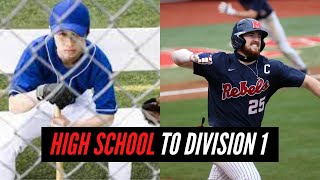
Alex Swenson, a former D1 catcher and three-time captain, walks through the college baseball recruiting process. He was undersized but improved his metrics through focused training and earned a scholarship to Jacksonville University. There are roughly 1,600 college programs across all levels, and most commits happen junior to senior year, with about 20-25% coming as sophomores.
Chapters
Hey, how you doing? Alex here. Thanks for joining me. And before I get into my story through the college recruiting process and how I was able to play at the next level and fortunately had a good career, was a three time captain, we went to the regionals three times. Regionals is like the March madness of college baseball. And that was a really good time. And then went on to be a college coach, scout and recruiter. And now what I do is help high school athletes go through this college recruiting process. But before I get into that kind of, that story, I want to address like kind of two things to this, because I talked to parents and student athletes that might have some anxiety about this process. They feel like they're behind. They're not sure if they could play at the next level. And the first thing that I want to cover is, hey, if you are a contributor to your varsity baseball team and you contribute, meaning you play and you really help the team win, you contribute at your position, you're able to do what you're supposed to do at your position at the varsity level, there's a place for you to play at the next level. I am, I'm extremely confident in saying that. There's over 1600 college baseball programs at the next level, and that is from juco to NAIA to Division 3, Division 2, and of course Division 1. And there's all different tiers of levels there, right? And the beautiful thing is there's all different tiers of athletes, right? And it's just finding which one you fit. And I'm sure you want to play at the highest level that you possibly can, and you should. Okay. The school I went to was a reach school for me, quite honestly, and I was able to make it, but also have a good career there. So stick with it, stay with it. I understand there's ups and downs as you go through this process. And again, this is why I'm here to help you go through that process. And the next thing that I want to address before we get into today's topic is, hey, am I behind on the college recruiting process? I hear from parents again, and student athletes all the time, talking with them. It's like I feel like I'm really behind and some of these are like sophomores. This is. No, you're not behind at all. You should be starting the recruiting process sophomore year and even juniors and, and even some seniors. Now there is kind of like a deadline, right? Because we're only so meant. We're only in high school so long, right? So if we're in Our senior year and we're in the fall of our senior year, we have really a good window of four to five months left and of. Of division threes, division twos, NAI and JUCOs. There are going to be some division one schools that are still recruiting, but it's going to be, you got to weed through the ones that are done recruiting and not recruiting your position and finding the ones that are recruiting your positions. Okay? But sophomore year and junior year, you hear on Twitter and you see commitments super early, right? Like, and they're super loud because you're like, whoa. Like they're a sophomore and. Or a freshman that's committed, right? And that is. They're super loud. But that is a small percentage of the guys. And you guys might have heard me say this, but just a real quick around 2 to 3% and that's if max of the total commitments that are going to go on and play at the next level in college happen freshman year, and that might be a high number. 2 to 3%. Okay? Sophomore year is about 20 to 25%. Junior year going into senior year, hey, that's about 75% of the total commit. So again, if you're a junior, man, you're right in the middle. If you're a senior, hey, you have that window. You still have time. But you need to be very proactive this college recruiting process. You have to go up, do not sit back and just hope to be found. That is the wrong strategy. Okay, with that said, let's get into kind of my background and where I was. So this is about 17 years ago. Okay, about 17 years ago, where I was going into high school, I was a kid that was honestly super nervous. Been playing baseball since I was like 4 or 5. Right. Had some good skill, skill sets. Excuse me, but I had some work to do. I was a, I was a catcher and went into a program, Mount Vernon High School, where I went, that had some good experience and was a. Had a winning teams the past few years, which was great and had some good caliber guys. But I wanted to go in and try to play varsity and contribute right away. And looking back, man, I had a long way to go. And if you were to kind of paint a picture of me or see my metrics, which actually I'm going to pull up right here and you'll see my metrics here are lower, like in the 30% tiles and below average. So I was like a below average athlete from a metric standpoint. Freshman. And this is like kind of thing going into sophomore year I had a lot of work to do. Okay. I was a slow catcher. You could see by the numbers, and I had to work on my pop time. My bat was probably pretty, pretty good for where I was at. But I was never a metrics guy in high school. Like, I never blew off the chart. So you guys obviously can't see. Some of you guys might know that. Watch my channel. I'm an undersized 5, 7 player that made it to Division 1. I mean, I'm pretty undersized, but I was physical. I. The good thing is I, I was blessed enough to have somebody in my life who's like a family friend that helped me go through this college recruiting process when the time was right. But even before then, I was in the weight room. I was in the weight room at seventh grade, sixth or seventh grade, right around there and starting to take it seriously. And I was able to add weight and get physical and get strong, which helped me a lot as I went through freshman year, sophomore year, and had this big jump junior year. In the recruiting world, they call it jump jumps. Okay. As a player, make a jump physically, metrics, all these things, game performance. And that's really where I was able to sell myself on a game performance standpoint. Okay. I continue to improve my metrics from what you saw back in Perfect Game back in the day, 17 years ago. But my metrics continue to get bigger, better, because I was working on it. My training was the focus of my, my, my recruiting process. And that what is, that's what it should be for you, your training, getting better at your skills, at your position. Okay. And you might play multiple positions. And then, you know, as we go through this sophomore, junior year, kind of narrow it down to two positions. Unless you're just a super, super versatile utility guy, it's good to kind of narrow it down to two positions as we go and especially as we want to play at the next level and focus on that development. If you're a position player, focus on your skills at your position, really focus on hitting. That can be a huge separator. If you're a pitcher, really focus on arm strength, repeatable mechanics, good loose arm, get into some, some of the metrics and things like that from spin rate, and that's getting really big these days. And there's a lot of facilities around the country that can help you with that. But some of the best stuff from a long, from an arm strength standpoint is just straight long toss. Okay. It's still some of the best that you can do from from that standpoint. So I continue to develop. And then as my fan, Mike, who was a guy that I helped me go through this college recruiting process, he was a past college player, he was past college coach, so he had some experience, kind of knew where to go, where my skill sets were. Because I wasn't a Power 5 guy, that this just wasn't who I was. I'm not a power. I wasn't a Power 5 guy. And, and again, going back to Division 1, I played at Jacksonville University. That was a reach for me. Okay. Playing division, I was a fringe guy. D2, D3 or, excuse me, D2, D1, maybe even D3. D3s were kind of like safe schools for me that I was looking at, but that, that is where I was. So I was able to get in front of Jacksonville. It was one of my schools on my target list. You guys should have a target list and a broad target list and narrow that list down. And as far as getting in front of coaches, especially this time, this recordings in the kind of starting in the fall, we want to get in front of college coaches, especially during the quiet period. We're in the quiet period right now, meaning college coaches can't go out and recruit in person. They have to recruit basically on their camps. And we're about to get into the contact period for only a few weeks, but then we're going back to the quiet period for about four, five months until March 1st. So really, really where we're going to be able to get exposure is in front of those college coaches. And we feel like we're ready to get in front of those college coaches. Let's get in front of them. And I was able to do that for a couple schools. I was able to play really well. And really this is what happened. So I reached out to Jacksonville. I had some video. They saw my video. They. They had interest in watching me play. And that's a big part of it. Your video should be really good because that can garner interest and create dialogue with these college coaches. And then I got in front of them first at a camp and then also at a kind of like a showcase type tournament where I was playing games and they saw me twice. Usually college coaches want to see you at least twice. They're not going to very rarely. They're just going to make a decision off of one seeing you once. Why think about that, right? They could catch you on your worst day. They could catch you on your best day. They want to see how consistent you are. They want to see where do you kind of average fit as far as your playing style and your, your player, player development as you, as you go. So they're going to watch you a couple times. Then I went on a visit to Jacksonville University. I fell in love with it, kind of a small little school in North Florida in Jacksonville, and I fell in love with the campus, fell in love with the coaches till this day. I talked to my college coach and he's kind of like a second dad to me, honestly. So we had great, got an offer, went home, talked to my parents about that. I had other schools on my radar and then ultimately a couple, probably wasn't a couple. About a week later I accepted and went and committed and then eventually signed my, my national letter of intent nli. And when was that? That was the fall of my senior year. Okay. That is when I committed. And that's pretty standard for a lot of guys. Okay. The summer after the junior year or going into the fall is really, really standard. I'm kind of part of that 75% of the group. So again, where you're at, of course, if you're senior, you probably feel you have still that window and you need to go after school. So that was my experience. It was develop, develop, develop, train, train, train, and then get in front of the college coaches that were a fit for me. If I were to gone to honestly LSU or Florida or Vanderbilt, I wouldn't have gotten any looks. Even though I was a good little player, I wouldn't have gotten any offers. I just, I wasn't that taller of a player and I had to be honest with myself. And luckily I had somebody honest with me telling me like kind of, hey, man, that's just not you. Like, you can go after him, but understand it's gonna get crickets. We're gonna get crickets. And so I was really fortunate to get that honest feedback and make sure you guys are getting feedback. You try to be as honest with yourself, but also get feedback from your coaches of where you fit, skill set wise and protect projectability, all of those things. So hopefully you took something away from this video. So hopefully something here that I said helps you go through this process. If you have any questions or if you want to hear any topics that for me to cover, please comment down below and I will see you in the next video. All right, take care. Have a good day.
More from Alex





Most families are not missing scholarship money because their athlete is unqualified.



Two families DM’d me this week with the exact opposite problem. Same answer for both. 👇

Thousands of families are on a waitlist for something that does not open for another week.

