The D1 Hitting Skill Set
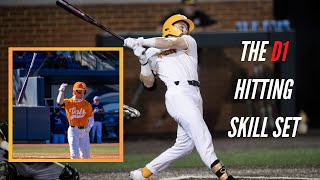
Alex Swenson breaks down what D1 scouts want in hitters: barrel control and hard contact, strike-zone discipline, and power that shows up in games, not just practice. Exit velocity matters less than you think. High-school clips show the quick hands and compact swings that translate to college ball.
Questions this video answers
July 8, 2021.
About 90+ mph (often 95+ for strong power profiles).
Around 87 mph.
Chapters
What's up, team? Alex Swinson here. Hey, thanks for joining me. Last week we Talked about the D1, D2 and D3 pitching skill set and had great feedback on that. I feel like there was a lot of value taken from that, from just how people were commenting on and email me back on that or what they got out. So I wanted to make an offensive side a hitting skill set for the next level and what these scouts are looking for. We're going to be talking about exit velocity. We're going to be talking about specific again skill sets and traits that they look for in hitters. We're also going to be looking at video of guys that are currently in college, but video of what they look like in high school so you guys can get a good feel. And we're going to take a look at everything that we kind of covered that's at the end. So stick around definitely for that. So, hey, if you get anything from this video and you're not subscribed yet, go on and subscribe. It helps me out a lot or select that thumbs up, that like button. But if you have any questions at all, go on and comment down below or email me about anything on the recruiting landscape and we will go from there. But let's hop into the hitting skill set for D1, D2 and D3. So these college scouts look at three things from a skillset perspective and it's not in any particular order, depending on the scout. Okay. And it depending on the situation, depending on your position, depending on your athleticism and your ability. But let's start with the first one, hitting and on base ability. So these coaches are going to look at you and measure you of can you just flat out hit? All right. And what's your ability to get on base? And we're going to go into more detail about that here in a minute. But does it translate in game and then will it translate at the college level? Will it translate to college pitching? Because it's a different game from a college pitching perspective than what you see at the high school level. Okay. Yeah, you're going to see it every once in a while. You're going to see a dude that can really throw it. But the college level, you're going to see that all the time. So will it translate to the college level? Because then coaches might see in bp, right? They might see some video of you in bp. Really quick hands, really knows how to control his barrel. But will it translate in game and will it translate at the next level? So what does hitting an on base ability really mean. So it's kind of some things that we just talked about right there. Feel for the barrel, make consistent hard contact. Do you have a consistent swing? Are you all over the place? Right? We want consistent swings in your ability to hit to all fields. You'll see guys on the videos that are coming up here in just a couple minutes of short, quick hands. All right, you explosive hands, explosive wrists and that has really good bat speed. So there's a lot of talk with, hey, using our hips, using our legs, which are, which is really important. But in my opinion there isn't enough to talk about his hands and like whippy hands and quick action forearms, strong forearms. Because hitting is a lot of that actually from here to here it is a lot of that. And I'll explain that here in a minute. So let's get to the next one that was hitting and on base ability. Next is plate discipline. Coaches look at a batter of how well he controls the strike zone, so knows his strengths, okay? Where he does really well as far as hitting the ball, whether it's away or to the left field. And guys, don't be just a left, left field hitter. Meaning if you're a righty and you're just smoking the ball to left field all the time, do not do that. You need to make sure you're working up the middle and to right field, especially left. Left handed hitters don't be just all pull, okay? You got to work on your ability to back the ball up and hit the other way. So this is that plate discipline, okay? You have a good approach, does not swing at bad pitches. You see this all the time. Hey, it's going to happen, right? You're going to swing at bad pitches. That's just hitting. But do you do it all the time? Do you do it consistently? You need to make adjustments. You control the strike zone. And a good way for these college scouts to know and understand if you have low strikeouts and a lot of walks is a good indicator if you have plate discipline. So do you have plate discipline? You need to evaluate yourself and you need to be evaluating yourself all the time on this, okay? So you can make adjustments as you go. You need to be evaluating yourself on all areas of your game and off the field as well in school with your relationships, how can you begin better? Where are you making mistakes? Where have you kind of plateaued? How can you get better in that area? Okay, the next one is game power, okay? Coaches measure of extra base hits and does it measure up to the Power you show in BP. So if you're a BP guy, when you're that 5 o' clock BP guy, because usually that's what time they take BP in the bigs. You hear this, he's a 5 o' clock BP guy, so he can only show it off in BP. You don't want to be that guy. Right. You want to be able to do it in the game. So doubles, triples and home runs in game, coaches will be able to see, hey, does your power translate into the game and into the next level? So that is how you're going to be evaluated on those three skill sets. Some coaches definitely have some smaller tidbits depending on their philosophy. We're not going to talk about speed today, but speed is a big one, especially if you're an outfielder, a middle infielder, got to be able to run a little bit and then traits. Okay, what do these college coaches look for as far as hitters? Good presence at the plate, confident. Hey, we want to see guys that want to go hit, guys that are throwing velo, that are confident, that are walking up there like they own the box. You need to work on your confidence at the plate. It can help translate into being just a better overall hitter. Okay? And not allowing your past abs, your past game to affect you. Meaning if you have a bad at bat, if you have a bad couple at bat or a bad game and you're playing doubleheader or even the day before, it's not affecting your next play. You need to have confidence. You need to have confidence going into that plate appearance, knowing you're going to get a hit. Of course you're not going to do it all the time, but that's going to help you go through that. Sometimes you got to fake it to make it in this case, okay? And then of course, they're going to look at your athletics, your athletic ability, your physicality, your projectable. If you're projectible, meaning size is going to grow into the body. And of course, similar to the pictures that we talked about last week, are you coachable? Do you seek knowledge or your work ethic leads and academically strong? So these scouts, how are they going to know that? They're going to come talk to your summer ball coach, they're going to come talk to your high school coach and see if you are that. Are there any problems off the field? Are you a bad teammate or are you a good team? Are you a good leader? Are you coachable? Do you want to continue to get better? So think about that. Next. All right, we're going to get into Exit Velocity. So this is in my opinion the most overrated thing that you see on these recruiting websites or perfect game pbr. You see Exit Velocity. And the problem is it's not like necessarily it's a wrong thing, but too many parents and student athletes in high school think it's like they need to get to a certain number and they're going to be recruited. I almost didn't even put this page because it's so overrated is yes, if you're going to be a power guy, you need to be definitely 90 plus. You're usually going to be 95 plus, but you're going to need to. You need, you're going to need to show that in game. There's guys that can. There's guys that can hit close to 100 off the tee exit velocity, but can't hit a lick in game or even in bp. So just. It doesn't translate well. But I know that a lot of people talk about this and it's, it's so close. As far as there's guys at the D2 level that are well into the 90s from an exit velocity stance. And again, this is off the tee and this isn't game wise. And there's plenty of guys at D1 level that aren't 90 plus and there's guys at the D3 level that are below 87 and above way above 87. So what you need to be focused on consistent hard content. Of course we want to be strong. Of course we want a quick actions. We're going to be showing that here in just a second. But I'll put this up more because I know that this is kind of appealing. These are the closest average that I could research and come up up with from here. But good numbers to kind of go for it. But again, there's plenty of guys at the D1 level that aren't at 90 or a little bit below that. And then there's guys at the D3 level that's way above 87 miles an hour. So don't be so focused on the exit velocity. Be focused on barreling up balls, hard contact, quick actions, being strong in your wrist and your forearms. Let's get to some video. Okay. This guy went on and played Division 1 and is actually in minor leagues right now, first year of minor league ball. But let's look a look at his hitting ability from a valuation standpoint. Okay. So right away, this is how quick you can kind of see it is. Boom. You See his barrel and his bat work quickly. It is really quick to the ball. Fast right there, you see that? It is fiery and it is quick action. He is in his leg. It's simple. There isn't a lot going on in this swing. But he is super, super aggressive. He is controlled. Aggression is the way I like to talk about it. He is controlled, but he is super, super aggressive. And look, his hands in his forearms, they're super fiery. They are quick and consistent. The ball, you can see the guys in the BP watching this ball, but he's barreling up balls here. And it doesn't mean that you're going to have the greatest BP all the time. It doesn't mean that at all. But you need to be working to consistently hitting baseballs hard. And how do you hit baseball hard? Barreling them up, barreling them up. All right, left handed. So this is from a left handed perspective. This guy, this is all. Both of these are from high school, but this guy went on and played in college and is about to get drafted this year. So let's take a look. This swing is not good. So look, hey, it happens. You, you're not gonna have the every swings, not gonna be perfect. But this guy is a really good left handed bat because he's short, compact and sweet. I mean he hit 330 in college at the high division one level. And it's just really consistent with his barrel path. Very simple. And he can manipulate the barrel and be consistent with his, with his bat. He uses all the fields. That one was right up the middle. He's hit some balls to the left, some balls to the right. But I wanted to show you guys this standpoint just so you can have a visual of it. And don't be so. Don't be so concerned about your exit velocity. I get it. I want you to get as high as you possibly can. I want you to get strong. I want you to do all those things, but be focused on barreling up balls, keeping your head down, right, Seeing the ball and barrel, barrel, barrel. I've said it probably 100 times already right now, but that is really is what matters. Because when you barrel up balls, you're going to get a lot of hits. Okay? And these college coaches want you to get hits and doubles and as you get bigger and stronger, those balls are going to turn into extra base hits. All right? So I'll leave that with you. If you have any questions, please comment down below and we will go from there. And please subscribe if you haven't. I hope you have a good one. I'll talk to you soon. Dubai.
More from Alex





Most families are not missing scholarship money because their athlete is unqualified.



Two families DM’d me this week with the exact opposite problem. Same answer for both. 👇

Thousands of families are on a waitlist for something that does not open for another week.

