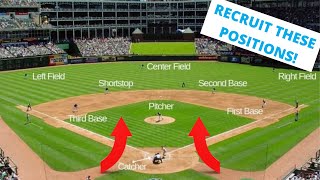
Alex Swenson (former Division I coach and recruiter) explains why college recruiters "recruit up the middle," lists the most sought-after and most popular high-school baseball positions (left-handed pitcher, shortstop, catcher, right-handed pitcher, center field), and gives practical advice for players at corner positions on how to increase recruitability (be versatile, play middle positions, or hit well). He also summarizes the five things college scouts evaluate: physicality, projectability (athleticism/actions), measurables (arm/exit/60), academics, and character. The video emphasizes starting recruiting early (sophomore year) and training to be versatile.
Chapters
What's up, team? Alex Swinson here, former Division 1 college coach and recruiter. And I'm here to help you or your son reach the next level and play in college and just become a better student athlete on and off the field. So there's a saying amongst college recruiters, college scouts, when they're out recruiting or they're at camps or showcases is we recruit up the middle and we're going to get into what that means and we're going to also get into what are the most sought after positions, what are the most popular positions? Sought after and popular are different and we're going to get into why that is and what if you're not that position that we get into. Well, I'm going to go into how you can help yourself and how you can still help yourself be recruited and give yourself the best chance to play at the next level. Plus what college scouts are looking for in a student athlete in high school. So if you get anything from this video, please select that like button and subs. Subscribe and please share. Just to be a part of this community and help out people go through this recruiting process. That's what I'm about. I'm here to help as much as I possibly can. So let's get into it now. Each and every college baseball program is a little bit different each and every year. And there's over a thousand college baseball programs at the next level. And the reason why it's different each and every year is because rosters change. Seniors leave the program, those positions leave the program. Some juniors leave the program because in college you have to wait three years before you get drafted. And there's a lot of guys in college that get drafted and play at the next level. So they have to fill those spots. And then you have to consider the freshmen that are coming in, what positions they're coming in with and that these college recruiters recruit two to three years ahead of when they bring freshmen in. That's why I emphasize here, if you guys have watched my channel at all, start your recruiting process sophomore year. Why? Because college coaches start the recruiting process that year. You want to be ahead of the game. You don't want to be on the eight ball that they say. All right, now the reason why college coaches say they recruit up the middle is because they recruit catchers, pitchers, shortstops and center fielders typically. And the reason why is those are the most sought after positions. We're going to talk about the most sought after position by position right now. Let's get into it alright, so the most sought after position, now this is my opinion, this is how I recruit. And I have a lot of friends that are college recruiters and coaches and I talk to these guys and they've told me very similar that it's left handed pitcher, the most sought after one. Why? Because there's not very many of them. Only 10% of the population is left handed. And then there's only a percentage that play baseball, right? And so on and so on. So that's usually the most sought after position. Then it is shortstop, okay? Then it is catcher. Then it is right handed pitcher. Then it is center fielder. Those are usually the most sought after position. And the only one I would really debate and could go back and forth is the right handed pitcher could be be number three and the catcher could be number four. You can kind of flip flop because from a number standpoint, usually on a college roster and most just baseball in general, there's more pitchers than any other position and there's more right handed pitchers than any other position. So that goes back to most popular, right? The most popular positions as you've already said, would be right handed pitcher. And then you can go two or three with left handed pitcher or shortstop depending on each roster. Kind of sways it. Then catcher, okay? Then center fielder. And the reason why they say up the middle is usually those guys are the most athletic. And if any pitchers are here, pitchers aren't usually looked at as the most athletic. But we need you guys, we need you to get the ball filled up. I was a college catcher, college catching coach, a hitting coach and even pitching coach. But. And I love you pitchers, I love you to death. But sometimes you're not the most athletic. I hope you're working on your athleticism and your actions and stuff like that, but it's usually kind of a running joke in baseball as far as pitchers are not the most athletic. So let's get into what if you're not one of those positions, what can you do to help yourself? So if your position is not up the middle and you're a third baseman, a first baseman, a corner outfield, right field, left field, what can you do to help yourself? If a lot of college coaches are not recruiting that position, okay. And the reason why they're not recruiting that position per se is even though they need third baseman, first baseman, corner outfielders, is they transition the shortstop into a center fielder or a left fielder or a right fielder or a corner guy or first base, basement if you will. Okay? But if you're not that and you know that. Hey, you can't go play center field or you're not playing shortstop, you're a third baseman, or you're a first baseman or you're a corner, then what can you do? Hey, coaches will recruit you at that position if you can really, really hit, okay? And if you are like a pretty good hitter, go and play different positions. Play up the middle, play center field, get behind the dish, right? Get behind a dish. And as far as that is a really high skill position as far as catcher, okay? Expand. Don't just be so locked in on first base or third base or a corner outfield. Be versatile. The college baseball rosters, these guys are versatile. If you were to see what all positions they played in high school and even some in college, they played all different positions. So when I was at Ole Miss, Coach Bianco did this, and I loved it, is before practice, we would have all the guys at all position, all positional players play infield. And they would rotate around, okay, they would rotate around the infield position. So third base, shortstop, second base, first base. And the main reason they did that is to be to make the players versatile in case they had injuries or in case they needed to fill a position. So you should do the same thing, right? If you're third base, first base and outfielder, hey, take ground balls at third base, take ground balls at shortstop, take ground balls at second base, take ground balls at first base. So you get all different angles. So if coach wanted to put you in, you could play that position and you could play at the middle, and you could let college coaches know that you play those positions as well. And you're not just a primary first baseman. And that's all you play. You can be a middle infielder in a first baseman or a middle infielder in a third baseman. Be versatile, help yourself. And hey, hit, hit, hit. Because there's no doubt it. If you match and you can hit and you can hit for power and average, they will find a position for you. No doubt about it. Okay, let's get into what college scouts look for just as a student athlete in high school. So once these college coaches determine which positions they need for your class, remember, that's depending on the seniors and the freshmen that are coming in and the class before yours. They're going to be looking at five components, all right? And the first one is physicality. Why do I start with physicality? Guess the first thing that they see. Your body. Do you look physical? Do you look the part? Have you been in the weight room that is a big factor to these college kilometers. And it can be such a separator because there's no doubt other kids that are very similar to you across the country that they might be recruiting. So what is going to separate you? And maybe it's your physicality or maybe it can be your projections, your athleticism. This is another one. Projections. Are you projectible? Do they see you getting better? How did they determine that? That is through your actions. That is through your athleticism. How do you improve that? Hey, true training, athletic motions as you go, cone work, footwork, working skill at your certain position, arm action for a pitcher, repeatable mechanics for a pitcher, catchers, blocking, receiving, again, footwork. There's all these things being consistent with your training. That's how you improve your projectability, your athleticism and your actions. Okay, the next thing is your measurables. Arm velocity, of course, exit velocity 60. If you're a middle infielder, especially a center fielder or outfielder, that is a big component. You got to be able to be quick out there and run down balls. And then of course from leaving off the athletic side or the physical side, that's the first thing that they're going to look at. Okay. For most of these schools, then it gets into academic and then it gets into character. So there's academic. They're of course look at your gpa, but look at your test scores, especially if it's a higher academic school like an Ivy League school or a school just somewhere like that, like a Georgetown or a Rice or a USC out in California. Hey, your academics matter and then character. They're going to talk to your high school coach or your summer ball coach and they're going to look into your leadership. Are you a good teammate? Are you a good just overall player that does what he's told in the sense of like a coach tells you something and you do it. You are coachable. That's what they're going to look at. Alright, so we got physicality, we got projectability, we have measurables, academics and character. Those are the five things that they're going to be looking at. Hey, if you got anything from this video, please like that, thumbs up and subscribe and I will see you in the next video. Take care.