Unlock Your Recruiting - 2024 Recruiting Calendar & Guide
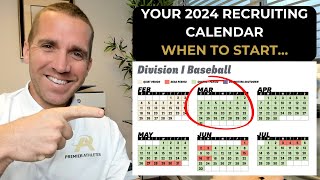
Alex Swenson, a former D1 coach, breaks down the 2024 NCAA recruiting calendar for baseball. Coaches can't make offers before August 1 before your junior year. Freshmen should focus on skill development, sophomores on getting noticed, and juniors on actively pursuing offers.
Questions this video answers
February 19, 2024.
February 2024.
August 1 (going into the player's junior year).
Green = contact period; Tan = quiet period; Red = dead period.
Chapters
Hey, Alex here. Thanks for joining me. In today's episode, we're going to be Talking about the 2024 recruiting calendar for Division 1 baseball that applies to high school baseball players and their parents and the changes that are coming up here. Real soon, I'm going to pull up a calendar. We'll be able to talk about it, and I'll explain everything that's kind of going on and why it's important. We're also going to be talking about the recruiting timeline and are you late to the game? Are you early to the game? What should you be worried about? What shouldn't you worry about? I get a lot of questions as we go, like I don't know what I should be doing. We're going to be talking about that and when to get the ball rolling in the recruiting process so you're not behind the eight ball as we go. And if you're new to my channel, my name is Alex Swenson. I'm A former Division 1 college baseball coach, scout and recruiter with 11 years of experience. And now what I do is help high school baseball players and their parents navigate this college recruiting process and put them in the best possible position to play at the next level. If you're interested in and want more information about my program, where I help guys go through this, you can go down to the link to my website there and explore and see if this interests you. But with that said, let's go on. I'm going to pull up the calendar right here. You'll see a bunch of months here. You'll see the January, January 2024. And kind of the middle right there. And you'll see the tan. Okay, so the tan in red. I don't want you to worry about the red right now. That is the dead period. We don't have to necessarily worry about that right now, but the tan, which is the quiet period. And if we're obviously right now we are in February and we're about to get into March. So this is as of this recording, we are in February of 2024 and we're getting into March, which is green, which means that is a good thing. That means go. All right. It is full blast. Recruiting, recruiting, recruiting has always happened 24 7. I talk to these college coaches on a weekly basis and they're always looking for good ballplayers, but there's limitations. All right, so what you're seeing, the color differences, there's these certain periods that NCAA makes rules of of what you can and can't be doing. If you are a college baseball coach and player as well, and what we're in right now, which is again, the quiet period, really just means that college coaches can't leave their campus to go watch and scout and evaluate players. Meaning they can't go to a tournament during the quiet period and watch you and evaluate you. They can communicate with you depending on the time of your year. And we're going to talk about that here in a minute. But there's a big misconception in recruiting about the quiet period. Hey, nobody can talk to me. That's not true, actually, at all. They can very well talk to you over the phone. They can talk to you on campus. They can talk to you through email in the quiet period. So again, it's a bad name because quiet period really just implies that, hey, you know, they can't talk to me, which they can again, especially if you're a junior or a senior. Now what the green means, which we're about to get into the green, which is great. And we're going to be in the green all the way, really through August is the contact period. Now the college coaches are allowed to go off and watch you whether it's on their campus, whether it's off their campus. They can go watch and evaluate you at high school games, at tournaments, all that good stuff at showcases, which is really, really important because they need to see you in person. So we're going to be in the contact period. So it's very, very important that you start engaging with these college coaches. So now let's talk about this because we're getting into the contact period and we're really going to get into the thick of the recruiting process really from now all the way pretty much to December. November is kind of the end. December starts slowing down a little bit, obviously because of the holidays, but they're going to go through all the way through November. We'll get into the quiet period, back into the quiet period, into the fall. But they can still recruit you on their campus and all that good stuff, the quiet period. They can still bring you on, have a college visit, you can go to a camp, you can talk to them at their camp. So it's all important here. The dead period and is where they can't watch you. They can't have any in person contact with you on or off their campus and you can still communicate with them during the dead period. So now with that said, let's talk about the recruiting timeline. Freshman in high school, you might be a freshman or a parent of a Freshman high school baseball players. Should you be getting the recruiting process started as far as like engagement and really getting the ball going? I say no, it's too early. You just need to focus on skill development, which is important in this recruiting process, but skill development, weight training and get acclimated with your high school and your high school baseball team. Sophomore year, it is a good time to get the, definitely get the ball rolling. Because the majority of college baseball coaches, all right, especially at the Division 1 level, are starting this at sophomore year, starting to look at players sophomore year and get on their radars. Now there is a new rule that was passed about a year ago of what they can and can't be doing. So you might have saw that commitments were happening super early, sometimes as early as eighth grade. And it was crazy enough you saw some seventh grade, which is just insane. And that's for another story. But this new rule doesn't allow offers until August 1, August 1, going into your junior year. So the end of your sophomore year they can start offering you and there's limitations of what they can communicate with you. You can talk to them at camps and things like that if you're a sophomore. But college coaches, my point of saying this is college coaches start watching you just because you're a sophomore and even a freshman. Some of the big time schools, Vanderbilts, Florida's, Stanfords, Texas, you know, Michigan's of the world, are going to watch freshmen, okay, but they can't necessarily offer yet, which again I think is a good thing. But, but you want to start getting on their radars because you're allowed to get on their radars. They just can't offer you until August 1st, at the end of your sophomore year, going into your junior year. So the things that the guys in my program that were going into at August 1st, leaving their sophomore year, going into junior year, were getting offers because of the things that they did, okay, that spring and summer to get their name out there and college coaches on their radar as we go. So important that you start this recruiting process. In short, what I'm saying is get the recruiting process started sophomore year so you get the ball rolling as we go. Whether that's targeting the right schools that are recruiting your position, communicating with college coaches, because you can reach out to these college coaches and engage with them, send video and all of that to look at camps and showcases of where they will be depending on the summertime, and then also getting your spring schedule out there as well. Junior year, if you haven't got it going, it's time to definitely get the ball going. Our really, our big window, especially for the Division 1 standpoint, is sophomore and junior year. From the recruiting process, D2 and D3, it's okay to get the recruiting process started around junior years. Those schools happen a little bit later as we go. But From a Division 1 standpoint, you definitely want to get the ball going as far as sophomore year and then definitely into junior year again, if you're watching this and you're a junior, hey, it's time. Definitely get the ball rolling now and targeting those schools that are recruiting your position because not every school's in need of every position each year, right. So targeting the schools that are in need, very, very important. And making sure that it's a good fit for you, not only athletically and baseball wise, but academically, geographically, you know, socially, financially, all of those things. So if you're a sophomore or junior watching this, hey, so let's get the ball rolling. If you haven't already. And if you're watching this, like, hey, I. I don't know what to do, what the first step should be. Feel free to reach out to me and go to my website. Be happy to talk to you more about how I could possibly help. I only work with a limited number of guys, but if I have spots available, I'd be happy to help if it's. If this is a good fit as we go forward. But if you have any questions, please comment down below and let me know if you have any questions and I'll be happy to answer. See you in the next video. Take care.
More from Alex





Most families are not missing scholarship money because their athlete is unqualified.



Two families DM’d me this week with the exact opposite problem. Same answer for both. 👇

Thousands of families are on a waitlist for something that does not open for another week.

