Ontario’s ONLY Beachfront Winery | Sprucewood Shores Estate
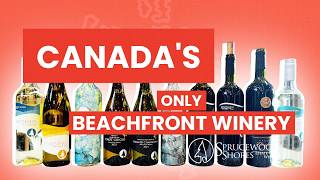
In this informal on‑site tasting, host A and Sprucewood Shores representative B walk viewers through the winery’s unique beachfront setting, its dog‑friendly atmosphere, and a sampling of its 21‑wine portfolio. They explain that while the estate sources as much fruit as possible from the emerging Lake Erie North Shore AVA, it supplements with Niagara grapes to meet demand. The dialogue covers a range of styles – a crisp Pinot Grigio, an off‑dry “dry” Riesling (10 g/L residual sugar balanced by high acidity), an unoaked Chardonnay produced only in favorable vintages, a “Beach Glass” red blend (Cabernet Franc, Cabernet Sauvignon, and a ripasso/appassimento‑style wine), a Merlot, and a sweet Select Riesling made by stopping fermentation to retain natural grape sugar. Throughout, the hosts discuss winemaking choices (malolactic vs. yeast touch, appassimento drying, ripasso skin‑to‑juice ratios), flavor profiles (fruit‑forward, mineral, herbal, plum‑like), and branding elements such as beach glass packaging and the lake’s shipwreck‑derived glass. The conversation is casual, enthusiastic, and emphasizes trial‑and‑error experimentation, the importance of acidity, and the estate’s appeal to visitors with dogs and beach‑goers.
Chapters
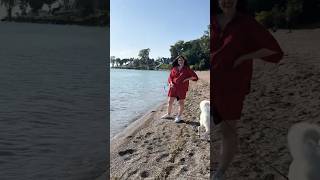
So Sprucewood Shores is actually the only winery that has its own shoreline, hence the name. You can see the winery just right back there. Gorgeous day today, and we're right on the banks of Lake Erie, so beautiful all the way across. Ohio is on the other side of that lake. Such a gorgeous, gorgeous spot to be in, and such a beautiful winery. All right, we're at Sprucewood Shores. This is right by the lake. That blue behind me right there, that's the lake. We got Togo with us. We are ready to taste some wine. This is a great spot to go if you're traveling with your dog in Lake Erie wine country. Yeah, I'm down for all of it. Whatever you taste, show me, I will taste. And I just need a spittoon. Yes, I might not be driving, but day must go on.
All right, so we got your spittoon. Do you need crackers or water or anything like that? He's got another one of these if you want.
Sit? Nope, he says, "I'll do the opposite of sit." He's a husky, this is what he does. He's like, "I heard you, but no." Would you— Pinot Grigio up first. All of your vineyards are here?
All of our vineyards are here. However, we bring in a lot of our grapes.
So you're bringing in the fruits from where would it be for this one?
So it's a variety. We actually try to get as much fruit as we can from the Lake Erie North Shore. However, being a small and emerging region, there's not always the availability we need for the demand for our grapes. So what we'll do is get some from Niagara as well and typically between the two places. All of our needs.
And so how does Pinot Grigio do? Because this is a really lovely Pinot Grigio. It's very fun and fresh, and it really definitely tastes like Pinot Grigio. Doesn't taste like Pinot Gris. It's like a Pinot Grigio, aptly named. Well, that's the only difference between Pinot Gris and Pinot Grigio. It's the style change once it leaves Italy.
That's right.
France.
Did you grow in the north or did you grow in the south?
Done. That's it. So this is really simple and keen and fun and fresh and simple, not in a bad way, but in the straightforward way. Not overly done, not too much pear, very apple-y. Really nice. So this one Dry Riesling.
Let's start with that. Yeah, so our dry Riesling is off-dry, of course. So again, we're going for, you know, easy, but in the general consumer's perception, I usually think of it as a balanced level, right? Is it going to be, you know, a little bit more acid or is it going to be a lot of sweetness on it? So there is some sweetness to it. It's about 10 grams per liter of sugar. It balances nicely. So you kind of put dry on the label because there's that existing customer perception that Riesling is all sweet. And most people that taste that, they're going to say, no, that suits fine.
I think it's other— the other thing too is with Riesling is, you know, it can have 10 grams a liter of sugar, but the acidity is so high that you actually never notice it. You would only really notice if it was 5 grams and how high the acidity is. And when you start to notice the sugar, it's actually at 25 grams per liter of sugar. What do you think? He's our regular consumer.
Not a fan of the reds. I might have a couple reds you might be interested in, you know, just as a test. I'd be curious to try them out if you don't mind.
All right, great. Dry, however, slightly off-dry Riesling, but you never know it, ever. We had to do a thing.
Beach glass. Yeah, we're Ontario's only beachfront winery, so we need to do a beach thing, obviously. It's amazing how many people come out here just walking along the beach looking for beach glass.
Really?
Yeah, it's a thing.
Do they find beach glass here? Tons. Wow.
Lake Erie has a billion shipwrecks, and it also has a couple of big cities along the water, so it's just all this glass that gets churned up and sent onshore.
And I had no idea that happens. It's actually really, really pretty, this beach glass. I had no idea that there's so much beach glass here from all the shipwrecks and Ohio.
And Ohio.
So what's the grape varieties that are in this blend?
Yeah, so So basically this is a blend of Chardonnay. The next vintage is going to a Pinot Grigio, Riesling.
Whatever works.
It's honestly whatever works at the time to make it get kind of the flavor profile we're going for.
Which is fun, crispy, by the sand, crushable.
And you're good.
There we go. Exactly what's happening in this glass. This is also the picnic wine, barbecue wine, the easy go-to, don't think about it too much, fun wine.
Makes a great gift too. This packaging and most of the people I mentioned out there that are wandering the shores looking for beach glass.
We're going to go look after it's done. Pinot Grigio.
It's a Pinot Grigio.
Fox Flies Pinot Grigio. Full malolactic on this? What's the— a little bit of yeast touch or no?
Little bit of yeast touch, no malolactic on it.
Okay.
And really this was about the expression we got out of the vineyard. That we were able to get really nice quality product out of. Tasted the difference in the body, tasted the difference in the character of the grape. We said, let's put it in a bottle.
This is a very unique Pinot Grigio because it definitely does have all of those aspects of Pinot Grigio with the first bottle.
Yeah.
But it's right away, it was nuttier and slightly more herbal. You can get with Regio. That's usually the high-end version that you find in Alto Adige type of styling, but here, which is quite nice. Done and done. Un oak Chardonnay, yay, my favorite!
This is a very nice one. We did just thought it's the right year for this.
So this is not always common. Do you have an un oak Chardonnay all the time, or do you have an un oak Chardonnay always?
Fox Flight wines are only made when the time is right. It doesn't happen every year.
So this is not always found in Fox Flight. However, there is always an un oak Chardonnay, which is good. We should always always be an un-oaked Chardonnay.
Yeah, it's the right thing to do.
Again, this fox-like, un-oaked Chardonnay, only in the good years. Yep, it's going good. It's going great.
All right, let's taste—
Seaglass, not Seaglass.
Not to be confused with another brand of Seaglass. We're not that one.
Okay, Beach Glass Red. Note the slight differences between this bottle and the other, but again, very, very beautiful. Cabernet Franc.
Cabernet Franc. And all Essex County Cabernet Franc is as well.
All Essex County. Amazing. This is my favorite style of Cabernet Franc, where it almost is that purpley tone, a little berry. Anyway, all right, Cabernet Franc, Cabernet Franc, peach glass. Lots of blue fruit, which is really, really nice, and almost this intense graphitey, fully stickiness to it in the minerality. I guess again, soil all from here, you said?
Yeah, it's all from this area.
And then also the best thing about this I find is in the palate, it's not overly vegetal as well, but you also get this nice intensity in this whole— and it's a really bold Cab, Cab Franc in particular. I find that sometimes on calcareous soil, Cab Franc can be a little bit too lean for some people, but also extra vegetal.
Yeah, I think you captured that nicely.
It's not the Sprucewood vibe, they want a bigger Cabernet Franc. This is exactly what's happening with us. Easy, that's it, that's all. It's just not the vibe.
You should definitely taste this guy.
Yeah, I'm— I, again, whatever you give me, I will taste. This might turn out to be a very bad idea, but we'll see. He just desperately wants the, the meat and cheese basket. You want one too? Yeah, we'll set up after, after work, after work, after the working is done. All right, so this is— what do we got here? We got Cabernet Franc— no, Cabernet Sauvignon Hawks Flight Reserve. I like Cabernet Sauvignon from here. This is what people expect Cabernet Sauvignon to be from Ontario.
We're the first winery in this area to do an opossumento method farming.
Oh nice!
So we've made an opossumento, which I can taste with Daphne as well.
Yeah, I would love that. Opossumento, dried grapes, 100% dried grapes?
In the opossumento we've made, it's 100%. And this is a blend? This is This is a ripasso.
Look at this! Italian winemaking styles are permeating everywhere. There's already Pinot Grigio here. So ripasso, the dried grapes from the appassimento-style wine have already been fermented into a wine, and then those grape skins have gone back into this. So their appassimento wine is obviously a Cabernet Sauvignon. There we go. And then they have these ripasso grapes that go into this standard wine creation. It's what makes it older. Anyway, this is delicious. So it's a full ripasso.
It's— no, so again, this is one of those things where we're playing with it. How much, how much of a volume ratio we put into it? Yeah, the question that is open item still in our minds. So this had a certain level, let's call it, of possible skin-to-juice ratio, and we've done some more and we've done some less, and we're still— the jury is out on what that right amount should be. We're happy with how it turned out and the way that we found that this brought a lot of great notes to it for the wine.
Yeah, there's really— it's not— Cabernet Sauvignon from here I find is very savory leading. You got a little bit more fruity in the leading edge of it, more berry, more dark fruited notes, and then followed by that tobacco-y, earthy characteristic, which is nice. It's kind of swapped it a little bit.
And that's what the riposte has done. 100%. It's amazing what's been discovered through humanity's history, trial and error.
This is all trial and error. All of this is just trial and error. If we leave these grapes long enough, it becomes something delicious. Maybe, you know what we should do? We should actually try to do it better next time.
Yeah.
Oh my God. All right. It must have been a real bad day.
Turned into a good one.
Turned into a good one.
All right, so I'm going to pour for you.
Great. Oh, I love Merlots from here. Okay.
It's Merlot.
Ontario Merlot. Niagara Vineyard Merlot, done here, still in the Hawk's Flight line. What does this mean? Instantaneously, we are going to expect something through the spruce wood point of view. Ah, new bottle. All right, Merlot. Very plush, very bold, really nice. Like the Cabernet Sauvignon that I had is showcasing to me that you guys really— and everything else that I've had Fruit is very important here. Fruit characteristic, fruit quality, fruit boldness, but also blended in with a lot of earthy qualities that are a little bit more plush and not as overly savory. No meaty tones, just straight soft earthy lovely minerality. But I love this lushness that it always has. That always makes me very happy. Very pillowy.
I'm happy to make you happy.
Thank you.
All right, so, last night.
Woo! It is going to be a last night. I know, right? I am a genius. She has a passimento. It came from behind a door. A passimento will be arriving sooner than later. And why did you guys decide to do a passimento? You know, complicated. This is gonna be a long answer because, you know, this is such a decision to make. Or why make— like, I don't, I don't think anybody really— how long it takes to make a passimento wine. You pick the grapes, dry the grapes, make them into wine. They only make a certain amount.
But this is all true. Everything she says is true.
Cabernet Sauvignon, Potts Light, tête-à-cuvée, top of the top. You can always tell a top of the top wine. It is a different label. It has a nice accoutrement. It is beautiful and it probably has a price tag to match, especially if it's an appassimento, and it's usually worth it. You know what I really think that this— what this is showcasing to me is, again, we get this stewed, dried, fruity, plummy, figgy kind of vibe, but all the way to black currant and cranberry, which is really quite mind-blowing. On the palate is just so spicy and fun. That's the best part about it in Paso Monte, you get this spicy, fun, fruited, intense. It's also 15.5 grams per liter of alcohol, but again, we're more northern, lots more acidity is coming into it. This is good.
Awesome. Enjoy it.
This is really nice wine.
Yeah, it's tasty stuff.
Wine consumers underestimate a lot of the times that you don't need acidity for making a big bold wine. Where you have this brightness, but you need this brightness. I know his, his facial His expression was literally, "Oh no, no, no." You need acidity. You need acidity. Otherwise you're basically eating Jolly Rancher candies. Yay! This has been really fun. Thank you.
Last one I want to taste.
Last one. They've all been delicious. Sweet Select Riesling. I will be finishing the rest of it.
So good.
Okay, so new glass time. Sweet Select Riesling.
There are people that that's exactly what they're looking for. If you taste wines and you feel 'Oh, that's too tart for me, that's bitter,' and these are the kind of words that come out of your mouth when you're drinking everybody else's wine, then this is the kind of wine you're going to want to consider.
I know.
If you're drinking Jacob's Creek Moscato, for example, and you know you want a wine from Ontario that's actually a little better price and great across the board, more natural sweetness.
There we go.
We actually use the grapes, the sweetness of the grapes inside of the juice.
And you know what? There's actually a clue that you can find on the back of bottles this. Uh, Sprucewood is a fabulous example of it because you can see there's alcohol listed right here. This says 9% alcohol. Now the grapes here will actually ferment up to 11% really easily, so a stop fermentation to keep sugar— sugar plus yeast equals alcohol— you want to keep some of that sugar and you stop the fermentation. And to keep it in the bot— in the final wine, you'll see something that's kind of under 11%, 9%. It's great. And for this one, you definitely get a very refreshing, crispy nose followed by that sweet Moscato-esque type of vibe on the palate with a nice brightness. By keeping that extra sugar without adding additional sugar and just stopping the fermentation, you also keep all the great acidity that Riesling is known for. It's a great finishing wine, especially if you're not a big fan of dessert or you're not a big fan of overly sweet wines or ice wines or ports or things like that. This is a very fun, fresh finish. Fresh finish. Fresh. Fresh. No, this is a great send-off. I love that.
Awesome.
Yay! All right, so I think these are all the wines that we tasted, and it is really a great snapshot of what they're doing here at Sprucewood. There's 21 total wines at the winery, but from sweet to bold, even going into the whites. Honestly, my palate, I love an unoaked Chardonnay, but there are some really, really great surprises in this, especially that Apassimento Cab. Mm-hmm.
More from Renee



Is the Most Famous Rosé Champagne Actually Worth the Hype? | Billecart-Salmon