From Limiting Beliefs to Limitless Life - A Framework to Live with No Bounds
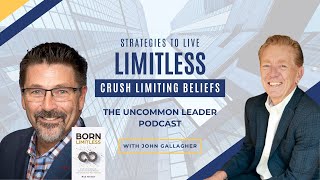
Rick Torrison, author of Born Limitless, traces how childhood abuse created limiting beliefs that shaped his life. He walks through his framework: experiences become interpretations, which become beliefs, which drive behaviors and outcomes. Shifting a single belief can change everything.
Chapters
But here's the thing I want everyone to hear. Because we've changed a belief doesn't mean our behavior when we wake up the next morning is now in alignment and perfect.
It won't be.
We didn't get to our dysfunction overnight. We won't get to our freedom overnight. I do believe it's possible. Typically, the process is the work of continuing to declare new realities and new truth declarations over my life, my relationships, my abilities in that area so that as I declare them, my behavior has to start aligning with my declarations.
Hey, Uncommon Leaders, welcome back. This is the Uncommon Leader podcast and I'm your host, John Gallagher. Rick Torson, USA Today bestseller best selling author, Rick Torres. And just recently, great to have you on the Uncommon Leader podcast. I'm so looking forward to talking to you about your book and about the process that you went through and some of the great things in it that led to that bestseller status and maybe even a little bit about how you wrote it and all the fun that goes along there. But I'm going to start you off with the first question that I always start all my first time guests on the podcast and I said, tell me a story from your childhood that still impacts who you are as a person or as a leader today.
Yeah, that's a great question. And John, first of all, thank you for letting me be on your show. I love the podcast. I've been listening to episodes, man, so in line with everything that you do. And so God bless you, man. Thank you so much for this opportunity to spend a few minutes with you today and to learn from you and then to share a little bit about, about my story. So, you know, there's, there's interesting stories I'll tell you. I was a single parent raised by a single parent and a grandmother. I was a latchkey kid before there were latchkeys. You know, I'm 60 years old, so, you know, I know I don't look it. It's okay, everybody. I don't, I work out hard, you know, I got to try to keep up with my wife. But lots of stories, and there's some I tell in my book really, that shaped me that were the foundation for where I am today. And they weren't the best of stories. They were really some stories with some challenge and heartache. I had some abuse situations by a babysitter that marked me. And I, and I bring that one up. It's not this positive story, but it's really when I reflect back and have learned I built my framework and how I understand limiting beliefs and overcoming limiting beliefs based on the beliefs I established over myself. When this abuse happened, it was about six years old and it was a babysitter. And I, I don't need to get in the details. We understand abuse. And so you guys know that I. And I had to define it and interpret it as it was happening, right? Because that's what we do. It's like, why is this happening? And I started to define myself in a certain manner. I must have deserved this. I must be bad. All women must be this. There was all these things that I didn't know at the time. But what we do to try to understand or justify something that's happening, we interpret an experience. So I interpreted those experiences. And what I found that I realized looking back is those interpretations or definitions of that experience became beliefs. Those beliefs began to drive my behaviors throughout my life. Those behaviors weren't the best towards females and women in relationships. And I found myself with a myriad of broken relationships until I met my wife, who I'm now married to for 33 years. But I remember being with her and going, man, this is the person I want to spend the rest of my life with. And then I remember self sabotaging that relationship. I thought, why am I doing this to this relationship that I really want to be with her? And that was. I share that story because that's what got me probably 30 years ago. That's what got me going, oh my goodness, what's going. What do I believe about myself and relationships that is causing me to ruin something that I really value and desire. And so I started digging in at that point over 30 years ago of going, what is up with our beliefs and how they drive our behaviors that give us our outcomes? And what if they're not good beliefs or what if they're based on a lie? And I'm living my life around these beliefs that were based off of a lie that I told myself in a situation. So anyways, that's kind of jumped right into the deep end, right? But that, that's a story and that's shaped this whole process that I've been in my whole life.
Rick, I appreciate you sharing that. So you go from 6 years old and as you shared to 60 years old, you have these experiences, these stories, these awarenesses, if you will, about some of the these limiting beliefs that you had. It's brought itself to your, your USA Today best selling book, Born Limitless Crush. Limiting beliefs cultivate an infinite mindset and unleash your true potential. So you had 54 years to really write that as you've gone through those stories. And so it's a great book. We know, just because of the time that it took. And congratulations also.
Thank you.
Being married for 33 years as well. So I.
Yes, sir.
I just celebrated 30 just a couple weeks ago.
So congratulations. You don't hear that as much anymore, so it's a.
No, you don't.
And I just love to honor that. And I know. You know, you know, and I know that road is. Can be difficult, but, man, it's worth it. I'm more in love with my wife today than I ever was.
So you. You write, you write the book, and it sounds like you wrote the book for your old self, if you will, in terms of going down through that journey. But tell me, tell me a little bit more. Who did you write this book for and why did you write.
Yeah, so it was interesting. I do a. Of executive coaching, personal coaching, and some of the things that I do. And I've been kind of coaching for a long time, but professionally for the last ten years or so. And as I was coaching people, I kept running into this place of realizing, you know, we typically coach, or a lot of people call it mentoring. Right. Or train. Trying to get people around skill sets to do better at their jobs, to be more productive, whatever it is, to. To deal with things that they. That are trying to break through. And as I was working with people, I realized it wasn't the systems and the processes that were holding people back. It was our belief system. It was a narrative we were telling ourselves in certain areas of our lives, not every area, but in certain areas of our lives, it was these narratives that we would be telling ourselves, I can't, I won't, I'm never, I'm not. And we don't even realize we're saying them. We don't even realize they're there. And I kept running into these walls, coaching people like, why can't we break through? And we have the system, the process, the know how, the passion, the vision, the desire, yet we keep hitting these wal. And that's when. Because I was doing my own work, but I wasn't associating the work with me and my limiting beliefs with my coaching. I'm just. And I realized in that process. And you know what it is, it's these limiting beliefs. And so the book is really short. It's, you know, 30 some years of life in 100 pages. Right. So it's. It's really just about the framework around where our limiting beliefs come from, how we establish them, how do we identify them, crush them and replace them with a limitless belief that allows us then to break through the ceilings in certain areas of our lives. I'll say this last, last thing with that. Sorry, just. We hold limiting beliefs that become truth because we've held them so long we don't even realize they're limiting beliefs anymore. We call them normal. And what happens was I learned is the reason I wrote this is people who are living in a normal that's not supposed to be their normal. And I challenge people, what if the normal you're living under isn't normal? If it is, then this is where you're at. But if it's not, what could be waiting for you on the other side of normal that you're calling this thing you're calling normal?
I appreciate you sharing that again with the stories that go along with it. You being a John Maxwell fan, a member, certified coach, and executive director in the Maxwell program, you know that he does a great job of bringing those things down on the lower shelf. So let's talk about that topic then, of a limiting belief. Early on your book, you talk about the difference between a limiting belief and then let's go to your book type title, limitless Belief. So define what a limiting belief is for me and then take me on the on a journey to limitless belief.
Awesome. I appreciate that. Yeah, I love John Maxwell. I've learned so much in my relationship with him and their organization over the last 10 years. It's been really foundational and a big driver for me. So. So the idea of a limiting belief. What is a limiting belief? It's anything that we hold that doesn't serve us. The challenge is we don't realize it typically, we don't realize that we have a belief that doesn't serve us. And so for me, the coaching process really begins when people are willing, it goes back to that normal willing to challenge some of the mindsets that they have around their beliefs about themselves, others, and the world around them. Right. It's typically an identity issue. It's a. It's a belief about what they can and can't do. And it typically came about in their lives, somewhere in their journey. And it's typically based on how they interpret an experience. Our experiences don't give us limiting beliefs. They're just experiences. How we interpret a limiting. How we interpret the experience creates a belief system. And it doesn't need to be limiting. They can be limitless beliefs. We all know People and we have places in our lives where we have this belief that, man, you can't stop me. I played basketball in high school and college and a little bit after college overseas. And you know, I had this great confidence. I knew I wasn't an NBA player, but I could compete at my level at a pretty high level. And I believed I could, I knew I could. And that drove my actions and my behaviors, the confidence I had in that area. But then you turned me over into relationships and faced that area and it was not pretty. I didn't believe I had confidence. I didn't believe in myself, I didn't believe in the others. So there was this whole other framework that I had adopted because of what I shared, the experience of my life. So that's. So a limiting belief is anything in our lives that actually isn't serving us or has put a ceiling over our lives and it's causing us to settle for something less than we were born and created for. So that's a limiting belief. We all have them. They're there whether we realize it or not. And that's the process. So a limitless belief comes and I'll share this a little bit. I don't know where everyone sits in your community here, but I'm a person of faith. And so I believe in our createdness. Now you don't have to believe in that for me to coach you. I don't lead with that, but it drives how I view people, all people. And I believe in our createdness, that there were no accidents, right? Both of my children are adopted. They were adopted from birth. Both of them were conceived in rape. The world could have said, you know what, to those birth mothers at 15 and 16 year old young ladies, these children don't matter. They weren't planned, they were not expect, you know, all these things said you could choose another path because we think that their value is based on their conception or their environment or their circumstances or what people say over them. And I, and I say this, I don't think so. I think our value is predetermined. There is a value in us, in our very nature of our DNA, that regardless of our circumstances, we have greatness within us. Now circumstances are real. Conditions of our birth are real. Experiences we have are real. I don't displace those. But those things then cause us to have definitions of what's possible for us. Because of my circumstances and I, I challenge people. I understand that. But does that have to be true? Is, is. Can there be another pathway? Can there be Another mindset or belief system. And so a limitless belief to me is this understanding that you will, you can, and you are, as opposed to I can't, I'm not, and I won't. And when we start shifting our language, that impacts our whole physiology. It impacts everything about our subconscious. Has to start aligning and agreeing with I can, I will, and I am right. And so when we can identify where we're saying we can't, we won't, or will never and shift that language, we begin to shift our energy, we begin to shift our beliefs, and then we can begin to change our behaviors. Does that, does that make sense?
Rick, I'm following with you as you, as you say that. I mean, I just have things that pop into my mind. I'm now a part of a, an accountability group. I'd stop short of saying mastermind, but certainly a, a group of men. And one of the things we talked on early on a couple years back were those limiting beliefs. And if we heard each other saying those things that were keeping us from there, they would ask each other to turn them around.
Yeah.
What that mindset might be, because I remember one myself, if I, if I own one, very specifically, if there was something that, you know, bad, whether you. The one I used to love to say was if I was in the atm and there are two ATM machines and I jump behind one lineup. They each have two cars in each line, but I get behind the slower of the two cars. And my, my favorite response, if you will, is, oh, it's just my life story. And there's a limiting belief, even in something as simple as that, to talk about how, you know, I just, you know, whatever line I get in, it's going to be the one that takes the longest. And it's something that we started to call each other out on. So there's an awareness that has to exist in that limiting belief mindset, but there's also that accountability for calling it out. And as an executive coach, you've got to do that on a regular basis. And so let's stay in that space. There's a, there's a chasm between limiting belief mindset, current state where I am today, and the desire to have a limitless belief mindset. When you're coaching individuals, what are the, what are the barriers you see that get in your way? Maybe you talked about some of those in terms of circumstance. What is, what are some of the other barriers you have to see folks overcome to move in that direction?
Yeah, that's a great. It's a great question. I have a framework that I, that I use to help people understand. The biggest barrier that we've already mentioned a hundred percent of the time is awareness that they actually have a limiting belief and that that belief is possibly based on a lie. If I can't break through that, if they won't question the normal, we'll never make it anywhere in the conversation. It's. It's a, it's a dead end before we start. So that's really the biggest thing, right? The framework says this. All of the outcomes that we get in our lives, the good and the bad, doesn't matter. It's neutral outcomes, products of actions. All of our outcomes come from an action, a behavior, right? Everything we do has a result. There's fruit to it, good or bad, but there's fruit. Every behavior that we do, all of our behaviors stem from a belief that we have. We may not consciously think about it, but there's nothing we do in our lives. No behaviors that aren't attached to some form of understanding or belief. Right? Those beliefs are formed by how we interpret life as we move through it. Things said, things done, experiences, how we define, how we understand, they create a belief. That belief demands action or behavior. They have to align. We will not survive with our beliefs. And our behaviors aren't aligned, good or bad.
They will.
Ultimately, the belief will drive us back to a certain behavior. Then we have the outcomes. So the challenge, I ask people is, are there any outcomes in your life that you are tired of or want to change? So they'll say, yeah, I've been stuck here. I can't break through here. I'm leading here, whatever it might be. Okay, so you want to change the outcomes. What is the vision? What do you want? Not what you don't want, but what do you want? That's the other big thing is people have a hard time creating a positive future vision. They can tell you what they don't want, but we have a hard time describing what we do want. And so that's the other breakthroughs I hear, what you don't want. That was my own story when I was. I had an anger issue. Wasn't physical, but it was intense. I was in intense. Your guest can. Your viewers can probably tell there's a lot of passion. So my son, he was little, and I kept just getting angry. My intensity would intimidate and scare him when he was l said, this is not what I want to be. And so I was going through counseling and coaching and the whole thing and they kept saying, well, what do you want? And all I could tell him was what I didn't want. I don't want to be angry anymore. I don't want my son to grow up angry. I don't want, I don't want, I don't want. He kept saying, I understand, but what do you want? And I go back, I don't want this now. He said, I understand, but what do you want? And I was like, you're driving me crazy. I'm telling you. He said, no, you're not telling me what you want. And it hit me, and I was like, oh, I don't have a vision for what it would look like to not be angry. And so I'm telling myself, don't be angry. But our subconscious, which is what drives us, only hears angry, be angry. And so I was continuing that cycle until I started to say, okay, I want to be peaceful. I want to listen first. I want to respond. Slowly I started declaring what I wanted, right? So here's the thing, right? So we have outcomes, we have behaviors, we have beliefs. And John, let me ask you this, like, in your relationships and in what you've seen in business, and this is practical, right? When we don't like the outcomes, what do we typically try to put our energy towards? And we don't like the results we're getting?
Well, I mean, too often it's excuses, but certainly I want to change the. The behavior change that you're not. Set up a new discipline, a new.
Discipline, new system, new process, and those are important. You cannot change your outcomes without changing a behavior. The problem is we never get to the reason why we act that way. And if we don't ask the belief question, how many times have you tried to change a behavior? And we end up right back we were, and go, man, and I've got a strong will. I can change my behaviors and I can sustain it for a long time. 99.9 of the time something's going to happen, it's going to cause me to revert back to what I'm comfortable with, what I'm familiar with, what I believe, because I never changed my belief that was driving my behavior. Does that make sense? So the coaching, the strongholds are those places where people have not asked those questions. They've not thought about the actual beliefs that are causing them to behave repetitiously in this way that doesn't serve them anymore. Once we do that, we can work through everything else. We can 100 of the time, I can get someone to level up their life to that limitless life, whatever that means to them, we can get there pretty easily. Once they start recognizing I got to change this belief, which is going to make me change my behaviors, which over time will give me better outcomes of that.
You're exactly right. If you don't have that belief in terms of where you want to be, who you want to be in that space, the habits likely won't stick. They won't be there. They won't. There's something you got to connect yourself to something that's bigger than the behavior you're trying to change. So you, you sound like you're one of your, you, you yourself again, are one of your best clients. But do you got us? Do you have a story of a particular client? You don't have to share a name or anything, but where you've used that framework and it's had a dramatic impact.
On life, changed, I guess, fortunately or unfortunately, I've got quite a few. Right. And it really, the principles are true. So my coaching is holistic. And what I mean by that is I believe you got to change and deal with. And I don't know if people are watching, they'll see that. But me, the flesh, the human, it's personal before it's corporate. So no matter what corporate things we want to change in our businesses and our structures and our organizations, the individuals have to first deal with their own vision, their values, their beliefs. Right. Because it's, it's the person that's going to drive the entity. So I've got lots of stories about individuals who called me in to work on their organizational roadblocks and structures and leadership. Right. That they thought, hey, I need to raise up leaders and I need to do a better job communicating. And yes, yes, yes, yes, yes. And then once we get into it, we do a kind of a holistic look, a success wheel, life wheel kind of thing, and look at what they're after and what they want and what their goals are helping them set vision. So I had this one person that I'm working with. He initially brought me in for business purposes. Very successful multimillion dollars in corporations, sold businesses. He's led businesses. He's. He's in an organization. He was struggling with some leadership and some relationship dynamics within his organization, primarily around the women leaders. He was like, man, I just, they don't stay very long. I just don't understand. And, and so we went through the process and here's what I found out. Successful in business. Amazing. Everyone goes, man, look at how Amazing. He is. Turn over here. And he's on his fifth marriage. He wants help with the business and the women in his business relationship because he's struggling, and they're really good people, and he recognizes it, but he can't keep them. But the reality is, what his issue was is his mindset and belief around his relationship with women. So he had a belief that this is just what life looks like. This is how they are. This is how I am. They don't understand me. We'll never get along. And yet he wanted. So when we started this conversation, it was like, let's talk about this situation, if it's okay. And he goes, well, I would love a relationship that would last, right? I. I want. I want the intimacy. I want the longevity. I want someone to, you know, live old with. But he says, I don't think that's. For me. That's just not my life. That's just not what it's ever been. It's. And I said, well, is that based on a truth or a lie? Well, it's my experience. I said, experience is real. The feelings and emotions are real. But what if the process. What if you're believing about this? What if that's not based on a truth? It's real, but what if it's not true? So we began to. To. To break into his beliefs around relationships and his ability to have a relationship with a female. I'm not talking about psychoanalysis and on the couch and all that. I mean, there's places for that, and I get that. But this was really just realizing he had adopted some beliefs because of behaviors and experiences in his life that caused him to hold women off this point and not feel that they had a place or were equal to him or he could be in that relationship with them. So, anyways, long story short, we worked through all that, shifted the belief system, right? So then he could then see women differently, pursue a relationship differently. Now you look at the business, and he was able to see. And he realized, oh, my gosh, I'm looking at the women in business the same way I looked at women in my personal life. And the light bulb went off, and it was like, this is not okay. So now he could change his beliefs. But here's the thing I want everyone to hear. Because we've changed a belief doesn't mean our behavior when we wake up the next morning is now in alignment and perfect. It won't be. We didn't get to our dysfunction overnight. We won't get to our freedom overnight. I do Believe it's possible again, faith person. I believe the Lord can step in and just kind of break you free. And I'm all for that. But typically the process is the work of continuing to declare new realities and new truth declarations over my life, my relationships, my abilities in that area, so that as I declare them, my behavior has to start aligning with my declarations. And so over time, he started seeing the behavior shift and the outcomes change. So probably longer than you were expecting. But that. That's one of many stories with the same principle that underlies it, just different circumstances.
Sure. No, I follow you well, and let's kind of jump in again. Back to you again. I love bringing it back to you. Is that in. Even in writing this book? So let's talk about the book test that I often ask. I mean, someone. Someone reads your book and a year from now they see it on their bookshelf, sits. Sits back behind us. We both have our bookshelves behind us. What do you want them to recall after reading your book that they leave with? So what are the outcomes that are produced after, you know, the behavior of reading your book? And frankly, the. The belief that it could have an impact?
Man, John, that's probably the best question I've been asking. All the podcasts you were asking me. What are some questions I wish people asked? That's one of them. And I didn't even know I wanted them to ask that question. What a great, great question. Because I look at my shelf like you do, and there's books that have, you know, I look at it and go, there's a thought from that book and there's a thought from that book, and there's an impact from that book. So if they were to look at that book a year later after, if they've read it and they were engaging it, again, simple book. It's around this only about the limiting beliefs. I would want them to look at that book and be reminded that there is greatness inside of them and there are no ceilings over their lives. If they will trigger that thought, then maybe they'll realize they've been settling for something less than in some area of their life and go, wait a minute, I don't need to settle for this. That's not my normal. If they'll just consider that, if that will awaken in them, then they can do the work. They can understand, they can engage, they can begin to break off the ceiling that's over them to where they're settling less for less than what they were born and Created for. If they'll have. If that thought will come through, man, I'll, I'll have, I'll feel like I've done a good job.
That's pretty good job right there then, Rick. Absolutely. And I appreciate you sharing your story. I can't believe how fast our time has gone. I just have a couple more questions for you if that's okay.
Yes, sir.
Maybe, maybe just a couple of fun questions. So you know, you share in your book, kind of your, we'll call it your vocational path as well. You mentioned being a man of faith is very important to you. You know, if you weren't a coach and an author today, what would be your career path that you, that you would have chosen?
You want the honest answer? I'd be a chef.
Chef. Really?
I love food. I love the kitchen. I love cooking and experimenting with stuff. My problem is those reality shows drive me crazy. They create anxiety. I don't want the pressure of that. But being in a kitchen and just with some and just creating and cooking and eating, there's something about that. So that would be just purely the pleasure side of it that I would just love.
So funny. I love watching guys grocery games and you're right, that is a little stress. 30 minutes they give you all, oh, it just dries.
I'm like, that's not the kind of cooking I want to do that I'm all stressed out. I'm like, I would just. But the idea of sitting in there and you know, just, I want to go to, we're going to go to Italy and one of the things I want to do is I would love to, I would love to sit in an Italian kitchen with someone as they're making and cooking and have a nice conversation, maybe a glass of wine and just, just around the meal. So I'm a meal person. I love community. I love coffee. I had a coffee house for a while. I owned a coffee shop. Didn't know much about coffee, didn't like coffee very much. But I love the atmosphere of a coffee shop. So. But if I was. So I was a pastor, I was a church planter. I realized I was never meant to be a pastor. I'm, I'm not wired that way. But that was the path that the ministry took when I, I was 25, when my wife introduced me to a relationship with Christ and I was an educator, a teacher and a coach at high schools. And then I went into full time ministry for about 15 years.
Wow.
Longer story for another episode. And, and then moved into really just Coaching and serving people. I don't think there's anything else I would want to do, John. And that's not. I have found my greatest passion because helping people recognize the greatness that's inside of them. Helping them realize they don't have to settle for something less than they were born and meant for and to dream again. I don't know if there's a greater thing I can do. And I will be quite honest with you, it always typically leads back around to a faith conversation. I don't start there. I'm not trying to drive there. This isn't about someone coming to faith, but it's typically where people end up regardless of their faith, because they're like, man, why do you believe that? And why do you think that? And where does that come from? And it gives me a chance to say, I see something in you that you can't see. And you've defined yourself based on circumstances, stories, and other people's opinions. But what if there's one who created you and knit you together in your mother's womb? Who said that I have a limitless life for you? What would that look like? To believe that for just a second enough to just tempt it? What would that do that for me? There is no greater thing that I could be doing. And that's part of why I wrote the book, is because I wanted people to start experiencing that, that there is freedom for us. We just don't even realize we need it.
Wow, Rick, I love that. Speaking of, how do folks stay in touch with you and where do you want them to go? Find your book?
Yeah, that'd be great. So at this point, my book is on all the platforms, so you can go to Amazon or Barnes and Noble Books, a Million Born Limit list, put my name in. I would love for you to go and grab a copy. If you like it, give me a rating. That'd be great. But to get into my world, probably the. The best way is through Instagram, which is at Rick Torresen. And I would encourage people direct message me. If you go to Instagram, message me with a limiting belief that you've wrestled with and overcome or you're still wrestling with. I will send you a one page simple framework of how I help people process through crushing those limiting beliefs and replacing them with limitless ones. So if they'll go to Instagram, connect with me there, message me there. I would love to. That's the easiest way to kind of get into my world. And they can message me through that. I do coaching and leadership training, communication training. But. But that's a great way to just get connected.
What a great idea, Rick. I'll make sure I put the link to your Instagram and to your website and. And to your book in the show notes so that folks can get to it kind of easily, but they can find you pretty quickly there on Instagram. That's a great idea, Rick. I'll finish you up. I've way overrun my time with you. I apologize for that, but I think it's been a great conversation. Last. Last question I always end my guests with is to. I'm going to give you a billboard. You can put it down there in Houston, Texas, whatever freeway you want to put it on. You're gonna have a lot of folks go by. What message are you going to put on that billboard? And why do you put that message on there?
So it's simple. The message will say, you were created for more. You were created for more. Why would I put that on there? Because I believe that our past was never meant to define our future. I believe that we are the author and star of our story, and we've allowed our past to be the glasses that we see our future through, and it's limiting. And so I want people to know that you were created for something more. It doesn't matter how successful you are or how challenged you are. I believe there's more. Not stuff, not things, not positions, not titles, but influence and impact that future into hope idea. So that'd be my bill for it. You are created for more. And that's why I would say because I want people to believe something greater, that they are born and created and destined for.
So great. Rick, thank you for sharing with the listeners the Uncommon Leader podcast. I know you've added value to them today. I know that's your goal and I appreciate the words that you've shared.
Yes, sir. Thank you so much, man. Bless you. And thanks for the opportunity to be here with you.