Part 2 Bringing out the Best in you! Speaking to Corporate Leaders, Executives, and Directors.

Rico Sharp leads a workshop on leadership confidence for campus directors and staff. He argues that confident leaders make better decisions under pressure and lift their teams, emphasizing self-awareness, owning mistakes, and delegating to empower others. He also addresses practical issues like getting part-time faculty to attend mandatory meetings.
Chapters
How was the food?
It was delicious.
Very good.
Oh, it's very good. Delicious. I don't know if I was supposed to eat in the middle of teaching.
Nice.
The first time I was here, it was delicious. I'm ready for a nap.
Well, I wanted to ask the group before you go.
Oh, I'm not supposed to do that.
Can I ask one question?
Certainly you can.
To the group, how do you deal with Adjuncts who don't want to attend faculty meetings or part-timers. It's in their contract on the second page. Yeah, I know, but I mean, what do you—
Email them that, email them that contract.
Well, I can make a copy for them, but what happens is the couple that I know of have jobs.
Oh.
And so my thing is, I get that, but it— you should attend at least one or two. But if they're working somewhere else full-time and they work for us as an adjunct, I would make it available, like either a recording, a PowerPoint. I have the minutes. I would give them the minutes and maybe ask them 2 or 3 questions about the minutes to make sure that they did it and get a, um, get them to sign in. I can do it that way. Yeah.
Quick question. Those adjuncts, uh, what, number one, what, what time is your meeting? 3 PM, the faculty meeting. So I do my faculty meeting, I alternate. For example, last Tuesday my faculty meeting was at 12:30. My next faculty meeting will be the following Tuesday at 5. So I make sure it's part of their sequence of their schedule because they have to be here at 12:30. They have to be at five.
That's a good idea.
Yeah, rotate them.
That way, I I make sure that everyone is in the loop. Okay. Everyone has to open the ODA because I send it electronically.
So one week you do twelve thirty, the next week five o'clock, back and forth. Okay, I like that idea.
But at three p.m., I will respect that if they're working, they're doing something.
They right in the middle with three.
Sorry?
No, I'm saying with having it at three. She's right in the middle.
Yeah, yeah, and yeah, you might have people that say, "Oh, this week I work forty-two hours or forty-five hours." You don't want that.
Yeah, okay.
Okay. Thank you.
And let me say that if you ever need my services at your local campus, I'll gladly come and speak to. your faculty leaders, and your students. I do motivational speaking as a student success expert for students, and I do leadership training for faculty team members. So I make myself available to you.
I appreciate it. Thank you.
Thank you.
It's what I do every day. All right, so shall we continue with part 2? I have a couple books that I've authored that are going to be in production here in about 2 months. One of them is called Bringing Out the Best in You, and the other is a companion workbook that shows you day by day, step by step, how to bring out the best in you and give people the tools to be able to do so. I'm looking for the cursor. Do y'all see it up there anywhere?
Uh, move it over.
I thought I just saw it in the bottom right.
Yeah, I saw it there.
I see it.
Yes, you had it in the bottom right.
Go up.
Press the clicker. Is this on a timer?
No. Nope.
Just in case.
Right-click.
Just right-click it.
Are you using your— oh, you got it.
Oh, there we go.
There we go.
I'm supposed to wear glasses.
Are you left-handed or right-handed?
Um, I'm both actually. I don't know if that's true, but I'm supposed to wear glasses, so.
All right.
So that will bring the best of you in you.
There you go. There you go. And I do have them somewhere in the bag. I've heard that before.
So your confidence level is up so high you don't need them.
There you go.
There you go. So, you know, we should start targeting him, right?
It's quiet. And that good food got me feeling really special right about now.
So good.
All right, so I believe we're supposed to end at 1 o'clock, so I want to get into this as much as I possibly can. Leadership confidence— we're still talking about that, all right? Leadership insecurity repels, while leadership confidence attracts. People can sense, like bloodhound dogs, they can sense leadership insecurity.
Yes.
Especially your faculty leaders.
Yes.
When they come around you, come to you with something, they're watching you to see how you respond. You'd be surprised just how many people actually make up in their mind what they're going to approach you with and bring to you, just to see what your response is going to be.
Mm-hmm.
And so it is always in your best interest to operate with leadership confidence because it attracts people. When people come to you with a problem, they can see how your heart is engaged and how you're able to problem solve and do conflict resolution. When they come to you and you show them that you are present, you are there in that moment with them, and that you're going to make decisions decisions based upon the best interests of your organization, their best interests, and the best interests of your students, they build confidence in your leadership. They trust your leadership. They feel good about following your lead. The people you lead, they can feel your doubts, your fears, and insecurity, but what they need to feel is your strength, your passion, and your leadership.
Confidence.
There will be moments where you may not be so, like, soundly certain and sure within yourself that the decision you made was the best to make, especially after you step away from out of the heat of that moment and you begin to retract things in your mind. You start going over in your mind and second-guessing your decision. You may feel at that moment, um, Maybe I could have dealt with that differently. Maybe I could have handled that differently. But when you take the time to engage your heart and build up your confidence and you make decisions in the heat of the moment, what you did right then was the best you could do at that time. And that's the leadership that we want to follow. We want to see you being able to handle the heat of the moment and do things in everyone's best interest. and have the confidence in yourself to do what's best, and afterwards know that you gave your best shot at it, right? When you operate with leadership confidence, it's okay for you to second-guess yourself, but others won't second-guess you.
Mm-hmm.
See, I'm going to always be my biggest critic. That's a good thing. I've learned how to channel that into positive. into a positive thing, right? But when I'm leading, people trust my leadership and they don't second-guess my leadership because they know that my heart is there. They know that the preparation is there. They know that I'm thinking not for myself but in the best interest of others. That is not something that you're gonna be just given, right? You have to earn that from the people. And when you earn that, it's not something that you're gonna just casually lose. People are gonna trust you to the very end and follow your leadership. Your willingness to commit to leadership confidence today produces team members' confidence tomorrow. It's like everything that you do as a leader is rubbing off on someone. It's inspiring others. When people look at you, they see themselves in you to the point where they're trying to now model your leadership. And if people are going to model your leadership, You want to give them a good model.
Right.
Right?
You want to show them the best that you have to offer. Confident leaders not only bring out the best in themselves, but bring out the best in others. I cannot stress that enough. You are there making an impact that is going to last a lifetime. Your leadership legacy is being written every single day, and your confidence is the foundation that substantiates your leadership legacy. When you're operating confident, I said this before, I'm gonna say it again. You don't have to ask others how well you did because you know you gave it your best shot. And I'm gonna always give it my best shot, right? I'm gonna always do the best thing for others, and I'm gonna always make sure and be certain that my heart is engaged Every time I step on my campus. You don't get to have a bad day. You don't get to have a weak day.
Yep.
You don't get to have a moment where you fall apart and you need somebody to come bail you out. All right? Those moments you have driving home after work, those moments you are allowed driving to work in your car, right? Those moments you are allowed to have when you're laying up in your bed thinking about that day and Staring up at the ceiling and saying, oh God, I probably should have dealt, you know, a little different with that situation.
No, you—
when you come to work, you don't just bring what you are paid to bring, hired to bring. You bring your best every single day. Again, some people are paid just enough to keep from quitting, and some people Work just enough to keep from getting fired. That's true.
It's very true.
When you show up, you bring everything you have to offer. And I'm not talking about the good, the bad, and the ugly. I'm talking about the good, the great, and the amazing, right? Because there are tiers and levels to your productivity, to what you can do. So when I say to you that you have greatness on your life, I'm not just saying that just to be said, and I mean that, you have greatness in your life. And there are some— there are gifts and talents, and there are things that you have inside of you that you haven't even discovered yet. But over a gradual process of being committed and dedicated and devoted to your school, your campus, you're learning how to discover those treasures and bring them forth. You're discovering how to operate at your maximum capacity. Okay? Say this with me, I'm bringing out the best in me.
I'm bringing out the best in me.
Great, great, amazing, absolutely. Leadership confidence, we're still on that? Yep, yep. Should we move on?
What?
No, we're working on something, right? Leadership confidence isn't loud, dominant, or intimidating. Some people think that being loud is a strength. Some people think that showing and throwing their weight around is the way to get respect.
I have—
I beg to differ on that, right? I beg to differ on that.
I've told—
I've done leadership seminars with executives of big corporations and And I've spoken for Fortune 500 companies. And that's one of the arrogance that you feel in the room when somebody walk in the room as if they already have everything they'll ever need to do everything they have to do. And it's easy for people who are in leadership position to walk into a classroom or a campus or an office or a department store or into the automotive industry or the banking industry As if they already know everything and that they're never there to learn and they're never there to receive from anyone. They're there to give orders, sign checks, and, and just delegate positions and delegate assignments and things like that. And, and it is a false sense of security because you're learning every single day, not just in life, but from the people you manage, from the people you are around. It's a tragic mistake to work at one company and think that you understand the people around you and then bring that knowledge and that information to a new company and think that everyone's the same and every system is the same and every principle is the same in terms of how you operate in it, and then you begin to misread people and you lose connection with people and you forfeit the opportunity to get to know people because once people see that you think you got them figured out, they shut down on you. They don't open up and reveal to you who they are. But when you come in and you say, I'm here to learn today, you're saying to yourself, I'm going to learn. I'm going to learn people. I'm going to learn me. I'm going to learn what this organization expects from me. And I'm teachable too. I'm trainable too, right? And I'm always focused on what I can do to better me, what I can do to grow me, because I want more insight to go along with my oversight, and I don't want to rely on hindsight to be able to determine my foresight. I want to make sure that I'm focused on everything that matters within my jurisdiction so that I can bring the best out of the people who follow my leadership. So I submit to you that Being a leader is something that you want to be easy to be received by others. It's important to know what your team members think of you. And sometimes a lot of people, they shun those moments to sit down and have a locker room talk to really understand how people perceive you. Because you could have just got into an argument at somebody in your house, and then you bring that disposition to work with you, not necessarily intentionally, but because the heat is still on you. You're still a little—
Agitated.
Hot, agitated. You could have gotten cut off by somebody right before you turned on to your campus, and before you realize it, you went into a certain state of mind and you walked into the doors with that, and the receptionist spoke to you and you didn't even hear the receptionist. You need to have moments where you sit down and talk to the people who follow your leadership and let them share with you heart to heart Mm-hmm. What their thoughts are about you, and if they have a thought with you, let's share that so that we can resolve that, because I need my leadership to be received by you. Listen, if you ever observed a duck walking with the little baby ducklings behind it, That mother duck would take a few steps and stop and look back to make sure the ducklings are in sync and following. Then when it observes that the ducklings are following, it will take another couple of steps and then it stops and look back. That's something to grow and learn from. Every good leader will take a couple of steps. And then digress for a moment to make sure that the people they serve, the people they lead, are keeping up with them and are in sync with them.
Mm-hmm.
And one of the ways to keep that continuity bond is to sit down and talk with them and ask them, how do you really feel about my leadership? Are you having a hard time following me? Have I done something that made you feel like getting out of line? Have I done something that made you— am I moving too fast for you? Am I overloading your workload? Am I treating you in a way where you feel like you're not getting the respect from me? What am I doing to make you feel like lagging behind? A good leader— and I'm going to cover this in a moment on my slide— a good leader will do 2 things. Number one, and I'm gonna say a great leader, a great leader will work themselves out of a job in a good way, and I, and I, I'll explain that to you.
Mm-hmm.
When you are good at what you do and great at what you do, you, you bring the best out of others. And when you bring the best out of others, people will come and volunteer to go the extra mile. They'll come early, leave late. When they finish their assignment for the day, They'll reach out and say, "Hey, is there anything that you need?" And then you say, "Oh yeah, by the way, I need to get this done today before five p.m. Can you assist with this? Can you go over and help this class with that?" You guys were kind of talking about that just a few moments ago. And in doing so, they would give you the extra that they have to offer. And in doing that, that takes a little bit off of you that that. That puts an I at the top of a dot at the top of an I and a cross along the T and a period at the end of what needs to be completed, what needs to be brought to a close for that day, and allows for you to be able to focus on bigger things because now you got that relationship with your team leaders where they are doing the extra stuff that they don't really have to do and going the extra mile that they don't really have to go just to make sure that your workload. is complete and that you're able to function the way you know that you can function without being overloaded. With the people that I lead today that are part of my organization, they're always coming to me, do you need something? Is there something I can do? Is there anything that I can help with? Do you need assisting with that? Do you need assisting with that? And I pass through to them things that I need to do because I've trained them how to take certain things that I can do And give it to them so that they can do. And now I don't have to do it because they're doing it for me.
A good leader is to learn how to delegate.
Exactly. And by that ownership, yeah. And by that, they're working themselves out of a job—not out of employment, but out of the assignment and the task for that day. All right. The second thing is a good leader will always identify the capabilities and the talent and the potential in others. Some people don't know that they are capable of doing certain things until you're able to identify it within them. Some people suffer or struggle with inferiority, right? And they don't really have that confidence in themselves. They need to borrow your confidence in them until their confidence in themselves kick in. You've had to do that before. You've had to borrow other people's confidence in you. Maybe it was your mother. Maybe it was your father, your aunt, your grandparent, a big brother. Maybe it was a mentor. Maybe it was somebody who was your instructor or your teacher or your dean or your director. You had to borrow their confidence in yourself until your confidence in you— until your confidence in yourself kicked in. And that's OK. So what happens is, through your leadership confidence, you're able to build confidence in others and help them to bring out the best in them. Are you with me?
Yes.
Does that make sense to you? OK. You build leadership confidence through preparation, self-awareness, resilience, and personal experience. It is good for you to have some opposition from time to time. It is good for you to have some conflict from time to time. It is good for you to have some hostile situation to deal with from time to time. What is that doing? It's building your leadership muscles, and it's building your confidence and conflict resolution. You cannot be a firefighter if you never fight fires. Yep. You cannot be a lifeguard if you're not willing to dive into the ocean. You have to be willing to jump in and give it your best shot in order to bring people out of the deeps. Or out of the fire. And when you have those moments, it's bringing out the best in you. So what does jumping in the fire do for an executive director? It proves you to be fireproof. What does jumping in the waters do for an executive director? It gives you the confidence That you are waterproof, and you need to have that confidence that even though I have to pull up my sleeves and deal with fires and problems and issues and hostility and attitudes today, I not only have what it takes, but I am who it takes. Say this with me: I not only have what it takes, I am who it takes. When your confidence is at its best, those you lead will take bigger steps, resulting in bigger success. Confidence, ladies and gentlemen, is not arrogance. Some people mistake confidence for arrogance, but confidence is not arrogance. Arrogance is a weakness. Confidence is a strength. When leadership confidence is affected— let me hold on for a minute, I just heard this in my mind. Arrogance is false confidence. It's an imitation of confidence, but the difference is that arrogance drives people away when confidence brings people in. Now I can move on.
Take it away.
When leadership confidence is effective and contagious, it trickles down causing others To rise up. Now, this— even though I've been teaching on leadership for over 3 decades, when I go to different places to speak, I don't use previous material. This stuff here, I did all of this over the past couple of days specifically for this class. And the reason that's important to me is because I don't want to bring to you something that I drew up for somebody else. I want to bring to you something that I felt would be beneficial for you. When leadership confidence is effective and contagious, it trickles down, causing other confidence to rise up. Listen, there are some people, some students in your school, that when they first started, they didn't think that they could finish and they could graduate—
Mm-hmm.
And walk away with a certificate or a degree of higher learning. They didn't think that. They didn't feel that confidence in themselves. But your confidence trickled down to your directors, and their confidence trickled down— your confidence trickled down to the people who teach your class, I should say. What do you call them? Instructors. That's the word I was looking for. Your confidence trickled down to your instructors, and your instructors' confidence trickled down to your students. And that's why some of them now Are going to be graduating, and they are beneficiaries of your confidence. They are direct beneficiaries of your confidence. It trickles down and it causes success. Okay, I got a couple more here. I think I just saw that. You did. I did, didn't I? Mm-hmm. There you go.
Oh, there he is.
I'm looking at the bottom. All right.
Okay.
Now, let's talk about leadership accountability. As directors of education, your accountability comes from your character, integrity, and passion to see others succeed. That's your thing. That's your niche. That's what you specialize in. That's what you bring to the table, the passion to see others succeed. You bring character, you bring integrity, and you bring a heart for other people's success. That's what separates and differentiates you from all the other people in the world. As a leader, your focus is on what you can do for others. Accountability is not about blame, it's about growth. Leadership accountability is not shame-based, it's responsibility-based.
Mm-hmm.
It's responsibility-based. As a leader, as a director, even though it's not about blame-based when something doesn't go according to plan, but the truth is, if there is any blame, you receive the blame and you brush it off. And then when people come to you with credit and compliments and want to celebrate the accomplishment, you pass it on. So you receive the blame and then you pass on all the praise. That's what great leaders do. And in doing so, they make others better. They make people want to work for them. They make people want to do things for them. Leadership accountability means you You use mistakes to level up, not to cover up or cower down. You're going to make mistakes in leadership. That's part of the job. Sometimes you're going to make mistakes and you won't be able to conceal those mistakes. Sometimes you're going to make mistakes and everybody's going to know you made a mistake.
Yeah.
But even at that moment, that's an opportunity and a window for you to level up and to show people how to deal with mistakes. how to turn a mess up into a cleanup. Great leaders don't dodge accountability. They demand it from themselves first, then they give it to others. We can't hold anyone else accountable without first holding ourselves accountable. Is that right?
Yes.
How many of you agree with that? As leaders, you set the standard. So what you tolerate, excuse, or compromise, It becomes the culture that other people follow. You set the standard, you are the standard. The way you operate is the way you operate. For all of the leaders that work with me and work for me, I'm always letting them know, do as I do. Do as I do. It's not so much about what I say. Do as I do, because my strength is not in what I say. My strength is in what I do. Your power is in your leadership. It is in what you do. Reflective question: What have you been silently allowing that's now sabotaging your team members your leadership effectiveness, and your leadership reputation. Kind of like where I started at, what is that one thing that you've allowed to— that you continue to evade, right, that keeps coming back? What is that one thing that you've been silently allowing that's now sabotaging your team members? Maybe it's something like knowing that you should bring correction, But you don't want to hurt anybody's feelings. And so you're trying to like navigate around that like you're walking on eggshells.
Oh, right.
And but that person that you refuse to correct, they're creating a disposition and a problem and it's affecting other leaders and other people and it's starting to show. But you don't want to hurt anyone's feelings because you don't like being confrontational and it's affecting your ability to lead. And now people ultimately are looking at you like, why are you not addressing this? Why are you not dealing with the problems? Does that sound like I'm talking to anybody?
Mm-hmm.
That has— that has to be something. That's a bridge you have to cross. Remember, if you don't confront conflicts, conflicts will confront you. And whatever you don't confront, you can't conquer. And whatever you don't conquer will eventually conquer you. Conflict is a cancer. You have to deal with it. It's part of the jurisdiction that you're over. It's part of your duty. It's part of your responsibility. What have you been silently allowing that's now sabotaging your reputation, team members, and your leadership ability? To hold yourself accountable, you have to face tough decisions. Number one. You have to have hard conversations. Number 2, you have to have or deal with uncomfortable truths and internal ego battles. I remember a time in my organization that I had to deal with one of my— in fact, this was— this person was the second person in command right up under me, and they had some things going on that was fracturing not only their leadership reputation, but beginning to affect my company. And I had to go to them and say, hey, look, I need to talk with you. We got— we got— we got to meet. We got to talk. We got to talk now. One of the things that I'm not going to do is allow for one person to create a problem that's going to take the next 5 or 10 years to repair. Can't do that. We work too hard to get to where we are, right?
Mm-hmm.
You build a reputation, you got to protect that reputation. Part of your reputation is not just staying on top when things are good, but knowing how to get down in the valley, in the trenches, to deal with issues that have the potential to bring foundational fracture to an organization that has been years in the making. Foundational fractures are hard to repair. As leaders, we must always find someone to help hold us accountable, and the best to do it with are those in the room with you. I don't know if you all have established that type of relationship with one another, but I think all of you should have each other's phone number so that when you're dealing with an issue at your campus, you can call the other director and say, how would you deal with this?
Mm-hmm.
Am I wrong for the way I feel? Did I handle this correctly? This is what I gotta do. This is my issue. This is my kryptonite, my weakness. I need you to help hold me accountable so that I can make sure that I am dealing with things accordingly. All right, almost there. Sweet gum.
I see the mouse. You see it? It's in the middle at the bottom.
No, that's it, right?
There we go. It's at the top now. There you go. I'm a little slow on that one, Dr. D. Okay, I got number 10 and 11, and then we're done, right? All right, sounds good. Leadership effectiveness. Maybe I should just stay over here. That would be effective. That would be effective. Establish clear expectations. This is what I want you to focus on going forward. Establish clear expectations with the people who follow your lead, right? Because people can't do what they don't understand is the vision or the direction that you're leading in. People can't meet what you don't clearly set. B, create feedback loops. Invite other leaders to challenge, check, and provide corrective criticism. We don't like that as leaders. We don't like to be told, you know, what we could do better at or do better in or be better at, but it's corrective criticism and it's necessary. It's necessary. Own results. When things go wrong, don't deflect or blame your team, especially for ego and image's sake.
Mm-hmm.
Take all the criticism and pass up all the compliments. Don't ever pass up an opportunity to show others that you are a team player. Jump in with the team. And I think it would be great every so often that you bring your team leaders into your office and sit them down and you guys have conversation about how you can network and build a stronger nucleus and things that you can do together to make your campus the campus that shines through the organization. I think there are 7 campuses, correct, in Florida?
Yes.
You want your campus to be that campus that shines, right, that stands out. The scores are constantly going up, the people are graduating, everything is happening for your— Your team leaders are happy, people are being promoted within, opportunities are being presented to people, and your campus is just shining more and more and more. It's important that you bring your team together, develop the vision and the focus for your team, and begin to run after that. And meet every so often, whether it's weekly, biweekly, or monthly, to make sure that you're on course with whatever that vision consists of. And finally, continue to develop you personally and professionally. Always work on you to refine and hone your leadership capabilities. Don't walk into your campus with the false pretense that I already have everything I need, I already know everything I know. Always come in with the mindset that I'm going to be a sponge today and I'm going to absorb everything that I can possibly absorb that is going to make me more effective as a team leader or as the director of my campus. And I want to be the one that people can look at and say, I learned something from you today. I've learned how to deal with problems. I've learned how to bring balance into my life. I've learned how to manage. I've learned how to lead by being around you, by following you, and by watching you. Each of us need personal recovery and interpersonal discovery. What do I mean by that? We have to make sure that we are constantly dealing with the matters of our life or the issues of our heart Whatever wounds, whatever hurt, whatever pain, whatever brokenness, whatever thing that has happened or transpired over the years, we got to make sure that we're healing internally, and then we're taking that healing and we're being able to project it into our relationships and our leadership jurisdiction. Don't fear bringing out your best leadership qualities. The expectations are on you to do so. People expect you to take your campus to the next level. They expect you to make your campus stand out and shine. You're expected to do great things. You're expected to be the changemaker, the trailblazer. You're expected to go distances that has not been gone by any previous directors that came before you. You're expected to do something more and to manifest greatness on your campus. Greatness is developed in phases and it manifests in stages, but when you're working on it, it will come to fruition. If you walk in every day with the attitude of greatness, with a mindset of greatness, with the focus of greatness, it's going to manifest. It is going to manifest. I have my own shoes. I have my own clothing brand. Never thought that that would happen until I began to focus internally and focus on what I have to offer. There are a lot of things that I'm doing now that I never thought that was possible because I was focusing externally. But when I started focusing internally, I started discovering gifts and skills and talents that I have that I've never explored before. Now every day with a flashlight, I'm looking inside of my heart trying to find things. With a magnifying glass, I'm trying to find other gifts and talents that I have that I can bring forth. Because I believe this here, I believe that the cemetery is the most wealthiest place in this world. Not in terms of money or cash and diamond and gold and silver, Because we know thieves would dig that stuff up and take it to the pawn shop, right?
Right.
But I'm talking about in terms of people dying with visions, and talent, and with strength, and ideas, and businesses, and books, and songs, and poems, and poetry— things that they took to the grave with them, that they never put to work, that they never brought forth, that was never extrapolated, that was never brought out interpersonally. These qualities, and attributes, and creativities, and uniqueness and levels of authenticity died with people, and it's now in the grave, in the cemetery. And it's a tragedy when you, when you have so much to offer but you never get it out of you. My greatest frustration in life was knowing that I had more to offer but couldn't figure out how to bring it out of me. But one day I got so frustrated with being stagnant that I determined that that I'm going to go to all ends to bring out of me the gifts and the qualities that I have within. And I say to you that when you step on that campus on Monday morning, you come in with a bag of treasure that you've discovered during this meeting and over the weekend, and you are ready now to walk around the room like Santa Claus and start handing out your gifts and your talents and present to the campus that you're— that you have jurisdiction over, what you know you can contribute, what you know you can do. There are things that you can give that you have not given yet. There are ideas that you have that have not been implemented yet. There are strengths that you can offer that you've not yet released, but it's time now to bring out of you everything that's in you so that the environment and the people around you can benefit from what you have. You have greatness in your life. And you are a gift to your school. And I want you to walk in there on Monday morning saying, I am here, I am present, and I am in the moment, and I'm going to give everything that I have to give. And I will not relent. I will not hold back. Promise you and those you lead that you will give all that you have, leading— leading every step of the way. Thank you so very much for having me. My name is Rico Sharp. I really appreciate you having me.
Thank you. Thank you so much. Thank you so much.
Any quick questions before I leave this this place?
You said you gonna give Miss Angela the PowerPoint, right? I will get.
I will send Angela the PowerPoint. Absolutely. Okay.
It's good stuff. Thank you so much.
You want? You want it? You mean you actually want it? Yeah. Yeah. Yeah.
I like because I made. I wrote some notes down now. I'm not gonna, you know, be Rico Swaby number two. But I will— there's some, you know, keywords and things. I've got a little message board by my, uh, my office. Yeah. And I usually write little messages, and there's a few little messages there on there. You know, I want to day by day make a change. Right, right.
I'll make sure you get them. I'm curious how you would tailor this to the students. Say that again. I'm curious how you would tailor something like this to the students. Well, we are students ourselves. I do this every day, it's easy for me.
Mm-hmm.
So what I would do is I would take— I would craft it— take this right here, right? And I would recraft it, and I would bring it to an educational empowerment perspective, right? And I would focus it more on academic achievement, and I would talk about what their struggles and their challenges are that oftentimes happens at home or in society, but interferes with their ability to focus. I would talk about how it's becoming an issue in their life, and it's, you know, you can't show up for school 7 o'clock in the morning if you were out at the club 3 AM, and now you're tired, you're exasperated.
10 PM?
Yeah, or 3 AM. You know, I would talk about the struggles that they have with focus. I thought you were all thinking about that. That's a good point. That's a good point. So— and if I was talking to your faculty staff members, then I would talk about the personal challenges that they haven't learned to differentiate between that happens outside of school, that they bring into the classroom with them, and how that they allow for certain circumstances to dominate their ability to focus so that they're giving the students what the students need in order to achieve. Because faculty members, they bring tools. Their knowledge are tools. They're training, they're teaching others, whether they're teaching them how to be a journeyman or a nursing degree or a degree in catering and culinary, whatever the situation is. I would talk to them about how you're supposed to be the lifeline between them and their degrees. You got to get on their level. And give them what they need. You got to understand each student because not all students operate at the same pace. You can't— there's no such thing as a one shoe fits all.
Right.
You have to get on their level and understand what their strengths are and their weaknesses are and cater to that. But in order to do that effectively, you got to make sure that you're at your best when you step in and you're not coming in with, you know, being angry at the world because of something that happened in your world.
Right.
So this is just right off the top of my mind. So like I said, I'd love to come talk to your faculty team members. I'd love to come talk to your students. I got a YouTube page out there with a whole bunch of videos where I go all around different campuses and colleges. I've gone to— I was sharing with Angela— Florida Technical College. I speak at all of their schools. And I do all of their training for their for their nine campuses, and I speak. We spoke on LinkedIn. What's that?
I said you and I spoke on LinkedIn a few times.
Okay, all right, great, great, great. So graduations probably. Yeah, graduations. Yeah. Yeah. So whatever you need me for, I'm at your disposal.
Awesome. So Mr. Sharp, this is Patsy Moore. She's our regional director.
Oh, you're Patsy. I know exactly who you are now. That's all you had to say. I knew you would say your name.
Awesome. Well, thank you again.
Thank you, Pastor.
I know you've been trying to get her for a while. You sent me several messages.
That is exactly right. That's why I remember your name.
She's a busy woman.
I can tell. I can tell. I can tell. Yeah, I said, this lady, Pastor, when is she going to respond to me? I'm just kidding. See, I passed the name on to the people.
You did. Exactly.
I appreciate it. You're great. Thank you so much. All right. God bless you. Thank you. God bless you. And thank you for the food. I appreciate it. Where did that food come from, by the way? La Brasa. La Brasa. Where is that?
They're right, right down the street. Uh, breaded Lake Mary and, uh, 1790.
Oh, that was, that was good.
Yeah, they're very delicious.
Yeah, that was delicious. We love them. We usually do them for like our pack meetings and use them for a lot of events.
Yeah, they're very affordable. Yeah, very good.
Pat, you want to leave us with some words of encouragement?
I mean, I feel bad that I missed the meeting. I know I was in and out, and I apologize. I wanted to welcome you all here, and I'm sorry that I wasn't here to welcome you. But I'm so glad that y'all were able to come out and visit with us and get some good word and wisdom today. And, you know, leadership is— it's like what he said, you know, leadership is not just a job. It's about you as a person. It's about growth. It's about empowering other people. It's about bringing somebody up and elevating them. And that's what our job is, is to elevate somebody else. And I think that everybody here pretty much does a really good job of that. Thank you. You know, we're all very successful in our careers, and and I just want to see everybody get to the get to the next level and take somebody with you. You know what I mean? So I hope this was effective. Hope y'all like it. Very good.
Awesome. All right, everybody. We're done.
Be safe on the way. Safe travels.
We're gonna do a tour.
I have some shirts in the back back here. They're motivational. shirts for my motivational platform. They got different messages on them. We have different sizes, so feel free if you're interested in a shirt. I would love to have you to purchase one and to wear it and people see that you are representing positivity and—
Oh, she loves her. Uh-huh.
That's one of the places that I messaged on Facebook, but I don't hear anything. Really? Yeah, but now I got to call.
Okay, you can just— somebody just called.
I just called my lady.
You trying to get to the date, right?
Because I'm leaving for Cocoa Beach tomorrow. My girl told me to relax since last time. She rescheduled, then she canceled Wednesday. She didn't show up yesterday. So I gotta find somebody else at this point.
Thank you for lunch too, man. You're welcome. You're welcome.
I've been to your campus a few times and I've seen stuff, but I haven't got to talk to you. Right. Pleasure meeting you too. I think I've seen you on camera. Yeah. Camera. TikTok. Yeah. TikTok. How are you?
Yeah, don't leave.
Mr. Sharp. Yes.
More from Rico


Rico Sharp- Mental Wellness Leadership Conference- See the true person before you, not their flaws.


Rico Sharp- Part 4 Bringing Out The Best in You- Mental Health Leadership Conference
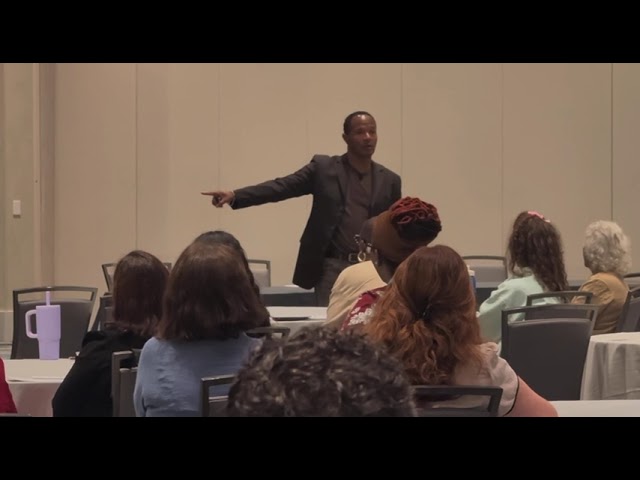
Rico Sharp- Bringing Out The Best in You- Leadership Conference. Build your 3 areas of confidence-

Part 2. Rico Sharp Bringing out The Best in You Mental Health Wellness Leadership Conference 8/27/26

Part 1- Rico Sharp Bringing out the best in you Mental Health Wellness Leadership Conference 8/27/26

Rico Sharp- My Brother’s last words to me before he died- Don’t let life kill you. Leadership Event.

Rico Sharp - Keynote: Bringing Out The Best in You. Leadership Conference. 8/27/26

Rico Sharp- Bringing Out The Best in Mental Health Wellness Leaders Conference

I’m on my way to Bring Out The Best In Mental Health Workers for Florida Behavior Health Conference.