Rob Henderson: How luxury beliefs took over the elite
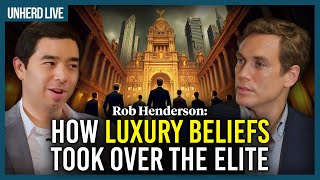
Rob Henderson, a former military officer turned Yale student, explains how wealthy elites adopt beliefs that signal virtue but harm the poor. He traces his theory of luxury beliefs through campus politics, family stability, and why the privileged can afford ideologies that disadvantage everyone else.
I got out of the military in August of 2015 and started classes, I think like two weeks later in September. And it was just like a very rapid transition, you know, so, so at first, for the first few weeks I, I was trying to come in with an open mind and I was really impressed with the students, just how quickly they were able to absorb and synthesize information. And like a lot of those students, they've been training their whole lives to go to a school like that. And so they were just very good at sort of reading and sort of scanning a syllabus, determining how to prioritize and which classes and so on. And so I picked up a lot of sort of useful study tips because I was a really bad student in high school. I barely passed. I mean I graduated like kind of a C minus average, like just barely scraped by. Part of that was self inflicted. Like I could have tried harder, but I just didn't. And so my study habits were already bad. But then I was rusty from just being out of school for so long. And so that was challenging to sort of keep up just academically. And then once I sort of got the hang of it, things went fine. But then I was unprepared too for the kind of, I guess like the campus politics, the, you know, the identity politics, social justice scene. I mean, this was 2015 and it wasn't quite the birth of what people now call wokeness, but it was kind of the birth of when it spilled out of the universities. Like I remember, you know, there was this big blow up on campus where these, you know, these professors had a dispute with the administration and this kind of debate about academic freedom turned into students calling these professors racist. But then, I mean, it was also interesting because they said, okay, well it wasn't really like actually racist, but it's sort of emblematic of racism on campus and actually it's emblematic of broader patterns of racism in society. And they were sort of using this isolated moment to champion the list of demands, get these professors fired and implement their preferred guidelines. And so I was watching all of this and they were saying that these professors, these professors had written some emails. Essentially the whole debate was about Halloween costumes and how that sounds ridiculous saying it out loud, but the administrators told the students, don't culturally appropriate, whatever, I don't know, they didn't want white girls dressing up like Pocahontas or something. And so one of these professors wrote an email to her college saying, you're all adults. Do we really need the administration interfering? And the students Were like, oh, this is not all of them, but many of them. There were hundreds of student protestors marching around campus saying, this was very offensive. And I'm watching all of this, and I'm just completely mystified. These students were saying that this email had caused them harm. It made them feel unsafe, that they didn't feel welcome on campus. And these were like the sons and daughters of millionaires saying that they had felt unsafe and that they were, you know, that these professors, they didn't want to, like, sleep in the same residential college if the professors were around. At one point, the students in Silliman College, the residential college at Yale, didn't want, you know, if the professors walked in to the college, they wanted them to announce their presence, you know, as like a kind of trigger warning, because they didn't want, you know, because they didn't want to be in the same room with them. So all this was happening, and then, you know, alongside this, I was having these strange interactions with these students.
Do they not even call you privileged in this?
There was. Yeah. Well, I would ask people because it was, you know, I was so unfamiliar with this environment that I didn't even, like, because there were students who disagreed, but they knew kind of what the. Like, the contours of the debate and what it was about. They could create, like, sort of sophisticated arguments for both sides, whereas I just had no idea. And so I would just ask students, like, why is this offensive? And they would say, like, there was. Yeah, there was one student. I tell the story about how she said I was too privileged to understand the pain these professors caused.
At that point, are you, like, fighting back? Are you saying I'm not privileged at all? Do you start telling your story? You just stay quiet.
I held my tongue because, well, first, I was so shocked that she said it. But then second, I didn't want to use my. I didn't want to use this as my identity and my experiences as, you know, I didn't want to exploit it and, like, berate people with it. I wanted to know what people thought. And so if. And, you know, I kind of understand now the logic that went through her mind when she said that was something like, okay, you're a. Whatever. You're a cisgender, mixed race, you know, whatever, male, you know, and she was making assumptions based on my identity. And if that's what students wanted to do, I thought, okay, let's go with this, and maybe they'll speak more freely in my presence, and I can really understand what they believe. And yeah, it was useful, actually, because I learned a lot more than I think I otherwise would have. If they knew that they were like. I tell this other story in the book about how I was talking to this young Asian woman. She was a student. She was telling me about how her parents were like tiger mom, and that they always expected her to go to this kind of college. And she said something like, I'm sure. You know what I mean, though, I'm sure you had the kind of. And I said, not really. My mom's Korean, but I didn't really have that experience. And then she said, oh, so you didn't have a traumatic childhood? And I'm like, yeah, they're making these assumptions. And so then I realized, like, oh, in her mind, you know, having an overbearing mother who makes you do homework, that's trauma to them. And yeah, that's kind of the opposite of what I had. Extreme neglect and no one monitoring whether I was doing schoolwork. And so these were kind of these early experiences. In addition, I was reading a lot. I mean, I was working in a psychology lab, I was taking a lot of classes and I would go to office hours. Like I was trying to, you know, capitalize on this experience as much as I could. And that's when the luxury beliefs idea started to take shape.
So when you came into contact with that, you know, this is someone who's lived pretty much five lifetimes compared to some of these college kids you'd have been coming into contact with, do you get the sense that it's just, well meaning, kind of ignorant, mistaken desire to be virtuous and righteous, or do you think it's cynical?
You know, like, like anything with sort of broad social patterns. It's a mix, I would say maybe 10 to 20% of the elite college students and graduates are cynical and sort of intentionally exploiting people's sympathies and compassion to advance their own interests. Like knowingly doing this? I think the other 80%, most of them have good intentions. I don't think they sort of reflect and interrogate their own beliefs enough to understand, like how, you know, how much of a coincidence it is that your compassion just happens to coincide with your social and professional interest. Isn't that interesting? But I think like in their own mind, they're doing the right thing. They've convinced, you know, people are very good at sort of self deception and finding ways to do the intellectual acrobatics to believe they're doing the right thing. And so, you know, and then that gives me Hope that most of the people aren't kind of duplicitous sociopaths. A lot of them are, but not all of them.
But the theory is still that it's somehow a kind of status symbol.
Right.
That because so many of that group are, to various degrees, privileged, they have to find these new factors to differentiate themselves and they. So they kind of seek a virtue signaling as a way to distinguish themselves. Is that fair?
Yeah, yeah, I think that's. I mean, it doesn't have to necessarily be about virtue. There are luxury beliefs that aren't about, you know, your moral character, your virtue, but they still elevate your status and still often have downstream consequences for less fortunate people. But that is the sort of the drive for distinction, this desire to separate oneself from the masses. I mean, I cite, you know, different sociologists and thinkers in the book towards the end when I'm sort of describing this idea and providing them, you know, the citations and everything. So Pierre Bourdieu talked a lot about cultural capital and his. He titled his book Distinction. He was a French sociologist in the 20th century, about how the elites of his time would signify their elevated status through, you know, intricate and arcane knowledge about wine or art or history or geography, furniture, exotic, you know, travel. And people still do that, but it's, I think, less frequent today. And cultural capital has more and more sort of manifested itself in these sort of newfangled and obscure beliefs. There was a great book written a couple of years ago by Michael Knox Baron. He wrote this book called wasps, the White Anglo Saxon Protestants, the Ruling class in the US from roughly the mid 19th to the mid 20th century. And he has this line in there about how the high wasps, the top of the top, that they would often support fashionable movements and ideologies because it would irritate the Bulgarians that they actually experienced a bit of joy at the thought that they were supporting these ideas that would abhor and upset ordinary people because it would distinguish themselves. If they supported it, then clearly they weren't one of the masses.
And what you say is that actually it has real world consequences downstream. They're not just silly campus ideas. It actually means that resources preferred treatment. Special attention goes to groups that don't necessarily need it, or people who have actually been struggling are ignored or demonized. Yeah, yeah, that's it. That feels like a very significant claim because it means that even if they're trying to do good in the world, they're actually doing net harm.
Yeah, and I don't. Yeah, again, I don't think that the harm is the intent. But, you know, I do look at things in terms of outcomes, that if the outcome of this belief, of this idea is that your status is elevated and then there are downstream negative external consequences for others, that regardless of whether you meant it or not, like the outcome is the same. And it's still something we should be focusing on. And you should, I think if you're, you know, a current or aspiring or future member of the elite, that you have a duty to actually think about the ideas you're broadcasting and the things that you're supporting and things that you believe in. I mean, one that I focus on in the book that I don't think I've written about anywhere else is this idea of sometimes they call it trickle down meritocracy, sometimes they call it trickle down diversity, which is this belief that especially in sort of elite spaces, that they talk a lot about equity. And my impression is that their view of equity is as long as the 1% demographically reflects society as a whole, then we've achieved equity. So as long as the ruling class is 50% women and x percent LGBT and x percent Asian and Hispanic and so on, then somehow we've achieved an equitable society. But when I think about, I'm not thinking about the elite. I'm not thinking about who the next president of Harvard is for, whether we've achieved equity. I'm thinking about actual marginalized, low income, dispossessed communities and whether they care whether the next president of Yale is, you know, a trans person or a woman of color or something like. They don't. I don't think they care. I think like, you know, but, but the belief seems to be something like, and I use this term, trickle down. It seems to be analogous to trickle down economics that somehow if we can put these historically marginalized groups in these seats of power, that somehow those benefits will magically trickle down to these communities. And I actually don't understand how that mechanism is supposed to work. Like, where does that occur? Because inequality has actually been widening in society. A lot of these communities haven't been improving. A lot of the sort of markers for human flourishing and well being have been stagnant or declining over time. How nice for me that I was a former foster kid and I went to this expensive university. But how does I think in their mind, they're like, well, if we put a foster kid here, then the other foster. I don't actually see that.
Yeah, the contrast with your earlier story where, you know, we're Reading about your childhood, your teenage years, and you're in one of the poorer towns in Northern California. I'm not even sure I can remember if people are black or white. In of the characters you talk about, there doesn't seem to be much interest in race. Your mum, when your adoptive mum, when she divorces your father, becomes a lesbian or out comes out as a lesbian. And then you have two mums for a period before they also eventually spit up. But again, it's, it's, it's told very practically, not with that sort of obsessive focus on gender and race.
Yeah, it wasn't, it wasn't that big of a deal. I mean, I do, you know, I used like the language of that time. So there was like a bit of casual homophobia, you know, a little bit of casual racism. Like it existed, but it wasn't, you know, it wasn't, it wasn't violent and people weren't as preoccupied with it. I mean, weirdly, I think like casual homophobia and racism and all these things, sexism, I think it exists in elite spaces, but it just sort of takes on this form of compassion of like this heightened salience of now we have to be hyper aware of everyone's race and skin color and sexual orientation all the time. That's the number one thing about their identity. And you have to sort of tiptoe around it and acknowledge it and pay fealty to it. Whereas where I grew up, it was like, you know, people, people weren't blind. They could see there were differences in everything. But it wasn't, it wasn't this all pervasive thing. It was more just like, I don't know, we're all kind of poor, our families all look the same. Like life is just kind of drudgery and we're all just trying to get by day to day. So yeah, the town. So like the foster homes I lived in, they were probably more diverse overall. Know, black, Hispanic kids, white kids, There was a couple Asian kids. But in Red Bluff it was like majority white working class. But there was a large Hispanic, you know, community there too. So my high school was probably 60% white and then maybe 30 something percent Hispanic. But we had some black and Asian kids too. But it wasn't. Yeah, like these, these features of identity were not. Yeah, not nearly to the same extent as when I got to Yale. And suddenly people are like, you know, like they're, they're like trying to like, ask me about my identity and like, like Asian people would ask me about. I'm like, it's just like I didn't feel like attached to it the way that a lot of other people felt it in, in more elite spaces.
Give us what the top luxury beliefs are, practically speaking, you, you talk in a little bit in the book about stability and marriage and family formation being something obviously that you experienced very directly and that it's a sort of luxury belief not to think that matters, whilst in fact you think it does. Is that the number one for you or where should we start?
I mean, that's, that's the one I've probably spoken about and written about the most. Yeah, there is this kind of disconnect between the families of educated and affluent people and how they actually don't look that different than they have in decades past. That family stability has more or less been the same, but for poor and working class communities, they've just completely deteriorated and fragmented. And so almost every single one of my friends that I've met since university have been raised by two parents. And then where I grew up in Red Bluff, none of them zero. And that's sort of reflective of the patterns in the US and I think in the UK too. I mean, what's really interesting is if you sort of trace this, Starting in the 1960s, 95% of kids born in the US were raised by both of their birth parents, regardless of social class. Then starting in the 60s, you know, they did introduce more and more sort of newfangled ideas around marriage being outdated and, or promoting open marriages or single parenthood. And, you know, this kind of in the wake of the sexual revolution, by the 1970s, divorce and single parenthood had spiked kind of across the board. And even for kind of upper class families, single parenthood and divorce and these kinds of things were on the rise as well. But by the 1980s, they had reverted back to their original figure. And the kind of stylized fact I think here is something like the upper class, they kind of, you know, they, they got high on their own supply and they were like, you know, let's actually try this kind of new age, new way of life. And then they kind of realized that, oh, actually this isn't so great for my kids and for my family and for, you know, the kind of life I want to live. You know, maybe it's fun, but it's not the optimal way to live. And so they kind of returned back to those sort of conventional bourgeois lifestyles and the lower classes marched in lockstep and single parenthood and divorce and all those things increased for them and they just Never returned. They just sort of continued to fragment and never recovered and like, continued to sort of get worse and worse. But yeah, there, I mean, there are other luxury beliefs that I, that I speak about in the book as well. I mean, one is the promotion of. And this is, I think this is maybe less. Some people accuse me that, you know, of saying luxury beliefs. They say that luxury beliefs are this Trojan horse to attack the political left or something. And I don't, I don't think it is. It's much more about class. And so one other example I highlight in the book is how tech executives and entrepreneurs will promote addictive technologies to the public and profit from this. And then at home, they have very strict rules about screen use. Steve Jobs famously wouldn't let his children use iPads. There was a, an op ed in the New York Times written a little over a year ago, and the headline was something like, you know, I make video games, but I won't let my daughters play them. And he, like, very, he was very honest. I mean, it was very blunt op ed where he was like, we want you to be addicted to the games because, like, like that's how we make money. Like, it's not that hard to understand, to connect the dots. But then he's like, you know, talking about how he's worried that, you know, his daughters would get addicted to it, and so he doesn't let them play. But I cited this study recently indicating that children raised in families that earn $35,000 or less per year spend two hours more per day on screens than children raised in families that earn $100,000 or more per year. So essentially, kids in poor families spend two hours more per day in front of a screen than kids from rich families. And a lot of that has to do. I think, interestingly, that is connected to the family issue, where if you are a single parent and you work all day and your attention and resources are spread very thin, and then you get home and your kid is disruptive or rowdy or something, it's just so much easier to just give them an iPhone or an iPad and just say, hey, go chill out. And they can be distracted and kind of, you know, soothe for a while while you can, you know, kind of have some peace and quiet. But if you have two parents, you know, you can, you can actually monitor a disruptive kid and find more constructive and engaging ways to take up their time.
Taken together, you're, you're advocating stability, families, harsh drug regulations, less screens. These all sound quite conservative principles. Do you now Think of yourself as a conservative.
So it, I think it depends on the context. You know, I, I think now, you know, if you, if you even question like identity politics, you just get sort of categorized as conservative.
What's your most left wing belief?
My most left wing. I mean, I'm not opposed to financial assistance. Like, I'm like nowhere in the book do I, you know, like some, some people inevitably make the parallels with J.D. vance's book. And in his book he does talk about the frustration that people in working class communities feel when they go into work every day and then they see their neighbor who's unemployed, you know, able bodied person, receive government handouts. I'm like, you know, I just don't think that's, you know, economics is a piece of the issue, but I don't think it's the whole story. I think culture and habits and mindset and families, those things are more important. So, yeah, I mean I'm not, yeah, I'm not opposed to like a welfare state.
So you've had this incredible journey from one very, very different environment to you're now a celebrated writer going around universities, places like this. Where do you feel you belong now, which you believe in classes and are you now a member of a different one?
To the earlier point about am I conservative? So I didn't, I didn't grow up thinking about politics. You know, that's, that's another point I make in the book. This sort of sociological difference is that politics is not as much of a dinner table discussion among low income families. You know, they, they don't watch cable news, they're not sort of keeping up with current events quite as much for a variety of reasons. And so I didn't think about it. And then, you know, I was in the military, you know, like, like my mom and her partner, they were working class Democrats and I kind of just through osmosis absorbed some of their views. And maybe that has something to do with my stance on, on government benefits. You know, it wasn't until I got to Yale that people started to think of me as a conservative, even though my views were kind of, I thought they were moderate or centrist. And I think compared to the, maybe the median voter in the states, I would probably be either like sort of right where they are, or maybe even slightly to the left in some ways. Whereas at an elite campus, I'm, I am to the right of them. Just, it's just a fact. I mean, I, you know, I've written about this in various places that elites on, on Average tend to hold sort of more kind of left wing views on, especially on social issues than ordinary people. And so where do I stand? I mean, it depends. Again, this is sort of a classic view in sociological theories of class that especially in the U.S. but I think it holds true here too, that you are the class you're born into and that it's ultimately very hard to fully transcend it. Pierre Bourdieu, he writes about the triadic structure. You have to have sort of schooling and habits and income. You have to have these different ingredients all in place. And, you know, one way to think about this is, you know, if I don't know, some, some, you know, menial laborer wins the lottery. Like, are they a member of the elite now? I mean, I don't think anyone would think that.
I've got to ask, how do, how do all of these issues compare over here compared to the U.S. do you think, do you find kind of college campus politics less bad? Worse?
I think it's less bad. I mean, it's funny. One of the reasons why I came here to study was because I thought, I mean, I'd seen a lot of surprising events occur at Yale. I mean, with the bands, the professors, the. I mean, it wasn't just there too, but I had friends at other universities by this point. I talk about this friend that I had who I helped get into Brown, and he was shocked when he got on campus and on Veterans Day they were burning American flags and like, man, these, like, it was just a very, you know, it was like, you know, the, the wokeness was spilling out. Trump had just been elected. Things were just very chaotic. And so I thought, oh, you know, I just had this image of like, I don't know, like, you know, these kind of stodgy Oxbridge dons who didn't have time for this kind of nonsense. And turns out they do have time for it. Not quite. To the same extent you and I talked about this before, that they're, you know, like, if Yale is a nine or a 10 out of 10 Cambridge, it's probably like an eight or an eight and a half. I mean, it's not quite. But then I get, yeah, I get here. I got here late 2018, started my Ph.D. and then by 2019, famously, Jordan Peterson was invited and then disinvited. And then, yeah, Noah Carl got fired. He was a postdoc who was maligned and treated very unfairly. And there were like other sort of behind the scenes. Like even to this day, I know stories of what's happening at the university. I still live in Cambridge, so I still hear sort of what's happening. Yeah. I mean, for every public cancellation we learn of, there's probably at least five behind the scenes that we don't know about. Yeah, it's not as bad, but still pretty bad. Sat.