The Value of Product Marketing with Rory Woodbridge
A recorded interview between Andrew and Rory Woodbridge (product marketing expert) exploring the role, responsibilities, and value of product marketing. Rory frames product marketing into four responsibility areas (commercial insights, messaging & positioning, launches/adoption, and enablement), describes it as the bridge between commercial and product/engineering teams, explains how PMMs build trust with product teams through insights, warns companies often hire PMMs too late (commonly when they reach ~30–100+ employees), and offers three core takeaways: PMM as the bridge, two core questions (customer pain and unique solution), and the need for a balanced PMM–product partnership.
Chapters
Today I'm joined by Rory Woodbridge. Rory is a product marketing expert. His early career was formed with Google and YouTube and his last in house role was with Hypergrowth Fintech Pleo. Rory recently made the decision to move into the freelance world where he provides expertise as an interim leader in product marketing. He's very passionate about his work and has a great substack that, that has tons of articles and thought pieces, so you should definitely check it out and subscribe. When he's not working or writing articles for his substack, Rory is doing more writing as he also writes fiction and has got his first novel in the works in his spare time. He loves going to rock and indie gigs, but he's also a secret swifty. Aren't we all? I think a little bit at this point and I think Antihero is one of the greatest pop songs ever written. He also loves comedy and he's heading up to the Edinburgh Fringe Festival this summer. Our discussion today will center around the value of product marketing and what it brings to the table. And Rory will give us an overview on why it's a critical element to successful products. Rory, welcome to the show today.
How are you doing?
Well, thanks.
How are you doing?
Yep, I'm very good, thank you. So we're going to dive straight into things. So do you just want to give a quick overview on from your point of view actually, what is product marketing?
Sure. So I think there's a few things that product marketing gets responsibility for and I'll go through those and then I can go like go through what it ends up being as a result. And so I tend to sort of put it into four groups. There's commercial insights, so competitive intelligence and landscape, maybe win loss analysis, maybe market research around customer demand and so on. And then two, you've got messaging and positioning, both at the company, the product level or for any feature. Three, I guess the stuff that product marketing is best known and famous for, which is kind of launches and driving product adoption. And then fourth, enablement, like primarily sales enablement, but can often extend to customer success enablement, SDR enablement, or even sort of marketing or product team enablement, depending on what a business needs. And so in kind of the pursuit of doing those four things and there's a lot of work streams going on under all of those buckets, you end up being the bridge in the company between the commercial half of the business and the product tech minor business. So it's not just the bridge between product and marketing, it's the bridge between Product engineering, design, user research and everything commercial. So marketing, sales, customer success, even like revenue ops and sales. So if you're a product marketing team doing your job well, you are kind of like the oil in the cogs, making the whole company machine run smoothly across those two large organizations.
Yeah. Cool. And I think probably a lot of people have got different opinions, perhaps what isn't product marketing and what have you seen in your experience where it's perhaps not worked as well? Yeah, of course.
And I mean, it's evolved a lot. I'd say, like, sort of product marketing has maybe existed for about 20 years. I think it's kind of in its current form, existed maybe 10, and has really risen in popularity in the last five. So there's some evolution there. I think in general, it's gotten much more strategic, has a seat at the table more so. But I think there's still like a legacy of it not being done as I'd see it. And so I'd say, like, one extreme example is where like product. Org might still see it just as the mouthpiece for a product team. You know, we've just shipped this, launch it tomorrow. Like. Well, I said send the email, that sort of thing. I think sometimes it is just like conflated with like broader marketing as well. And suddenly you end up seeing product marketers. You know, I don't know. I've had product tell me they like, they're working on performance and paid, paid media marketing or, you know, sort of deteriorating into like a CRM role, which is kind of a very different. Different kind of role. So I think it's being careful about not that. And then at the same time, you never want to be too prescriptive to a, like a product team or product or I mean, in general, you don't want any team sort of prescribing another team's work. So I think it's about balance and then it's about. Yeah, being a partner of the teams you work with and having great relationships.
Yeah, cool. And I think moving on to those relationships. And I guess the. One of the critical elements to the role is obviously bridging and managing those relationships between different teams, but I guess particularly the kind of core product teams and then engineering as well. And how have you found that you've been able to do that successfully?
Yeah, I mean, I mean, really, it just takes time, I think, like.
Because.
You'Re building trust, you're building like a strong relationship. And so for me, where product marketing is being at its most effective, it's when I and the team have had a really good, healthy relationship with the product team. I think a good way of starting a relationship like that is bringing is that first part of what we do, the insights part. Because if you take like a product manager, typically a very busy person, they're running a team, very executional focus, they're focused on shipping and got a million stakeholders. And so having time and space for another input, like a product marketer coming in saying, okay, have you thought about this and have we assessed whether what we're building is actually going to solve a problem, the right problem? I think it tends to be things. If a product marketer can bring insights to the party, I think it really starts something. And then you as the pmm, start becoming a trusted member of the squad that people want to come to. And that's a great way of kicking things off. And then, yeah, just continue to bring, I guess, balance to the partnership and making sure it's a two way thing.
Yeah. And I guess part of that then becomes the trust in what each other's doing as well. And I guess that's absolutely critical, 100%.
And so, you know, it's why I think spending as much time as you can together, especially in person time always helps speed up those things for those who can.
Yeah. And I think if we think about some of the people that are going to be listening to this podcast today, there are people in different types of businesses, particular scales of organization. And I think there's probably a feeling, and certainly when I look at this, that the stage of an evolution that a business is at would actually determine whether they could have somebody in a defined product marketing role. Do you think that's a fair comment or do you think there should maybe be a little bit more focus on it?
Well, I think definitely something I noticed is that most companies end up hiring their first product marketer way too late. And from speaking with companies about why that is and how they've got themselves into that situation, because when I speak to them, they tend to be in a state where they need a product marketer yesterday. They've left it so late, they're like, we've got so much for this person to do. And then you're talking to them about kind of like their journey and you realize that a lot of founders are the original product marketer for a company there. You know, it's really in. It's just two, three people around the table and that's close to 10 or whatever. It's these founders that tend to be speaking to Customers would you use this product, pushing for it to get to an mvp, but then also ending up probably doing the messaging on the website, maybe even doing the first sales calls.
Right.
And so that ends up in that first couple of phases of a company's growth journey. The founders doing a lot of what a product marketer would be bringing value on. And then at some point, you know, it stops scaling. You get to maybe like somewhere between 30 and 50 employees and suddenly the founder can't have influence over everyone in the company. On kind of, okay, these are the messages. This is the USPs. This is why we exist. This is what our ideal customer profile looks like. They know that deep down inside. It's just you can't, you know, police that company wise. Why you need a product marketer. But I think it's quite hard having the awareness internally to, to spot that and then hire at that point. And so most companies, you know, a lot of companies, I mean, are getting to like past 100 and still not having their first product marketer and then getting themselves a real pickle because there's no one owning it and there's a vacuum where all that, all those skills are missing.
Yeah. Cool. And I think this, the role of product marketing, I guess is quite uniquely placed to solve some of these problems because you're obviously coming at this from a different angle. Regular product person.
Yeah, well, I think a product marketer needs to be able to think and speak like a product person and then also think and speak like a commercial person. You're the product person in the room with the commercial teams. Maybe giving context to sales teams about why a feature or product is being built the way it is or why something's maybe going to take a bit longer where something's not being built. And then like vice versa, you're there to represent the needs of the commercial teams in product. Or like this product isn't landing, this message isn't landing. The product team's vision might not be actually matching up with what customers are telling us on the ground. And so on and like, and so some hard truths sometimes. And then in both cases you're really there to be the voice of the customer. Many teams are the voice of the customer. Product marketing definitely needs to play that role and be really grounding everyone in the. This is what our customers are telling us. This is the value they're getting from our products. These are the problems we're solving and these are the pains that they're still feeling. And everyone wants to hear more about that. In a healthy, healthy business. But I think being able to switch like hats and play those different roles, I think is key to being a pmm.
Yeah. Yeah. Cool. Well, we've taken a really quick whistle stop tour through product marketing there. So as we kind of bring the conversation to a close today, what would you say the key three takeaways you think people should take?
I guess like. Yeah. One is that first point around, like, what is it? And it's. Yeah, remembering it's the bridge. It's there to sort of bridge the gap between the commercial half of a business and the product minded half and to align their strategies and align everyone on the value prop and to just kind of like, yeah, like I said, oil the machine. I think two, as I think more and more, I think it's more pronounced as I get into the consulting and freelancing space. I think product marketing can be boiled down to two simple questions. And I've written about this on my substack recently. Two simple questions. One, what is the pain or problem that your business is solving for your customers? And then two, how are you, your business uniquely placed to solve it for them compared to all alternatives, including using nothing? The hard bit is then like all the work and influencing and relationship building you need to do in answering those questions and actually like getting consensus on them. So that'd be my second point. And then three is. Yeah, around that relationship between the product marketer and the product manager, around the need for it to be a true partnership of balance when neither side is dominant and both working together and putting the customer above all else.
Yeah, absolutely. Cool. Well, thank you very much for your time today. It's been a great conversation, nice and informative about how, I guess product marketing can benefit companies and obviously how you operate as well. So thank you very much.
No, at all. Thanks for having me. Andrew, you.
Thanks.
More from Rory
Selling A Story Not Features With Rory Woodbridge Senior Director of Product Marketing @ Pleo
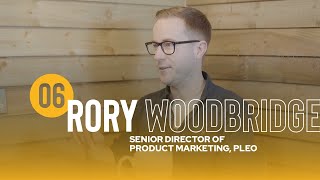
Spotlight On #6 - Rory Woodbridge, Senior Director of Product Marketing at Pleo