Adobe Animate Tutorial & Making Of
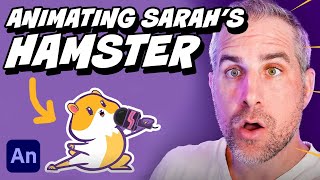
Ryan Maloney animates a hamster in Adobe Animate for a song by Sarah. He discovers the reference design is a stock image, hits a creative wall he calls the Valley of Despair, and rebuilds it. The video walks through his technical process: symbols, keyframes, in-betweens, and hand-drawn mouth poses for lip-sync.
Chapters
You may have heard this song. <LYRICS>Please stop watching me, the name makes you say gee.</LYRICS> That song about a genie and a hamster, in parentheses. My daughter's obsessed with Sarah's Songs. Sarah texted me and was looking for an animation for a hamster. I thought I would turn on the camera and record my entire process from getting that message to delivering this final animation. Notice there is no final animation in this scene right here because I don't know what I'm going to do for it. Throughout this process, I'm probably going to fail a lot, mess up a lot. I want you to see the ins and outs of what goes into making an animation, but but also the creative process and the back and forth process to make things that are cool and that an audience connects with. So let's dive in. Every project starts with an idea, and I have an entire system to come up with ideas. But for this, I didn't do my due diligence, and I thought the hamster design was original. I should have asked more questions about this, but I dove in and started sketching the animation poses. But then we've got a problem. The hamster in the Spotify artwork is a stock image. That changes up the game plan. I am going to use a little bit of the style, but I'm gonna have to redesign in my style. Did you hear what I just said? In my style. Whenever you start a new project, there's a sense of excitement. This is when you are super pumped up for your idea. It is gonna be the best thing ever. You tell everyone about it, you talk about it. At that point, Mr. Unrealistic takes over. I'm the artist, I know what to do. It's nothing, trust me. I got this. Sit back and relax. Water spill. And that's when it all goes downhill. Right when you think you have all the answers. This is the shape of all progress. Creativity, growth. And this is the Valley of Despair. It's also called the dark night of the soul, the belly of the whale, the abyss, the pit, the crisis, the struggle, the obstacle, the climax's downward spiral, all is lost moment, the breaking point, the descent, and the resistance. Bad news: this happens every single time you want to get something done or grow. The good news is this is just resistance. Imagine if you wanted to bench 350 pounds. You wouldn't put 350 pounds on the bench and just try to do it right away. You'd build up to it using resistance to get stronger. Even while you're sliding into the belly of the whale, you still think you can avoid this valley of despair. I was still clinging on to this drawing that I had. I thought it was perfect, so I sent it off to Sarah and I waited. And then— Hmm, I don't love it for this song. There's nothing worse than when you think you've got the character, it doesn't connect on the other end. Ouch. Side note, you can tell it's pretty easy to work with Sarah, but even though Sarah's professional and great to work with, I still find myself at the bottom of the valley of despair. Now, it's at the bottom of the Valley of Despair that you have two choices. You can quit, go home, tell Sarah, "Yeah, not my style, project." Or you can let go of your ego, drop all of your baggage, and start climbing the mountain. You know in a movie how the character usually meets some sort of guide that helps them through the Valley of Despair? Well, Sarah kind of played that part in this role. And she sent me this text and this style, and I thought, "Yeah, that's the right style. That looks good. I can work with that." You know, maybe I can take that style and put my own twist on it, and it can be an original style, but using that as the base. And that was the beginning of my climb out of the valley of despair to try to figure out this animation. Lost the button to my pen. Gotta work through these things. No button, gotta find a button. Don't have a button, we make a button. How am I gonna right-click this? Since I had a good idea of what I was gonna do for the drawing, I went off on a side mission and created some rough keyframes in an animation to send to Sarah to get the timing down. The first time I listened to the song, I immediately had a vision for how this hamster would move, so the keyframes Keyframes came very easy to me, so I exported out a video and texted it to Sarah. I got the thumbs up pretty quickly, and I felt good that this was my final push to do the final animation, also the thing that I dragged my feet on the most. I always have this voice in the back of my head that says my animation is not as great as other animators, but I've had this voice forever. It was around when I made the Owl City video, Fancy and Ariana video, the SoMo video. It's around for every single one of my projects. I'm pretty sure this is the weight that you put on the bars. This is also the resistance. That internal voice telling you, "Eh, yeah, people are gonna say it's not really that good," that's what I use to push through and to make myself better. I'm gonna design the character at the same time that I'm starting to do the final animation. So I'm gonna design all the body parts in Adobe Animate, turning them into graphic symbols and nesting them. And I don't want to confuse you too much here, just know that everything you design in Adobe Animate, you'll usually turn it into a graphic. Got my rough key poses down, and then I start moving the graphics into place. Then I'll start doing the in-betweens, the anticipations, meaning before an object moves, there's usually a movement. The overshoots, which means after an object hits a pose, there's an overshoot to it, a little bit of extra movement, and then it settles back down. Eye blinks are just nested graphics. The same principle goes with the mouth. The mouth is a nested graphic. I have this shell of a mouth here, and then when I double-click inside, I can see my 10 or 12 mouth poses here. Now I can auto lip sync this to the music, that only gets me about 60% of the way. I usually need to go in and correct many of the keyframes for the mouth. When you build a nested mouth, it's not that flexible. So I like to lip sync the mouth to the music using most of these set poses, but then there's times where the character really needs to emote, where I'm going to hand draw that mouth and open it up really wide. Final push. This final animation process, this is my battle to win. Monday, Tuesday, Wednesday, Thursday, Friday. I spent day after day on this to try to get it right. The next thing I share with Sarah, I want it to be as close to perfect as possible. When I first heard this song, I thought that it would be hilarious if the hamster went from running on the treadmill to kind of this head-bobbing walk at the end of the video with a ton of confidence. In that, there's a little bit of an arc from low confidence to high confidence. Now that I think about it, the theme that I'm trying to convey in the video is what I've actually learned through this process. Funny how creating works that way. I'm getting close to the end of animation, and I've worked this pretty much as well as I could within this period of time. And at some point, the game has to end. I could rework this forever and ever and never be fully happy with it. What I've learned in 40 years of creating, that, that feeling of "I can do better" is always going to be there. That voice telling you it's not going to be good enough, or somebody's going to leave a bad comment, it's always going to be in your head. That's what you use to be a better and stronger creator. If you have that voice in your head, welcome to the club. Now tell it to pipe down and go make something.
More from Ryan
Drawing Mr. Beast into a Beastly Baller trading card #art #drawing #tradingcards card
The first draft of my graphic novel #art #procreate #originacharacter #graphicnovel #drawing