Drawing a Picture Book Page in Procreate
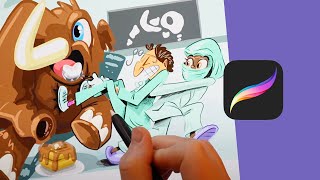
Ryan Maloney walks through illustrating a picture-book page in Procreate, moving from rough sketch to flat colors to shadows and a textured ink line. He works fast in 45-60 minute sessions, favoring done over perfect, and uses the ink-bleed brush for strong edges. The page is from his upcoming book "Waffle, Wisconsin," featuring a woolly mammoth with a wisdom tooth.
Chapters
For this video, let's pretend that I actually hit record when I was sketching this drawing. Thought it was rolling, but it wasn't. So we're going to start off here at this stage where you'll see in the background I have a rough sketch created with Crunchy Cow Pen, and then that layer I turned on the opacity, and now I'm going to build up flat color shapes on top of this sketch. Usually my process is sketch, ink lines, colors, shadows, highlights. For a picture book, I do it a little bit differently. I do sketch, then I build flat colors on top, and I do shadows, highlights, and then I do a rough textured ink line around the edges of the characters and wherever I feel it just needs like a harder line to move the viewer's eye around. So you're gonna see this is a little bit different than my other videos where I try to make everything really smooth. This is more about texture, energy, keeping it fun and keeping it loose. Because I find when I'm, when I'm making a picture book, if I use these really tight, smooth lines, I start to overthink them. I don't— I never feel that they're perfect enough. But when I just do flat color shapes and a rough ink line over top of it, I'm just— I'm much more free and I just let things rip. So let's get started. I'm going to walk you through how I draw this. Once the sketch is down, my goal is to lay down flat colors as fast as possible because I know how my brain works and I'll get hung up on the details and I'll constantly change colors. If you wanted to move really fast for this, you could really just go black and white. And just drop down like grayscale colors all over this on different layers and then go back in and fill those in with colors. So you don't get hung up on making the perfect colors. I like to see things a little bit more complete. I probably waste a lot of time trying to pick the perfect color as I go, but I need to feel like this is going someplace and this is going to be a final page just so the pressure is always on me and it forces me to finish this drawing so I don't get too lazy and put it on the back burner and start to tell myself, "Oh, I'll figure out the colors later." This dentist clearly needed a pink sock and maybe I should Talk about what is actually in this drawing. It'd probably be wise to give you some context. This is gonna be a page out of a book called Waffle, Wisconsin, which is a follow-up to Pancake, Pennsylvania, one of my other picture books. Yeah, looks like this. Pancake, Pennsylvania, like a rhyming picture book. I don't even have the words written out for this page. All I know is the book is gonna be alliterative and there's gonna be a lot of W words. So it's gonna be a woolly mammoth with a wisdom tooth getting pulled. And I have to go back and actually write the story I don't have it all figured out but I find creating these drawings again puts the pressure on me to move the project forward. When I see this page here, I can kind of envision what the final book is going to look like. It forces me to go back in and write out the story and figure out the next page and make the next page just as cool or a little bit cooler than this one. So, I made the x-ray in the background of the mammoth, that x-ray in the back of the room. Clearly there's no there's no bones in an elephant or a mammoth's trunk, but I thought it'd be kind of funny to just put that in the x-ray. So don't think that I think that an elephant trunk has bones, and if it does have bones, I didn't Wikipedia anything. So you can leave that in the comments that, uh, I need to do a little bit more research. Now I'm moving into some shadows and highlights, and I'm sort of breaking my process. Just to see some dimensions on these characters. I think it's best to drop in your flat colors. After you get your flat colors, drop in your shadows. Just pick a direction that would be hidden from the light and put darker color there. You could even do this with a layer above using a, like, a dark color and then turning down the opacity and setting it to darken. I like to choose a different color and just play around, and sometimes I get my drawing into a mess and sort of have to figure it out. And the process of figuring it out and having it be a little bit sloppy, but like, you know, a messed up puzzle, kind of gives it this a little bit of anxiety and energy that I like in my drawings. Like, they're— and it makes me step away from the thoughts of making things perfect. You know, I feel like when I figure out the puzzle of my drawing and figure out ways to make these color blocks work with the with the lines and the shadows and I spend time and I really go deep with these drawings, then I feel good, then I feel like they're complete. I don't really know where I'm going with that, but all I know is the trying to be perfect is going to hold you back. So, done is way better than perfect. So, I'm just throwing in colors here and getting ready to work on the lines. Here I'm experimenting with different lines. I'm actually— I'm choosing some, some of the pencils in Procreate. These are just stock pencils, and you can see they just bleed over. They're not strong enough. So I jumped over to the ink bleed, which is in the inking tab, and I could tell right away this was strong enough. It's it's almost like a smooth pen with rough edges. And you don't have to like perfectly connect this line like I would in my other art. I find if there's like a little texture, a little roughness to the line, it's cool to draw it for one part of the shape, skip part of it, and then, you know, complete it. You can see where I did that on the dentist's nose and head. That way you can create this like energy throughout the drawing. You can— a viewer's eye would get caught on the line in the upper right-hand part, but then you can move it along with some shadows and, you know, pickup in other parts of the characters with that rough line. One of my favorite parts of a drawing is after you get the color blocks, the shadows, and the highlights down, is putting in this ink line and making— and it starts to feel like it's clicking. Like there, you don't really have this set of rules you're following, but you have a little bit of a process and you're unsure throughout this entire drawing, but then it's like you get over these hills, these these bumps and you start to see the characters coming alive and you just want to push it through to the end. It's like all these peaks and valleys. I find that if I sit down for like an hour-long session and I force myself from, you know, minute 1 to minute 60 to draw, it almost always comes together. You may not love it at the end, but you have a certain sense of accomplishment at the end and you may use the drawing, you may not use the drawing, but you've learned a little bit. You've learned new techniques, you've learned new tools you like to use. Almost every single drawing session you learn something new. So, it's always worth it just sitting down doing that 1-hour drawing session. I put that Jerry Seinfeld technique to use where you sit down and you can write or you can do nothing, but you can't get up. You have to sit down and do it. I apply that to my drawing where I force myself to sit down for 45 minutes to an hour. I can do nothing or I can draw. And once I get in that mode, like my brain would rather draw once it gets over the fear of this isn't going to be good enough or I'm going to waste my time. Once it gets in that flow state, at the end of that hour, you don't want to stop drawing. It feels so good. I have a tendency to overwork my lines and overwork my shadows with the lines. When I look back at my drawings, I always think, ah, it could be a little bit cleaner, it could be more minimal, and I didn't need to put all these scraggly shadow lines. But today I was feeling that things needed to be textured and needed to be really rough. I think the mammoth works with the rough lines, and I feel like I established the style of the book because this is the first page that I'm drawing of the book. Might end up in the middle of the book or the end of the book. I may even scrap it if I rewrite the story, but gave me a lot of confidence to figure out that, all right, I'm going to do colors with this rough line on top. I don't need to make perfect lines. This is going to be a fun, free, loose book, and I'm going to knock it out as quickly as I can. Once I get the story down. So there it is, the final drawing of a page of a picture book of Waffle, Wisconsin. Not too shabby. I'm sure in a day or two I'll think I can do much better than that and redo it. But hopefully you learned a little bit here. If you have any questions about what brushes I use, drop it in the comments. And I will respond to every single one. Thanks for watching.
More from Ryan
Drawing Mr. Beast into a Beastly Baller trading card #art #drawing #tradingcards card
The first draft of my graphic novel #art #procreate #originacharacter #graphicnovel #drawing