How I Run 17 Companies in 12 Hours Per Week
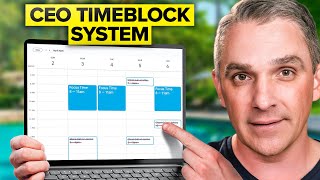
Ryan Deiss presents a YouTube walkthrough of a CEO time-blocking system that claims most effective CEOs can run businesses with about 12 focused hours per week. He shows how to create a separate "CEO blocks" calendar in Google Calendar (light blue = tentative, dark blue = locked), enforces a key rule that blocks may be moved/expanded/multiplied but must not be deleted, and outlines five weekly thematic blocks (4 hours focus, 90 minutes strategy with seven guiding questions, 2.5 hours people time, 2 hours recovery, 2 hours professional development). He also recommends practical habits (Sunday planning, turning off notifications, specifying tasks and converting tentative blocks to locked meetings) and points viewers to a follow-up on leadership meetings and scorecards.
Chapters
If you're working 50, 60, even 80 hours a week. But somehow it feels like nothing ever gets done. I have good news for you. You're not lazy. You're not disorganized. You're just stuck in reaction mode. But what if I told you that the most effective CEOs I know really only need about 12 focused hours a week to run their entire business? No, it's not a trick and it's not hype. It is a system that, that actually works in the real world. Here, let me show it to you. So what you're looking at right now is my CEO time blocking system. You see that there are dark blue boxes and there are light blue boxes. The dark blue are for the meetings that are absolutely locked in stone. And the light blue are the ones that are the time blocks that I'm blocking off, but that will ultimately need to get filled in. And we'll talk about what each of these blocks gets filled in with in just a second. But there are five thematic blocks that matter. I want to kind of get into, just quick, the technical aspects of how we, how we do this. So when I'm setting up my calendar, I'm just using Google Calendar here. If you don't have this, you'll see I've got this calendar type called CEO blocks, and I made it light blue. If you want to create your own, just go over here to other calendars and you can click the checkbox and you can say, create a calendar. And if you go in here and you put in CEO blocks or just blocks, whatever you want to call it, you can eventually give it a color and it will create this new category of calendar. Now we're going to get into where you put these in just a second. But the important thing is, is if it's a light blue box, you are claiming that time, you are claiming that space. Now freely admit that the downside to most time blocking systems is that they completely fall apart the second that real life kicks in. Now, this one doesn't, and that's because of the following rule. And these are really, really important because this is what makes it work. So be sure you pay attention. Each category block can be moved, meaning you can change the time. If something comes up, they can be expanded, meaning you can invest more time. If a focus session is going really well, you can give it more time. If you're just kind of on a roll, they can also be multiplied, meaning you can add additional blocks if you have space on your calendar. The only thing is they can't be deleted. And this rule is non negotiable. Once your calendar blocks are in place, the meetings must be completed. You can shift the times if you need to, but you can't cancel a meeting with yourself simply because it was a busy week. Let's get into what each block is and how they work. Step one of this process is to block out four hours of focus time. Now, you don't have to do all four hours in one day. You could do two two hour sessions, which is what I tend to do. The point is, this is your deep work block. This is when you do your highest leverage genius zone work that really only you can do. And if you want to do this right, you kind of need to go into full monk mode. You need to turn off notifications, shut your door, turn off apps like Slack and Gmail, and close out any unnecessary browser tabs. Then set a timer and give yourself permission to go deep. You'll be surprised at how much you can accomplish in just one, one or two focus hour blocks. Now, what's important about these blocks is you don't want to go into a focus session wondering, you know, oh, what am I going to do this session? So what I do is every Sunday I choose ahead of time, what am I going to work on during my focus blocks? And I make sure that I've got that decided. And I make sure specifically that I go over to my calendar and I change this particular meeting right here from light blue to dark blue. By scheduling an actual meeting and writing down specifically what what I'm going to do during that two hour block, it makes me accountable and it also ensures that nobody else butts in to my focus block meeting. With focus blocks in place, we can move on to step two, which is to block 90 minutes of strategy time. That's right. Once a week, you need to give yourself a chance just to zoom out. I mean, unlike your focus block, the goal of this time is not necessarily to complete a task or a project. This time is all about analyzing what's working, analyzing what's not working, spotting some trends, and just giving yourself the time and space to think about the future in the context of the present without any distractions or interruptions. Now, I like to do this Monday afternoons after our Monday leadership meeting. So all of the important metrics and all the project updates are all kind of fresh on the top of my mind. I also like to do them before I do my focus blocks because very often what I wind up working on in my focus blocks is informed by this strategy block. It can be a little bit challenging at first to know exactly how to get the most out of this time. So what I want to do now is give you seven questions that you can ask yourself during this strategy time. I don't expect you to ask all seven, but if you have this list and you pick two or three, I promise it's going to be really valuable time. So let's go through them one at a time. Question number one is, what is the one big thing that, if accomplished, would have the most significant impact on my business and render the need for any other seemingly important projects unnecessary? Just to give credit where credit is due, this question was inspired by one of my favorite business books of all time, the one thing. Question number two. What are our ideal prospects? The one who already know about us, the ones who already like us, they already know about our product. Why are these people not buying from us? Is it an offer issue? Is it a messaging issue? Is it a brand issue? Think about the question and ponder it. Question number three. In what areas of the business could we double our intensity? What about 10x? Again, maybe you don't know right now, but if you ask the question, if in the context of the answers, you may come up with some areas and some opportunities to increase the intensity. Question number four. What are three things I haven't started because maybe I'm pursuing perfection? And what are a few steps that I could take today or maybe during one of my focus blocks to get the process started? Question number five. If I was competing against myself, what chinks in the armor would I exploit? How would I go after me if I were them? Question number six. Is our strategy not working because the strategy is bad, or is it not working because we're just incapable of executing this strategy due to constraints we really can't solve at this time? This is a good question to ask because it forces you to think about the strategy, but it also forces you to balance that with the execution. And then question number seven. Knowing what I know now, if I could start all over again, what changes would I make to my business model and what's preventing me from maybe making those changes today? So decide the questions that you're gonna ask ahead of time and treat it like the important meeting with yourself that it is. Step three, block two and a half hours of people time every week. Now, again, the two and a half hours don't have to be all at the same time. You might do an hour one day, an hour another day, and 30 minutes another day. But you do need to block off intentional time with the people that matter the most in your business. And I'll acknowledge this, I talk a lot about systems and processes and all the things that aren't people. But it's important to remember that leadership happens in conversations, not spreadsheets and dashboards. I would encourage you, out of the two and a half hours, maybe block two hours off for your internal team. But you should spend at least 30 minutes each week sending emails to text messages, even go crazy and make the occasional phone call to industry peers, to mentors, and to strategic partners. Because I'll tell you, it's amazing how often a simple hey, what's new? Hey, how's business? Winds up unlocking a massive opportunity for you and for your company. Step 4 Block 2 hours of recovery Time Now I admit it, this one feels kind of soft. But trust me, it is not. You have got to recharge. Whether it's a massage, a walk, a light exercise, a hobby, or heck, even a nap. And I know what you're thinking, but I'm going to rest and I'm going to recover on nights and weekends. But is that really rest? Now, I don't know about you, but as the father of four very, very, very busy kids, nights and weekends are anything but restful. And don't get me wrong, I love my family and I love spending time with them. But it's not what I would classify as recovery time. Recovery is work. So take a couple hours every week just for yourself. Step 5 Block 2 hours of professional development time. Now look, you. Whether you realize it or not, you are your company's most valuable asset. So if we can upgrade you, everything else is going to level up too. It could be reading a book, it could be watching a training, listening to a podcast, watching a YouTube video like the one you're watching right now. Now, if you do the Math, that's just 12 hours a week. That's less than a third of a 40 hour work week. And be honest, when was the last time you worked a standard 40 hour work week? The reality is, most CEOs are working 50, 60, 70, 80 hours a week or more. But here's the shift. When you proactively block time for the work that actually matters, you wind up moving the needle because you're finally working on the right things and you're doing them at the right times. So ironically, the more time you block, the more freedom you gain. On Sunday, before the work week starts, decide what are you gonna do in each block? What are you gonna do this week for your recovery time. You gonna go walk? Exercise? You know, get a massage? Maybe go take a nap? What are you gonna do during your focus block? What are those critical times? Maybe you wanna leave one of them open for what comes up during your strategy block. But what are you gonna do during the strategy block? What questions are you gonna look to? Ask yourself? Who are you gonna look to? Connect with that week on your team and outside of it? What? Get those meetings booked. Turn those light blue meetings into dark blue. By actually articulating what you're going to do during that time, this system becomes bulletproof. If you do that, you will become more productive and you'll do it while working a lot less. And if you found this helpful, be sure to hit that subscribe button. Please leave a comment and check out the next video on how I structure my weekly leadership meetings using a scorecard based system and how I'm able to roll that into that pesky strategy block. You're going to want to check that one out. I'll see you over there.










