If You’re Still Trading Time For Money - Watch This
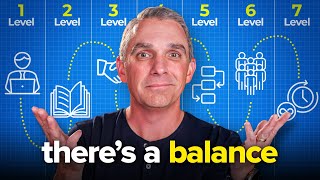
Ryan Deiss presents a seven-level framework for escaping “time for money” work and building toward passive income. He opens by calculating how large a capital base one needs to generate $250,000/year at different returns (3% ≈ $8.3M; 5% ≈ $5M; 7% ≈ $3.6M), then introduces seven progressive leverage levels—(1) no leverage, (2) education & experience, (3) sales, (4) media, (5) systems & technology, (6) people, (7) capital—illustrating each with personal anecdotes and tactical advice (e.g., document systems before hiring, own your media, reinvest profits to scale). The talk targets business owners who feel trapped and emphasizes climbing the ladder sequentially rather than attempting to skip to passive income.
Chapters
You've already heard people say, stop trading time for money. And it sounds nice, right? But let's run the numbers. Let's say you want to make $250,000 a year in truly passive income. So we're not talking about compounding. We're talking about money that you can actually withdraw every single month. So to do that, if you're generating a 3% return, you need $8.3 million. If you're getting a 5% return now, you need 5, $5 million. And even if you're able to get a 7% consistent return, which is no small feat, you need $3.6 million. The real question is, how do I maximize the return on investment for every hour that I do trade? And that's where the seven levels of leverage come in. In this video, I'm going to take you through all seven levels. And I'm going to do this by kind of taking you through my own journey. If you don't know who I am, my name is Ryan Deiss. My partners and I manage 17 companies across a $200 million holding group. And here's the thing, we got there through leverage and by leveraging the same levels of leverage that I'm about to walk you through. So if you're a business owner who feels trapped, if you feel like you're working harder than ever but somehow earning less, this one's for you. Let's get into it. Level number one is no leverage. This is the bottom rung. This is where you have zero leverage because you are simply trading time for money. And I remember this one. I remember my very first real job. I was an intern for a financial advisor when I was still in college. I was earning minimum wage. I basically showed up at the office, I did whatever my boss told me to do. Maybe that was drafting an email for a client. Maybe that was fetching him a fresh cup of coffee. Didn't really matter. The point is, if I didn't show up, I didn't get paid. It was pure time for money. But I think it's worth pointing out that this doesn't just apply to lowly employees like me back in the day. If you're a sole proprietor, if you're self employed, this applies to you too. We can't confuse equity with leverage. If you're still selling time for money, then you're still sitting on this bottom rung where you could pretend like you own the business, and I guess you do legally, but the reality is that the business owns you. You got a job with crappy hours and probably pretty crappy pay and definitely kind of a crappy boss. No offense. Fortunately, there is an easy way to buy yourself just a little bit of leverage. And that starts with Level 2, education and experience leverage. Now, this is where we're learning more. This is where we're getting faster. It's where we're getting better. And because we're getting faster and better, our pay is going up. This is simply why college graduates earn on average, about 65% more than high school graduates. And if you're already in business, then you might feel this way when you master a skill that allows you to raise your rates. Or maybe you just get really good at what you're doing and so you can shave hours. But the reality is, is that we're still capped at that 24 hours in a day and kind of needing to sleep for some of it. Now, for me, this looked like teaching myself web design and email marketing. And I remember I was able to go to my boss and I was able to say, hey, I figured out some of this marketing stuff. Can I. Can I help you market these little events that you're doing? And what was nice is I was able to lobby to get a promotion from Internet to marketing manager. And this additional skills meant that I was able to make some more money. I don't remember how much I was making, but it was more than minimum wage. It was better pay, but it was still capped. Education, experience, it's good. It does get you leverage. But if you want to break out of that cap, then we've got to get closer to the actual money, which is where the third level of leverage comes in. Level three is sales leverage. And I'm surprised that when people talk about leverage, they don't think about this one. But I truly believe that the ability to sell is one of the ultimate forms of leverage, because at this level, you're actually able to make the cash register ring. And if you can sell this is pig, you're more valuable than 10 people who can just do the fulfillment. And this is why salespeople at companies, they're often making more. I mean, it's typical for the top salesperson at some companies to earn more than the CEO. And this is especially true if this is your business. I know a lot of business owners that they do okay, they do pretty well, but they're 100% reliant on referrals and repeat business. And they frankly just don't really know how to sell. Hopefully some new clients come in, but if they don't Then they kind of gotta dance with the ones that they got. This is a problem. If that's where you are, your business is highly fragile. Also, you're highly dependent upon the clients that you have, which means that they basically get to boss you around and you pretty much have to do whatever they say. And that sucks. When we don't have the ability to sell, we don't have the ability to say no to a client. We don't have the ability to say no to a project. This is why the ability to sell gives you so much leverage. But the catch is, if you're not selling, you're not earning. Your income is still chained to hours. I needed to find a way to go from selling one to one to selling one to many. And that is where the fourth level of leverage comes in. Media leverage. This is where things really start to scale. Because at this point, instead of selling one to one, you're selling one to many. So think mastering ads. So getting really good at marketing or mastering social content or email campaigns, putting out information, content out into the world, the kind of stuff that can sell and that can work even while you sleep. Now, if you're a business owner, the first time that you experience this, this is the first time that it really starts to feel like you're winning back some of your time. But here's the risk. If someone else controls your media, then they control your leverage. This is a lesson that unfortunately, I have had to learn the hard way a number of times. I learned it the hard way the first time going back to that financial services firm when I was working there as a financial advisor. I remember getting this brilliant idea. Instead of selling one to one, instead of reaching out and cold calling people, I realized I was like, this is stupid. They're giving me a list of people to cold call. I've got a script. Why don't I just take the script, turn that into a sales letter, and instead of calling everybody, next to the phone number, there was an address. Just take the letter. I can print it out, I can fold it up, stick an envelope, affix a stamp to it, and I can mail it out to all these people and I can get them to call me. And guess what? It worked. I'll never forget the first time that my phone started ringing and I didn't have to call them, they were calling me. And it was all happening while I slept, while these letters were getting sent out. I was able to basically market at scale. I had an audience. I own this audience. I owned this media. The problem Is I remember my branch manager walking into my office one day and saying, hey, this letter that you're sending out, it's not compliant. It needs to get reviewed by the home office. And the home office reviewed it, and they're like, no, no, no, you can't say all this stuff. That's not okay. And that's when I realized that if I really wanted leverage, then I needed to actually own the business so that no one else could tell me what I could and could not do. I couldn't have somebody else controlling my media. And so that's what I did. I quit the job. I decided to start my own business. I was gonna sell ebooks, I was gonna sell other silly little products online. But again, ownership alone does not equal leverage. But the next level, level 5 systems and technology leverage. So here's where most founders get it wrong. They finally have a business that is working, and so they decide, I need to bring a bunch of people in here. That's how we're gonna gain additional leverage. I can't do all this stuff. I don't wanna do everything. I'm really, really busy. I need somebody else selling. I need somebody else fulfilling. I. Let's just get a bunch of people in here. Here's the problem. Good people don't fix broken systems. Broken systems break good people. And when we hire people thinking that they're going to give us leverage, in reality, they don't do the work as well as we would do it. So we wind up just doing it for them while also paying them at the same time. Does that sound familiar or is that just me? We need systems, and we need technology before we layer on people. Systems are what make the work repeatable and scalable, and technology is what actually automates what the people do. So let's solve for systems first, and then let's automate what we can automate, and then we can look at layering on the people. But by starting with systems, suddenly your output is going to grow, and your output is going to grow without adding additional hours and without adding additional overhead. And so for me, what that meant was documenting every single step of my process for building out these little web pages. I remember I had all these dozens of little web pages, all sell, selling a bunch of these little products online. And I was thinking, you know, I've got a couple of them. If I just had more and more and more of them, I'd make even more money. And at the time, I could launch like one new one a week. But by automating some Things by adding some additional systems and documentation. I went from being able to launch one website a week to launching 10 a week. A 10x improvement just through the addition of systems and technology. That was a big deal in the beginning. I just wanted me to be more effective. I wanted to buy back some more of my time and I wanted to do that through better systems. Whether those systems were software. Maybe today that looks like AI or heck, maybe it just looks like checklists and SOPs so that you don't feel like you're having to reinvent the wheel every single time. But this is the turning point. I know it was for me. Suddenly I wasn't just making more money, I was actually getting more time back. I was getting more of my life back. Once your business runs on systems, then and only then should you move on to the next level. Level six, people leverage. All right? Once you have systems in place, people actually amplify those systems instead of just drowning in them. We're no longer just picking up humans and throwing them at our problems. That is not leverage, that is chaos. Okay? So at this level, we're not having to do all the work. We've got systems that are doing it now. What we want to do is we want to build a team to sell, team to fulfill, a team to operate, and even a team to optimize. This is when the money starts flowing, even when you're not personally touching. Everything for me, started off really, really. I remember I hired my college roommate. I was like, can you just help me build some of these websites? And the nice thing is, is because I had already built the systems for me, I was able just to hand those systems over to him. And that was my first real taste of people leverage. But it only worked because I had the systems in place first. I can guarantee you had I hired him and said, figure it out, he would have failed. And I would declare like, ah, this doesn't work. I'm the only one who can do it. And I would have no leverage whatsoever. Here's a tip. The most valuable people bring their own systems with them. This is the difference between an individual contributor and an executive. Executive level talent. They don't just bring their efforts and their energy, they bring systems with them. In other words, the most valuable people combine level 5 and level 6 in a single beautiful, profitable little package, all wrapped up in a bow. The ultimate leverage in life and business is a well trained, well equipped human being who truly gives a crap about you and your business and what's going on. And they're going to improve upon the systems that you create, which means they're adding leverage to your leverage. And once you got people executing and optimizing inside a proven high leverage system, this is when you're finally ready for the ultimate level of leverage. Level seven, capital leverage. This is the end game. At this level, your money is finally working harder than you do. This is when we're truly getting that passive income that we talked about. That part where I said it's not really achievable. This is when frankly, it can become achievable. Because at this level, you should be able to take the cash that your business is throwing off and put it into assets that pay you even when you're not around. This is that level that gets that true passive income. The point is you can't skip straight here. We've got to climb the leverage ladder. So I'm not saying that you can't have passive income. I'm simply saying that unless you're already starting with a giant pot of money, you can't skip from time for money to, ooh, look at me, I've got passive income because I just said I wanted it. It's not how it works. We got to climb this ladder. So for me, it started with reinvesting the profits from these little businesses that I was building from my college dorm room so that I could launch more little businesses, going from one or two little websites to 20 or 30, but also to fund passive investments. And today I've got capital working for me and stocks and real estate and Bitcoin as well as private companies where I'm not involved in the day to day, but where I still receive distributions every quarter because I'm an owner and I have equity in those businesses. And that is capital leverage, which is the final rung of the leverage ladder. So here's the lesson, alright? Don't waste your life chasing the fantasy of skipping straight to the passive income piece. That's like late night infomercial nonsense is not true. And hey, like if you found this helpful, be sure to hit subscribe every single week. I'm breaking down another way to gain leverage in life and in business. And I don't want you to miss the next one. So I'll see you there. It's going to be fun.










