How Clay, Figma, and Higgsfield Price AI, and How to (Finally) Get Your Pricing Right
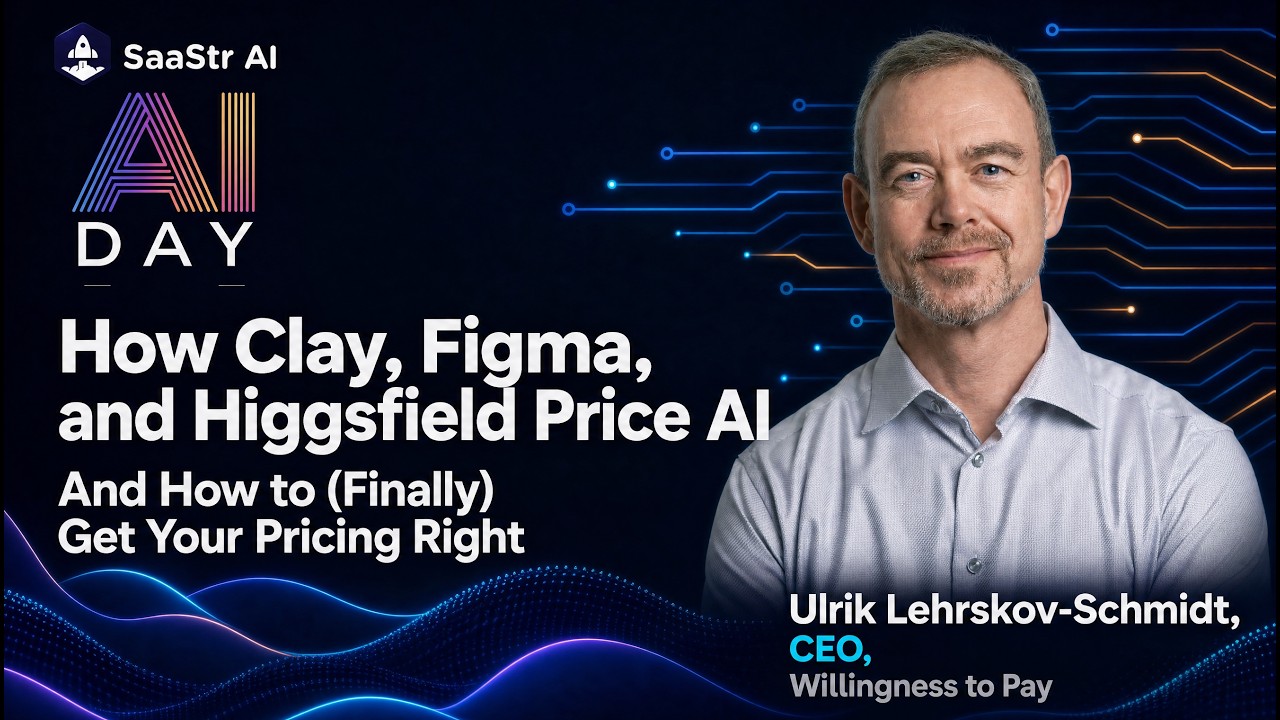
In a SaaStr live session, Ulrich, founder and CEO of Willingness to Pay, presents a practical framework for pricing AI‑enabled products. He introduces the “double hockey stick” problem: both value and cost can be power‑law distributed, creating four cost‑value scenarios (spiky value/flat cost, spiky value/spiky cost, flat value/spiky cost, flat‑flat). He applies this framework to three real‑world companies—Clay, Figma, and Higgsfield—showing how each sits in a different scenario and what toolboxes they use. For spiky cost, he recommends guardrails such as fair‑usage throttles, “kill points,” and incremental “breaks” (the “boil the frog” method) to protect margins without immediate monetization. For spiky value, he advises moving from flat seat pricing to outcome‑ or action‑based metrics (credits, usage‑based pricing) and to surface high‑value use cases before charging. He also discusses the challenges of pricing AI agents versus human users, arguing that agents are too dense a metric for seat‑based pricing and should be priced on the actions they perform. Ulrich suggests an experimentation phase: give free AI access, observe usage patterns, then introduce monetization (cost‑plus, then outcome‑based). He promotes his upcoming book “The AI Pricing Roadmap” and provides contact points (willingnesstopay.com, YouTube, LinkedIn).
Chapters
Um, good to see you in the last 2 minutes. Um, hopefully you got to see mine and Jason's kickoff this morning on agent-led growth. If you missed some of it, it is on our SaaStr YouTube page along with this session and then the ones following. So I'm excited for our next session because if you guys have been following or watching the agents, we talked about recently how AI pricing is chaos. That was our experience has been a little bit chaotic. Ulrich, who is the founder and CEO of Willingness to Pay, is an expert at this cuz he does it all day long. He advises companies on how to do this. He's done this himself. And so we thought it'd be fun for him to give you guys a deep dive into companies, you know, so Clay, Figma, Higgsfield, and talk about agent pricing, AI pricing, what to get right, what's wrong, what to avoid, and how to finally get your pricing right if you find yourself in the same boat of chaos. So with that, I'm gonna turn it over to Ulrich, but if you have any questions for him, please drop it into the chat and we'll come do Q&A at the end. So. Without further ado, Ulrich, to you.
Thank you, Emilia, and thank you, everyone. So yeah, I'm going to finally start sort of talking a little bit about AI pricing. So as Emilia said, I do pricing all day, every day. And so after sort of a decade into this, I still find it sort of enormously fascinating and fun. And it's been very clear for a while that the market was ready for a really good book on AI pricing. I've written other books about pricing, they've done pretty well, but I've sort of been holding off on doing a book about AI pricing. And so like everyone else, I've been sort of following along on what's been going on with agent pricing, MCP pricing, suddenly margins, pre-AI margins of 85%, 90% drops to 55 growths, and nobody knows what's going on. And I was sitting there trying to help my clients and trying to get that one primary insight that cuts through the noise. And so, without further ado, I think I got it this April. So, I'm going to share that with you. So, the fundamental, I think, problem or model that for me has translated a lot of this noise into what I think is actually going on. And then I'm gonna try to apply it to Play Figma Higgs Field to sort of show you how I use that framework to evaluate pricing as I sort of see it live in the field and how you can also start to think about your pricing. So the idea is that we're gonna go through first what I call the double hockey stick problem. So this is this insight that I had, and then that's gonna give us 4 cost-value scenarios. different sort of versions of how the world can look for you. And then I'm going to show you how Higgsfield, Figma, and Clay are in each one of these worlds and sort of what that means for them. So that's sort of the fundamental idea. Okay, so the double hockey stick problem. It was always the case with all products since the beginning of time that they have provided unequal value to different customers, right? So One day I'm throwing away a bottle of water in the airport, and the other day I might be dying of thirst in the desert. So same bottle of water, different value to different situations and customers. Same cybersecurity software, not a lot of value for one customer, tremendous value for another. It's also true that this value is not only sort of distributed where some customers get like one of value, others get 2, others get 10, it's that it is actually— Distributed. Power law distributed so that not only does one get twice as much value, one customer will get 1,000x value compared to something else. So we do these distributions of usage and value across all the different projects we do. We've done hundreds of projects. And it's very normal to see a client of ours, like let's say a couple hundred million ARR, have maybe 10,000, 20,000 end clients. Where one of those end clients is a full 30% of all the users or a full 30% of all the infrastructure across the entire base of customers. So you have this sort of 80/20 distribution that then multiplies where it's like 20% of the customers have 80% of value and 20% of those 20% have 80% of the value in that and so on it goes. So what then happens is that If your pricing doesn't match that value, you're not getting the money. So you might have what we call flat pricing where you charge whatever, $5K, $50K, $500K, and then you might miss that you actually have a customer that would be willing to pay $5 million for it. So we have a project right now in France where we are increasing pricing for some of the customers 30,000%, like 300x. based on what they have because they have this extreme hockey stick, but they have very flat pricing. So for traditional B2B SaaS, that was fine. They didn't need to sort of capture that good pricing because they had flat cost. So every one of their customers kind of cost the same. So if they didn't capture that sort of like hockey stick extreme power law distributed value for all of their customers, It was more like an opportunity cost. It didn't actually show up anywhere in their P&L. So they didn't— nothing externally forced them to go and find that value in their customer base. And this now changes because we don't have just one hockey stick with AI, we have 2 because the cost is also hockey stick distributed. So we've done like a couple of dozen like pure play high growth AI scenarios at this point. And it's very normal to see across these that about 50% of the customer, the user base in these products actually don't have any consumption at all. It might be zero, like flat zero, or it might be very close to zero. It's also very normal to see that 1% of customers and users are responsible for a total between 50% and 75% of all of the total AI cost. And we actually seen it as extreme as 0.1, so 1 in 1,000 of users being responsible for 75% of cost or more. So imagine this, you have 1 million end users and 1,000 of them are responsible for 75% of your total cost. It's a real example where we actually had customers where the most unprofitable customer was burning 380 times the token cost as they were bringing in revenue. So we would have to 380x the pricing just to break even. The problem, of course, is if you have a model where you have this spiky cost but you have flat pricing, then you're going to end up losing money. So this was exactly sort of the case with this sort of 1 million end-user client we had. They had super flat pricing, they had super spiky cost, they were losing money, didn't work. Also, when you're thinking about this, where this is sort of where I see a lot of people trip up is that, okay, so AI costs money, so we just need to figure out a way to take that cost and turn it into monetization. And the issue is that there is no symmetry guaranteed. You might have a great way in your product to turn a dollar of cost into a dime of value. There is no sort of law of nature that says just because you have the cost, the customer is willing to pay for it. You might just have found an inefficient way to burn tokens inside your product. So for this customer, we had that particular end customer that was burning 380x of the revenue for that category of product. What they had, there was just no way that we could charge that money. They would just instantly churn. The value wasn't there, but the cost was there. And similarly, we had another client. They had an ACV about half a million for some enterprise customers. They were really worried about the AI costs. We talked a little bit about it. It turned out that the AI cost of some of the larger enterprise accounts they had was about $20K a year. So for these guys, I said, what are you worrying about? You found a great way to turn maybe $20K of AI cost into like $500K of ACV of value. Do that all day long. There's no problem. And also, because the LLMs change, the capabilities of the models change, the costs change, they go up, down, and sideways. And also because your customer's behavior, the way that they learn to use your product will change, that whatever relationship you have between your 2 hockey sticks, the value and the cost, it will move. It will be different tomorrow. So I call that the stick stand, like this shift position between each other. So we have this sort of fundamental problem with the hockey stick situation is that number one, value is no longer free. Like there are now 2 hockey sticks, the cost showed up. 2, the cost shows up on its own, the pricing does not. Like you actually need actively to have a good pricing model to actually monetize the value. It doesn't just come there, but the cost, it does. 3, symmetry is not guaranteed. 4, the stakes dance, so they move around. And 5, this is what we're seeing all around, is that nobody really knows how to deal with this yet. So it's like, okay, so brand new scenario, things move all the time, we have costs, we can lose money, where's the value? Nobody really knows how to adapt and change pricing as we go along. So that's sort of the situation that we're all sort of dealing with. So, With this, at a very sort of like children's book simplicity way, the way to sort of look at this is if you consider hockey sticks to have like 2 settings, like spiky and flat, like on or off in a sense, you can kind of create these sort of 4 scenarios. You can say, okay, so you can be in a scenario number 1 where this is like the traditional software one where you might have spiky value. but flat cost. This was also like the $500K ARR customer I talked about. This is great. This is where I think Clay is. Clay actually doesn't really have an AI cost problem, but they have a lot of spiky value and they've found a way to sort of turn this into sort of even more value by blaming AI. I'll get to that in a second. Then you might have both spiky value and spiky cost. So this is where you need to sort of navigate a little bit. This is where Figma is. Higgsfield, they have pretty flat value. I know they have some spiky customers, but by and large, the majority of their user base is super, super, super flat, but they have very, very spiky extreme costs. So their model is to figure out how do we monetize the broad base of like flat-ish pricing customers while controlling for this cost. And then you have some traditional scenarios that actually doesn't have a lot of cost and doesn't have a lot of spikiness value. Sometimes they put Netflix into this category. It's like everybody pays $10 a month. They have super scalable infrastructure. That's it. If Netflix suddenly did generative video for your movies every night, everything would change. But they haven't. So right now it's just flat, flat. So if you have spiky hockey sticks, value or cost, you kind of have to use 2 different toolboxes. If you have spiky value, you need good pricing. I won't go too much into whatever that is, but it's like figuring out what the outcomes are for the customers, figuring out the right pricing architecture, the right metrics, the right things to measure, starting to price for that. For the spiky cost, you need to have different forms of guardrails in place, such as fair usage, where you actually get to control the cost and throttle consumption on the product without necessarily monetizing it. So we can take sort of Higgsfield as an example. So this is Higgsfield's pricing page as of, I think, 3 days ago. They might have changed it since then. So if you take a look at it, it's like $19, $49, $99. So it's like relatively low prices, like consumer, prosumer type product, lots of things going on. But if we sort of zoom in a little bit, we can see that here, like at the bottom, we have a lot of like unlimited stuff. So it's unlimited AI, which means You get to pay a fixed amount of money to them, and then you get to have unlimited access to something that costs them money. So this is a very sort of fixed upside for them, but a very sort of unlimited potential downside for them. So if you're Higgsfield, you're going to be in this scenario where you have some users that are going to use this unlimited AI a lot. This is where you get that customer that consumes 380x of whatever it is that they give you in terms of money. So what we do here is that we put in fair usage mechanisms where we say, okay, so take all the users, maybe you group them into certain types. So for example, for someone like Higgsfield, it could be new users because maybe they get a little extra leeway, like the first month that they're signed up so that they don't churn immediately. You can also have malicious users, so people that are clearly misusing or defrauding the product. And then you might have other users. So you do some sort of like a categorization of users. Then you define for any given user group at what point are you actually going to shut down the product. And there will always be a point. Let's call this the kill point. So say, okay, if they do whatever, a million things a second, we're going to turn it off. Just define what it is. Then you define one or more breaks. Take 3, for example. So you say, okay, so we're going to define a break, which is like when they hit this break, when they do 1,000 edits a minute, we're going to slow down the product to half, or we're going to limit the number of concurrent sessions they can run, or we're going to put in a delay. So when they finish one thing, they have to wait for a beat before they can start the next thing. Whatever it is, you intentionally create something that deteriorates the utility of the product. Then you define the customer communication around the brakes and say, okay, if people hit this brake, we're going to send them an email, or the product interface is going to do something, or we're going to send some sort of message through the MCP, whatever it is. And then you boil the frog. So the idea is that you can boil a frog if you turn up the heat slowly. So what we do is, and we've done this for a number of customers now, is that we actually take the brake, like there is slowing down the throttle mechanism, And then we started at the kill point. And we know because of the way that the hockey stick is formed that maybe the kill point is like 0.01% of users. And then we move the break in and say, okay, now we're going to define it so it starts earlier. So now we're going to affect like 0.1% of users. And then we see how people react once they hit the break. And there are only 4 types of reactions they can have. They can Keep going at the same rate as before, just click the button faster. They can decrease consumption, they can churn, or they can upgrade. So now you have these sort of 4 outcomes. You measure what happens. You can say, okay, if I like this, now you push this brake slowly sort of through your hockey stick until it affects more and more users. And maybe you say, hey, at around 4% of my user base, I'm happy. I've covered like 60, 70, 80% of my cost. This is fine. You have the outcome you want, then you start another stronger break at the kill point, and then you chase the first one, and then you sort of phase them in throughout your customer base until you have the margins you want. So we have taken customers that have gone from, let's say, profitable to unprofitable by introducing AI, and they've had these sort of extreme sort of hockey stick point cost and improved gross margins as much as like 22%. In a matter of weeks by actually sort of boiling the frog, by putting in sort of throttles that only affect a few percentage of total user bases. So it's a very, very effective way to deal with the cost base without actually monetizing anything extra and without actually affecting the vast majority of user base. So not a lot of people are— this is essentially what Claude does when it slows you down. This is essentially just like, hey, this is where you need to sort of Go grab a cup of coffee or take a break because you're using it too much. Another scenario is Figma. So Figma had these break plans in place before they ever started their credit monetization. So Figma is a very sort of curious case of what I call the double unlock, which is Figma had a great business. They were doing design. They were obviously going to be disrupted by AI. So they took a step back. They said, okay, we're going to give AI to everybody, but we don't want to lose our shirt. So we're going to create these fair use mechanisms before we start, and then we're going to give them AI, and then we're going to see what happens. They introduced it, people started using it, they used it a lot. Slowly, Figma then turned on credit count, then they turned on enforcement, and then they turned on monetization. What actually happened was then curious because during this sort of time, we saw that Margins actually went down from 92% to 82%. So AI cost money. They actually had spiky costs. But what we also saw is that they were actually able to monetize at a faster value. So it turned out that they had a positive asymmetry. The AI cost was worth more in terms of monetization than it was costing them. But we also saw that the hockey stick actually got spikier. So my read on that is that Figma actually had flat pricing and they had a hockey stick they hadn't monetized. Like, seat-based pricing was never the right thing for Figma. It was actually a form of like paying per design, like a usage-based or consumption-based pricing model. They'd just never been forced to go there. They didn't have an AI cost that had forced the board or sort of the C-level to actually do something about it. So they have sort of played it safe with their seat-based model until AI came along and made it obvious that they needed to do something else. They introduced credits and suddenly actually they accelerated growth at a billion plus in ARR. Suddenly growing faster is quite a feat. So we are seeing a lot of these, let's say legacy SaaS companies introducing AI and actually finding value in their existing customer base and sort of value proposition. That they didn't monetize before. And they get to monetize it, I would say, with Figma almost by accident by actually introducing an AI, like a pricing that was meant to monetize the AI. And then you have the clever ones such as Clay. So Clay had the data credits. We're going to have customer data. We're going to enrich it for you. We're going to allow you to use it in certain like GTM flows, sales flows, all these things. And then they found out, hey, it looks like a lot of these smaller accounts are getting away with murder, like they're getting a lot of value and they're not paying for it. And especially some of these larger enterprise accounts are getting away with murder twice, and all day through. So, how are we going to do this? And I think fundamentally, if you look at the pricing memo and look a little bit through the lines, you can see that costs are a problem for Clay, but it's not an urgent one, but value sort of is. And sort of they're more actually forward-looking, like saying, hey, this is where AI is going. This is what we want to do with this. This is the vision of things. So what I think actually happens with AI is that they introduce action credits, a whole new pool of credits, a whole new way of monetizing. And actually what they're doing is they're finding a way to actually capture the spikiness of their hockey stick. So they have used AI as an excuse as a narrative to explain why things must change and why we must have a new pricing model because AI, they introduce it. And then suddenly you see that the good customers of Clay are starting to pay multiples more and they actually sort of carve out the value that they have in this hockey stick that's already there. So I think for these different, 3 different scenarios, you just have different sort of I call them cost-value worlds that they live in where Figma has this double unlock because they have both things to deal with. Clay kind of just needs to find a way to just deal with their spiky value. And Higgsfield, I don't know if they have a fair usage or consumption mechanism, but if they don't, they should. This is sort of how you deal with monetizing broad user bases flatly without losing your shirt to some of this. So this is as far as I've got. I think the double hockey stick is becoming sort of the fundamental sort of framework that we try to sort of apply just like at first principle level to any case to say, okay, so what are we even dealing with here? Do we have spiky value? Do we have spiky cost? Do we have both? What kind of toolboxes do we need to get on the playing field to solve this or start to solve this? And then we go from there. So, this is what we got. And I see that We have a— we might have some questions over in the chat, but I don't know if you've been following along, Amelia.
Yeah.
I have a little QR code here. My book, The AI Pricing Roadmap, comes out, I think, in about a month, 5 weeks, something like that. Really excited. Double hockey sticks all around for everyone.
Double hockey sticks all around. There's a couple of questions in the chat and then some from the live stream. I'll ask one from the live stream first that came in a bit ago, which is, How do you think about agent versus human pricing?
So I think human pricing can make sense when humans are sort of a good meter for the value. I think sometimes you can have both. Like if you're transitioning like Figma, they still have both. It still makes sense. That's fine. I think pricing seats for agents, I think there was like 5 minutes when that was a good idea and then it turned to be not a good idea anymore. So it's like, So the problem is that an agent is a very— it has a very low density as a metric. So if you have a human for— let's say you sell a seat for Salesforce for a sales rep, there is like some sales reps are better than others, so they don't have the same value. But it isn't that one sales rep is a trillion times more effective than the other one. But that is the case for agents. So the problem is that an agent can just post a lot more activity, value, et cetera, through than another agent can. So having them as like one unit that you try and count doesn't make sense. So find something else to count. Whatever the agent does or is there for, that's probably your metric instead.
Yeah. What do you recommend for that scenario, right? I feel like somebody was asking me this yesterday. I was like, I'm gonna ask you because I don't know the right answer. And certainly I feel like Salesforce, HubSpot, and others have gotten heat now for announcing that they're gonna start charging for agents distinctly versus humans.
So what do I think about Salesforce pricing or
just pricing for like, uh, you know, I think there are, there, there are folks like Salesforce, um, that have, you know, said now they're gonna start charging for agents distinctly in addition to the humans. So if we have folks listening who have themselves in the same scenario where they're, they're not sure if they should charge for agents versus humans, What would be your advice to them?
So actually, I had another former client of mine that's introducing AI on a call just before this one. And so they're just introducing agent pricing. They have an MCP. They've opened it as read-only. They're opening it as write as well in 6 weeks. And they, as many others, are in this position of we're unsure how this is going to work. Is this access that people have through the MCP going to— they have a lot of add-ons that might suddenly be like cannibalized because of that access. So what I told them to do is like, do what Figma did. Put in place the guardrails, give access to AI, see what happens first.
Give access for free first.
If you can afford it, give access for free first. Because what's gonna happen is that a lot of things will happen and you can't sort of tell what you're gonna have. Hopefully you're gonna have more adoption. But what will happen is that if you don't have pricing, and you don't have adoption, now you know you have a product problem. If you have pricing and you don't have adoption, now you don't know if you have a pricing problem or you have a product problem. So by just taking pricing out, you test first for product, and if that works, then you can actually add in monetization later. Also, what's gonna happen is that in the beginning, you're gonna have a lot of what I call undefined work. Like people will do, Ton of stuff. Over time, patterns will emerge and you can say, oh, people seem to be using their agents or their MCP access for these 10 things. Those are the 10 things that you now charge for later. So the undefined work gravitates to more defined work, whatever makes sense for your solution. And then so in the beginning, you can have sort of— you can try to subsidize it, give it away for free, or you can do some sort of cost-plus basis version of it. And then as soon as you have those like outcomes or actions or things that gets done repetitively, then that's what you then start to charge for in terms of credits or per action or whatever. And also, once you have these repetitive defined actions, that's usually when you can then substitute your expensive frontier models with like cheaper open weight models. So you actually have this margin expansion where, okay, in the beginning we just cost plus pricing the like heavy frontier models. Later we can outcome-based price the defined work, and then we can actually solve that problem with like low-cost frontier. So you get like, now you get the margins back that you didn't have to begin with. So instead of like trying to figure out the good pricing right now, consider it as something like an experimentation phase that you have to fund, learn what works, and then you can monetize.
Great advice. I know we're running out of time 'cause we're at time. In addition to the book, how else can folks get ahold of you if they are confused by pricing? And this was super helpful to a lot of people, so thanks for doing it.
So we have willingnesstopay.com. That's our homepage. You can find me there. And then that will also lead onto our YouTube channel where we have like 600 videos and everything. And my LinkedIn is there as well. And then you'll— the universe will guide you to all the content we have.
Yes, and Ulrich is going to come on the agents in a couple of weeks, so that'll be fun. We'll do some more around pricing and agent pricing and the chaos that it will be in the next 2 weeks. He'll also be at SaaStr next May, so you guys will see him IRL. In the meantime, thanks for doing this so much. I know pricing has been a very hot topic for us at least, so thanks for doing this.
Thanks for having me. Thanks, Ulrich.
We'll see you at the next session.
See you.
More from Jason







Claudeforce vs. Replit vs. Lovable. Our Agents Pick Our Vendors Now. Who Wins?