You might be working on the wrong problem

In this live Substack conversation titled “You Might Be Working on the Wrong Problem,” co‑founders Carolina and Phil Powis of Sacred Business discuss why entrepreneurs often misread the signals that indicate why their offers stall. Phil introduces a diagnostic framework that isolates three primary failure points: the Offer (clarity and audience fit), Conversations (generating and tracking meaningful interactions), and Invitations (making explicit, non‑disguised offers). They explain how to spot which of the three is broken by asking targeted questions and by tracking simple metrics such as number of conversations, invitations sent, and yes‑responses. The discussion expands to a broader “scoreboard” concept that categorises work into Job (the core service delivery), Business (sales‑and‑marketing activities that generate future revenue), and Busy (tasks that feel productive but don’t move revenue). They advise regular self‑check‑ins, simple spreadsheets or peer accountability to keep focus on the Business side. Practical tactics are shared for improving offer clarity (elevator‑pitch style messaging, aligning problem‑solution‑outcome), increasing conversations (networking, purposeful outreach, setting conversation targets), and crafting invitations (avoiding disguised offers, personalizing outreach, especially to past clients). Phil also introduces two proprietary tools – the Clarity Compass and the Harmony Map – that help entrepreneurs narrow focus to one priority, assess inner blocks, and align business decisions with heart‑centered signals. They address why highly skilled entrepreneurs get stuck (over‑choice, mixing advice from many sources, fear of missing out) and suggest narrowing to one concrete focus for 30‑90 days. The conversation ends with actionable advice: take one small step, observe the feedback, and iterate, emphasizing action over over‑thinking. Upcoming events (a live interview with Ryan Levesque) are announced.
Chapters
Hello, we are live. So welcome everyone. Hello.
Hello. I can't see. Oh, there we go. There's the chat. Oh, there you go.
There's like a little bit of a delay. So I'm Carolina. I am co-founder, um, of Sacred Business with Phil, my partner. And we are here in this live series that we are calling for now, Sitting on a Bench. And we are just bringing conversations. Um, it's a series that our intention is to bring topics that will help you expand your business, grow your business in a fun and profitable way. So tomorrow, um, Phil is gonna release an essay and we are, he's gonna be talking about something that comes up very often in our work, uh, with our clients, uh, that's Sometimes we misread the signals in our business. So sometimes we have a small lunch and we think it's like our small lunch, we can eat a small portion too. Back to the conversation, we have a small launch and we think it's like we failed or we have an offer and it's not going the way we thought it was. And he brings a very important point and that's the topic that we're going to be exploring here, sometimes we are looking at the wrong thing. And the way he calls it, it's we are looking at the wrong scoreboard. So for that, I would love to invite you, if you're here, to ask your questions. We want to try to make this conversation as dynamic as possible. So if you have any questions for Phil, if you have any questions for me, I do have some questions that I prepared to ask him. But feel free to jump in. And we would love to bring like certain things that you could be looking at in this scoreboard idea. And then most importantly, like the actions that you could be taking. So you keep yourself on the track and maybe the numbers will not like make you, um, think the wrong thing about your business or maybe about your offer or sometimes even like doubting yourself. So welcome. I'm very happy to have you here, Phil. And first question to you is, when someone comes to you feeling stuck in their business, what is one pattern that you usually see faster than they do?
Yeah, so thank you and welcome, everyone. Thank you for joining us live. I just wanted to take a quick peek again at the chat before we jump in. Hey, Anne, Deborah. Yeah, I'm just seeing lots of familiar faces. So thanks for being here. Yeah, so the question was kind of what pattern do I I typically see faster than other people when they come to us. Is that it? Cool. Yeah. So right now I'm all big on this topic of simplicity. And, you know, if you've been an entrepreneur or been trying to create a business for any period of time, you know how quickly things can kind of get out of control. And I've been, I've been as guilty as anyone else for this. And it's just so important to have people in your world that can kind of help you see when you're kind of stuck inside your own process. And from my experience, it's actually quite simple. There's really only 3 main places that things tend to break down if you're not experiencing the results you're looking for in your business. So really, that's— there's something going on with your offer. You know, something is not working there. You're not creating enough opportunities to get that message in front of other people. And I like to use the word conversations because even though we're here on Substack, conversations extend. That could be putting out emails, that could be doing things like what we're doing right here with you, doing a Substack Live, but it also could be out in the real world. And actually, I think that's a huge thing that's coming back now. I think more and more people are looking for connection outside of the online space. So Conversations is a very broad category. And then the third one, that third area that I see things breaking down is just not making enough invitations, which is different than conversations. Sometimes I think also people confuse those 2 things. Conversations are where you identify the right opportunity to make an invitation, someone that you feel that you can help, that you can serve with your work in the world. But that's different than an invitation. So I don't know, Kelly. I was thinking I might just like break down a little bit more of what I mean by this offer conversation invitations, and then maybe, maybe just like a couple practical things folks could do, like to diagnose or think about where their primary challenge might lie. Usually you'll find that there's little tweaks that are needed across all 3, but usually there's one area that people are more kind of caught up in, you know, than the other. And if you can kind of get that moving, then things start to flow much better. So does that make sense? If we— if we—
Yeah, yeah, sure.
Cool. Yeah. So just like high level, I think, you know, most folks that are here kind of know what I mean when I say offer. But this is just— this is the thing that you, you know, your meaningful work, the thing that you want to put out into the world, the way you talk about it and If you're experiencing challenge with your offer, like there's really probably 3 big areas I would look at there. Like one is just, can another person really understand what you are offering literally as quickly as possible? And so, you know, there's all the old world kind of advice of like, oh, try to get your elevator pitch and, you know, all that sort of thing. But the whole point of that is not to be super polished, but it's just like if you can't convey what you do very quickly, especially in today's day where our attention is pulled in so many different directions. It's very easy to lose people. And so it's really just making sure, looking at your offer and making sure that when someone scans that, because that's what they're gonna do, you know, in most cases they're just gonna quickly scan, can they very quickly tell what it is that you— how you can help them essentially. And then the second thing is when you describe Because typically what you'll see when you look at an offer is there's 2 things, right? There's the problem that you solve or the opportunity that you help them lean into. And then there's kind of the outcome that you create, right, through doing the work. And so when you share that offer, are people leaning in? Right. Because this is— and especially if you've been building an audience for a while, we can get confused. And I see this a lot on Substack because if people are talking really broadly on Substack and, you know, trying to chase things like virality with notes and things like this, then the offer could be a really amazing offer, but it might not be a perfect match to the people you've been talking to if you haven't been getting the right connection between the content you're creating and what you're putting in front of. So when I say, are people leaning in, it's kind of that like, are you creating the right connection and the right match for the people that you're serving. And, you know, I know something that, you know, Carolina and I, we've talked about in the past when we first started Sacred Business Flow, we thought we were going to be talking to a lot, you know, a lot of people that were closer to what I've served in my past. Right. So I spent quite a few years working as a fractional CMO, and I worked with people that were already in this like high-level scale. Right. They had proven everything out. They were probably at least $200,000, $300,000 of revenue. And they were, you know, they were hitting a ceiling or a plateau. Right. And so I thought, Hey, this is where I've been playing. We're just bringing a really cool new way of supporting people that's really honoring all of who they are and kind of the whole person and the identity within that. But fundamentally, that we're going to be talking to the same people. And what we found was, you know, we've been really fortunate with how we've been received here on Substack. But what we found was we got a lot more people that were earlier in their journey, right? So if we just kept putting that offer in front of people that we had initially kind of scoped out the beginning, we wouldn't have been able to get the traction we've gotten. So that invited the question like, okay, like, what is life giving us? Who's showing up? And is this offer that we had in mind actually the best thing in service of those people? Right. So that's kind of what I mean around that. And then lastly, the third thing around offers is just, are you getting in front of enough people?
Right.
And so this is, this is Well, I'll just move pretty quickly there, but that really connects to the second piece, which is the conversations, right? Because you can have a really clear offer, you can have people that are leaning in, but still, if you're not getting enough of those conversations started or there's enough of those opportunities for people to see it, you're going to get stuck at some point, right? So that's, that's what that is. And then, you know, if you want to look at conversations, I invite our clients to get often really, really real about this. Like, you know, get out, you know, get out a notebook or something and just look at your calendar or, you know, just look back at your week and ask yourself, like, how many conversations have I had in the last week, in the last 30 days? You know, and by conversations, this is pretty broad. This doesn't mean pitching, right? This doesn't mean— I'm not a big, not at all a proponent of like this idea of like going into people's DMs and being like, you know, just cold pitching people things that you think they may or may not need, right? So that's not what I mean by conversation. A conversation could be responding thoughtfully to someone's note. It could be reaching out to an old friend and asking them how things are going, reaching out to an old client. It could be going to some sort of a networking event. It could be a side conversation at your yoga class. So conversations is just Are you basically putting yourself in contact with other people and not being afraid to share what you do essentially when the right signals are there? Right. So it's not about going around and being like a, you know, in this constant pitch mode. It's just being open to have those conversations when it's relevant. So then I would also look at like, if you're not having enough conversations but you've had success in the past, think about where those conversations have historically come from. So for example, Recently, we were like looking at these sort of things for ourselves. And in the past, I've been part of a lot of different like entrepreneurial groups and masterminds and places that I just love being inspired by, by other people's thoughts and just hearing what they're up to. And then I was like, I would love to have more of those conversations. And we have not been putting ourselves in those types of spaces. So that's just a very specific one. So we recently joined a group that is supporting us. That's, you know, a good fit for where we are. Yeah. And so that is an example of me looking at conversations and seeing how very organically a lot of really good business opportunities and allies and connections have been made just by being in rooms with other people that I had good resonance with, that, you know, we were just having exciting conversations that we were lit up about. And then those just naturally lead to other things. And then if you want to challenge yourself just to bring a little bit of structure to it, set a goal for yourself. Like, look at what you've been doing historically, and you'll start to see some correlation or pattern there with the types of results you're getting. And maybe look at like, okay, how can I bring more of this in? And what would be a good simple number for me? And that's going to be different for everyone. But I'm a huge fan of having targets because if you don't have targets, it's really hard to kind of hold yourself to your commitment. And there's a lot of ways we do that. You know, one of the things that we Yeah, I'll pause there because there's a lot I want to cover. There's a lot that we could talk about that's probably more that would go beyond this conversation. But, and then the last one, invitations, right? So same thing. Like, if you think of conversations as the space where things can kind of unfold quite naturally and effortlessly, if you're in the right spaces with people that inspire you, that the shared interest commonality things like this, then start to look at how many explicit invitations you've actually made. And this is probably the one where people in our world get— are the most challenged by. And, you know, this conversation is more on the practical side, but this is where a lot of Carolina— and I know maybe in a moment Carolina can speak more to this, but this is a lot of where Carolina's work comes into, is helping people kind of on the inner side of this. Because a lot of times what I see is there's this idea of almost like a disguised invitation. Like we, we think we're making invitations, but we're kind of not, right? So it's an example of that is, here's my website, take a look at what I do if you want, or maybe someone even comes to you and says, oh yeah, I really could use, I don't know, let's say What would be a good example? I'm trying to think of a good example of this. Well, let's say you help people with procrastination and someone says to you, oh gosh, procrastination is a massive problem for me. I just keep finding I'm putting things off and off and I never get to them. And, you know, my, my, you know, my attention gets put on whatever the biggest burning issue someone else has is in front of me. Right. So maybe a disguised invitation would be like, oh, I'd be happy. And, you know, you can help. Maybe that's what you do is you help people, coach them on that. And you say something like, I'd be happy to help with that sometime. That's not an invitation. So an invitation is— and this is being really clear on what your offer is— it's explicitly saying, hey, well, you know, you know, I have something that does X, Y, and Z. You know, we're actually going to be supporting a couple more people next month. Would you like to have a conversation about that? You know, so it's being very clear and not Kind of muddying the waters. And so, yeah, so just to kind of close on this because I feel like I went down the rabbit hole, but a simple diagnostic, like if you're trying to figure out where you're blocked between kind of these 3 categories of offer, conversation, invitation, basically ask yourself if you feel like when you do have a conversation, people understand it. but you're not having enough of them, then it's probably a conversation problem. If you're out there, and I see this too, which if you're out there having a lot of conversations and you're really committed, and this is what I really, yeah, I really, it kind of makes my heart hurt when I see this, people that are really dedicated, disciplined, and committed, and they're having conversations every single day, but nobody is expressing any interest. That's when I would definitely kind of point the attention back to the offer. And then, If they're interested— well, this one's really obvious, but if they're interested, but you're just finding— this is more of usually an internal block, but you're finding you're not— when there's an opening, you're just not willing to put your voice out there and share that there's something you have to offer, then that's an invitation problem. So I find that the invitation one tends to be the most of an inner block, whereas the offer obviously is more of a practical, tactical thing. It's where I spend more of my time. And then the conversations in the center, it's interesting, right? As you work the inner and the outer, you get that offer really clear, you get really comfortable making invitations, then it's almost like that's when we give ourselves the most permission to start having more conversations more frequently. So yeah, that's— I think I'll pause there and catch my breath.
Yeah, thanks for sharing. And if anyone has any questions around that, please post it in the chat. And what I see, as you were sharing it, I was thinking about myself. And some of like the services that I appreciate for like, I, it made me think about like my hairdresser, for example, right? And I have like a couple of places that I, I like to go and how much I appreciate them inviting me to cut my hair. So here in Brazil, like WhatsApp is a big marketing tool and everybody uses that for their business. And once you raise your hand and like, hey, I'm interested in whatever you're doing, and it could be online, like, hey, I'm reading your stuff, right? So it's kind of like opens like a door for conversation. So then very often, like every 2 or 3 weeks, they like, hey, like we just thought of you. Like, would you like to, we have some spots available. Would you like to come and cut your hair? Like, I know it could be like very simplified because we all have resistance towards making the invitation, but I'm on the other side right now as a client. And I'm like, whoa, thank God. Like you sent me that message because I completely forgot about it. And You know, I actually appreciate when people have a solution for a problem that I have and they tell me very clearly. And maybe you, like, if you're listening to us, like, just put yourself on the other side and how much you appreciate. It's not being pitched. It's not about like them forcing anything. And it's just like, hey, I'm here. And if you have this situation, I have the solution, for example. So That way, for me, it makes me feel less resistance if I need to invite someone that I believe I have a solution for, for their problem.
Can I say one more thing on that, Caroline, before we move on? Yeah, and this is where, you know, one of the things I see as people are growing their audience, it could be on Substack, it could be other places. It's hard. Like, let's be honest, it's really hard when you're first getting started and people, you know, they feel like almost like every subscriber they get is like a hard-earned victory. And so then I think this is also where people get the resistance practically around making an invitation or an offer, because we know, and it's true, that usually even if people are enjoying your content and they're reading along, it's at that moment of making an offer invitation that if you're going to get a higher frequency of unsubscribes, that's when it's gonna be. But what I always tell people is this is This is good news, like, because we're not here just to collect people that aren't here to be truly served by what we do. When you make that invitation, typically what happens is the people that are unsubscribing, it's nothing about you or your self-worth or having a crappy product. I mean, of course, there could be things around, again, around your offer that need to be fine-tuned, but usually it's just people self-selecting themselves out because they're not a good fit for what you do. And so this is actually a good thing because then you know that the people that are still there Even if they don't say yes the first time you make the offer, they're there for the explicit reason that you're here to serve, right? And so I always say, like, don't worry about that. This is just information. And it's actually helpful to know that over time you're talking to the people that actually want to help you receive, whether they're saying yes or no in that moment. There's a lot of factors, but people will kind of like not do that. And they're building this list over time that May or not, back to the earlier conversation, may not be the right fit for what they're trying to create or serve. And so, yeah. And yeah, like if you've— I'm sure same thing with email. Anyone put yourself in that shoe. There are people that every time they send an email to you and they offer something, whether it's a yes in that moment or not, you're delighted to receive that. And then there's other people that you're like, this is freaking annoying. I'm going to unsubscribe. They're just not your people, you know? And it's not a one size fits all, right? Someone that could be really freaking annoying for you could be like the perfect match and resonance for someone else that's in a different place in their life, belief structures, philosophy, all of that. And so, yeah, it's just a really good thing to think about.
Yeah. Rebecca just, she made a comment. My first offer was successful and I lost lots of subscribers, but also gained a bunch. So my subscriber numbers stayed the same and I thought to myself, I'm fine. fine-tuning my audience. And I think that's what it is about. Like, and if we, if we don't take it personal and it's just like, hey, some people like it, some people don't, and you're kind of like clarifying and making your, your offer, your audience, like how you serve more clear, um, that's going to happen. Right. And it's better to have, let's say, 200 people that really are being helped by the things that you're sharing than having like 20,000. They're just like entertaining their minds and maybe not even reading the content. So if it's like 200, but they are being helped. And as you're fine-tuning, like this number maybe is like shrinking, but it's not about quantity, it's about the quality, right? Ian did not have a question, but he said invitations. Oh, now he has a question maybe. How do I make an invitation to a past client, but I haven't engaged with in 2 years? They haven't opened my email since, and I've raised my prices.
Yeah, so great. Maybe Ian, you could let me know in the chat when you say they haven't opened their email. I'm assuming you mean like a Substack email or using something like Kit or ActiveCampaign. So let me know if that's true. But what I would generally suggest for most folks in the situation that you're in is talk about or think about the highest level of intimacy that you have with that specific person and hold them— yeah, ActiveCampaign, right? So yeah, this is like you're emailing your list. So think about that list of past clients and think about the highest level of intimacy you've had with them, right? So You know, you typically, if I've worked with clients, you know, there were some people that it was just— this isn't as common anymore, but like, hey, I could just pick up the phone. Or you think about a friend, right? That there's people in your life that you could just pick up the phone and call them on a dime, maybe your mom or your dad, and you could talk to them, right? Then there's people that like, hey, I can send them a WhatsApp message or a text. And that's like a kind of a pace that's been matched, right? And then there's people that you just have personal email, right? So like in your personal Gmail or Outlook inbox, and then you've got people that you've just been communicating with on ActiveCampaign. So generally, it's kind of, in my opinion, a huge— it's a mistake just to assume that if you're sending stuff just by something like ActiveCampaign, like what I would do is I would make a list, I would pull those people out, all your past clients, and I would kind of just kind of bucket them into lists of like, again, like this highest level of intimacy that you have. And then I would think about like, Remember, it's like one person in front of you, right? So these are people that have invested likely, probably pretty significantly with you in the past, and you probably know very good information about what problems they had, where you were able to take them, what sort of result you were able to get them, and probably a whole lot of other stuff, right? So I would honor that context. I would send them an email that's, you know, an email or text or WhatsApp and just check in and say, hey, you know, it's been 2 years. Let's say that— let's go back to the procrastination example just to stay consistent. It's like, hey, you know, last time we talked 2 years ago, we had ironed out a lot of things. Things were going really well with your projects. I know you had gotten a huge raise and promotion, you know, because of the level of focus you had. It's been 2 years. How are things going? Are you still at X company, for example? It just opened a very simple conversation, like almost like a binary yes or no. That's just like And this should be like from a genuine place of curiosity and care, and ask them like how they've been doing since that engagement last. And very often people will be delighted to hear from you and they will respond and they will invite the conversation. You don't even have to do anything. They'll say something like, well, they might say everything is great and fine and that's awesome, like no more work. But like, if they might say, oh, things were going really well, but I've fallen into some bad habits again, and I could really use a tune-up. You know, like, what are you doing right now, Ian? Now you have an invitation. This is— now you have an opening, right? And now you have the opportunity to make an invitation. So, yeah, I would get a little bit more personal with folks. And you can do this. You can kind of tier these out, right? Like, based on, on kind of the level of, again, level of intimacy and how well you know them. So, people that you don't know a ton, maybe then you still are gonna go with the email in ActiveCampaign. But again, if they haven't been opening those anyway, what I would still do then is just switch to like a personal email because that's another thing. Sometimes ActiveCampaign emails, Substack emails, they'll just end up in people's promo or even worse spam. But the minute you send a personal email with your personal signature on it, A, people know the difference. It's not like we're like tricking anyone these days with like an automated email. And so there's a specialness to us when you actually take the time to email them, but also the context switch of now coming from a personal Gmail. You might show up in someone's inbox where you're previously showing up in their promos. So, uh, so yeah, there's that. And, um, Tara, it seems like a tricky balance to be inspiring, resilient, connect, and then be distracted by it when you need to be more direct and clear about— yeah, so I think you have to choose those Wisely, right? You know, and I think that you make a good point there. There are people, I believe, and I've been guilty of this in the past too, where they think that showing up and being on group mastermind calls all week long and they stack their schedule like that is the work. And this is a slippery slope too, because this is not the work. And I talk about, yeah, this idea of the job, the business, and the busy. And You know, so yeah, you, you do need to, yeah, you do need to be selective and smart about that. But yeah, Carolina, let's maybe go back to, I know we had some other questions we wanted to get to.
Yeah, just finishing with Ian. He said, I see, so a personalized email and wait for them to respond and not invite to anything yet.
Yeah, I wouldn't, you know, I wouldn't Make it feel like an offer. At this point, I wouldn't make it feel like a direct promotion, especially if you've already been doing that and they're not opening it. I would turn back to connecting with past challenges, outcomes you created, and just inquiring into how things have been going and make it real personal. And yeah, I've done this for myself quite a few times in campaigns. So even, even let's set aside the whole Kind of thing of like, maybe they're not interested. I've had situations like there were a couple of years ago when I was helping a client promote a retreat and he had his list in ActiveCampaign and he had been sending a bunch of emails about this retreat and he was getting people signed up. But there were a lot of people that he just was surprised they weren't even like responding or opening his emails. So we did the same thing. We like kind of created a scoring system of like, hey, these are people that are kind of like We've had the best relationship in the past and it's kind of surprising that they're not responding. And he just started sending them private emails like, hey, I thought of you, like, you know, that this would be a perfect fit for you for this retreat. And that's exactly what it was. They were ending up in people's promos and stuff. And he— and they were like so grateful to get that email. They're like, wow, like, I'm not seeing your emails. I'm so glad you thought of me because I would love to come to this retreat. And 2 things happened. Like, we ended up selling like with I think we ended up selling like 10 more seats to the retreat. And like, I think it was about $3,500 a ticket. So you can do the math. That's like over, what, $30,000? And then also the secondary result of that is those people, and they even said it, they're like, oh, I just went in and pulled you out of promo. I want to make sure all of your emails show up in my inbox. It was also not only getting the immediate gratification of a sales result, it was fixing the relationship so that like basically they're gonna continue to get the communications going on. So it could be a really effective campaign strategy.
Yeah. And I think it's very powerful to think like if you have a small audience, like the level of intimacy that you can have with your people is like huge. So going back to past clients, like making a phone call, like reaching out on a message, like Sometimes people like, oh, I'm going to send one and expect that everybody will open. And just going back to, you know, like real life, like, hey, I know you and how are you? And just bringing that connection opens up like a whole conversation. Maybe they are not even in, and I'm thinking about you, like they're not up for what you are inviting them right now, but you're just re-inviting them into your world. And then if soon, like you create something else, they're going to be like, oh, you know, we reestablished a connection. So, more than thinking that, like, I want to sell anything, I want to reestablish a connection, and that, like, drops the resistance. I do have another question, so if we can keep going here, why do highly skilled, capable people stay stuck for so long, in your opinion?
Yeah, so, I think this, and this kind of question is definitely connected to some of the essays we've been writing, but something that I think that people that are really capable, highly skilled, highly educated, have— they have this challenge that's almost like a gift if they can see it, but they often have too many legitimate opportunities in front of them. It's not a problem of not having enough. It's almost like I have way too many doorways I could walk through. And that kind of getting to one thing can be a tremendous, tremendous gap to cross in this fear of making the wrong decision or even worse, trying to take on too many things at once. Right. And so that's one thing right there. It's just like getting to the one thing. I'm a huge fan of one thing at a time, especially if you are not in— I'm not a huge fan of using all this like 6-figure, 7-figure language, but using that $100,000 mark is just a benchmark, like is a very practical tool. Like if you are have any sort of service or practitioner or coaching kind of service provider business and you've not hit at least $100,000 in revenue and you have multiple things going on, that's probably already one of the challenges, one of the reasons in itself. You should be able to cross that threshold very easily with one thing. It's a different game if you're doing products or e-commerce or anything like that, but if it's more of a service-based thing, So that is one thing. It's just getting to one opportunity and then holding that pose. And then the other thing I see is that even if folks are able to get to that singular kind of choice that they want to plant that flag and get traction, they will then continue to kind of consume advice from too many different sources. And so you This is really, really dangerous. This is something we tell clients too. Like, if you're going to work with us, we're not the only choice and we're not going to ever— like, we're not going to pretend that there are. There's a million people out there that you could choose to get advice from. But if you do choose to come into our space, then kind of not forever, but for now, put that other stuff aside because it gets really dangerous when you start kind of mixing and matching from different people's models because most people that kind of support business growth. There is a specific structure, order of operations. You can almost think of it like a recipe, and there's always room for your own intuition. But what I see happening a lot is people will go out there to the world or like where all these people are kind of sharing all this information, and they will choose the things that actually match their blocks, right? So it's like, hey, Phil said to do this thing, and that's That's something I'm super comfortable with. So yeah, yeah, go Phil. Like, let's go do that. But then Phil tells me to make an invitation and I'm like, no, like, absolutely not. Like, I'm not going to make an invitation. And there's like this heavy block there. So what do we do? Then we go out and we're like, okay, I don't want to make an invitation. So let me find someone's advice who tells me I don't have to make an invitation. But then we take that piece of information And then we try to connect it with the thing that Phil said that I liked, because this other person who said you don't have to make an invitation says something else that hits your stuff, right? It hits your block. And so we end up with this Frankenstein mess where nothing's really working because, you know, you're just taking all these pieces from different systems and putting them together in an order that doesn't make sense. And so I see those. So yeah, those are kind of the two things like getting to that one choice and then limiting their focus to where they're getting information. And so I think like, we actually, we actually just created a tool for this. It's called the Clarity Compass. But like, just before I go there, like, you can do this yourself. Like, you don't need a tool. Like, you could just go and say, okay, what are the 3 to 5 legitimate things that I could be focusing on right now? And really narrowing that down to what is the one thing that I'm going to focus on for the next 30 to 90 days. And it's not— you may have heard us say this before— it's not right now doesn't mean ever, right? So you're not even— you don't even have to throw the ideas out. You just need to put them into the later category, get onto an information diet, and then, yeah, just pay attention to what life is sending back to you. And so, yeah, just— I'll plug it just because this is where we went with the conversation. But yeah, we just like actually just last week, we Was it last week? Yeah, we just created a new tool called the Clarity Compass, and that's exactly what it helps you do. It helps you take all the ideas, the possibilities you're thinking about, going through what we call a narrowing the field exercise, which is to get that down to 3, and then go through a really— I think it's a pretty cool kind of scoring process where you're looking at kind of the external. You're also looking at like what the real business opportunity is from a traditional sense. You're looking at some of the signals that are coming from kind of what you're feeling called towards with your heart. And then also it's relying on our Harmony Map framework to kind of look at some of the inner patterns you might be dealing with and how they might be impacting the decision. So yeah, it's a, it's a pretty cool process. If anyone wants to check that out, I would recommend it.
Yeah, it is really cool. And it's actually based on how we work with clients. So it's not, you know, like we kind of like brought that format into a tool that you could do it yourself. But just adding to that, like, I think it's very important just to understand that, like, if you're going to a next phase of your business or if you're just like launching your business right now, the way your business starts, it's not how it ends. And it could be like a whole lifetime. Oh, thank you, Rebecca. She put it on the chat. So like bringing one idea into focus, The way Phil said, not now doesn't mean not ever. It's just like right now you're putting all your energy, all your attention there. And then back to the beginning of this conversation, like then you're refining that thing over and over and over. So it's like the offer, maybe it's a slightly shift over here. And then those other things as you walk, and I like calling it like co-creation with life, you receive information and maybe right now there's a space for another thing. There's maybe something that you thought it was unconnected.
Yeah.
that was like disconnected and connected is not a word, is it? That was not connected to your current offer that now, because you're walking, because you're helping more people, now you can bring another aspect of yourself to that same thing. So what I see that, and it's real, like the fear of missing out, like the fear of making the wrong decision makes people like scatter in their energy and with all their ideas. But if you focus in one, all your energy, all your love, everything is there. And then you keep evolving with that. You are not stuck in a cycle of creation because often what happens like this didn't work. So then you shift and there's another shiny object over here. So then you forget about what you're doing. That was like something that felt really special to you. And then you look over here and then this doesn't work. And then you look over here and then there's people like they're working on their business for 5, 6, 7 years that we see sometimes, but they are not moving forward or it's not like growing. It feels that they are in the same cycle and it's because, you know, you are constantly changing. So know that whatever you decide right now, if you keep co-creating with life, it's going to be evolving with you, but it's going to be growing and it's going to be evolving. So just adding that because it's not about thinking that like, I made a decision right now and now I need to stick with that for the rest of my life and I need to forget about all my passions. Like if you're a multi-passionate person, Like I am, like, just trust that choosing one thing, it's gonna help you to actually add all your passions on top of it, but you need to walk the path. It's not just, um, try to put all together from your mind alone. Yeah.
And one, one other thing I'll say that, 'cause it actually came up on a coaching call yesterday. I was describing to someone like, yes, there is a world where your passions are really across the board. Like there, there's no connection to them. And that's, that's one challenge and there's a way to solve that. But what I see with a lot of people is You have kind of like this zone of expertise, right? And a lot of these ideas you're playing with, they're still within kind of— there's a context, there's a relationship between them, right? And so just, you know, you can't really get wrong with this because even if you change your mind, which you always have the permission to do, because people are, you know, tend to be a big part of creating your business, people are falling kind of more in love with who you are and like your philosophy and your way of being and how you, you know, think about the problem more so than like the specific mechanics, right? Because again, there's so many people out there that do. It's very rare. Like there are people that have really cool businesses. For example, Rebecca is on here. She has a very specific niche business. There are people doing it, but it's a much smaller group than, for example, the type of work that we do. But for most people, there's, you know, a lot of people out there doing it. I like to think not of them as competitors. It's just more like there's a different guide for you. But I've kind of gone off a tangent here. But what I'm trying to say is that even if you decide a year from now to change your offer, a lot of those people will follow you. Like what I was describing yesterday is the business that I talked about at the very beginning of my journey, like 10 years ago, was, was explicitly helping doctors with practice management grow. Get more patients essentially using Facebook ads. Right. And then I shifted into more of the transformational space, but it was like general marketing advice, none of the kind of inner experience connection. And then Carolina ended up in this space that we're in now. Right. But it's really beautiful because there's a thread there. Right. You can see that even though the offers have changed, it's actually 3 different businesses. My zone of competence has evolved. I've gotten stronger in certain areas. But there's a thread there. And so it was just like last week, actually, on Facebook, a doctor that I had met almost 10 years ago in that first business reached out and she raised her hand and was like, oh, I'm really interested in this Harmony Map thing you're doing. Completely different context. But my point is, she's followed my journey because she likes the way I think. She likes the way I communicate my worldview, all of this. And so just remember that that's a lot of what people are buying into. you know, they will follow you. And so, you know, you choosing to commit to one thing, you can't really get this wrong. Like any audience you're building, you just kind of shift and people will continue to follow, you know, where you go next.
So. Thank you. So one question, something you talked about, it's on your essay tomorrow, but I hear you saying like very often is the idea about like a So, what do you mean when you say people don't have the right scoreboard?
Yeah, let me see where I would want to start with this. Well, I think I'll anchor it in something that one of my mentors taught to me, and I just love this. I love holding this for myself, and I love holding this for others. It's basically that there's just 3 kinds of work, right? There's only 3 categories of things that you can do to fill up your day if you're kind of an entrepreneur trying to build your business. That is the job. So this is, this is the thing that our folks tend to be really, really good at. This is delivering the thing that people pay you for, right? So whatever it might be, that's the job, right? So the thing you actually get paid to is showing up for the session. It's teaching the thing, creating the outcome. That's the job, right? The second is the business, which is really anything that is an activity that will create future revenue, right? The lifeblood of your business. And so basically, if you go back to our beginning of our conversation where I was talking about offers, conversations, and invitations, that's effectively the business, which, you know, to use the words that many people have, are challenged by, that's essentially sales and marketing, right? Like, this is the actual— this is what turns something from, you know, either doing the work for someone else as an employee or doing something as a hobby, this is what turns it into an actual business, right? And then there's the busy, and that's like everything else that feels productive. And this is where a lot of us spend our time kind of fooling ourselves, right? So, and a lot of things in the busy can feel, yeah, you know, they can feel productive in the sense of like, hey, I'm tweaking my website or like the other, actually just yesterday. So I'm going to call myself out because some people on this call probably got them. I was tweaking with our And I was like, I just want to— it's an escape, right? I was like, I was a little stressed from some of the things I was focused on. I was like, oh, I just want to go make our Circle look a little prettier and fix a few things. And I ended up sending some RSVPs that were not meant to go out. But that kind of action, right? It's like, okay, I feel like I'm being productive. I'm making my Circle better for our community. There's some truth to that. And there's value to that as well. But if your thing is that you need kind of to go back to the start of this conversation, that you need to generate more income to make this thing more stable, that's typically not going to be the sort of thing that's going to lead to the result. That's the busy, right? And so, yeah, if you think about that, those are kind of the 3 kinds of work. And so, yeah, basically I would say What you want to make sure you're doing is kind of being honest with yourself. And again, it's like kind of mapping out how you're spending your time during the week. And so I would start with having something like a check-in date with yourself. Like we teach a process which is called Sacred Business Planning. But again, there's like lots of ways you can do this. You know, we just had David Allen on our show talking about GTD, which is awesome, but basically having Some appointment with yourself to check in and know kind of where your focus is. Like, what happened last week? What changes need to happen this week to move the things forward that matter to me? What is the thing that I want to be putting my emphasis on putting in front of people? Who am I talking to? Where are there opportunities to make these invitations? And just having a couple meaningful numbers that you track. It could be really simple, like it could just kind of based on this conversation we've been having, it could literally be like, hey, how many conversations am I having? How many invitations have I made? How many do I want to make? How many yeses have I received? And ultimately, we have another tool that we use for this, which is called our money map. But ultimately, how many dollars has this resulted in? Right. And Just having a system of accountability to yourself, whatever that looks like. It could be a spreadsheet, it could be a peer. I know a lot of people like to create like a peer accountability relationship with someone that they can message back and forth with. It could be a community like we have, could be working with a coach, but just something where you're keeping yourself honest because a lot of time can go by where you're not paying attention to these things. And it's so fascinating, like whenever I feel the slip even in our own business, and I go and I'm like, what's happening here? And I go back and start looking at these kinds of numbers and like these sorts of things. All of a sudden it becomes so clear. It's like, oh yeah, I've been kind of off here in la-la dreamland, dream space, doing some really cool stuff, entertaining myself, but I'm not keeping the focus on those few things that are going to make sure that we can keep showing up and doing this work, you know, time and time again. So yeah, that's really what I mean is just figuring out what those, you know, what those metrics are for you and building a very simple system for accountability.
Yeah, like, I like the idea of building like a scoreboard and also like paying attention to where you are, right? And kind of like I had a score, I didn't know I had one, but like at my previous, well, the one before, I Even the one before the one I had here with the Sacred Business, uh, I was putting all my time on the job. I was putting a little bit, um, on the business and I was also putting a lot of time on the busy. So I was like refining my technique, for example, like over and over and going to trainings. And then at one point I had to ask myself, like, do I need more of that? Or am I delivering like already like a good service? Am I, are my clients having results? So then if I need more clients, then it means that I need to be spending more time on the business side of it that I wasn't, uh, doing much there. So it's kind of like, and sometimes like maybe you're going to help a client and you're going to hit a wall and you do need to do more of the busy, like you need another training, like you, you know, but it's kind of like based on Necessity that you're creating with life and not necessarily just you entertaining your mind that like, I would love to learn a new modality or I'd love to be, you know, it's kind of like I hit a wall and then what is asking, what life is asking from me right now. And Rebecca has a very good question here. Writing your newsletter or having a Substack life, would you say that this is a business or a busy category? Yeah.
I would— so I would say business for sure. So think about what we're doing right now. We're having a conversation and chances are the more of these types of conversations we have, they're going to lead to invitations or people that are like, hey, I just like the way that Phil and Carolina show up. And, and, you know, we've talked about this a lot, that one of our biggest drivers of really making invitations and getting into deeper conversations with people has been through our Sacred Business Stories podcast that we also do live here on Substack. So this is a little bit of a different format, but yes, so that is a form of conversation. Writing a newsletter is also a form of conversation and being in connection with people, right? So they're definitely in the business. Now, what I will say about that, Rebecca, and for anyone else, is that it also— it requires— so for example, we put out a tremendous amount of content and there's 2 of us, right? So we have that advantage. You know, if you work with a partner or have someone else, then that's going to be a little easier. So I wouldn't try to match our pace necessarily, if you're, especially if you're a solopreneur. But if you are hitting a cadence of content, right? So you've made a commitment like, hey, I'm gonna send out a weekly newsletter, I'm gonna do a live every other week, something like this. And you're not getting the results you are hoping for, but you're doing that very consistently and with discipline, adding more of that. is probably not going to be the thing that gets the result necessarily, right? So this is where it could shift. It's a little bit nuanced. It could shift into the busy. So this is where I would start. If you're doing that thing consistently and it's just not landing, that's when I would look back at the offer, right? And see, okay, am I having the right, you know, do I— am I making the right offer? Are the conversations that I'm having the right conversations that are leading people to solving the problems that they want to solve? Because that's the thing I see sometimes people do is if something's not working, it's just like, okay, I'm gonna ramp it up. I'm gonna do more of the thing that's not working, right? And the more we can get really clear on that offer and knowing we're talking to the right people, this is where that simplicity kicks in, right? Because it could actually be, and I'm not saying we've completely cracked the code of this in our own business, but there are people out there that they can send one email and they fully fill up their program, right? And this is typically not something that happens overnight. This is usually from years and years of refining and getting to know their audience and knowing that they can kind of arrive at this one point, right? So that's something that we can all aspire to. But yeah, that's how I would answer that, Rebecca.
Yeah. And I'm just thinking about writing and we have our cadence and how we divide the writing. But for example, like you could just write for the joy of writing and you don't want to make any invitation and you're kind of like connecting to a topic in your business. I would say like, it's not that you should not be doing this. I'm all about trying to find ways to bring joy to your daily life and to how you operate your business. But maybe if you're just writing for your own pleasure and you are not talking about what you offer, it could go into the category of busy because you're spending a lot of time. But then people like, it's not even clear. There's no, some people, they don't even have a CTA, like a call to action. They don't even talk about what they do. So like, I'm not saying to not do that, but just find balance because sometimes the writing could go also in a direction of like, I'm just entertaining myself because I like writing, for example, and I'm not getting any results, or how can I balance writing, making invitations, talking about what I'm doing, and trying to get people into my world?
Yeah. And also, let's just be really clear about what that is. There's absolutely nothing wrong with that, and there's lots of really cool voices here on Substack, but that's essentially a hobby, right? And there are people there, it's either a hobby or it's someone that is in a very kind of early stage of finding their voice and finding how they want to connect and get and put themselves out there. So again, there's nothing wrong with these things, but if you're past that phase, then yeah, just kind of knowing, knowing where you are in your process. I would, I would agree with, with what Carolina had to say there.
Yeah, and we've been here for 52 minutes now. Yeah, let's keep going.
Let's keep going.
We're, uh, well, I do have a few more questions for you, but the next one I want to ask you is, uh, for you, what is the difference between a good offer and a business that can support your life?
Yeah, and I've got my coffee here, so I'm, I'm pretty like fired up right now. So, uh, we can go as long as, as long as, as long as you want to go. I'll let you call it if, if I don't know what, I actually don't know what's on our schedule next. I think we still have some time, but, um, Yeah, so great. That's a cool question. So what's the difference between a good offer and a business that can support your life? So basically, the offer is really connected to the thing that someone else wants, right? So it really is solving a need, a problem, a pain point, a challenge for someone else. And there's a real kind of validated answer that someone is willing to invest in that, right? And then the business, what I would say, and there's a lot we could go into, and I'm really staying focused more on the practical stuff here, but a business is something that the math, if you think about it, it's kind of a math problem, can support, right? So if we've got a really good offer and it's doing something that you enjoy, that is a good fit for your skills, your gifts, you feel lit up, you feel on fire to show up and have these conversations, then kind of taking that offer and mapping out what that business is, is kind of thinking through a couple of different lenses, right? So some of the things that my mind gravitates towards would be things like, okay, like what is my desired monthly income, right? So there's probably a desired, and you could go into the total dream space and be like, oh, this is what would really light me up if I was making this. It could also be a number that's like, hey, this is my floor, like I need to clear this much on a monthly income to stay viable and have this be a real business, right? So then if you have those numbers, you can look at your offer and get really practical about that too, because I think a lot of people just kind of set their number based on this arbitrary thing of like looking out there and seeing what other people are doing, which I could go into a whole other conversation about that. But making it practical, if you look at your offer and you look at what the price is, If you look at kind of what a realistic number of yeses— like, there's, you know, this is almost like a science. Like, it's like if I put this in front of 10 people, I realistically think I could get 2 people that will be a yes to this right now, for example. And then how many of those yeses would you need to kind of make that desired monthly income? And you'd be surprised at how many people just don't slow down to Do that very simple math, right? So I would start there. And then you need to think about the delivery, which is pre-thinking this out can also bring the stress down because a lot of people get— they either don't do that thinking or they actually block themselves from success because they imagine a world of their success where they're just stressed out and burnt out and can't handle what is coming to them, right? So then if you figure out the income number, if you figure out what the offer math is, and then you think about, okay, Like, if that's all working, can I realistically get this many people to a yes? And if I can, can I actually even serve them? Right. If they show up, do I have the structure and the systems in place to serve them? And then if that was all true, is that aligned with the life that I want to create and how I want to spend my time? And so, which is also a really important factor because that's different for everybody. Right. So then making that even simpler, like you could probably, yeah, like just take that main offer, multiply the price by the realistic number of people that you think would say yes, that would get you to that income number. And then ask, can I sustainably acquire and serve? That's the 2 things, right? It's like, can I bring these people through the door and can I do that in a way that I don't stress myself out to the point that why am I doing this in the first place, which is a huge part for us. Like for most entrepreneurs, like we don't get into this to like hit that place of burnout, right? Like we're looking for more time, we're looking for more freedom, spending time in the ways that we enjoy. Otherwise we would still be working in a company, which there's nothing wrong with that. But when I— when people have chosen to make this leap, those are often the reasons they do it. And then it's funny that we recreate the same patterns that were kind of existent when we were working in corporate, for example. Like one of the things that you see very often is like, hey, I work— I worked an 8 to 5, so now I'm going to be working an 8 to 5 as an entrepreneur. And if you like that and that works for your schedule, cool. Like, for example, I'm a really early morning person. And even when I worked in corporate, I was always like, without a doubt, I was always the first person to the office before the sun came up. It would be like, I don't know, maybe like 6 a.m., 5:30 a.m. I was there. The janitorial staff would still be in the hall, the lights would still be off. But I got to a point where I had enough flexibility there that I would show up early and I would be like 2 or 3 o'clock in the afternoon and I'd be like, done all my stuff. And I'd check in with my, you know, my director and I'd be like, I'm out, you know? And she'd be like, cool, you got everything done. And, you know, but then other people would be rolling in, you know, at the normal time. So I've kind of kept that same pattern because it works for me. But that's the beauty, right? You get to choose. And so that also connects into how you set up your, kind of how you facilitate and serve your clients. And so, yeah, I think that's, that's really it. I think that's all I have to say on that for now.
Yeah, it's, uh, it's very interesting. Like when I, when I think about myself, um, it's just kind of like pausing and defining success first, because sometimes we say we don't want something because we think it has to take a specific shape. And my mom, uh, she was a psychologist and a successful one, full of clients, like waitlist. And she was booked up forever. And I remember like when I thought of like having my own clinic and opening for, um, getting clients, I, it wasn't conscious, but I wasn't taking the step forward because I did not want her version of success. And then I thought of like, if I'm becoming a practitioner, if I'm becoming a healer or like a therapist, it meant that I had to see like, I don't know, 8 people a day, which is for her schedule was like 7 AM, 9 PM. Like, and I was just like, and then one day I'm like, wait a second. I don't need to create what she created. I can create something different for myself, which means I need to price it differently. I need to relate to my clients differently. And And all of that. And we have a lot of preconcepts about what success is. And even like when we see like people with a lot of money doing a lot of stupidity, often we kind of like connect, like, I don't want to have a lot of money because I don't want to be like that person. Right. So just step back and like, what is, what would you do with that much money? Like, what is your version of success? Because your subconscious is actually blocking you from the things that you're trying to protect yourself from. And then you could have a very successful practice that's not like seeing 10 people a day. You could have a lot of money and not being busy and not giving attention to your family, uh, like someone else that you see out there. So I just think it's, um, it's, it's just a great opportunity to reflect and define like success for yourself and, uh, what are you building? So I'll ask you one last question. If anyone in the chat wanna ask any questions, go ahead. Um, let me see here. I have many questions actually, but I'll just ask one more. Um, so if someone feels like they have something meaningful to share, but the business still feels harder than it should, what would you tell them to do next?
Let's see. Get another swig of coffee here for that one. Yeah, I would say, first thing I would say is kind of try to stop solving for everything all at once. Take it one step at a time. Like, I love this kind of Is it analogy? But this idea that like, hey, that, you know, you just, you know, there's a fog in front of you, which I think for so many of us as entrepreneurs, that's kind of what we're signing up for is like we're going into uncharted territory here. And all I really need to see is the next step in front of me, right? So stop trying to kind of solve it all at once. Can I see what that next step is right in front of me? Can I pay attention to The signals that life are showing me? And if so, take that next step forward. And that is what that translates into generally is some sort of action, right? And so, you know, that's what I think we're looking for. And if you take that action, you know, you'll have another 6 feet in front of you of distance that you can see. And with that new vision and sight, you'll be able to take the next step, right? So That's, that's kind of the way I would, I would frame it. And yeah, I mean, that's really what— that's so much of our work, right? Like, that's what we built a lot of our tools for, right? So we have our Harmony Map tool, which is really helping you to look at the inner patterns, seeing where things like your energy and competence and, you know, visibility or follow-through might be creating friction and looking at that through like an energetic lens and energetic qualities. And, you know, we If you've been around a little while, you know, we talk about 9 fundamental frequencies and this relationship between you, the business, and the divine. And so this is really like an inner tool to kind of help you see where different energies might be working in your favor and also where your next breakthrough might live. And then, as I mentioned earlier in the call, we're now taking that a little bit further, which is like, hey, you've got your map, let's get you a compass too. And that's really looking at more of that Practical orientation of like, okay, how do we focus this down into that area of what that next step is, looking at it through the lens of business evidence, how your inner patterns are at play, and also just like what you're feeling that pull of the heart towards, right? And so, and then from that place, making a clear decision like what gets my focus, what am I choosing to pause for now, and what are those next actions that are going to give me that distance where I can see a little bit further in front of me? And so, Yeah, that's really it. That's really the way I would think about it is like, what are the actions that I could take right now that are going to give me just enough signal to see a little bit further down the path in front of me? And if you can keep doing that and keep showing up, you're going to keep moving and it's going to become clearer over time. And it's going to be amazing when you look back and you see how far you've come. This is the desire that I have for everyone that is on this path with us.
Yes, thank you. Yeah, I think action is the name of the game. It kills overthinking. One action often gives you answers for 10,000 questions that you had in your mind. So just take the action, see what comes back to you, and then from that space, you take another one and you keep walking one step at a time. So thank you so much, everyone, for being here. Thank you, Phil, for sharing your wisdom with us. And we're going to keep going with our sitting on the bench. We are having fun. I hope you are too.
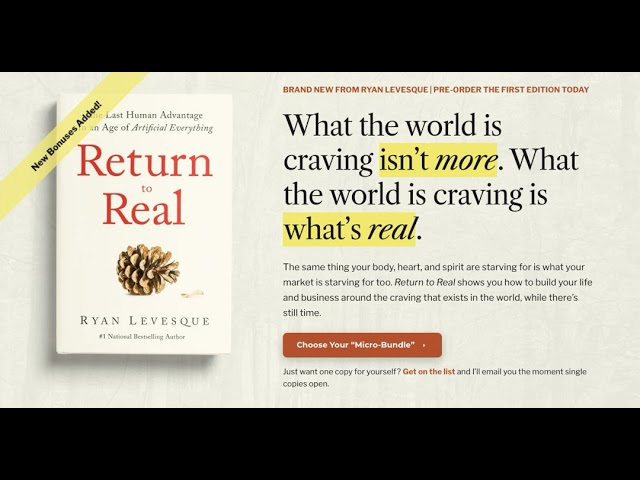
And yeah, I think we're going to be, we're going to be, you know, we're going to be rotating things a little bit. I think next week we actually have an interview. Do we? Is it next week? I think we have a cool interview happening. Let's see if I'm right before we break. Yes, we have. It was one of our favorite conversations from last year, I think. Ryan Levesque, he is a really brilliant— well, I would say he's more than a marketing mind, but he's kind of one of the pioneers of kind of assessment and quiz funnel style marketing. So anyone that is considering doing something like that, I would highly recommend showing up for that interview. But we're actually going to be talking about his new book that he has coming out this month, which I'm going to totally butcher this because I can't remember. But it's basically, it's something about being human and it's all about as we enter into this new era of AI and kind of overly polished, kind of synthetic everything, like how do we continue to bring back our humanity to that conversation and how this is actually going to be one of our greatest competitive advantages as we move forward. So I think that is going to be— it was a great conversation we had last year and I think This is going to be even more fun. So yeah, it'll be next week at noon Eastern. It's a different time than this, but Wednesday the 26th at noon Eastern. If you can make it, we'd love to have you there. And yeah, thank you again for being here, and we'll see you next time.
Thank you, everyone. See you.
Bye.