Your Work Gets Clearer When It Meets the World
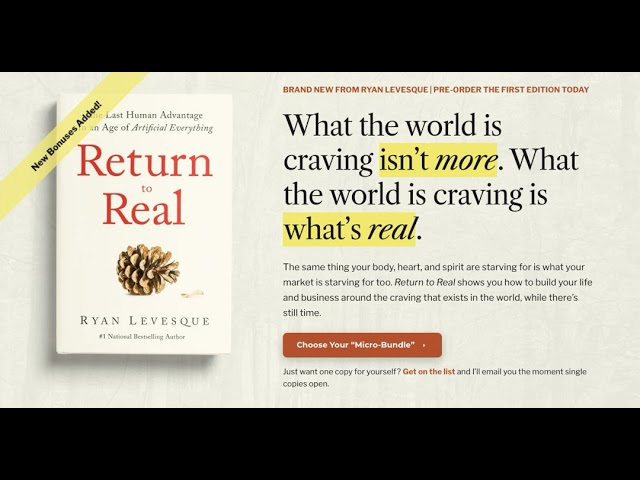
In this author‑spotlight conversation hosted by Phil Powis (with co‑host Carolina), bestselling author and creator of the ASK Method, Ryan Levesque, discusses his upcoming book The Return to Real: The Last Human Advantage in an Age of Artificial Everything. Levesque recounts a personal crisis – a failed $70 million company sale during the 2022 market crash – that led him to a summer on a Vermont farm, where he experienced an “awakening” to the need for physical, analog, and biological connection. He frames this awakening as part of a broader cultural shift toward “real” – defined in three dimensions: real world (physical presence), real connection (human touch and oxytocin‑driven trust), and real trust (skepticism of AI‑generated content). He contrasts the dopamine‑driven, attention‑grabby loops that dominate modern media with oxytocin‑driven, trust‑building experiences, arguing that the market now craves authentic, provenance‑rich products and content. Levesque illustrates this with personal practices: hand‑drawing every illustration in his book, hand‑writing weekly newsletters, and sharing raw farm anecdotes (e.g., escaped pigs) to demonstrate transparency. He introduces the concept of the “contrarian voice of your heart” – an inner guide that may conflict with the strategic, market‑driven voice – and explains how aligning the two creates sustainable, purpose‑driven businesses. Practical tactics include a disciplined weekly writing habit, building in public, using AI as an augmentation tool while maintaining human authenticity, and becoming AI‑literate to set personal boundaries. The conversation also touches on the historical pattern of counter‑revolutions (Industrial Revolution → Slow Food, etc.) and outlines three critical shifts for creators and businesses in the AI era. The episode ends with a pre‑order call‑to‑action for the book (returntorealbook.com) and a discussion of bonuses for early buyers.
Chapters
So welcome to this. If you're joining us live, welcome to this special author spotlight series with Ryan Levesque, who is actually a return guest to our show. We've only had a few of these, so that was very exciting that he was willing to come back on. I think I shared last time that I followed Ryan's work for quite some time. His ASK Method had a huge impact kind of on several of my businesses prior to this. But even, even now, it's the gift that keeps on giving with, you know, a lot of folks that are joining us are probably familiar with the Harmony Map. So a lot of that was based on a lot of the things that I learned from Ryan's methods way back in the day. And I feel that— I feel like Ryan was ahead of the curve then. And I have a feeling or more than a strong inkling that he's— he may be ahead of the curve again right now for this conversation we're having, where I feel we're entering this moment where many businesses are, if not struggling, definitely starting to ask questions around this era that we're moving into with AI and how it's forcing us to reconsider what matters and what's going to be really valuable in the years ahead. And so that's why I think this conversation is important. And just to kind of say, Ryan's a 2-time number one bestselling author, creator of the ASK Method, and he has a book coming out on September 29th, which is The Return to Real: The Last Human Advantage in an Age of Artificial Everything. And so, yeah, well, welcome, Ryan. And I was thinking before we get in too deep, just like Maybe take us back to where this began for you and what the central premise is of The Return to Real and kind of what you've been experiencing in your own life that felt this was the right moment to share this information.
That's great. Well, Phil, it's awesome to be here. Caroline, it's awesome to be here. Grateful to be back and excited for this conversation. And to the extent that we are able to engage with everyone who's here live with questions and topics, I'm happy to take this conversation wherever we want to take it. So I'll try to just give a little bit of context. Why did I write this book, Return to Real? Where did it come from? And why is this moment in time that we are experiencing right now a unique confluence of events that has never occurred? And why does it feel like there's this shift that's happening? And of course, the easy answer is to point to it's AI. But I believe AI is actually just one of 3 forces that are colliding right now at once to create a singular moment. So I'm gonna go back a few years to kind of take us to this point in time. In 2021, I was running a very big company, almost 100 team members across the globe, and with my business partner made the decision that I wanted to sell the company. I wanted to get out. And we hired an investment banker. to bring the company to market. Fast forward, we received a number of offers and we accepted an offer to purchase a majority stake in our company for $70 million, which is a life-changing amount of money. I never thought I'd ever see that kind of money in my life. I grew up blue collar. Neither of my parents went to college. My dad worked for the post office. My mom cut hair. Like, I didn't grow up with that at all. And over the course of a year and after $1 million spent, 2021 to 2022. At the 11th hour, at the very last minute, the deal fell apart. And it fell apart in the wake of when Russia invaded Ukraine and there were fears that there was going to be World War III. If you remember back in 2022, we weren't sure, is Putin going to throw nuclear weapons at Europe or at Asia or at North America? What's going to happen? And so in response to that, the stock market crashed, crypto markets crashed, capital markets collapsed, and interest rates spiked. So we were in a near 0% interest rate environment. It was really easy to raise money. And so as a result, the private equity firm that had made the offer to purchase our company said, we're done with all deals right now. We brought the business back to all the other companies that were interested in buying us, and they said basically the same thing. The M&A market completely dried up. And I had this moment where I thought, gosh, I've I've missed my window and I missed my window to sell. And so I kind of fell into like a bit of a funk, like a, I mean, I would call it a depression and kind of questioned everything. This was not how the story was supposed to end. I'd spent 15 years working really hard building a company from the ground up. Like this was how the Hollywood story was supposed to come to a close and it didn't. So I spent a lot of time reading, reflecting, And that summer when my kids were away at summer camp, I had an opportunity to live and work on a farm in Vermont where I earned my permaculture design certification. And I was literally living in a tent, bathing in a pond. And it was when I was on that land that I had this awakening. That's the best way I can describe it. I just had this awakening and I realized that I'd spent the last 2 decades of my life really in a very synthetic environment connected to a screen, working in software and technology and media. I didn't even know who my neighbors were. I was so connected with the world, but so disconnected from anything physical. It got to a point where I kind of had this realization where I was ordering food from Uber Eats and other delivery services that would land on our doorstep, and I was living in a box. I was working in a box. I was eating food from a box. And I thought like, we, we were not meant to live in a box. We were never meant to be as human beings in a box. And so when I was on this farm, I sort of had this awakening that there's something that I had been personally craving that had been absent in my life. It was, as I describe it in the book, it was hands in the dirt. It was going analog. It was rewilding to reconnect with my humanity and my biology and my physiology and everything that I was missing in my life. And when I look back at the sort of reason why I wanted to sell my company so bad, like why did I want to exit? Well, I reached a point where I came to this conclusion that I really started hating my business and I started hating who I'd become and I started hating my life. And so I was on this personal journey and I began sharing a little bit about my story and there's more layers That I'll, that I won't get into now. But as I started sharing the story, Phil, I can't tell you how many people came to me and expressed some version of this story in their own life, that they had this similar craving for something that was missing. And with the advent of AI promising to the most, you know, promising to be the most transformative technology, you know, certainly of our generation, maybe ever. You know, for me, I had this, this strange starving to when I was 12 years old and I would wander in the woods and I had a garden and I wanted to reconnect with nature. And so from this personal journey, I started having conversations and I started doing more and more research and realizing that there is a craving that is emerging in the world right now. What I've, what I've described as a desire to return to real. That's showing up everywhere all at once. And it's a double craving, meaning it's something that I'm seeing inside of us as individuals, but it's also a craving that's existing in the market, which means that there is a business opportunity to not only give what your body and your soul and your spirit might be starving for right now, but actually delivering what the market is craving. And building a living and a business and a livelihood around filling this massive gap that exists in the world today. So I know it's a long answer to a short question, but hopefully that kind of sets the stage for our conversation here today around Return to Real.
Yeah, it does. And I think in many ways it resonates with everything that you're saying, and it's part of like my own journey of like, it's been like 5 years or a little over that I kind of like left the city and like, I need to be closer to nature. I need to be like the same thing. Like, I don't know the, my husband, my, my neighbor's name. Like, I don't talk to them. I don't know who they are, what they do. And like, I think it's like everybody in different ways are craving for that. And I just love the way you're relating because we, here, for example, and I would love to hear your opinion, like we have an online business, right? So then it's this thing that feels that's like far and we try to create experiences as much as we can and we try to build connection. Like, and then you saw that like, oh, and the market is craving for something that's real. And when we talk about real, for me, what comes first is the real world. Like when we touch, when we smell, and when we feel people, like how do you relate that we can have an online business and return to real? At the same time, if you do.
There's 3 dimensions to real as we define it, or as I define it for certainly for this conversation. And you hit on one of those dimensions. There's a craving for the real world. Increasingly, we are living our lives through proxy and abstraction through a screen. And so we're overstimulated through the sensory experience that we have in some ways doing what we're doing right now. Like we're, you know, let's just, let's just call it for what it is, right? This is where we spend more and more of our time. We've got our, um, you know, the smartphone theory of everything where disconnection and loneliness and all of these modern maladies of, of, of our modern life can be attributed to this life that we have that's increasingly experienced through, um, abstraction. So real world is the first dimension. The second dimension is real connection. And I'm gonna, I'm gonna talk about some of the, the scientific mechanisms behind all of this. So as we peel away layers of the onion, my academic background before going into business was studying and actually teaching neuroscience at the Ivy League level in the United States at Brown University. So I've always been a student of the human mind, of the neuroscientific mechanism behind why things show up. So you're going to see a little bit of that come through when I explain some of what's going on, and it's going to help you understand What you might consider doing in your business to elicit the neurochemical response that people are desiring in their brains. I'll talk about that in just one moment. So first dimension is real world. Second dimension is real connection. Third dimension is real trust. We live in a state of distrust, default state of distrust. If you study the Edelman Trust Barometer, for example, which has measured trust objectively since the year 2000, so we have 26 years of data. We are no surprise, um, at the, uh, uh, lowest level of trust in the world today. And this is trust with institutions, with governments, with corporations, with NGOs, individual trust. And I think what shifted in the world with AI is that we no longer trust our own sensory experience. Like, I think most people would recognize on this right now, you're live right here. This is a live, real conversation. Like, you're getting me, you're getting you guys. Like, this is, we're not AI avatars. It's not ElevenLabs putting together some, you know, crazy thing. This is real. You know, I'm probably going to trip over my words. I might say something a little bit embarrassing. We're all working without a net. And it underscores that one of the few things that we still have is this in-the-moment experience that we can trust with our eyes and ears. Is what's really happening. We don't know if that video that we saw on Instagram last week, is that really the US bombing a city in Iran, or is that an AI-generated thing? Like, do we really know what's going on? Can we, for sure, is it really something that that celebrity said? Or was it an AI version, a deepfake? We just don't know. So we're kind of walking around with our trust radar. Like firing at high at all times. But what we do trust is our sensory experience when we're physically in the room with someone. Like, I can trust that if you, if the 3 of us are in a physical room together, that this is really happening right now. So, so I'll, I'll pause on that. What's, what's missing in the world? So I'll talk a little bit about the neuroscience. I think this will be an interesting, maybe a gateway into the conversation. The last decade was, if we look at the story of business, was a story around one neurotransmitter, one neurochemical that stole the spotlight. And that neurochemical is dopamine. We're all familiar with dopamine. We all know about dopamine loops. We all know about addiction. We all know about anticipation and reward. Dopamine is a neurotransmitter that is something that's easily hacked, meaning when we have the anticipation of reward. We fire dopamine in our brain, which gives us a feel-good experience. It's brief, it's fleeting, and it creates an addictive loop. So like, for example, the right shade of red on your iPhone that has the little alert when you get like a text message and it says, oop, like 1, you know, with the white number and the red, that shade of red is scientifically engineered to elicit dopamine in your brain. Now dopamine is the neurotransmitter that stole the spotlight for the last decade, But I believe the next decade belongs to the neurotransmitter oxytocin. Now, oxytocin is the neurotransmitter of trust. It's the neurotransmitter, it's the chemical in the body that when a mother gives birth to a newborn baby, she has a flood of this neurochemical that creates this lifelong bond, this feeling of love that just cannot be explained unlike anything else. Now, unlike dopamine, Oxytocin, which is also the neurotransmitter of trust, cannot be hacked in the same way. You can't have a shade of red on your iPhone that causes an oxytocin flood in people's brains. Oxytocin is elicited with physical touch, with a hug, with physical presence, with eye contact, with being in the same room as another human being. And if we go back to many of the modern maladies of modern life, everything that we were talking about, the loneliness epidemic. The sense of isolation, the level of disconnection that exists in the world. You can reinterpret every single one of those phenomenon as a global oxytocin deficit that we as human beings are craving what we can't necessarily put words to, cuz we don't all understand the science behind it. We are craving oxytocin. And so if you understand the neurochemical mechanism behind what it is that we're actually craving at a biological level, Well, then you can actually do something about it. You can build products and services that are designed to elicit oxytocin to fulfill this craving in people that they don't even know they have. So I'll pause there because real world is one ingredient. Real connection is another ingredient. Real trust is a third ingredient, and I believe it's the single biggest opportunity of our time right now.
Yeah, I love what you said even about this, this whole Substack Live thing, right? Because it's— and it's interesting, it's really backing up what you're saying because I believe this is kind of one of the closest things you can get to what you're describing while still being in this digital format. And interestingly, almost every single time we end up on a call with a new prospective client and we say to them like, hey, like, what brought you here? Like, what really made you want to have a conversation with— 9 times out of 10, it's like, oh, I saw you on, you know, either you and Carolina just chatting on Substack Live. Or having a conversation like we're having here. And I think that is the thing, right? Because everything, it's almost like everything's so polished now. It was almost like back 10 years ago to have that level of polish, it almost had to mean like you were a big deal or you made it. But now everybody can just do that in 10 seconds. And it's almost like your willingness to kind of just put yourself out there and be real or be human. Is the thing that people aren't doing anymore, right? And so, yeah, I really resonate with everything that you said there. Yeah, and there's so many more questions I have, but—
I'll respond to one thought and I'll give you an opportunity to invite where we want to take this next. So Adam Mosseri, who's the head of Instagram, said something in a keynote that I think is profound, and I'm going to paraphrase what he said. And I've put it in my own words, which is we spent the last decade trying to figure out what makes something perfect. We're going to spend the next decade figuring out what makes something real. And that's exactly what you're describing. Like, we sought this level of perfection where we have filters on social media that make us look a certain way. We want polished presentations that just look super slick and super professional. We're opting for the highest 4K, 8K, 16K level resolution on cameras to make it feel even more perfect. And we've reached a point in the world right now where perfect is not good enough. And I know that's a provocative or profound statement, but perfect is not good enough. What people are craving is not more. What people are craving is what's real. They want real food. Like, for example, I shared in my story, spent a summer living and working on a farm. When I walked away from that experience, I was literally in the tent with one bar of service and I called, texted my wife, and we had thought about putting our suburban house on the market and sell it and made a decision that while we were there that we're going to sell our house. I texted my wife, I said, let's put the house on the market. We'd line up a real estate agent. And I think we are meant to be on land like this. And we had this crazy dream as a couple and as a family with my 2 boys that we were going to figure out how to raise and grow 80% of the food that we eat as a family. And so fast forward, we sell our house. We road trip across America from Texas where we were living to Vermont where we now live. We spent a year bouncing around from Airbnb to Airbnb. At one point we lived in a shopkeeper's apartment above a general store in a tiny town in Vermont. And eventually we landed on a piece of land that's over 100 acres in the Green Mountains of Vermont, and we raise and grow more than 80% of the food we eat as a family. We raise cattle, we raise pigs, we raise turkeys, we raise chickens, we raise laying hens, we raise bees, we tap maple syrup. We have a pond full of trout. I have multi-acre production garden with every vegetable and fruit you can imagine. We have over 100 fruit trees. nut trees, berry bushes. And we raise and grow 80% of the food we eat as a family. And that started from this craving. We took it to the nth degree and it's not to say you have to do this or any version of this, but what I found was this craving for real food. That I found that increasingly we were eating packaged proxies for what it is that we actually should be eating, what actually nourishes our body. And I went down this journey of, it started in COVID. where I began cooking for my family because all the restaurants were closed. And then I kind of became obsessed with like the level of ingredients we're putting in the food. And so you shop at the grocery store and then you see, you see the food's not kind of great. So then you go to Whole Foods and you're like, ah, it's not that much better. It's a lot more expensive. So then you go to farmers markets and then you visit some of those farms and you're like, crap, they're doing some of the same kind of shady stuff that big industrial factory farms are doing, but they're just closer to home. And you reach this conclusion where like the only, logical end to this is I've got to grow this food myself. And living in the Texas Hill Country where there's no water and it's 100 degrees for 100 days in a row is not a great conducive environment for growing food. And so this trip to Vermont that summer kind of opened my mind to what was possible. And so I'm giving an extreme example, and I know my story is like a crazy person going all in, but I can tell you that there are versions of what I am describing at every level from the microscopic to the macroscopic. Microscopic and everywhere in between where people are craving real things. We don't want more plastic in our clothing. We want linen and cotton and wool and real fiber. We don't want food that's just packaged somewhere in Asia and shipped across the ocean. We want food where we know where it comes from. We want to know the farmer. We want to know the ground. We want to know what's gone into it. And every product, I talk about it in the book as there's what I call the provenance premium, which is there's a premium attached to provenance. It's just a term from the art world. It's a bit of a sort of highfalutin term, but basically what it means is where something comes from. If you can trace the origin of a painting, a piece of art, the provenance has value. The story I tell in the book of a painting called Salvador Mundi, if anyone's familiar with it, you'll know the story. If you're not, A group of art collectors came across this painting at an estate sale and they purchased it for like $10,000. And then over a series of years, they did research on the painting and had it authenticated and come to find out that it was actually created by Leonardo da Vinci. It was a lost masterpiece. And when it went to auction years later, it sold at a record price of $450 million. It was the difference between knowing where it came from and not knowing the source, the premium attached to provenance. And so this is another opportunity in business. People want to know not just the what of what it is that you're selling, but the how and the who, who it's coming from and how it's being made. A Steinway piano in part sells for $180,000 because it takes a year to build. And they've documented the process. You can see how a Steinway piano is handcrafted by a team who meticulously create this product from start to finish. So the opportunity is whatever it is that you do in your business, you don't have to create pianos. You don't have to grow food, whatever it is that you do, take people behind the scenes and show them your process, show them the effort and the work that goes into something, whether it's writing a, an article on Substack. Take them behind the scenes. I hand illustrated every illustration in this book and I knew people—
I saw that.
Yeah. I knew people were—
It's beautiful. I saw that on Facebook.
Yeah. I know people were going to doubt that it actually was real. In a previous life, 25 years ago, I was a published political cartoonist and it's something, a passion, a love of mine that I let go to go into business and I didn't really revisit it. I decided in this book I wanted to kind of dust off those skills and draw. Not to say that the drawings are world-class, but they're certainly good enough that someone, if you did not show the drawings being made, the illustrations being made, you'd say, oh yeah, yeah, AI definitely created that. So what did I do? I have my phone above my head, a camera over here, time-lapse video of me hand drawing every single one of those illustrations to show people behind the scenes of the process. You could actually see its creation. And so when it comes to writing, when it comes to creating a piece of content, take people behind the scenes, show them the provenance of your work. They will attach a premium value to that thing, knowing that it came from a real human being with a real beating heart and not some machine somewhere where you just pushed a button or uttered a prompt and it spit it out in a matter of seconds.
Yeah, it's so powerful the way you're sharing. And I love because you're taking this to like a different perspective and in the business building idea, like, uh, one, like the people that we work with and everybody that reads our content, um, they are creating from the heart. So I believe like we are lucky enough, if I could say that word, that we are being surrounded by people that like the dopamine hit is not enough. Like, I just don't want to like have a business to quick have it. Like, I want to have the results and I want to have money and I need to have, you know, like the business kind of like supporting my life. But we are lucky enough to be surrounded by people really creating from the heart and going through the transformation and the struggles and everything that involves, uh, to build a business. And then a challenge for people creating from that space is also like being seen, which is kind of what the return to real is, right? Like, who am I? Like, I, Yes, maybe I have this certification over here. Maybe I have this diploma and I know this, but more than that, people right now are like craving to know who you are behind what you do, right? And the way you're explaining is just like fascinating because you're putting words into, um, it's, it's not about marketing. It's not about selling. It's about real connections that the business needs and that gonna make you sell and that's gonna give you the results, but it's a, it's a necessity. Like, would you agree?
A million billion percent. Um, I made a commitment 115 weeks ago that every single week I would sit down and handwrite an email to my email list after literally a 7-year stretch, as embarrassing as it is to admit what I'm about to admit. A 7-year stretch where I had a team of writers in my company writing in my voice and signing my name to everything that we wrote. The process that we had was simple. Years ago, decades ago, I wrote everything myself. As my business scaled, my responsibilities increased. I didn't have the time to write every email and every ad and every piece of social media content myself. So I had a team of writers that learned how to write in my voice. We trained them up, they put stuff out. But I wrote this email 115 weeks ago that I titled An Embarrassing Confession. And the embarrassing confession was basically what I just admitted, that for the last 7 years, everything that you've seen with my name attached to it is actually not written by me. But today it stops. And I made a decision that day that from this day forth, that anything that had my name attached to it would be actually personally written by me. And if it wasn't written by me, it would say Ryan's team or the company team, but it wasn't going to be implied to have been written by me. And the same thing is true with AI, that if something is written with AI, I believe that not only the advantageous thing to do is to use disclosure to say, hey, I used Claude to create this, or I used OpenAI, I used ChatGPT to create this thing. Disclosure is key. Disclosure doesn't hurt anybody. It's honest, it's transparent. It makes whatever it is that you do believable, and it doesn't cost anything. It doesn't cost anything to just be transparent about that. So I made this decision to make this shift, and I'll tell you what, in the first 6 months when I started writing that newsletter by hand, and oftentimes 2,000 to 4,000 words, deeply researched, I'm not talking about like a few words on a page. And we started publishing on Substack at the beginning of this year. I had more opportunity come my way in the first 6 months than the last 6 years. Of my business performance. And the line that I use in that embarrassing confession email, which I think is helpful, it's a useful metaphor, is people can tell the difference between the watered-down version of orange juice that comes from a can and the freshly squeezed variety that you drink at Sunday brunch. And what people are craving is the freshly squeezed version of you. So how do you give it to people? This is how you stand out. I know it's frustrating on a platform like Substack where it feels like every single day there are more creators, there are more writers, there are not enough readers. There's an asymmetry that's there. It starts with what I just described. Nobody can beat you at being you.
Yeah.
You wanna present the most concentrated version of yourself out there, and you've gotta do it consistently. I didn't have my first piece on Substack go viral until This is ironic, issue 104 of my newsletter, which was exactly 2 years. It took me 2 years before a piece went viral. And then I wrote a piece called The Shape of Enshittification. And that piece has now been seen by hundreds of thousands of people on Substack alone. It's gone viral on LinkedIn, Instagram, Facebook. It's gone viral on every platform that we've posted it on, including Substack. But it took me 2 years to get to that point. So I think there's this also an unrealistic set of expectations around how quick things are going to come. We have to work harder and longer than we think it should take. And most people give up before they get to that, you know, the 3 feet from gold analogy that we've all seen with the, you know, the miner in the mine just picking away and you're just like 3 feet away from finding the gold, but everyone gives up a little too early.
Mm-hmm.
You know, so it does require a level of stick-to-itiveness and discipline and willing to continue to put yourself out there. But I'll tell you from personal experience, as someone who's committed to craft, committed to analog, committed to real, is that the relationships that you build become incredibly powerful, non-transactional, not just one and done, make money and then move on. But people will stick with you. They'll stick with you for a long time. They'll stick with you for life when you deliver what it is that they're craving and build this real connection.
Yeah, there's, gosh, there's so much there. First, I really appreciate you saying what you said about the 3 feet to gold thing. I mean, that's something we're very open and honest about with our clients. And, you know, because most people don't say that, right? You know, you see people come onto a platform and they go from like 0 to 10,000 or something. And it's like, it looks like this overnight success. And the next thing you know, they're selling, you know, Substack growth or whatever it is. But like, even in our case, like, We're having a modicum of success right now. Like, we're having a little bit of a moment, but 10 years in, 3 online businesses, and a lot of that credibility carried over and was like the wind under the sails to get the thing moving. And so, but people don't see that, right? It could, you know, we have grown our audience here on Substack pretty significantly over the last few years, but it wasn't like out of nowhere, right? There was a lot that went into that behind the scenes. So one, I really appreciate that. And 2, I just wanted to share with you like a personal story. This is just from maybe a month and a half ago. Like I was feeling disconnected a little bit from what we were doing here and kind of feeling a little bit on autopilot again. So I started asking questions because I was like, what am I doing here? Like the whole point of why we're building this business was to be, you know, doing it from a different space. And, and, you know, I noticed like one of the things I noticed is because it's so easy to get, get it, get into it. I bought into kind of using some of these automated tools to do the Substack notes. And I'm big into data and all this too. So I was looking at everything from every angle and trying to figure out what's the perfect recipe. And I had notes going out all night while I was sleeping and stuff like this, which is totally not real, right? So it's like out of alignment with most of what we talk about. And then I realized like I wasn't enjoying it. I was like, why am I even doing this? Like, if I'm here to like be a creator, like, this is not it, you know? And so I literally shut that. I was like, I'm not doing this anymore. I'm like handwriting my notes. And if it's like one note a day, it's not someone's formula. Like, that's great. And not surprisingly, it's again in line with what you're saying. Engagement went up like quite a bit. And not only that, what I think is more important, and I think this is what you're probably describing with your experience writing too, is my senses You probably feel much closer to the heartbeat of the work and you're talking about things that really matter. And this is the space that those conversations get executed from. So just, I mean, just in the last month since making that shift, the level of conversations I've been having with people, it's through the roof. And like, you know, business kind of like, actually, you know, it's the time of year in the summer that things tend to be a little slower anyway. But— You know, I attribute some of like kind of turning the corner on that really quickly was, was that like all of a sudden I found myself in really inspiring, you know, two-way conversations. So, so yeah, it's really like a fine line. You know, I think everybody is trying to find, you know, how they want to relate to all these tools and it's really easy to get sucked in. And, you know, I said, you know, I've said a couple of times, it's like we're all kind of like toddlers with this technology too, right? Like even the people that consider themselves the highest AI experts, like how many years, you know, especially in the market, how many years do they really have under their belt? So I think we're all just kind of learning as we go. So yeah, I just really appreciate all that perspective that you shared.
There's a balance, and I write about this in the book, between following the voice of your strategic self and your true self. So within all of us, like if you study psychology, there's a theory that we have 2 selves. And when we are very young, we learn that in order to be accepted into the world and in order to not hurt the important people in our life, we need to listen to the voice of our strategic self. And the risk of living a life and building a business that's focused on the strategic self, listening to the voice of your customers, what does your market want, give it to them, which is the whole focus of my first mountain of work in the Ask Method company, was all about how to figure out what your market wants and give it to them. And it was responsible for building a $100 million business that we grew and did incredible things with and helped build businesses like yourself and many, many, many others. And the problem when you focus on the voice of your market and giving what your market wants is that you can lose yourself in the process.
Mm-hmm.
Lose who you are. And what I realized is that in that first mountain of work, and one of the reasons why I wrote Return to Real is because I failed to teach how to listen to the most important voice of them all, which is what I describe as the contrarian voice of your heart. Now, the contrarian voice of your heart, I'll unpack that because it's a phrase I know for some people is maybe triggering or may sort of elicit certain thoughts. When we talk about contrarian, we're not talking about it in the sense that it's disagreeing for the sake of disagreeing, disagreeing for sport. It's contrarian in the sense that what's true for you may not be true for the world. It may not be true for the voices that you're hearing on social media, the people around you, the people of your past generations behind you that have informed the way that you've incorporated their views into the world. It's, it's, it's more than gut instinct. It's more than intuition. It's what some might call, if you're a person of faith, the voice of God. It's a voice inside that tells you what's true for you. And when you find the balance between living the life and listening to the contrarian voice of your heart and listening to the voice of your market and finding where those 2 things intersect, that is how you thread the needle. That's how you build a business that is in service to a group of people that actually solves a real problem. That people will pay money for you to help them solve and build a livelihood that allows you to have all the things that you want to have and build the life that you want to live whilst at the same time, not giving yourself up in the process. It is, in my view, the secret to financial success and simultaneously living authentically and having both of those things at the same time. And I think what you both have done in your business is a version of that for you. It's, you found a way to incorporate that. Now, what I will say is, and I open up the book with this dedication to my family, is that you will lose your way along the way. You will step off the path. You will be tempted. You will be convinced that you're wrong. You will doubt yourself. And you will, that voice, that contrarian voice of your heart that you know to be true, you will silence it because you'll say, everyone else on social media, everyone else in the world is saying this other thing. How could I be the only one? So you silence that voice, you ignore that voice, and you say, okay, maybe I'm the crazy one here. But I can tell you that that voice that's true to you will not go away, will not disappear. It will keep coming back. And so the way I describe it in the book is the path to real for you is between death and danger. And I'll share a story that had a profound impact on me that will illustrate this. I was in the Grand Canyon with my older son. We were hiking the Havasupai Trail and we were going through a rite of passage journey for Young boys, teenage boys. And it was a group of fathers and our sons. And in part of this experience, we took a day where we all went out independently, alone in the wilderness. And it was part of a vision quest experience. And I had found a rocky outcropping where I was looking down into the valley and I was sitting there and I was looking for the answer to a question that I posed in my mind that we were supposed to meditate on and reflect on. And an hour went by, no insights. Two hours went by, nothing. And then suddenly behind me, I heard a small chittering noise, a little. And when I turned around, what I saw was a desert pocket mouse. And the desert pocket mouse was chewing on. the seed of a ponderosa pine cone. To her left was a prickly pear cactus with sharp spikes. To her right was a blackened black bush, scorched black from a forest fire that had come through like a tumbleweed ghost. And when I saw her in that moment between the spiked cactus and the blackened tumbleweed, the words came to me. Between death and danger is the path. And I believe that that is the secret, that this path to real that we're talking about here in business is a perilous one. It is not for the faint of heart. There is danger and it will require death, as in a death of your past identity that you've maybe been attached Or a death in your past beliefs that had been steering you in a direction. But between death and danger is not only the path up the mountain, it's the path to real. And so I think as a metaphor, for me, that had a transformative experience when I walked away. I mean, it was one of these like moments of, you know, God being present that just, it was like a lightning strike when those words hit me. It's something I'll take with me for the rest of my life. I write about the story in the book, by the way. But I believe that if we use that as a guiding principle in business and in life and know that the struggle is the solution, convenience is what's killing us. The world that we live in is filled with distraction, and it's not about distracting ourselves with the next vice, whatever that may be. It's about taking that path up the mountain between death and danger and finding what's real for you.
Yeah, it's beautiful. And I agree like 1,000% with you. And I think, well, I resonate as being my own path of like, uh, you see everybody often going right and then eventually something happens in your life and you decide that like, well, I'm going to take left, but then there's nobody around you. Right. And then like life in a way keeps showing you that you're wrong because we have this thing that like. If everybody's doing this, then it means that it's right. Right. And then when you cross that threshold of like, maybe not, maybe I can be alone here. And then when you find peace in being with you, and that's the way I'm relating to the danger and the death. And like, yeah, maybe I'm like here and fulfilled alone on my own. Then you start meeting the new tribe that actually made this choice on their own journey and are going in the same direction as you, but there is this, I don't know, maybe in your own story, like this time and space where you look around and there's nobody and nobody agrees with you and nobody thinks like you. And you're trying to look outside to like, can I get a sign that I'm right too? But there's nothing out there. And I think that that's the return to real because the truth is inside, right? So we need to kind of like break this idea that We need to be validated that it's everything that everybody's doing out there to then realize for myself that actually what's in here is what it is. And then eventually, once I fully believe in—
oh, for me.
Oh, there you're back. We lost you for a second there, Carolina. Maybe you could repeat that last line because I was loving hearing what you had to say there.
I just said that, like, I don't know exactly where you lost me, but, um, I just said that the returning to real for me did not happen overnight. So like I had to be in my struggle bus, looking around and feeling alone and not finding validation outside. But then at some point I, I crossed something that then I started finding other people in their own journeys that had returned to the real as well. But I don't know, in your own journey, like, how was that for you?
I think I'm still on the journey. I think we all are on the journey. So I'll start by saying that. I will say what I believe, you know, in this conversation, what I'm trying to do is touch on this at different levels. There's a spiritual, philosophical level to what it is that we're talking about. And then I also want to bring it down to a tactical level as well. So how do we actually, what do we do with this? So this is not just like an interesting conversation that makes us feel something, but we walk away saying, okay, what do I do? Like, I've gotta sit down and write my next Substack article. What do I do? Well, I believe on the path to real, there's an opportunity to not only build in public, like we talked about earlier in the conversation, but also to express your thinking in public, to use your Substack as an opportunity to to write about the ideas that are evolving in your mind before you fully figured everything out. In fact, my entire book, I spent 2 years writing that weekly email newsletter. And in many ways, I use that as an opportunity to explore the ideas that I was pursuing, the intersection between permaculture and biology and evolutionary economics and behavioral science and history and all of these different disciplines. Combined in a way that I'd never seen them combined, but it was an opportunity for me to express these half-baked ideas, the path of returning to real for me, and getting response from the market and seeing what landed, seeing what resonated. Like the title of the book, Return to Real, was not an accident. I was on a family vacation and before the rest of my family was up, I was overlooking the ocean and it was probably 4:30, 5 o'clock in the morning. My family was fast asleep. In, in, in the hotel room. And I was on the balcony overlooking the ocean and I wanted to write. And so I sat down and I was writing and I'm on the balcony. I'm watching the sunrise over the ocean. And these words came to me. There's a return to real revolution that's taking shape in the world right now. And I wrote an email that was just about that. And that email got more response than anything that I'd ever written up until that point. And I think the thing that we need to recognize is that any creative work, and if we're writers, just being here on this platform, Substack, I'll speak as a writer, that there's a certain alchemy that takes place where you as the creator, you birth something, you put something out into the world and you want to prototype it. You don't want to just put a finished product out there in the world and say, ta-da. You want to prototype it. You want to get feedback from the market because the market's response to what it is that you create adds another ingredient that shapes where you take things. And so by thinking in public, by writing about your half-baked ideas, what it does is it forces you to sharpen your thinking and you become very observant. It creates a constraint. Like, for example, I believe that a weekly writing routine is arguably the most effective because it forces 2 things. It forces a creation habit on, on your part. You have to show up every single week at the day of the week, at the time of the day that you've allocated as you're writing and have the discipline to do it. Even when you're not inspired, even when you're not motivated, even when you don't have any good ideas and you're staring at the blank page and saying to yourself, what the hell am I gonna write about this week? It also forces a consumption habit with your market. Where just like the favorite TV show or a sporting event that you might watch, knowing that it's showing up at the same time, same place every single week, it builds a consumption habit with your audience. And so you're building a creation habit on a weekly basis. Your audience is building a consumption habit. And there are basically 2 timescales that habits tend to stick. We've got daily habits and we've got weekly habits. Right? Like you brush your teeth every morning and it's a habit and you go to church on Sundays, right? Like there's a reason why, you know, habits don't form every fortnight or every 7 days, every 9 days, or, you know, even once a month is hard to form a habit. So bringing this from like a philosophical spiritual conversation to a very tactical conversation is pick your day. of the week and make a commitment to yourself that you're going to do this. My commitment, I said, I'm going to do this for a year. And after a year, I'm going to assess if I'm going to do it for another year. So I'm 2 years and 10 weeks, 11 weeks into my journey of writing this. And it's resulted in this first book. I have already started on the next book that's going to come from this. And so, and then from that, all sorts of opportunities, this being one of them, to be able to share this work into the world, it comes, you know, so, you know, we can take this as a spiritual philosophical practice, but it also has real true business implications. And it goes back to the very beginning of this conversation. What the world is craving is not yet another ChatGPT AI sloppified version of something that took 2 seconds to come out. What they're looking for is deep, original thinking, a unique voice that's truly written by a human being with a real, with a real beating heart. And we all have the opportunity to, to provide that.
Yeah. And I'd like to just, just commenting like what you're sharing, because I feel that this is also feeding the, one of the things that we are craving, which is trust, right? So like, if I am reading you and I can trust that you're going to show up every week and I kind of like, it's like going back to building connection, building relationship. And maybe every Sunday I am expecting something from you, right? So it's that relationship that coming back to real again. Like if I'm telling you that I'm going to meet you like down the building here every Monday, I'm going to be there. And if I'm telling you that I'm going to write here every Monday, I'm going to be there.
Million percent. And, you know, I wrote an email to my My email list, not just on Substack, but to my primary email list today. I wrote it late last night to send this morning. I was intending on sending it yesterday, but the way I opened up the email is, hey, I was supposed to send this to you yesterday, but I have 2 pigs on our farm that escaped and went missing. And I spent the better part of the day running around like a crazy person through the pastures, through the woods, trying to track down where these 2 now semi-feral pigs decided to have a grand pig adventure. And as I'm driving around on my RTV and walking through the woods and trying to figure it out, I finally stumble upon these 2 pigs. And one of them is having a standoff with one of our cows deep in our pastures. And I have a photo of it in the email that I sent out where it's a pig and a cow looking at each other face to face. Where the pig has never seen a cow before in his life. The cow has never seen a pig before in her life. And they're looking at each other and saying, I didn't know pigs have horns. I didn't know pigs have udders. And the cow's looking at the pig and said, I didn't know cows have snouts and are pink. What's going on? And I take this photo and I used it as an opportunity to share a real slice of life of my life, a humanizing moment. That explains why I was a day late in the email that I was intending on sending. And it really takes it to what would've otherwise been a transactional marketing email to something that's really showing up in the world. And we all have an opportunity to do that version. It doesn't, it's not about pigs and cows and, and, and running around like a crazy person. It's about taking people for a moment into your life. And what happened in this day such that people are following along in this journey with them. It's not some evergreen piece of content that you could have written 6 months ago or 6 years ago. It's in the moment. It's fresh. It's right here, right now, which I believe is a huge opportunity for all of us as writers to be incorporating into our work.
Yeah, for sure. Well, before we wrap, there's something I would, I would love to kind of ask you about connecting back to this, this reel and the farm thing. It's funny because We're in a similar space right now. We're actually in the process of moving out to 25 acres here in the mountain. We want to put some— and I see you do these really cool events in Vermont. We want to do similar stuff, bring people down there, kind of like some of what you're talking about with the illustrations. I've been into music my whole life, but I never found a way to kind of incorporate it into my work. And Carolina does all this embodiment work, helping people feel into their identity and emotions. So I want to start bringing music to the experience. So that's really cool. And I'm really excited for us. I'm really excited for you. But I also see a way where, like, if someone is— I don't know, I'm going to say, like, we have a lot of coaches, we have a lot of consultants, we have a lot of people that just feel like they finally bought their freedom and, like, got out of, like, their corporate gig or something. And then they see all these forces colliding. And I feel like there's almost a question of, like, that's cool what you guys are talking about. But I can't get to that space of creating the physical yet. And I'm worried, like, I'm feeling what you're saying about the authenticity of the writing. And, but I'm worried if, like, just my whole occupation is even going to be here. So I know you still mentor, like, a lot of really smart people. So, like, what are you saying very practically to the consultant, the coach who's worried about just the whole occupation being gone, regardless of whether they're highly skilled at authentic communication. I would love to hear your perspective on that. I'm sure you have one.
So look, I think, you know, 12 months ago, I was definitely concerned, truly, for just the future prospects for anybody who's in one of these helping professions. coach, consultant, even therapist, anything in that. And what I'm seeing, oh, the punchline to this, to the answer to the question is I have never been more optimistic and I'll explain why. In the West, we are certainly seeing an AI witch hunt taking place right now where the initial frenzy and infatuation with AI as this life-changing, game-changing technology for all things is certainly waning. And there's absolutely a place for AI in business, a million billion percent. But I think what happened is initially we saw this rush to AI-ify the aspects of business that interface with other humans. First. So writing that other humans are expected to read, customer service lines where you're calling and speaking to an actual AI agent instead of a human being, coaches that are no longer coaching but have uploaded all of their IP into some type of AI assistant that I can now just ask and interface with and get all my questions answered. And I think what people are seeing is that, you know, whether it's a a terminal limit with the technology itself, and that there's only so much we can get from it, or just at odds with our biology as a, as a, as a, as a biophysical organism that was designed to exist in the biophysical world that we want to interface with other human beings. And so I've never been more optimistic that if you are a coach, if you're a consultant, that there's an opportunity for you. Now, at the same time, I also believe that you need, if you want to stay competitive, and I know this may be a controversial view with this audience, that you need to become fluent in using AI tools and understanding where they should be used and where they shouldn't be used. Not from a moral or ethical standpoint, but from a pure pragmatic standpoint to best serve your audience. Like, for example, I just got off a client call before this. There's a CEO that I advise. We spend a tremendous amount of time in person together. We spend time over Zoom interfacing with one another one-on-one. And we both use AI to transcribe the meeting minutes, to summarize the meeting, using AI in real time to research something, to figure something out, proving, hey, I don't know the answer to this, but here's exactly how I would approach AI. Let's use AI to help us to come up with an answer to this thing. So I think this augmented version of what it is that we're doing is, is coming. There will be a window of time, like any new technology, where the technology is derided wholesale. Like, for example, when typewriters were first invented and typing on a typewriter was not real writing unless you're writing with a, you know, quill pen and parchment paper. And then typewriters were replaced by word processors. And oh, if you're using a word processor, that's not real writing. And then word processors were replaced by the personal computer. And then personal computers and keyboards were replaced by voice dictation, which is also not writing. Well, that will come and go. There'll be a window of time where the old guard is going to try to hold the old English language before modern English comes in and takes over. But that will not last forever. And so I think there's a, you know, put yourself in the time machine. And, um, ask yourself with what you know, the technology that you grew up with, that you were born with, if you were dropped in history 100 years ago, 200 years ago, 3 years ago, and you were typing something up on Substack on the computer that you use, and you were facing a contemporary writer at that time saying, oh, that's not real writing. What would you argue? The future generation is evolving in what it is that they want, but they'll accept. What they even desire. So again, it's this balance between listening to the voice of your true self and also listening to the voice of your strategic self. So I'm very optimistic if you are good at what it is that you do and you help people get a real tangible result in their life. It's certainly like anything is going to be a shakedown in the market for the bottom 20% that people have no business doing this profession because They're not, you know, they don't take it professionally. They're not skilled at getting results for their clients. But if you are good at what it is that you do, I believe there's never been more opportunity than where we are right now. So very optimistic, very encouraging. And I would lean into the human aspects to what it is that you do in your business.
Yeah, thank you. I think that's a message that a lot of people need to hear right now. And what you're describing is, to me, it's like AI literacy, right? It's like learning enough so you can know where the line is for you. And it's kind of like the way I thought about marketing when I was learning marketing. I would say like I went into the bowels. I remember going to like ClickFunnels events and all this stuff is like to learn the dark arts so I could know like what I wasn't willing to do. Right. And, and where that line was for me. And so that's what I share with a lot of our clients around AI. It's like you need to get literate, you need to get fluent so that you can make the decisions for yourself for the future and define that line because it's a very individual conversation. But yeah, thank you. I mean, I know we're at time, Ryan. I want to be respectful. We're at the top of the hour. I could ask you a million more questions, but I'm really excited to read the book too. So like for anyone that's been following along in this conversation, I know it's September 29th. Yeah. So like how can people kind of get a hand, get their hands on this thing? And I know you've got a lot of cool events, I think happening right now, kind of like a launch event happening.
Yeah.
Yeah.
Yeah. You know, it's, I'm so glad we're doing this now. So, um, so the book is Return to Real: The Last Human Advantage in the Age of Artificial Everything. And the book not only goes much deeper into the conversation that we've had here today, but it puts what's, what's happening in the world right now in an historical context. Every technological dynamic period in human history has been met with a counterrevolution in response to that, from the Industrial Revolution to transcendentalism in the United States, to globalization and the slow food movement in the 1980s. This is a predictable pattern that we're seeing right now. But what's different is there's a collision of forces taking place. We haven't talked about what those forces are beyond AI. And so the book dives into the history and behavioral economics behind what it is that we're seeing, and then provides what I would describe as 3 critical shifts. to consider making in your business and in your life. And the book is Return to Real. It does launch on September 29th. We are putting together a special pre-launch opportunity for pre-orders that is available right now as we speak. And if you go to returntorealbook.com, so returntorealbook.com, You'll be taken to a page with several different preorder packages that you can take advantage of, which include all sorts of cool bonuses, like a category of one training, which is a key framework in the book, how to differentiate yourself in your market by being more of who you are. I take you behind the book launch. So if you're curious about like how to launch a bestselling book in today's environment, there's a bonus where I'll take you behind everything that we're doing in the launch, every funnel, every phase, every offer, every campaign. The stuff you're seeing, the stuff you're not seeing. So if you've got a book that you're thinking about writing on the horizon, you'll take some tips away from that and a whole bunch of other cool stuff, including an advanced heirloom copy of the book that you can start reading right away. So returntorealbook.com is the link. And I spent 2 and a half years researching, writing, editing this book, wrote it entirely by hand, illustrated it entirely by hand, recorded the audiobook entirely with my own voice. So the book is an example of the thesis in the book, which is that real things matter and real things represent what the market is desiring right now.
Al, thank you so much for being here with us. Thank you everybody for joining this conversation. And you made my heart smile when you were sharing your optimism because I share the same opinion. I think like this whole AI thing is just showing us how awesome we are and how much we need each other. And yes, that's great that we have robots over here that we can optimize a lot of things, but life is not about optimization only. And, you know, the writing, the business, like the food, the friendship, the relationships, the everything is kind of like everybody in their own way are going back to themselves, you know, like making different choices. And I think that we are building together like a beautiful world. And it's exactly what you said, it's like returning to real. And I think the machines are actually helping us to see what's real and what's not. So I appreciate your presence here and thank you everyone for being here with us too.
Yeah.
Thank you so much, Fran. And yeah, I've gotta go check out those book bonuses myself. We've got a book in the works too, so I could probably learn a few things from you. Actually, I'm 100% sure I could. So Yeah, thank you again for everything. Awesome.
Thank you guys. I appreciate it.
Thank you so much. Bye. Bye everyone.
Thank you.
Bye for now. Bye everyone.