Welcome to our live show!
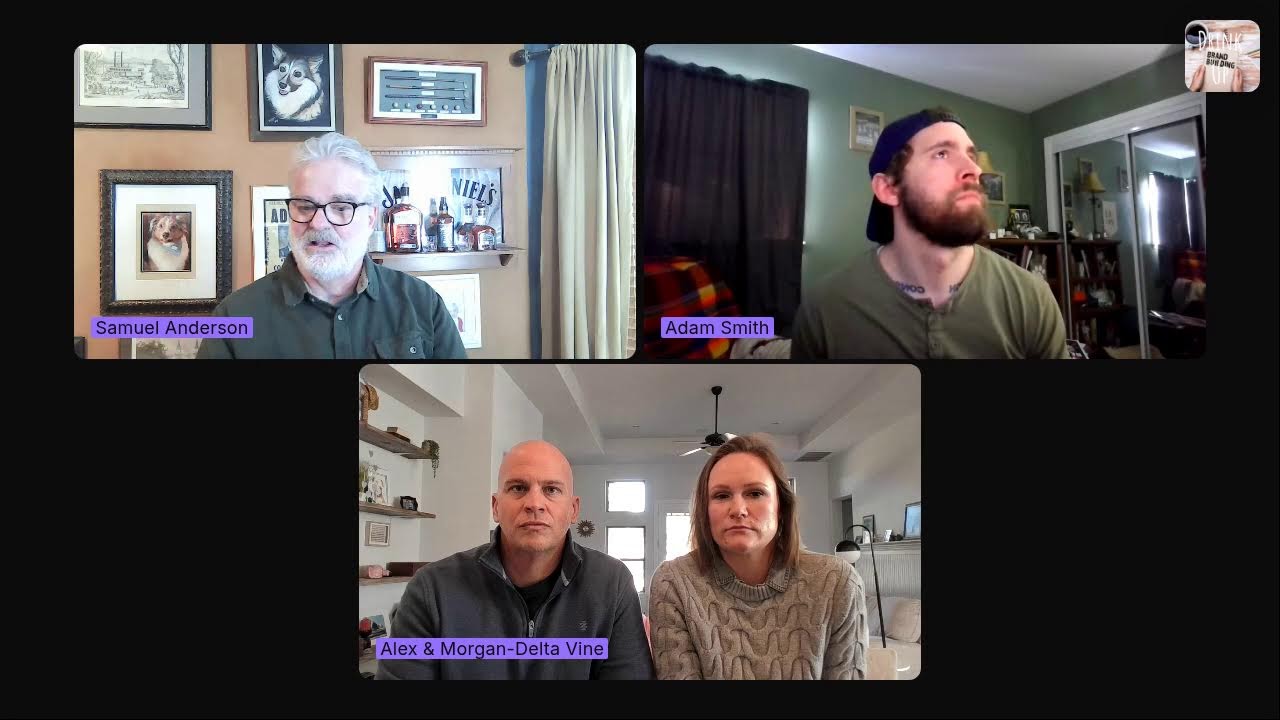
Morgan and Alex of Delta Vine make low-dose THC wine drinks (2.5 mg per can) they sell direct-to-consumer for $5 a trial. They spent about $20 K on formulation, work with co-packers like Ironheart and Braxton Brewing, and are navigating Texas hemp licensing fees that could hit $20-25 K annually.
Chapters
Into it. As always, we'll do shoutouts to our to our sponsors, Sam and Alicia with Bev Assets and Frontline. Frontline. Sir, second word there is just Frontline Beverage. Thank you, Frontline Beverage.
National Sales Agency boots on the ground.
There we go. Frontline Beverage, Ryan Hallman and Rocks Advisors, Jay Williams and Freebird, and our obligatory Jay Williams Freebird cam shot for the morning. Bingo, there it is. And, uh, finally, uh, myself and Alias Advising. So, uh, with that, we'll jump right into it. Alex and Morgan, uh, again, welcome. And I know we did it a little bit before we got on, but give us just a little bit on who you are, what you do, where you live, how we got here.
Yeah, sure, I'll start. I'm Morgan, this is Alex. Uh, we, uh, have been married for a handful of years. We're based out of Austin, Texas, and we started Delta Vine. The idea came to us about 2 years ago after— he is a firefighter and got approved for the THC gummies, so it actually helped him sleep a bit and relax and be able to just function a lot better.
Sure.
So as we started doing that, I was like, I'm a wine kind of girl. And realized that everything out there right now, they're all seltzers and they're all 10 milligrams. I'm not like a gummy or a smoker.
Are you the only wine-based, um, hemp-based product or wine? Like, yeah, wine product.
Yeah, that we've been able to find. I remember Googling it because I was like, if I can find it, I'm gonna buy it, and I could not find anything. Um, so we realized that there was a hole in the market and we just started kind of figuring it out from there. We Uh, just tested milligrams and what we wanted to do. We just had conversations about what it would look like, what it felt like, what we were as a brand, and went live about a year ago.
Wow, that's awesome. Congratulations.
And, uh, you're right.
I'm sorry, go ahead.
Sorry.
No, I was just gonna say, uh, uh, as I mentioned before we got on, I've got a couple family members who are in the firefighter space, and, you know, there's like every year now there's Obviously need for that across the country, but there's always the, the massive California fires every summer, and, and they're in Reno, and that's a long story for another day. But thank you for, uh, the effort that you put in there, as well as, you know, Morgan, and, uh, just the two of you in general. Sam and I work with folks all the time who have day jobs and are trying to build brands on the side, and we know it's not easy. So kudos to you for doing so.
Yeah, I got a, I got a brand called Snazzy Beverage, and he's a firefighter.
Oh cool.
Um, and, uh, David Peterson.
Oh, I didn't know that. No, Dave was a firefighter.
Yeah, he's a— yeah, he— I think he's a paramedic or something now or whatever. Uh, but, uh, yeah, he's grown up around that.
So I was literally just telling these guys before we got on that my brothers in Reno, one of them started as a paramedic, the other was a firefighter, and then they both got trained in the other's field, right?
Um, I was a wannabe fireman, but I couldn't make the cut.
Probably better off.
You're right. So, so the, the THC, you know, beverage, you kind of walked us through a little bit of, of the impetus behind the THC piece of things and the impetus behind the wine piece of things. But, you know, for me, I'll try and tee this up in a way that makes sense. So I talked to a lot of brands who want to make a beverage, whether it's an energy drink or anything else, and they don't understand what a commercial formula looks like, right? Something that a co-packer will actually engage with. And that even extends into the non-alc space for people just making sodas, right? So when you start to look at something that, that is getting more and more regulated, and not without good reason, right? Like, it's an, it's an intoxicant of sorts.
Yeah.
But how did you guys go from what Morgan mentioned, which was the, the sort of at-home trialing of, hey, this is the dosage we like, this is the the look and feel we want, which is obviously super important. But how did you take it from that to something that a co-packer would be willing to work with? Because I love— I think I know what the answer is, but I love hearing this story firsthand.
Yeah, it's been— it's a ride. So from our backgrounds, you can tell we, we had no background in business, beverages, formulation, anything. So it was all completely brand new to us.
Yeah, that's probably how we get all y'all into this category is you don't know what you're doing.
Yeah, you're not, you're not wrong.
If you knew, you wouldn't have done it.
Right. And, you know, we, we The idea was there. We're like, you know, this is— this seems like a good idea to us. What's the next— it was always just what's the next step, right? So we had the idea, that's great. And like you said, how do we create a formula? What do we do with that information? So literally just jumped on Google. We found a couple of companies across the country that will make you a commercial formula. We went with one called Power Brands out in LA.
Oh sure, shout out to Power Brands for sure.
They were great. We loved them. And it was literally just reaching out on their contact form and saying, you know, we have this idea, What's our next step? Um, and they— we set up a, a call with them because we're obviously in Texas, they're in LA. Just set up a call with them and they kind of walked us through, you know, what the process would look like, the pricing, the timeline, and whatnot. Um, and basically it started and they had us fill out a whole bunch of forms on, you know, what we wanted the flavor to taste like, what we wanted it to look like, uh, milligrams, uh, packaging. And these were all things we had not thought of at all. in any shape, form, or fashion. Um, didn't even really know, like, we put ours in like a 12-ounce sleek can. Didn't even think about that beforehand, you know. So it basically forced us to kind of make some decisions on what we wanted it to taste like. We, you know, we wanted a wine flavor. What does that mean, right? Do we want a Merlot? Do we want a Sauvignon Blanc? What do we want? Like, how do we want that to taste?
No, I gotta go online, I guess, and order it.
Yeah, we, we'll send you some for sure. We want you to go—
I'll give you my address.
Yeah, absolutely. So, you know, they sent us these pretty, pretty in-depth forms, and we just— it literally was handwritten, and we, Morgan and I, sat down and, and thought about it for a couple hours and, and just sent it to them on just the basics on what we wanted. Um, they took that and then made us samples, and they sent us the samples. Uh, we, we have a red flavor and a white flavor, and we just kind of, in our minds, we wanted like a generic red and a generic white is all we were thinking about at first.
Sure.
They sent it to us and it was okay. Um, you know, it was the first, first iteration and they asked for notes. So we gave them a bunch of notes on kind of what we wanted, what we liked, what we didn't like, where we wanted the flavor to be more or less. Um, sent them those notes and I would say about 2 months later we actually flew out to LA, uh, and got to sit down with like a food scientist, which was fascinating. We'd never— we had no idea what that— what went into that.
This sounds really expensive. Expensive, by the way. I mean, this wasn't, uh, an inexpensive— so many people think I'm gonna come out with a brand and I got like $5,000. Like, I mean, this is a lot more than that, I'm assuming, to do this whole process from soup to nuts.
It was expensive. It wasn't prohibitively expensive, you know, like we didn't have to put our house up or anything like that. Um, it wasn't, it wasn't terrible. It's doable, you know. We're fortunate enough we have, you know, decent jobs. We don't have kids or anything like that. We had some assets and we were able to kind of put money into it that way. For that part, obviously, you know, it's gotten a lot more expensive since then, but the actual formulation wasn't as terrible as we thought because, you know, again, having no experience, we had no idea walking into this if we were going to spend half a million dollars just trying to get this thing formulated or what. And it was significantly less expensive than that.
Yeah, I'm just asking that because there's people that have dreams, right? We talk to a lot of founders or a lot of people like, hey, I'm going to mortgage my house or I got $200,000 I want to spend. I talked to a young man in Alabama And he had saved about $250,000 and he started talking to us. He wanted to come out with a functional brand because I know a couple of influencers and stuff like that and I don't know what the number is to get started. Then I've talked to other people, they started with like $50,000. I mean, I don't know the number. That's more Adam's, you know, area. But I'm just curious.
Yeah, we're on the lower end. I want to say the actual formulation process was right around $20,000, I think. So again, it wasn't prohibitively expensive. It's not nothing, but I mean, it's less than a car. It's kind of how we looked at it.
Um, so part of the reason— hi buddy, that's a perfect time for you to be doing that. Um, my Australian Shepherd. Uh, uh, so yeah, shout out— while you were talking, I was pulling up— shout out to, uh, Saul Hirschhorn, who's the, the contact that I have over at Power Brands. Not that that's who you worked with necessarily, but, uh, um, I was pulling up some of the pricing lists because I, you know, like to know who's who in the zoo and what they're offering. So I can bring business to them when the time comes. Uh, looking at pricing lists, yeah, I mean, that $20 grand's right in the range. And it's funny, I've had a lot of conversations in the last week of like just brands who will say things like, you know, what should I pay for formulations, right? And obviously that can ebb and flow a little bit based on the complexity or the simplicity of what you're looking to make. But, you know, I— yeah, go ahead.
Not right now, but see, when you go live, man, we just, we get things going here, man.
Uh, but I tell people all the time, you know, if you have somebody Within the realm of normalcy for a product, right? When you're not trying to put, you know, curdled milk in a 5-ounce shot or something like that, right? Like, um, you shouldn't pay $50 grand for formulations. You also shouldn't pay $500, right? Like, there's problems at both ends of that spectrum and the sweet spot's somewhere in the middle. Um, so again, shout out to Power Brands. I'm really, I'm super glad to hear that, uh, that you guys worked with somebody reputable like that and that you had a positive experience. Um, in terms of, of taking that to— because again, this is, this is a conversation I have all day, every day with folks— in terms of taking that and kind of work with Power Brands to production, right? That's often the work that I end up doing. And so I'm curious, did you guys do that on your own? I know, I believe Power Brands has some services they offer that might be similar to mine where they could help you through that, but Did you guys just piecemeal that together? How did that go?
Yeah, we basically just piecemealed it together. Um, you know, I, I'm not sure. I know Power Brands used to have kind of a formulation facility in that. From what we talked to them, they don't really do that anymore. At least they took a pause on it when we were going through. Um, so we got— when we got our commercial formula, you know, obviously we had the recipe itself, and then they put down where they sourced their materials from just on the page. So, you know, me being the guy with no experience, I just jumped on and put everyone on a group email and emailed every vendor. I tried to blind carbon copy everyone, didn't work out very well. So apologies to everybody.
Apologies.
But, you know, it's just one of the small things you work through. But, you know, it ended up working out, you know. So we had the contact information for, I think we have something like 7 or 8, you know, different ingredients coming from different vendors.
Sure.
Um, I literally just reached out either via, by a contact form or the contact person that they had and just said, hey, we're, we're looking to make this beverage, we need this product, please help me. I don't know how to order this. I don't really know what quantities they come in, right? Because, you know, when we got the samples, they were very, very, you know, 12-ounce samples. So they tell us the percentage of what it's going to be, right? And then our commercial formula is based off 1,000 gallons, right? That's pretty standard. Um, and it tells you how much. So reached out to them. Well, at the same time, while we were reaching out to them, we had to find a co-packer, um, which again, no idea how to do that. So jumped on Google, started looking, um, and that first run we ended up finding this company called Ironheart.
Yeah.
Um, really interesting. They're a company that basically— I don't know if you all know them or have worked with them. They were great. Um, but briefly, basically, basically they are a company that finds producers, breweries, places like that, kind of in certain parts of the country, and will bring their people in to use their facility to make whatever product you have.
So— Bingo. Yeah.
Yeah.
So we reached out to them, they popped up, had a call with— I can't remember the gentleman's name. Very nice guy. He was phenomenal. We had a call with him and just kind of explained what we were looking for. Again, they only work in certain areas, so we ended up finding a brewery up in the Cincinnati area. Northern Kentucky, Southern Ohio called Braxton Brewing. Again, phenomenal. I would say we lucked out on pretty much every step of the way. They were so great with 2 new people who had no idea what they were doing with a million questions. So reached out to them, explained what we wanted. They kind of told us their minimums, which was 1,000 gallons per SKU, which worked out well because that's what our formula was for. And we're like, let's just try Let's try it. So talk to the vendors, worked out, you know, how much to buy, how to send it, all that. Send it to, um, Braxton, and they— Ironheart formulated it for us.
Very cool. Um, yeah, so yes, Ironheart's a— again, shout out to them. Might have been Kenny or Brian with Ironheart.
Brian.
Brian. Very cool. Um, yeah, again, I'm looking at my— see, last time I emailed Brian was first week of December. Um, uh, so switching gears a little bit, which again, I, I, it's so incredibly rare because a lot of the work I end up getting looped into is people did not have the good fortune that you did to find folks who worked out, right? Positive intents or not. Um, I usually end up getting looped in with folks who maybe found somebody, it wasn't a great fit, and it kind of ended up feeling like square pegs and round holes.
Right.
Um, so the fact that you found both Power Brands and Ironheart and Braxton all sort of at—
these are all legit places, Adam. These are places they find the right people.
Yeah, I'm familiar by name with Braxton. I've not personally worked with them, but again, if the Ironheart team is saying that they've, they've got their stuff together, I'm, I'm going to take that at face value.
So it's good that you guys did that. So when I open up my, my beverage brand I'll definitely call the 3 of you.
Yeah. Um, so I think switching gears a little bit, uh, and this gets kind of into Sam's world is— and Morgan, you were going over it a little bit before the call— is like, so tell us a little bit more in terms of, you know, the liquid. You know, why 2.5 milligrams? Why a kind of a red blend and a white blend? Do you want to do, you know, more specific flavor profiles later? How are you— you mentioned, um, uh, direct-to-consumer and having some pushback from distributors, but, you know, how are you trying to thread that needle on telling the story of the liquid and the product itself and building the brand?
Yeah, so we, um, originally we wanted to start out with like the, the red and the white, just kind of basic. I guess what we call it is like a table wine option.
Yeah, okay.
Um, we wanted to just be like simple across the board. If you like a dry or a sweet, like No one will be offended by either of these if you are a wine drinker. We just kind of wanted it to be like our, our core products.
Yeah.
And we decided to go with the 2 because we didn't want to choose red over white because we know, myself included, people have very specific tendencies towards like, if they want, if they're red wine, then they don't want to try a white wine, or they'll try a white wine, but they don't want to try a red wine, which actually has changed a little bit Since we've brought these out. But, um, and then we went with the 2.5 milligrams. I'm not, um, an imbiber, if you will, so I wanted something that would just feel like a single glass of wine. So we didn't want to have anyone have drops. Like, I've seen drops out there, and at the end of the night, you're having fun with friends. We didn't want to be like, oh, I need 2.5 drops in my drink right now on the side, and it's like not chemistry, you know? You can open this, you know, you're getting 2.5 milligrams in here and be done with it. So that's kind of where we started with our— kind of where we started with like the formulations of how we came up with those, those ideas. Anything to add?
Nope, that's it. And then you'd asked about the next, you know, do we have other flavors? We definitely have a few different flavors. The next one we want to do is like a rosé. And, you know, We have some friends, uh, some of Morgan's, um, family lives up in Michigan and they really love sweet wines. Yeah, we'll do something sweet at some point.
Yeah, sure. A mulled wine for Christmas time would be great. Uh, yeah, we've got a lot of ideas.
Okay, hell yeah, that'd be cool.
Yeah, that's great. I mean, you definitely— absolutely in the marketplace. What— so if I— I mean, if I could come in with a couple questions, um, I think, or, um, Remind me, so you're in Austin, Texas. Are you sold in stores in Texas or just online right now?
So we're sold in a handful of stores. When we first started, again, having no idea what we were doing, we didn't even know how to— we got all this product down, we drove it down from Cincinnati to Austin, put it in the back of a Penske truck and drove it down. Terrible idea. Don't recommend it.
Horrible.
24 straight hours in the car. It was awful. Pallets fell over. It was miserable.
Nightmare.
But we got it down here. Um, and then we were like, what do we do? We have 20,000 cans. What do we do with this? So we just started reaching out to people either on Instagram or through their websites, emailing, saying, hey, will you carry us? So we got 4 or 5 stores, um, who just took a fly on us and carried us. Well, at the same time, we were trying to— we're like, man, this is— we can't sell it store to store. Like, we need to do this in a much bigger fashion. How do we do that? So that's when we started, um, we realized we needed to redo our website because we just basically created our own website on Squarespace and just kind of— And it looked great, but it didn't look professional, you know?
Right.
So we reached out to a company to redo the website, which is the website you see now. And then at the same time, we're like, okay, we're gonna go direct to consumer. Let's start talking to distributors. So we started talking to distributors and reaching out. And like Morgan said, people really like it. But, you know, with the Texas laws, there's a lot changing right now. And one thing they're trying to do is raise the fees for a retail license. Right now, it's just a couple hundred dollars for a retail license, and they're trying to raise that to between $20,000 and $25,000.
What?
Yeah, they're trying to, they're trying to kill the industry that way is what, is what they're basically trying to do. Um, they're trying to outlaw a bunch of stuff. Um, so there's—
So all the smoke shops and everything up and down the street in Texas will be done.
Done. And that, and that's, that's, that seems to be kind of the goal now. You know, a little background in Texas earlier this year, actually right when we launched our product, they outlawed, um, they put forth a bill in the Senate to make all hemp products illegal. So that made it all the way to the governor's desk.
Greg did veto that though, didn't he?
Yep, it made it all the way to the governor's desk. He vetoed it and said, no, we're just going to regulate this, which makes a lot of sense. Put some regulations down. The people that were backing the ban bill, the politicians, decided that, okay, fine, we'll make the rules so prohibitive that you can't, you can't run a hemp business there. So for us, a yearly license would be $20,000. For the retail places, it'd be about $25,000. per year.
Um, so as we're reaching out to sell to retail, you have to have a $20,000 license as well?
Yes, sir. Yeah, so it would, it would basically kill most of the industry except for the big players.
Um, and what happened to helping small businesses, man?
Yeah, you're not wrong. Um, so they put forth those rules about a month ago. There was a bunch of outrage, so, you know, the, the, the Hemp Council is fighting against it. You know, there's a lot of, a lot of good people working to make that not so. So the rules aren't set in place yet. It just seems like that's kind of the writing on the wall. So as we were reaching out to these distributors, a lot of those distributors said, we love the product, we have to wait for the rules to come into play because if the— if it's going to cost me $20,000 a year as a license, we're going to get out of the space, is what we were told.
Yep.
So the distributor part for us is paused, and that's why we kind of pivoted to direct-to-consumer because we're like, well, we're getting some traction there. Let's put some money into spreading the awareness of the brand so we can just do direct-to-consumer that way for now. For now.
You have a buy now button on your website?
Yeah, we've got a lot of buttons.
Yeah, that's one of them. Yeah, yeah, we got that.
We may know about that. Alicia, good morning, Alicia. She knows about that. Vargo, my partner's on and she's a D2C expert. And then Robert Cogan out of Canada is alive and well, so maybe he can take you into Canada. He's always a frequent, uh, um, with us. We actually almost come with like a tri-host. He likes to join in occasionally. He's a great guy. So, um, so the journey— so you've been on a year? So a year you've been around?
Uh, we've had product for just right around a year. The idea was about 2 years ago, product about a year.
Got it. And then how is your business? Is it growing?
Yeah. Which is shocking. We have very little advertising at the moment. We're just starting to do that. Um, we are on a website called Soberish, which is great.
Okay.
And they're amazing. So we do a lot of, uh, sales and, uh, work through them, but we also get on our own website right now too. So we're about to amp up our advertising through Meta with a professional company who knows what they're doing. Um, so that should help us, but It's kind of awesome how great, like, we've actually been growing organically.
Got it. And is the plan to actually get into distribution? I understand everything you explained to me, the $20,000 here, $25,000. Do you wanna, um, like, how many states are buying your product right now through, uh, your DTC?
I mean, it's pretty much all over the country. Um, the only place we really can't sell is Idaho. Uh, their laws are pretty restrictive there, but I mean, pretty much every other state we're, we're getting Traction in the Northeast actually is huge for some reason.
Northeast and Florida, there's a— we get a ton of sales there.
Okay, we'd love to. We'd love to get distributors. Um, you know, as you know, as you both know, it's, you know, it's difficult to get in. It's, it's some steps. Um, so, but yeah, we'd love to get into distribution.
Okay, well, we can talk about that. I was just curious. So you have a story, by the way. The reason I asked that question, so many people think they don't have a path, especially with your product. DTC actually helps you build a story. So when you go talk to distribute— distributors, be it in the Northeast or you said Florida, at least you can tell that distributor, look, I have a set of consumers that are looking for my brand, right?
Yes.
So that can help you obviously build your product. Plus your differentiator is that you're basically this hemp-based, you know, that tastes like a wine. I guess it's not a wine, but it tastes like a wine.
Right.
So, which is really interesting because if you think about the wine industry and what they're going through, this is, this is an opportunity to maybe capture that consumer, that occasion, you know, in terms of what they're looking for. And then also your low dose. I believe that's where the category is going to go. You know, I think they're going to, I think they're going anywhere between like 5 milligrams or lower. I think that's where it's gonna go. I think these, these cans of 50 milligrams, I don't think that they're gonna exist. That's my prediction.
Agreed. I think there's also something that we do because we're low dose and a product that's not really out there right now, where people who are curious about this but maybe have never actually done it or had any kind of THC beverage, we offer a single can on our website for $5. If someone wants to, it's like a low buy-in for them.
Wow, that's including shipping too?
Yeah, because we, we love our product and we actually, we just want people to try it. And since we can't really go out and do sampling like the traditional way, that's our way of doing it. Um, and I think it's like a good way for people, like if they're nervous about it, just one single can straight to their door. Um, is—
Can you show your—
can—
I mean, I'm going to do this, Adam. You might have to get them there, but can Can you show your website?
Hang on, I'm looking at it right now. Oh, please share screen. Come on, you know you want to.
There we go.
Boom.
Ah, cool.
Right there, $5. Yep, very cool. So, so what's that?
What's the link to the website so I know?
Oh yeah, enjoydeltavine.com. I'll put it in the chat. You can throw it up on the screen.
Okay.
So you said, uh, you made product about a year ago. I mean, are you coming up on, you know, doing another production run? Are you looking at that? I guess, where does that sit?
Yeah, we're actually in the middle of it right now. Uh, so we're— you'll probably know them. It's a company called Meta Brand up in New Jersey, Edison, New Jersey. You know, like we said, Braxton was great, but, you know, using Ironheart and Braxton was expensive, and, you know, it's a lot of logistics.
Sure.
I don't want to say problems, but, you know, hurdles to kind of get through. So we wanted someone who was more of a specific manufacturer, specifically if we could get like THC or hemp people. Reached out to them, they were phenomenal, been great, super easy to work with, which is great for us because again, we still have a million questions. So it's It's really easy to ask questions of people who do this all day, every day. So yeah, we're running— we should be having a run there. They should be doing the actual production here in the next week or two. So we should have more product by March 1st. And then we'll keep kind of spinning that up. But it's been— obviously, the first round was, like we said, quite a few hurdles. Many less hurdles this time.
And we're not driving it back ourselves.
Not driving it back ourselves.
Good call. Good, good call. So I'm curious, because again, this is always a moving target for early brands, how did the— I guess forecasting is the word I'm thinking of. Like, I'm sure the first run it was, hey, we're just gonna make what we feel like an adequate minimum is, and then we'll kind of figure it out, because sometimes that's just all you can do, right?
Mm-hmm.
But then from that, you know, obviously you have 12 months of, you know, we got these sales here and these sales here, and this is how the product, you know, maybe it tastes the exact same at day 1 as it does day 300, maybe it doesn't, right? So you have learnings along the way. And so how did that, how did, how did that adjust your plan for your second production?
Yeah, so, uh, you know, we went with Meta because they do have lower minimums, right? Some of these places have minimums that are just, just too high for us right now, right? So still growing. So they had a lower minimum, so we went with their minimum again with the idea that we can, we can now spin up another run much quicker this time. So we're not just sitting on product, um, we will be able to kind of continuously have it.
Um, good for you guys, part of it. No, it's, uh, again, I asked the question because it seems like you guys have taken a really, um, and, and I don't say this because I, I'm trying to put words in your mouth, but, but, you know, I talked to a lot of early-stage brand owners, some of whom are younger, and I don't mean that as a knock, but who maybe have seen a little bit less of life than us.
Knocking on yourself there, Adam.
Right.
And what I mean by that is, you know, more than a few of the folks that I talk to will say, you know, yeah, I'm gonna, you know, prime example, I got a gentleman who lives up in the New York area and He's like, well, I'm gonna go make 2 truckloads of product. I'm like, I'd really recommend you don't, um, and here's why. He's like, well, yeah, but my, my per unit cost isn't gonna be as good if I, if I don't make X amount of product.
Yeah, but you got like 12 months to sell that stuff, right?
Yep, 12 months.
Right. And I'm like, hey, hey buddy, I'm, I'm aware of the cost, you know, inversion in terms of volume produced versus per unit price. But cash flow is also a very real thing and you're going to tie up a shitload of money making that much product.
Yeah, I got a couple of clients that they're trying to figure out how to move their products, quite frankly.
Yeah.
And so I, yeah, I applaud you guys for taking a very pragmatic approach because not everybody does.
Thank you.
Yeah, it's interesting. I mean, I always tell people, and I'm probably going to scare you what I'm about to say, but I'll just say it. And Adam and Alex Morgan challenged me. I think you should be prepared to lose money for 3 to 5 years with your product to be competitive.
Oh, sure.
Absolutely.
Yeah.
Yeah.
I mean, I have brands like, well, I'm going to be $19.99 because I have the most awesome ingredients. Mine tastes better than everybody else. I'm like, no, the reason you're $19.99 is your can cost is $2.75. You need to get your tank off a little buck anyway.
No, you're—
this—
so this drives to that a little bit. I'm curious if you guys get the ask, and I'll preface it with, I like wine. My wife and I had a bottle.
Hey, Joey says hello, by the way, Padone. She's, uh, she's in the audience. So, hi, Joey. She says, I'm so happy that Yaro got on this pod.
We're happy too.
We've got a few people in the comments. Good morning, Alicia, obviously Joey, and, uh, Cogs. Good to see you all. Do you guys ever get the question from, you know, the more initiated wine drinkers of the world, or maybe distributors or retailers, that like a typical glass of wine is a 5-ounce pour, right? And you're serving it in a 12-ounce can, which don't get me wrong, for, you know, the Luddites like me, I'm like, I'm gonna have 12 ounces either way. I don't care, right? Do you get that question? And I guess, how do you handle that from like just a sales and expectation setting standpoint with folks?
So even straight up on the can, we say it's inspired, wine-inspired. Um, and the fact that it's a 12-ounce, we wanted it to be a little bit easier, I guess, to drink than a typical glass of wine.
Okay.
Um, so it's never gonna fool anyone when you're drinking this. Like, I'm not gonna have a glass of red wine and then, uh, like pour Delta Vine and not know the difference.
Sure.
That's kind of where we fall into it. It's kind of to scratch the itch a little bit of like, I want wine, I want flavor. I— that's non-carbonated, uh, also, which is a huge hit with a lot of people. They don't like the carbonation in a lot of beverages. Um, so that's kind of how we answer that. We're inspired by the wine. We're not trying to fool really anyone.
Yeah, but the value though, if I'm a wine drinker and it's inspired by wine, The value versus getting a glass of wine. What's a glass of wine cost? Maybe Alicia, you're out in the audience there. What does a glass of wine cost at a restaurant? It's like $12, probably.
$8 to $12, depending on what you're getting. Typically, I'd say.
Yeah, right. You can get that can for how much? And how much can you get your can for? $5?
$5 for a single can.
Yeah.
Yeah, single can. So the value is there, plus you're getting more ounces.
Right. I would like to try something new.
I think you talk about that because people are looking for occasions. I mean, look, the adult drinking occasion— drinking is not going down. These people are just switching from occasions. So maybe I would go out and have 3 glasses of wine. Maybe I have 1 glass of wine, I have your product and a water.
Right, right.
And of course, even maybe I stay out a little longer. So the— so if you know what occasion you're going after, so I think your message is really spot on.
Thank you. Yeah, um, and to kind of expand on, on your question, her answer, a lot of it is just the, like she said, the education of it, right? It's explaining to people. Because we, we used to sell at a farmer's market here in Texas. We had to stop because of some regulation stuff, but it was super fun because you get to just talk to people, give samples, and people were always like, what is this? How is this like wine? How is it not? So you kind of get to explain like, no, yes it is, you know, it's 12 ounces, but you're not drinking 2 glasses of wine, you're drinking 1. And kind of explaining that, um, was one, fun, and B, like necessary because You know, hemp is new to a lot of people. And, you know, to explain like, yes, one can is one glass of wine, people kind of like, oh, okay, that's— I'm not smoking like a full joint, I'm not taking a gummy. This is more of like having— it's like drinking one glass of wine.
In my case, my age, they called it dirt weed.
There you go.
Yeah.
And if you are a smoker, there's a lot of people who don't drink alcohol. They can have a joint and then they can have Delta-9. Divine and do, do it supplementary. Like, it's fine for them. Like, they know what they're getting into.
I know I ate a gummy over, uh, is it Thanksgiving? I had family over. Maybe it was Christmas, I can't remember. But anyway, um, the Polar Express, the movie Polar Express was on. So I ate this gummy from Charlotte's Web, right? It was like, uh, like a 10 milligram or something, right? And I just like, it was the best movie ever watched. And then I proceeded to watch Frosty the Snowman.
Oh man.
And I discovered on Frosty the Snowman, I, I shit you not, excuse my language, but Adam's growing on me. I shit you not, there's a, there's a clip in there where he, his body, he turns his head but his body doesn't turn. And for all the years I've been watching Frosty the Snowman, I never saw that until I was on weed. And I watched it after and it is there.
That's great.
Oh, that's great.
I love you.
So I'm gonna get my Delta Vine and watch my next movie, uh, for the next holiday. So for Valentine's Day, we'll have your product. Oh yeah, Lord knows what I'll discover.
Um, so, so Cogs, as Cogs is one to do, is, uh, throwing some names into the chat because I think he's on the move, so he's being a little, a little, uh, tight-lipped about it keyboard-wise. But he said Fun Bev in Columbus, Ohio, or Lipari, L-I-P-A-R-I. Um, which I just looked up. La Pari looks like a foods distributor, so I think he's trying to throw out some names of folks that might be interested from a distribution standpoint because that is his world. Um, which, thank you, Coggs, appreciate it as always.
Yeah.
Um, yeah, I mean, I, again, I applaud you guys and I'll take the opportunity to give you a compliment. A lot of the brands that, that I talk to, and I know Sam feels this too, is regardless of whether it's an alk brand or a non-alk or a hemp-derived or functional, whether that's caffeine or anything else, right? Like, consumers in general have, have such a, a locked-in baseline of what they know and what they don't in a lot of these buckets, right? Like, people are very familiar with caffeine, they're very familiar with alcohol, right? So on and so forth. So when you try to come in with a product, for good reason, that is an alternative to that, educating people is such a massive part of it. And so many brands don't think it's necessary, or even if they do agree that it's necessary, don't spend the right amount of time doing it, right? So good on you for having that farmers market experience and for taking that approach of like, hey, we're going to tell you things that help you understand this product because it's the only way you're going to connect with it.
Thank you. Yeah, thank you. Yeah, of course.
And we even learned about our customers from there. Like, we were expecting a lot of Gen X, um, or no, Gen Z, Gen Zers, to like just drink this down, which they do enjoy it. But we get a lot of 60-plus-year-olds that came through and loved it because they could still relax. It helped them sleep at night, help their joints. And I was not expecting that at all. So it was great to be able to do that.
The 60-plus is going to surprise you, man. We're driving everything in the category. Um, so don't, don't give up on us. I just want to go back to Texas and a handful of customers you have. Are they building your business? Are they continuing to order your product?
They are, yeah. So we, we have subscription on the website and we've just over the past couple of weeks, more and more people have been subscribing, which has been cool. A lot of repeat orders on the website. Soberish doesn't really have a subscription model, but we've had multiple people you know, reordering, which is really cool. Um, like we said, we haven't done a lot of advertising yet, so once the advertising kind of kicks off, we think it's going to be—
So have you broken down, like, do you understand, like, like how many customers do you have and what percentage of those are reordering?
Uh, we haven't, we haven't, we haven't broken that down yet. Um, yeah, but we take a look at that.
I mean, so in terms of what's your base, and of that base, how many is reordering? And also start to look at your velocity. And then back to your, your, your brick and mortar in Texas. Those are like established customers. They've stuck with you and they're reordering.
Yeah.
Right. So look at what they're ordering on a weekly and monthly basis with you and figure out how you can continue to increase that velocity and activate them. Because what that's going to do when you go talk to a distributor, they're going to want to know those metrics. They're going to— how many consumers are you touching? How much volume are you selling? What is the reorder rate? You know, what is the velocity? You know, out of those customers, what percentage are, you know, reordering or not? Like, I just did this for a distillery, one of our clients, and they, you know, we were having this conversation. They're like, well, I was in 400 accounts in Colorado last year. I'm like, well, how many reordered? She goes, well, based on this math, I think maybe like 25% or something. But it was just a fictitious number. I said, tell you what, give me all your sales data for the last 12 months listed by account, by month, and I'll tell you who reordered. And simple math, it's like they only ordered once a month, they only ordered once. So they ordered like month 1 and 2, they ordered twice. And then you start to rank those people in terms of what you're doing. But distribution wants to know that. Uh, piece. So sorry for going— being a preach this morning, but—
No, it makes a lot— we'll take anything. That makes a lot of sense.
Yeah, we're new to this, so we don't know what we don't know, so we're going to listen to anyone who will tell us anything.
Well, so, so maybe because we got about 15-20 minutes left here, is there anything— because I'm sure there's several things, but I'm trying to phrase this well enough. Is there anything in particular right now that you're like, you know, this one or these one or two things are the nut that we're trying to crack today, right? Um, or anything that, you know, we haven't asked that you want people to know?
Yeah, um, I would say the, the, our focus now, the biggest nut we're trying to crack obviously is the growing the sales is, is difficult, right? So like we've touched on a little bit, but You know, everything, pretty much everything in business for us is a struggle right now, right? Like, it's— we're trying to get the name out there, we're trying to educate people, all of that. So sure, our biggest thing right now is how do we get people to— how do we educate people that we are a brand and that people want to order and then reorder? And that's been where we've been kind of sticking. So just little bits, we jumped on like things like Google Ads was one thing we tried to do just ourselves. didn't really understand it. So we're like, oh, how do we— what— how do we basically— how do we take the money that we have, the time that we have, and put that to the best use so the most people can find out about our product?
Sure.
And I would say that's been the most difficult thing over the past, you know, month or so that we've really been focusing on, is our big focus. Um, uh, and, you know, we partnered with a company up in Boston called Cannabis Creative Group. CCG. They're, they're a cannabis marketing business. Um, and we've started talking to them about a month ago, I'd say. Um, and they've been, they've been really great to us. And we just— they've been kind of walking us through like, what is the best— you know, it's a marketing company has so many different branches basically, right? You can do, you can do Google Ads, you can do Meta Ads, they'll do your SEO, they'll do, you know, whatever kind of marketing or advertising you want to do. So for us, we again, we're like, we don't know What what moves the needle, what doesn't, and what's legal and what's not with them.
Well, it sounds sounds something like drink pairings must be moving the needle with Alicia this morning because she's like their drink pairings on their website are awesome. No, talk about that a little bit. So what are your drink pairings?
Oh goodness, they're silly.
It's part of our brand. So a lot of like that's right. Yeah, it'll be like pairs well with like a housewise. rerun. Or so like you can imagine yourself sitting at home and having a can of Delta Vine relaxing. Um, those kind of fun casual—
That's occasion-based marketing, by the way, and that would resonate with the consumer. And you should stick on message with that, you know, because you obviously drew Alicia in and, and, uh, you know, got a laugh out of Adam, but that stuff actually sticks.
Because that makes sense.
What you're talking about is it's going to resonate with the soccer mom, you know, whatever, whatever, for the soccer mom that just watched 20 soccer matches and got home.
Yep. I mean, it makes a little— yeah, you're right. And like, one of the— I think one of the smartest things we did was, you know, when we first got the brand, we didn't really— we had kind of an idea of what we wanted it to be. We didn't want it to be super pretentious. We wanted it to be a little bit, you know, funny and, you know, kind of silly and fun, right? You just want to have a drink. have a good time. It's not serious. And so we, when we built our website, we put some, some time and thought into the actual branding of it and came up with a lot of the stuff that's on the website. And it just made a lot of sense, right? It was just, it was stuff that made us giggle. So we're like, if it makes us giggle, it's gonna make someone else giggle.
Yeah. I mean, you got Adam to laugh, for heaven's sakes. He never laughs.
Take it. Very serious man.
So rigid over here. Yeah. Very serious guy. Very cool. Okay, well, I think— trying to think if there's anything else. Sam, I'm— what else? What have we not asked?
I don't know. Is there any? So, so I'll tell you what, we ask every founder that comes on the podcast a very important question. I think I already gave you the answer to the test. There's not an answer. The question you can answer however you want, but the question we ask everybody that comes on is, is what's the difference between success I mean, it's, it's a great question, and it's, it's definitely something you need to put some thought into, right, as starting a business.
This is the first business we've started, so as we've harped on, it's all completely new to us. And I would say the biggest kind of hurdle throughout this whole process has been there's always a next problem, right? You never, you're never completely problem-free. There's always a problem with marketing, distribution, co-packing, your vendors. It's a challenge.
Are you saying that every day is a perfect day when you wake up and your plan that you developed is going to crush it?
If you think something's perfect, something's wrong. You just don't know it yet.
Yeah. Um, so with that being said, right, we wake up every day, we say we either have 2 choices, right? We either solve whatever problem is in front of us or we quit. That's— those are the 2 options that we have. You either move forward with what— and create this business, or we put the end to it. I would say that's the difference between success and failure, right, is when do you throw in the towel. Um, and, you know, some— obviously some of the stuff is completely out of your control, but if we're talking about just what you can control, if there's a way forward, just figure it out, right? Just figure out how to do it. If you need money, there's a way to find money. There's a way to find an investor, find a lender, something like that.
So you're resilient.
I mean, you're just— you're persistent and resilient.
Yeah. And it's an everyday thing.
So what keeps you going then? So that's great, but what keeps you going? Because this isn't for the faint of heart.
No fear. It comes up a lot. Um, and then in the end, like, we do get good— like, we get customers who come back and they give us, like, praises, how much they love it, how much they sleep. And then when we have one at the end of the day, we're like, this is good. Like, we love our product. I've quit, um, companies before. I work in tech, and there's been times where I'm like, I'm embarrassed to work here because this product sucks. And so I've left companies over that. And when I— like, when we drink Delta Vine, I'm like, this is good, and people just need to try it. And, and that's kind of what pushes us forward. We're not failing because of the product, so we just need to figure it out every day.
It's a challenge. It's a new challenge every day, right? It's, you know, if we weren't doing this, what would we be doing? Just be working our jobs. Like, why not? Why not try to create something, right? Why not go for it? Why not, why not figure out that next challenge?
Is there any innovation coming with your brand? I think we talked about one. Any other innovation coming?
Uh, uh, the next step will be the rosé, and I think we're thinking about like a champagne after that would be the next kind of 2 that we're thinking about.
Um, I still like a mulled wine. Like, I like the idea of a Christmas something, and if it could be warm, but that's gonna take a lot of testing because I don't, I don't know how that's really gonna affect the hemp and the THC levels, like if it's warmed up. But that's down the road.
Mm-hmm.
Something like— You could call Adam, probably can help you with that and figure out.
I'm curious, even on the, on the rosé, I'm assuming that one will be carbonated?
Uh, not— maybe unsure. Um, so we'll probably, you know, the good thing with Power Brands is we can go back to them and say try it carbonated, try it not carbonated, and see kind of which one we like better.
Sure.
Same with the, you know, the champagne, kind of getting, dialing those flavors in was, you know, half art, half science, I would say. They did the science part, and then we kind of sat there and tasted it and said more of this, less of this, which was a lot of fun.
Have you thought about going into like, in addition to cans, maybe going into some bottles?
We originally had thought of that. I think because it is such a space and such a low dose and people are new to this, like we didn't want someone pouring a whole Bottle full, like, like they— like a traditional bottle of wine, and then just overwhelming them with like THC, you know. So this was easier to control the, the dosage. But a bottle, I think, is something going to be down the road as people get more used to this.
Yeah, I mean, I just think in terms of the occasion, like, you know, when you go to the restaurants, all these restaurateurs have all these bottles of wine. Why not position that and do like a test? Do like a bottle, like especially champagne, right? And do it, do it that way. It'd be really interesting to see how that would do. Do like a test. I mean, I always look at brands in kind of 4 phases, right? You test it, you build it, you scale it, sell it or keep it, right?
Yeah.
And you're, you're in the building phase. You've, you have a little bit of testing going on too. But you have a product, you have customers, you know, and you're, you're selling your, your product. So it'd be really interesting. And I have not heard of anybody, um, that in my years they're doing what you're doing in terms of that, which you definitely have a point of, uh, a point of difference. So great job there. So is there any— so, um, we like to kind of go around the circle and stuff. and give you the opportunity, and I'll give Adam an opportunity too. But is there anything that we didn't discuss today? I guess Adam asked earlier, but anything that you, you want to convey about your brand, about, you know, who you are? I've been flashing on the screen how they find you. Anything that we did not discuss that you actually want to discuss today?
I think we covered a lot. I think as owners, I think we're trying to run this in like very intentionally. We're not just— we didn't raise a ton of money and are dumping this, um, into just blindly into a big company. I think that's where we kind of differ from some of these like larger companies and, um, uh, bros who start these big huge companies and it's just kind of overwhelming. We're a true small business who are trying to do this right from the beginning.
Yeah.
And it kind of bleeds into our brand as well. Like, you're drinking this like intentionally. This is 2.5 milligrams. You're not intentionally trying to get blitzed out of your mind when you have one of them. And so like the way we run it is the way our brand is. And I think we're still learning and so are our customers. So—
Well, Alicia says, Alicia says interactive social media pairing campaign, put that personality behind your brand.
We try, we try to do some, uh, that's our social media is us being silly, weird, uh, because also that is something that's a roadblock that we have hit. We can't say on Instagram exactly what we are because, um, the THC is something that block. So we just have to do something weird and fun and hope people, hopefully people are like, what is That, and then they click into our website.
Well, share your lifestyle. We have a brand called High Octane Lemonade, uh, and they're out of Utah, and it's like in a— it's like in a jug, right? And it's lemonade, right? And Mike and Janelle founded it. They're the 2 founders. We represent them, and they do crawling, like they crawl around, and they also will be at like pools and stuff. And then their friends, like, they show the personality of the brand, and they're part of it and weaved in it. Yeah, so I definitely think, um, uh, Alicia's on to something there. Um, can find you in Austin, Texas, can find you online. I'll flash this back up here again. Enjoydeltavine.com. Um, how do they connect? Can they connect with y'all on LinkedIn or anything? Are you on LinkedIn?
Yep, we're on LinkedIn. Um, all of us are on LinkedIn, uh, and then through our, our socials is Enjoy Delta Vine.
All right, and then, uh, uh, tell me about the fireman's calendar coming up.
We'll send you a copy.
It's weird, it's just Alex.
It's just me. Yeah, 12 months of Alex.
Just standing there with different cans.
I was asking the other day, I'm like, are you going to be on the, uh, the, the fireman's, uh, calendar? I think, and then, uh, Morgan's like, hmm, yeah.
Hell yes. I'm imagining—
Anything on your end that you want to cover off? Any final closing thoughts from your standpoint?
For me?
Yeah.
Uh, well, first of all, I gotta go back to the calendar. I think it's Alex, 12 months of Alex, but, uh, you know, watching Housewives, or, you know, uh, you know, whatever the, whatever the pairing is, right? It's the pairing examples, right?
That's a great idea.
Um, I mean, you have him like, you know, like with the helmet on, the whole bit.
Yeah, man, sell out tomorrow.
Oh, fuck, that's funny. Um, no, I mean, again, I think, uh, truly, I mean, it's probably— and Sam knows this, as do most of the folks listening, uh, because they're in a similar boat— but I probably talked to 3 to 5 either, either actual brand owners who've, you know, started the LLC and are going through the formulation process or raising money, or folks who think they want to do that. So kind of folks in those buckets, 3 to 5 folks in those buckets weekly. So you can do the math on how many people that is a year, and I've been doing this for 9 years, so that's a solid number of people. It is very rare that people take a metered and, again, pragmatic approach to their business. It's usually very— and not for bad reasons, obviously you want to be passionate about your business, but people typically take a very emotional stance on things of like, well, I have to be on Amazon, or I have to be at this price, or I have to be at this whatever, as opposed to getting all the information first, making an informed decision that's going to let them live to see another day from a brand perspective. So yeah, my closing thought is just again, like, round of applause, kudos to you guys for, for doing those things and for making it work and, and fighting the good fight and finding good partners like Power Brands and Ironheart and all the folks you've mentioned, Meta, um, to help you out along the way. So, um, I'm super excited to see, you know, innovative stuff like this have a shot and, and, you know, a chance at making it. And, uh, yeah, wish you guys the best. And obviously I'm here to help, as Sam is, where we can. So awesome.
Thank you all very much.
I love the fact is that, that you shared, and I'm probably gonna get this wrong, so please correct me, but when you wake up in the morning, you don't know what you're gonna face in terms of the barriers that come at you, right? But you figure a way around those barriers and you keep on moving forward. And you definitely both have resilience and persistence. And so many people, they don't stay in it, you know, and ultimately they do cash in and give up. But it sounds to me, based on this conversation this morning, you got a great product. As Alicia identified, you got this great personality that you can capitalize on. And you're— there's nothing like it on the market in which you have.
Mm-hmm.
And as Adam said, you have a lot of people that you've tapped into their expertise. So hats off to you to actually, you know, find those people that can keep you moving forward and keep on growing your brand. I think so many founders try to do it themselves, and I think that's a recipe for disaster. Now, some make it, and some of them have the skill set and they figure it out, but I think that's a hard road. So, uh, I'm, yeah, I'm so excited that came on today. I'm excited that Joey came and joined us as well. I want to thank— let's see everybody here— Adam, Alicia, Robert, Joey. Who else joined us? I think that's the crew that joined us this morning. I think there's some people that have not put— I can't see like who joins us in the live session, but there's several others. They just haven't communicated with us this morning. morning. With that, I'm going to ask everybody on this call to remain on the line because we have to upload your video. And for everybody else that's joined us on this Saturday morning, we'll give you the gift of time of 5 minutes. Uh, get to your Saturday, and thanks for joining us.
Thanks, everybody. Have a good weekend.
More from Samuel





He Sold Pickle Shots Out Of His Trunk. Now He Runs The Co-Packer That Won't Bury You In MOQs.






What market do you think gets overlooked most? #Toronto #BrandStrategy #Marketing