Fireside: The Passion Economy with Co-Founder of Patreon
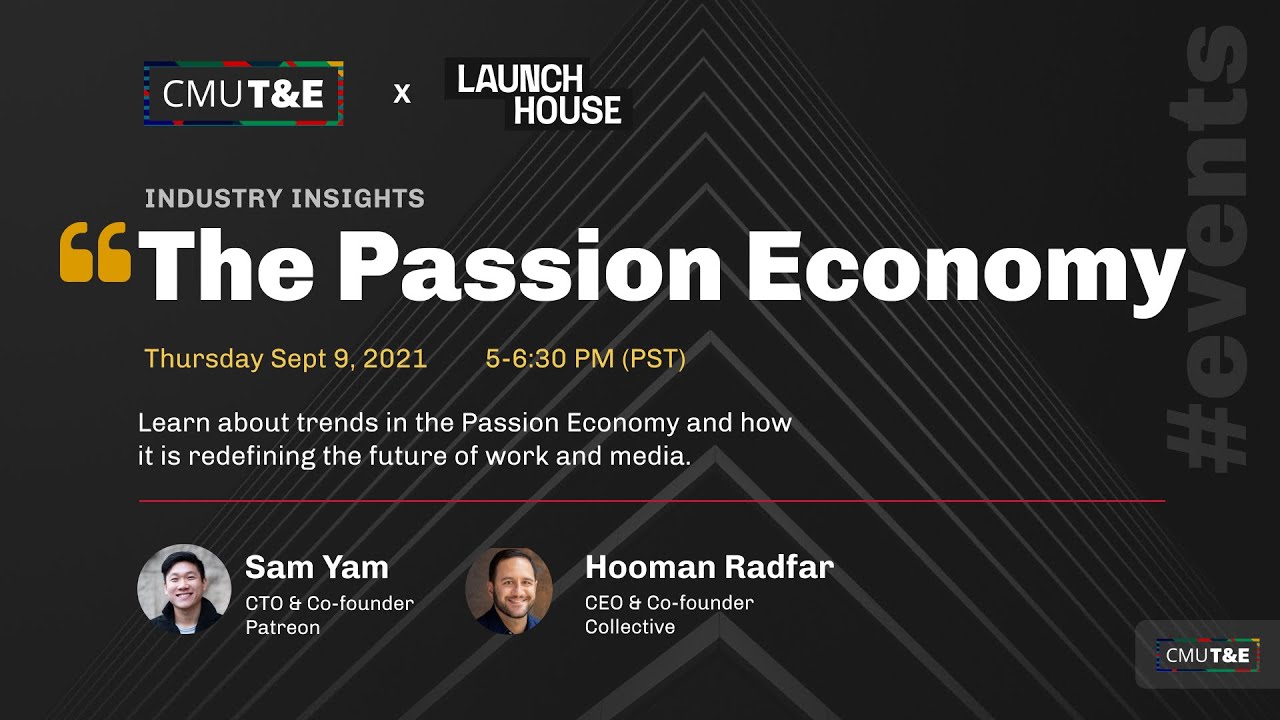
The session, hosted by Carnegie Mellon University’s Tech and Entrepreneurship Alumni Association (CMU TNE) in partnership with Launch House, brings together moderator Hooman Radfar, Patreon co‑founder and CTO Sam Yam, and other community leaders to explore the rapidly evolving passion/creator economy. The conversation defines the passion economy as a shift from commoditized gig work to creator‑driven, expertise‑based value exchange, and positions Patreon as a foundational platform that enables sustainable, membership‑based income for creators. Panelists discuss how creators are seeking ownership of their audiences through tools like Linktree, Beacons, and emerging back‑office services (e.g., Collective, Carrot) to overcome limitations of traditional platforms. They examine the role of emerging technologies—NFTs, crypto DAOs, Discord, Substack, and AI‑generated content—in expanding monetization options while highlighting challenges such as platform lock‑in, DMCA licensing, and the lack of financial services for creators. The discussion also covers Patreon’s network effects, the importance of proof‑of‑concept for early adopters, and the future of creator‑centric business models. Finally, Sam offers practical advice for founders building tools for creators, emphasizing the need for demonstrable value, creator‑first design, and addressing gaps in financial infrastructure and audience ownership.
Chapters
All right. So just to give an introduction about our communities, CMU TNE, which is Carnegie Mellon University's Tech and Entrepreneurship Alumni Association. We organize various events related to industry insights, startup school, founder stories, and also other happy hours during the weekdays. And as part of various such events, we have this special panel discussion on passion economy and where it's going to be that we'll get to know. So now I'll hand it over to Kishan, who will talk a little bit more about TNE.
Hey, y'all, it's amazing to see everyone here today and to have so many people come out. Super excited for this conversation. Uman's been, you know, a proud senior alum founder and has been extremely supportive of this community that we're building. So I'm one of the founders. We started this a few years ago and it's come a long way since then. Our really goal and mission is to bring together CMU entrepreneurs across the globe with the mission of just encouraging and supporting them building and enabling more startups. So as KP mentioned, we do this in a lot of ways. We host events like these. Most of them are just for CMU alums, but this is one of the more public ones we've hosted, but also opportunities to help CMU alums as they're building their companies, whether it's finding co-founders, early hires, or helping alums join startups. So it's come a long way since we've started, now over 6,000 alums. I'll post the link if anyone's a CMU alum here and not already involved, we'd love for you to join. So without further ado, I want to introduce Michael Houck. He's one of the founders of Launch House. I'll let him share more about Launch House, but I actually participated in one of their cohorts last July. It was an incredible experience. So what they're doing to support founders and bring like-minded folks together is really exciting, especially around the creator and passion economy. So we'll share more about Launch House today, and we're really excited to be co-hosting with Launch House. Michael, over to you.
Yeah, Kishan, same here. Really loved having you out to our LA house in July and have enjoyed collaborating with you since then as well. What's up, everyone? So for those who don't know, Launch House is a community of founders and creators. Started in Tulum in Mexico last year, and then now we have a house in Beverly Hills and another one in Chelsea in New York. We do cohort programs each month. We bring about 20 founders to live in each house. Some of the programs are themed around things like the creator economy, Web3, SaaS, fintech, lots of others. And then others are just general cohorts for any founder building an exceptional startup to come join and be part of the community. Once you go through a cohort, you're part of the community from there on out. And we have events all the time with amazing people, and we try to keep the community engaged and help founders out with fundraising, introductions to investors, go-to-market support, and a bunch of other things. So super excited to be here today with Sam and Iman and Kishan, and yeah, just pumped to be here.
All right, so with that, now let's begin with the introduction and introduction of our moderator and also our speaker for the night. So first, we'll introduce Hooman Radfar, who is a CMU alum. So after graduating with his master's in ECE and information networking from CMU, he began his entrepreneurial career as founder and CEO of AddThis, which was later acquired by Oracle in 2016. Hooman then joined as founding partner at Expa, as well as founding his own personal investment platform, 10A, 10E9, where he's invested in businesses like Conroy, Onfido, Sweetgreen, and Uber, and 40 more category-defining companies. Puman is now the founder CEO of Collective, whose vision is to increase the number of financially successful businesses of one by building the first online back-office platform designed for self-employed people. They just finished raising their $20 million Series A led by General Catalyst. And now I would like to introduce Sam. Sam Yam is the co-founder and CTO of Patreon, a membership platform that makes it easy for creators to earn salaries directly from their biggest fans. On their platform, they have 8 million+ paying patrons, 200K+ active creators, and $2 billion+ sent to creators. Patreon has raised over $400 million in funding with a $4 billion+ valuation and now has over 500 employees. Prior to Patreon, Sam co-founded AdRoll, which was acquired by AdMob. Sam graduated with a BS in computer science from Stanford. And now I'll hand it over to Hooman.
Thank you very much. And thanks to everyone for coming. Sam, you especially, I'm sure you're busy. stats are mind-blowing for your company. So thank you very much, appreciate it. So let's dive in. So I'm a CMU alum, but many of you guys may not know Sam is very tied to our community. Sam, you want to give the quick story about your ties back to the school?
Sure, yeah, yeah. So I mean, I'm from Pittsburgh, I grew up there, and I don't know if folks are there now, it's a little different with COVID but my dad owns the restaurant Lulu's Noodles down the street, as well as like Asiana in the Neil Simon Building or whatever. I think they've temporarily shut down, but like now there's government stimulus, so I think he's going to try to open back up. It's not like it's like amazing food or anything, but it's just funny that we have an operation there. And then I also studied at CMU for like over 10 years. I did all my private piano lessons there, so all my classical training was from Carnegie Mellon, and I'm very familiar with campus.
Yeah.
Awesome, awesome. So we, we're excited to dive in, and I believe that Kishan just posted— there's all the questions you guys want to have, there's a link in the chat. So go ahead and post them in there, and at the end of this, we're happy to address them. And for whatever reason that doesn't work, I'll try to like look in the chat. So we'd love to, we're here for you guys. So we wanna make sure that you guys are successful. Hopefully you have some fun, we'll tell some stories, but start to crack some codes here. So Sam, I wanna ask you before we dive into it, what exactly is the passion economy and how does it relate to the creator economy?
Yeah, yeah. So I think there's a couple of terms that get thrown out a lot. passion and creator economy, I actually don't differentiate between those too much. Sometimes it gets shared in the context of like the gig economy too. And the way I view those as different concepts is, I think when the gig economy came up, there was a lot of excitement around it. It meant that people could have a lot of freedom in scheduling their own work. And you were sort of your own boss in many ways. And what it also meant was that on the receiving end for these services, Uh, it was commoditized. So you could get this service at any time, uh, from anyone, and it wasn't really that different. And I think what's exciting now about the creator economy is, um, it matters a lot who you get, uh, sort of these services from. And, uh, what you have with these creators who have built these huge communities and followings is that, uh, those people care to get the expertise specifically, uh, from that creator, and it's no longer commoditized. And so what's happening with the whole creator economy is you You have a couple of key individuals in various communities where their knowledge and expertise matters a lot in those communities and sells matter a lot.
Got it.
Got it.
And again, for those who are not familiar, can you talk a little bit about Patreon and how do they fit into this creator economy?
Yeah. So Patreon is effectively a platform for creators to get paid in a sort of sustainable way. from this community that all these creators have built up. And in return, the community oftentimes, they get access to exclusive content, sometimes get access to the creator. In many cases, effectively, it's like a safe environment for the creator to express the work that they do.
And you've been doing this for a while. I think it's fair to say that you were one of the people that helped set the rails in terms of platforms here. Why do you think people are so hot on this area now? It feels like in the last year or two in particular, Um, the zeitgeist has been buzzing.
Yeah, certainly in the past year, I think, uh, I guess year, almost 2 years now, uh, with COVID there was an acceleration of people who saw their revenue streams, whether it was through live events or other things, um, just evaporate. And so I think there was an acceleration to move their businesses online. Um, and so I think that's a piece of it. I think the longer trend of what's been going on is just the tools for creation have become easier and it's more democratized in many ways. So you have platforms, and if you look at even like the most recent set, like TikTok, it allows for really interesting creations to be made very easily by people because you can just have your mobile phone, you can just put up content, and in some sense everyone has access to have that. that piece of creation that they make go viral. And I find that, or I think everyone that's involved in these sort of services finds that both that's very appealing and also it allows them to look up to other creators that have made it big. And so I think it's sort of a self-feeding cycle too, where you have these people who now look up to some of these bigger creators to figure out how they themselves can make a living out of it. And it's also a lot easier for them to start creating on their own.
And obviously, with the great interest in the— from a news cycle perspective, from a story perspective, investor interest has followed. Are there companies that you're seeing out there that you think are exciting, that are either helping catalyze this community, that are going to be important on the go forward?
Yeah. a lot of really interesting companies. I mean, and I think it runs the gamut from like really sort of cutting edge, pushing on the boundaries right now with like NFTs. And you have things like OpenSea. I think I saw recently they've sold in like the past year, something like $3 billion of art, just sort of back and forth. And then you also have, I think, some of the I don't even know if you want to call them like incumbents, but I find like you have platforms like Discord that have really emerged as areas where communities can be really fostered by these creators. And so I think that's helping a lot to facilitate, you know, these creators rising up. And then you have the whole set of maybe monetization or specifically creator tools, and there's a lot of startups Here, you have things like Substack, you have services. And I guess one interesting area, and we can touch more on this, is I think creators are looking forward to, as they grow bigger and bigger, effectively owning their own properties. It feels largely like when they're familiar with platforms like Instagram and Facebook and YouTube, they're getting frustrated for many reasons. But one of them is that even if they build up millions of followings on these platforms and followers, they don't have access to them necessarily. You can't send a message and be guaranteed that it hits the inbox of all your followers. Even if you make a post, you have to sort of hope that that algorithm surfaces you, and you don't have access to like all the email addresses of these individuals. And so I think more and more of these creators want to look for their own properties and own either their own sites or their own platforms. And so what I find interesting is that you have things sort of moving up top of the funnel and specifically like platforms like Linktree, or I think a more new one is like Beacons that are effectively creators' landing pages in a lot of ways. And yeah, I think you're gonna see that go up as creators don't want to have their lock-in of their communities on a specific platform. And you have services like Collective that are effectively allowing creators to combine a lot of their various services and figure out how they're gonna organize and, you know, like keep track of their finances and run their business.
That makes sense. That makes sense. And you, you know, you touched a little bit on the crypto angle here, and I think it's another massive trend, somewhat adjacent. Are there other ways other than NFTs that you're seeing crypto impact creators, passion economy, any of these individual businesses? Like how is that How's that shaping up in your opinion?
Yeah, the longer movement I see happening here is like— and I think this is true even with what we saw at Patreon, which is initially a lot of the money coming through was like very supportive. It's like, let's support creators, uh, they're doing awesome work and it's very difficult. But I think more and more that the larger market is going to be about ROI. So, and ROI from the perspective of the audience members in the community. So it's like, what do I get in return for giving money, uh, to these creators, whether it's knowledge, whether it's something like, you know, why I pay for a gym membership, uh, getting that expertise to better myself. And I guess, uh, alongside that, I think, uh, what decentralization and, and crypto in many ways offers is ownership of something. And I think more and more people are going to feel this sense of entitlement. So you have like DAOs, like, uh, you know, your decentralized autonomous organizations, where it almost feels like the community can own a piece and operate that on behalf of creators and some of these groups. That may be the more— the future, I guess, for a lot of this stuff, because creators can then actually give a piece of something to these people that are supporting them or paying them.
You talked a lot about creators, I think, that are going into the classic you know, folks like Instagram creators, YouTube creators, folks on your platform. How is the passion economy expanding beyond what like that zeitgeist was like? I remember when the gig economy started out and everyone just effectively thought of drivers, and clearly it's expanded since then. You know, you mentioned Substack. Are there other areas of passion that you see are emerging that people can, you know, work in that are beyond what we've already become familiar with?
I mean, we've seen everything, right? We've seen the crypto experts, we've seen, again, fitness gurus. I think where it gets interesting are some of these, whether you want to call it niche communities or what have you. There's one creator in particular, I think, like Ask a Mortician, who she just effectively talks about really interesting deaths on YouTube. So I think every community can have a set of creators that they follow. In terms of like actual interesting things happening more on the fringe, I think it again has more to do with like ROI. So, and oftentimes you can like look to markets like China, I think, that have figured out a lot of effective monetization. I think knowledge is a big area that people are trying to look to. Again, the differentiator between like gig economy and passion economy is that it's not commoditized. And so I think a lot of people look to get their knowledge from these experts. And so more and more, like having these various folks share their expertise, and you see this through companies like MasterClass too. But what's interesting, I think, about things beyond just classes is sort of the interactivity that communities can have. I think that's sort of where a lot of the space is going towards.
So when you mentioned MasterClass, I mean, have you seen platforms like Maven from, you know, those types of things? Do you think that's worth— I mean, China, I think they've really done a great job creating platforms where people package knowledge. You know, there's so many different teachers now. I think the US is almost behind that.
Yeah, certainly. And I think even like what happened in the past year, I don't know if it's gone away or at least plateaued a little bit with podcasts, is sort of indicative of this too, where it's like quick consumption of knowledge and there's sort of this resurgence of that as a as a medium. Well, both in knowledge and entertainment. One of our largest segments that we see that it's sort of surprising is like the true crime segment, which has really just emerged as, I guess, like entertainment for many folks.
Got it.
And when you— as this emerges, and again, you've had a really nice view, so maybe you have a longer view on this. What do you think is going to surprise people about this community? When we look forward in 5, 10 years, is there something that is non-obvious that you think is gonna happen?
Yes.
So it's, I mean, we've been at it for like over 8 years. And so I think a lot of the things that we'd like to initially talk about that was surprising, like even the fact that people can make a living online is no longer surprising. We used to do comparisons about how like Alex Day, who was this YouTuber that most folks had not heard of, released his album on the same day that Justin Timberlake released 21 Experience, but actually ended up higher on the iTunes charts. And I think similarly, there's this other phenomenon that we continue to talk about that much more mainstream, larger properties, like even Game of Thrones, right? I think I might have this number somewhere. Right, so they were like, on the series finale, the final episode of Game of Thrones, there were like 20 million viewers initially, eventually moving up to like 45 million viewers. But then you have these YouTube channels like 5-Minute Crafts generating like 100 million views every single week. So from an engagement perspective, already these creators and properties are garnering much larger audiences, at least within the similar timeframe, than many of these much more established, well-known types of mass media properties or something like Game of Thrones. I still find that surprising. Um, but I think more and more it's going to become clear that you see this blurring. I think, uh, the other day I saw like Addison Rae, maybe that was today actually, uh, you know, the movie, right? Yeah, yeah, but then now signing like a multi, uh, property, uh, deal with Netflix. I think there's this crossover where people are recognizing, um, that these people who have these large communities are, are quite powerful, um, in terms of like, yeah, commanding them.
So one of the things we've seen with social media as it came up, you had the big media companies and it used to be go through the studios, right? And the studios would get you marketing and distribution and it was a very integrated system. So there were 4 or 5 companies that had a tremendous amount of power. Then you had social networks that, like you look at Twitter, for example, people have their own following and now you're seeing them able to monetize it in ways like with your platform and others. How do you see it evolving over time? Do you think that these major media companies have a different role, diminished role? It seems like everything keeps pushing more and more towards if you build the audience direct, you kind of are in charge. What's your take on that?
Yeah, again, even if you get more views or whatever, it's still cooler if you're a part of Game of Thrones. And I think that cachet value is still going to be important. for the time being, although I think farther in the future that's going to change. If you look at a lot of these creators, they effectively want the respect and the recognition of them doing serious things, whether it's with their creation or their artistry or what have you. And so I do think longer term, and there have been many attempts at this already, you're going to have folks be able to generate their, their own content on their own platforms, um, and have sufficient reach, and the quality of the content's gonna be at the level where it's gonna garner maybe a similar amount of respect. And so that may extend beyond just content too. You see, uh, like very large creators like MrBeast sort of doing their own things. Like he created his own app, um, he has MrBeast Burgers and sort of spinning out their own businesses. You have folks like David Dobrik who went away and maybe is coming back now, I don't really know, also try to get into their own space, like trying to create Dispo, right, his own app. And so I think more and more you're going to have these top-of-the-market creators building out with their own brands, their own business lines, their own content sort of distribution centers.
That makes sense. And as you look forward, and I think a lot of folks here are either technologists or interested in using technology, disrupt this ecosystem. Where are the gaps or opportunities that you think are really large in the next decade? Obviously, you mentioned, you know, some of the companies like either, you know, we're Collective, we're doing more of the back office, and, you know, you guys are generating revenue. Are there gaps that you think are really big that, um, the folks here should, should start to research and look at?
Yeah, there are all kinds of gaps. I think for the, uh, the, the biggest sort of general sentiment, and I think Collective is thinking about this too, is like being a creator still isn't really recognized as a job. And so it's not just the perception of it, it's the actual practical piece of like not being able to get health insurance, not being able to get a loan to buy a home, um, and, and all these things that— that's why you see companies like Carrot coming into play, where eventually like they'll have an understanding of your finances, they can give you a credit line, um, as you're building your business and you have steady revenue stream. Banks can't recognize that still. It doesn't look like you're like fully employed. And so I think there's a huge area there that will enable people to have a lot more security in continuing to create. That's going to be really important. And I think again, longer term too, like creators don't want to be trapped on a platform where they don't own the audience that they feel like they've built up. And so this is why I find like Linktree and again Beacons as very interesting where they're like allowing creators to effectively spin out and own their own properties. And to a large extent, I think that's how we think about Patreon too. Like, you want to be able to own your business. We give you access to all the email addresses, um, we give you access directly to your communities, uh, when people churn out, you can like try to reactivate them through emailing them. Um, I think that is still a gap because, you know, all creators look at these larger platforms for distribution, and so they still exist on your Instagram, on your YouTube, uh, but like longer term needs to be a way for them to really feel like they're owning the people that are supporting them directly.
Do you think that there will be— I mean, people have tried this in the past. Do you think there is going to be a platform where creators can get distribution, but they're more empowered? I think Twitter and Facebook always dance around it. They're paying the big-name creators, but do you think that there is room for a new social platform that lets people build their audience, but also like kind of, you know, is doing what you guys are doing. It almost feels like they're separated, right?
Yeah. So as a pure value prop, I don't think that's strong enough because like the audiences come to places that have interesting content. And so like when the next TikTok comes out with like the mentality that creators should own their audiences, I think that will happen. But like to just emulate what platforms have today and say that you'll own your audiences, I'm not as convinced, just because you won't have the distribution, which is what creators care about initially. I think this is where maybe a lot of decentralized companies are trying to offer that value prop, but because they don't have the scale on their platform, there isn't sufficient value there right now. I think you have to focus first on the content experience and why it's interesting to come there as an audience member. But longer term, I do think if— yeah, your question is whether there can be distribution and ownership together. Of course there can be. I think traditionally companies have not thought about it this way because they've been very advertising-based. And so it's important that they own as a platform their audience. I think as— and this is happening, we've even seen basically people are understanding this concept of subscriptions and paying people directly for the services. Like Patreon is all about membership in particular, and we've seen just, uh, even within the same audience, an increase in spend over time. I think initially we were seeing like $10 a month, and now people are paying like $13 or more a month, uh, just on average. And so that's increased. So as it's like generally accepted that people are willing to pay on an ongoing way for content, I think you'll see other platforms come out where focus is not primarily on advertising despite having distribution. You could argue that Netflix is effectively like this already. And more and more, you'll then have both ownership of your audiences and distribution at that point.
That makes sense. That makes sense. So when you look at content creation, do you have a point of view staying in the future on— you're looking like in LA, for example, there's all these people are saying, okay, well, I'm tired of working with these influencers. I'm going to make like an AI-powered virtual Instagram person and all that. So can you talk about what you think of that particular trend and just AI in general and how it's going to influence the creator ecosystem?
Yeah, AI is super cool. I thought through this once in another conversation a few years ago, but effectively what I think happens with like AI and even how it's tied to like, um, is it AGI or— no, that's the artificial general intelligence. But like a universal income is that AI is gonna, in the same way, like there's a lot of commoditized labor, it's gonna remove that, right? And so hopefully in, in to replace it, we make sure that, uh, folks have sufficient resources or whatever to, to live a good life. But then I think what that's really going to cause, like, once you have commoditized labor taken care of, um, is that non-commoditized experiences and labor and what makes us effectively human are going to be even more important. And so, like, ideas around passion economy, or like things that an individual really cares about and has expertise around, I think more than ever that's going to become really valuable because AI can effectively take care of a lot of the other issues where people normally would have sunk a lot of time in dealing with. And so, I mean, this is a very far horizon outlook, but I think ultimately it makes this whole economy even more important and much larger at that point in time. You'll probably have a lot of sort of like sharded communities where, because people aren't spending 12 hours a day working a commoditized labor thing, they can be focused on, on those areas.
And do you, you know, based on your kind of bird's-eye view now that, you know, you have the seat at your company, um, what, what is like, what are the biggest blockers? So we talked a little about the future, but what are, what are things that are slowing down the progress of the economy, uh, this, this as it grows?
Yeah, what's slowing down? I mean, certainly we've actually seen like, uh, since there was an acceleration of everything, maybe almost leveling out or slowing down slightly since many things were reopening, because again COVID initially accelerated stuff. Now with Delta, it's just really unclear what's going to happen overall. I think the other sort of phenomena that could potentially slow down everything is still related to like the foothold that large platforms have. And so I think you do see like Facebook and Spotify offering, uh, all these platforms actually, even YouTube offering memberships now. Um, but, uh, it— they have to be careful like it doesn't commoditize, um, their own advertising business, I think, in many ways. And so you'll see that while you can pay and support people, I think Spotify is an exception here. but you still don't get access to your users' information. I think Facebook is now experimenting there too. They had like a service called Bulletins or something that came out recently. I think Malcolm Gladwell was one of the initial people trying it out. I think that's gonna hold back creators' abilities to really like invest and build out a property if they don't feel like they own their audiences. So depending on how all the platforms play out, I think that That may slow things down too.
And so, and by the way, we'll wrap our back and forth. I want to address some of the questions here. We've got a lot of good ones. But given what we've talked about so far, again, we have hopefully some entrepreneurial folks here. You talked a little about opportunities, but do you have any advice for founders who are specifically looking at this space based on the lessons that you've learned? Yeah.
I mean, I always point back to— it's usually the way I think about advice is not necessarily like what to do, but like, you know, the mistakes that we ran into initially. And I know a big one that was like counterintuitive to us was when we first launched and why I thought like Patreon was an interesting idea. So my co-founder was like a YouTuber. Jack, and he had access to this whole network of creators. And we felt the idea was compelling enough that we could sell to those creators and they would all just launch. And so we had built this platform and then Jack went out and reached out and emailed and contacted, I think, 50 to 100 different folks. And I know I've told this story a few times, but they all rejected us. Nobody launched with us at the beginning of Patreon, even though the idea seemed really clear and they're varying reasons why, but I think there's a lot of like risk aversion, especially for people that have already built up like the, you know, how they operate their business. And so the way that we got through that, so first of all, it's like, I don't, it's not just you build it and they will come largely, I think, especially with creators, because they get pitched so many things constantly. So even with someone that they know within a trusted network, it didn't quite work out. what it really required was just proof of concept. And in our case, it was Jack launching and making a few thousand dollars per song, and people looking and being like, well, Jack with his audience, if he can make that much, this is a really interesting thing. I want to try it out too. And so actually just having it out there in the world and effectively it working in a demonstratable way, I think that's way more important. And even then, I think there was a lot of hesitation. So today what we see is every time a large creator launches on our platform, that's where you have the satellite folks that come in afterwards. I think Amanda Palmer was one of the early examples of this and even like Pentatonix on YouTube. And so you gotta just keep finding these examples and having some reason initially why they would launch to prove the point for other folks to eventually figure it out too.
Makes sense. Well, appreciate the conversation. Let's turn to the questions here. Just as a reminder, in the chat, there's a link at the bottom to Slido. And I'm looking at these questions now, and anyone can dive in and see what there is. It's— there's all voted up, so I'll start with the top. Okay, so one question for you. What caused the shift from viewers originally being more passive watchers wanting to pay for and contribute directly?
Yeah, I think the way that I think about this isn't necessarily that it was a conversion of mentality, although I think that now is gradually what's happening more broadly. But I think initially it wasn't so much a conversion of mentality to, hey, I'm just watching and now I've been convinced to pay. I think it's actually that there was no mechanism to to pay, but the pent-up demand to support these creators was always there for this initial set of early adopters, which was a sufficient market size for us as a startup. And so, I mean, again, if folks are thinking through startups, like if you can find the opportunities where there's pent-up demand, but like not sufficient like access or means to fulfill that, that's effectively what we saw. Like I think Jack, through his experience, just knew that he had audience members who were super passionate about his work and would've happily helped support him had they had the means to. And so that's also what happened with services like Kickstarter, but it just wasn't a sustainable sort of operation. Kickstarter was a single project. And so this idea that how can we get creators like an ongoing salary through communities that wanted to pay them that meant that we couldn't see a platform that really looked like that. And so that's what initially launched. Now I think again, the longer-term shift is people are seeing that you do pay for these sort of services and it really helps these creators to churn out better content or specific content to you or content behind a paywall. And I think that mentality, because you're seeing other people pay for it and you're seeing creators talk more about it, has become more mainstream.
That makes sense. And then next question, there are many niche communities on Patreon. Leading to Patreon for X startups emerging.
Okay.
How does Patreon plan to address, prioritize these communities' needs?
Yeah, yeah. I mean, this is certainly true. I've seen, you could argue initially Substack was for journalism. I've seen things for podcasts and you even have things for, I saw out of Y Combinator a startup launching for Patreon for ASMR. You could argue that it seemed like a niche initially, things like OnlyFans that were for the NSFW community that now now is actually serving a larger TMV than us in the past year. I think they did like $5 billion. And so there's a huge demand for those sort of things. So the question though, how are we addressing prioritizing communities? I think we want— we're thinking primarily on the horizontal. So like, what are the types of experiences that broadly apply to a large set of creators? And that oftentimes has to do with like native content. and like native community management. I think to be like really frank, we have a lot of shortcomings there in our product today. And so we're really rebuilding a lot of this. And the reason why that's like interesting versus specific tooling for verticals is we think ultimately there are powerful network effects. And like we have all these network graphs that we're looking at, seeing how patronage is shared across creators. And we have like our own stats. I think if I can pull up some of it that like, Recently, we see, like, as new creators join, like, almost half of their patronage comes from, like, existing network of patrons already on Patreon. And even for us recently, like, half the revenue or, like, total market of dollars coming in come from patrons who are subscribing to multiple creators, which only flipped a few years ago for us. And so this idea that if you build and have a large set of creators, even across different verticals, There are really interesting things ultimately that you can do within the network effect. Certainly, there's very basic things like discovery and cross-collaboration. But I think longer term, yeah, there's like any sort of network service, there's more interesting things that you can do that we're still baking around right now today.
Speaking of networks, so that's the next question. Someone is curious, how did you build the network effect on Patreon and what was challenging about that?
Yeah, I don't think we have super strong network effects today. I think we've largely grown. So here's where it was nice to— where fortunately it wasn't this— I mean, it was part of the pitches from a strategy perspective, but the networks that existed were the creator networks. And so we were playing in a space where I think what we had was brand ultimately at the end of the day, And still today, I think we're riding on a lot of that where people associate like, okay, Patreon is for creators getting paid. Let me check it out and check out what tooling they have. I can manage my community there and whatnot. But the network effects came from the creators. And so creators, when they launched, could reach out into their existing networks of YouTube and Instagram and whatnot. I mean, in many ways it was very straightforward, right? And grab in those communities. And as many creators did that, again, I think our strength was actually brand recognition. People within those communities and audiences just heard Patreon over and over again. And eventually when a creator then talked about launching their Patreon page, I think people were familiar with that behavior and they could go there and just pledge to them. There was like a secondary, I don't know if you want to call it a network effect, but like once you had been using Patreon and registered as a user, it was It was way less friction to then sign up for subsequent creators. And so I think there was that benefit too.
Got it. Next question here. Okay, this is a good one. I don't know if you know this. For an active creator on Patreon, what percent of their total income comes from Patreon? Is there a target for this metric? 100%, haha.
So yeah, 100%, like maybe again, long-term horizon would make sense, but like right now we're focused on memberships and I don't think, that we don't even think that membership, which is like ongoing subscriptions to be part of this community with the creator, is, you know, has to be 100% of the pie. Actually, we don't even think it should be. This number varies so much. We have done surveys on creators, but because we don't have like access to all their incomes at all times through data, we don't have an average here. You know, we've seen things where like— Like compared to advertising revenues, someone's earnings on a paid subscription basis can actually be 50 to 100x larger. And we've seen cases where that's not true. I think largely, I'm trying to get at like maybe the core of what this question is getting at is creators are diversifying their revenue streams. And I think what's interesting for us is, again, the ROI perspective, what do people want Right? And what can creators offer them in that regard? And so I think it's really interesting what's happening with this idea of like drops and merchandise drops. I think Shopify is really well positioned in this space to sell things to users that feel very bespoke, whether it's the creator branded or the creator saying, hey, this thing that I'm releasing, I've looked at all these other products and they all have a shortcoming, but now I thought about it and I'm the expert in this space and you should get it from me. I think there's a lot of interesting things happening there. Obviously brand deals and whatnot are still a large percentage of revenue. And I think now like direct continual subscription basis, whether it's for access, lessons, interactions, or content, is going to continue being a large aspect of creators' revenues too.
Awesome. Keyshawn, I'm going to skip yours because we talked about blockchain for creators a bit, but let's go to another one here. So a lot of creators are earning income through subscription models, affiliate ads, et cetera. Is diversification the future or is there any one model that you think is gonna be bigger, I guess, in the future, emerging as king are the words here?
I feel like it's gonna be diversification as I noted earlier. I think this is also true in terms of what you see happening with people's LinkTrees and some branching off to multiple options. Now, it's possible that that it's hard to predict the future. I think there's a lot of experimentation happening now, even within creators. So it may be that there's just a general mob mentality eventually that this is the way to support creators. You look at what happened initially with Twitch, where shoutouts and paying for— and even that, I would say, is sort of ROI. People largely paid money to get like LOLs to be able to post whatever comment and have that creator interact with it. But what you've seen from that, I guess my point is that there's still a lot of experimentation. And I think my guess, to get to maybe what they're asking here, is that it's always going to be experimentation because as a creator, creators come and go. You have to fight to stay relevant. You have to keep pushing sort of like the boundaries of what's fresh. And I think as part of that, you're gonna be experimenting constantly with business models too. And ideally, I think as a platform, this is how we're thinking about it too. You're also offering sort of like cutting-edge business opportunities or models for creators to experiment with as they're growing.
Okay. So I think this could be an interesting segue. So we talked a little bit about the diversification of income. More on income, what are your thoughts on the growth of a creator middle class? So people who are making income on an audience of 100,000 subscribers or less is how Heather is defining it.
Yeah, we've seen creators make— now, I don't know what you consider as a sufficient threshold. We use our internal metrics of like, if you can get like Well, to $10,000 to $20,000 a year, it's starting to get interesting as a creator. And so we look for that as a threshold of like creators that continue investing into their business. We've gotten panned in some articles around this notion of a middle class not existing, meaning like every platform, right? It's like top creators are the only ones making any sort of meaningful living wage. Although I'd certainly think our goal is to sort of open up the opportunities. And again, part of it is just the shifting market too, and people's willingness to pay for a lot of this content, to have a larger middle class of people who can make sufficient living. And so— oh, I lost the question. So I don't— oh, here it is. Nope, I don't have it anymore. But effectively, What do I think about how much—
Middle class.
A middle class, yeah, existing going forward. Again, let's go back to long-term horizon. I think it's going to be like the whole notion of creators' non-commoditized labor and passion economy. I think that's going to be the primary means of interesting labor longer term, especially when we have artificial intelligence taking care of everything else. So certainly think long-term, it's going to be in existence.
Yeah.
Okay. One question just like flew through the charts here, literally to the top. 7 people uploaded it. So I think people love it. How do you see OnlyFans as a competitor for creators? Yeah.
I mean, I don't think they're positioned as a competitor to creators, maybe a competitor to Patreon, but even there, I think we don't necessarily view them that way. Now it's interesting that that market became even larger than what we serve today. very rapidly too. But also, we consciously wanted to shy away from— again, I think it was never a moral perspective. We don't want to be arbiters of what art is, but we also— what happens on the internet is when you allow pornography to come into play, it ends up taking over your brand. I know very clearly OnlyFans is trying to shift that perspective. I think they have like a property now on like Apple TV or something else, maybe it's Roku, that is safe for work only and they're trying to get some more mainstream creators, I think it's gonna be difficult for them to shake it. But in terms of whether they're competitive for creators or competitive to Patreon, I think we don't view them that way today. It's great that there is a platform that allows people that are normally marginalized in many ways and unable to get payments through payment providers and whatnot because they don't like any of that content, to have a platform fight for that, as recently happened in the news, where they can continue processing payments for those communities.
Okay. Okay. Let's see. How do you see video creators interfacing with music and content given DMCA being a continuous issue for a decade?
Yeah, that's tricky even for us as we're moving into native video. My co-founder actually has a lot more perspective on this because not only does he do video and music, he does cover music of stuff on video on YouTube and also on Spotify. And so like the rights and licensing, there are a lot of different platforms. That try to take care of this, but it's a constant battle. Where this is actually, actually going back even to the setback question, I think this is where it gets super tricky for some subset of creators because, um, it's much more better set up that, uh, you know, the rights holders don't— it's not attacking creators, but like file DMCA takedowns and whatnot on platforms where they're at least getting advertising revenue. So on your YouTube, on your whatever else, They're okay sometimes as long as you can do the attribution because they're going to get paid for it from advertising. Now, what you're doing is a membership service and you're getting paid directly from your community and it's not properly registered, and even if it was registered, it's not clear what percentage revenue you should be getting. That's where creators are going to deal with a lot of tricky pieces with either direct DMCA takedowns or these rights holders coming after them. And I think back to certain people like David Dobrik that don't even care, right? They put their stuff on YouTube, they don't have it monetized because they just put in the music in there, and that's fine because YouTube is still making advertising money and paying the rights holders. But that model becomes really difficult when you're trying to launch on a subscription business. And I would say today we don't have a great solution there yet.
Got it. And that's one challenge, the DMCA and the music side. What are other— what are the big challenges that your company is trying to solve and is focused on?
Outside of the DMCA, right? I actually think there's innovation opportunities there too, you know, because I think a lot of creators like to mash up content, and that's like very true also in something like TikTok. I think for us, the way we view challenges today is More from the— like, we like to tout ourselves as being creator-first. And I think the thing that creators are really thinking about as they're growing their businesses, they're very thankful for the communities. And so how do they continue valuing, recognizing, rewarding them without it taking over what they really want to focus on, which is their craft, their art, what they're passionate about? And our challenge is figuring out the balance to make it easy and frictionless, while actually being of value, of ROI to the community. And so building out that set of experiences, we have a few theories here and a few products I think that we're going to release out over the next several months. That's, I think, what we're viewing right now as our top challenge.
Got it.
And then this is a little bit of a spin on an earlier discussion we had before. How will AI-based content generation tools create opportunities Uh, for the passion economy? So for like maybe even people on Patreon?
Yeah, actually this was the, the, the spin on the question I got that got me thinking about like, uh, you know, how commoditized labor and whatever happens. I think even with AI-generated content, which is very cool, I think you're gonna have similar to how you said there's like these virtual avatar Instagram people or creators or whatever that will build followings. There's gonna be maybe similarly, um, you know, OpenAI I think was doing a lot of this cool stuff where they're generating music and whatnot. You may have a specific type of like virtual musician and things like that. All very cool. I'm sure they'll get like large followings. But again, even in this world, uh, there's— what's missing then is like the real personal story. And, and what I said at the time in this conversation is like, when this song was relevant, like Ariana Grande with her song like Next Please, like talks very personally about her life and like her exes, and people care about that narrative and that story. And so I think in a way the contrast, if there's a lot of content out there that's generated, even if it sounds great, is that you're missing that sort of personal connection, which is what pulls you into like identifying with an artist and caring about them. that's going to be more important than ever. And so I think that still becomes critical in the future. Humans, right? You love hearing that human narrative and relating to it and finding common threads in others.
I agree with that for sure. I think in particular with media and content, there's so much of it that's resonating with you on a personal level. Well, I know we're wrapping here. So Sam, any final thoughts for this group before we end? Appreciate your time.
Yeah, yeah, no, I really enjoyed it. I don't have final thoughts. Did you want to— I don't know how to wrap this. I wasn't thinking through a talk, but it's just awesome, you know, getting to chat with this group. I miss Pittsburgh. I haven't been back in a really long time. I hear it's become really cool lately with really good food. And yeah, it's just been too long.
It's awesome. It's awesome. Well, we'll have to go back together. Yeah, I guess, I guess we can wrap here. We have You know, a minute or two to spare. Thanks to the folks at CMU Teeny. Thanks to Launch House, and thanks to all of you, most importantly. Let us know how we did, and love to do this again with you soon, Sam, and appreciate all of your time. I know you're super busy.
No, no, yeah, thanks. It's great chatting with you too, Hooman.
Yep.
All right, team, take care. Bye.
Thank you.
More from Sam

The Untold Culture of Silicon Valley & Starting Patreon | Lessons from Sam Yam

MarketX Webinar Series | Interview Patreon Co-Founder & CTO | What is the Creator Economy?

