50 Years of "Limits to Growth". With Prof. Dr. Dennis Meadows, Saori Dubourg & Dr. Patrick Graichen
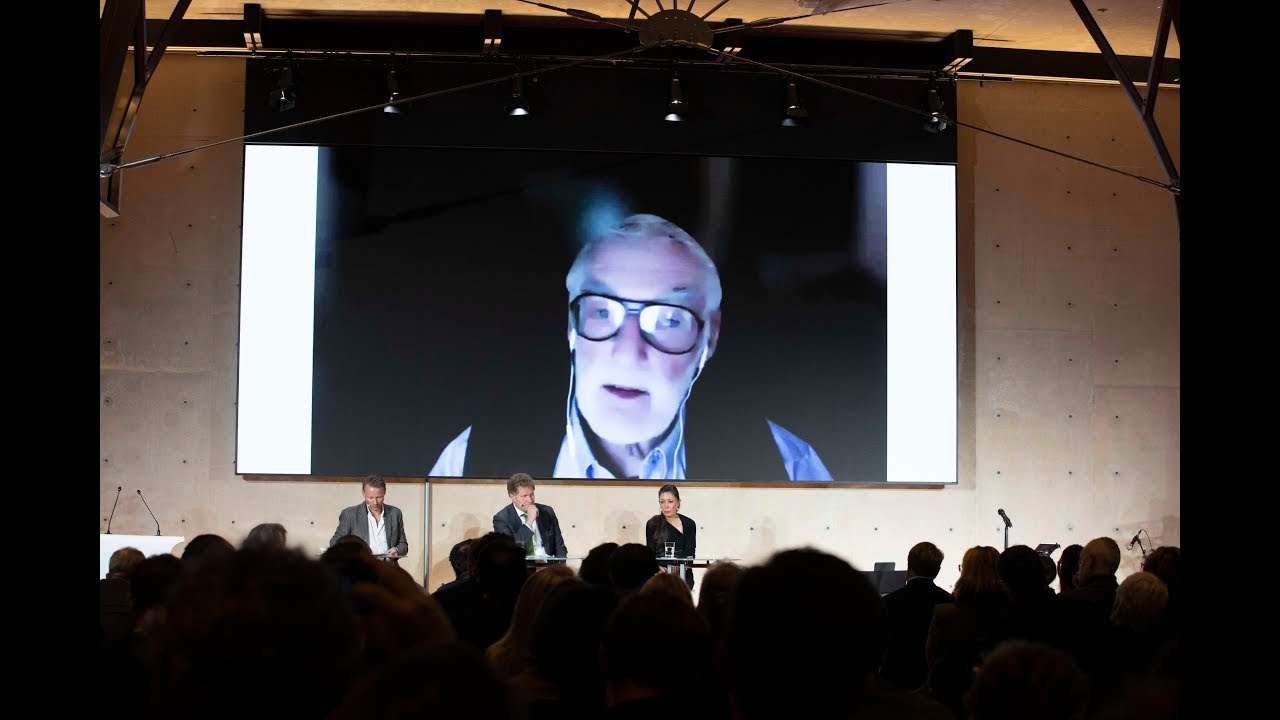
The Club of Rome Salon in Berlin marked the 50‑year anniversary of the seminal 1972 report The Limits to Growth. The event brought together Prof. Dennis Meadows, BASF board member Saori Dubourg, State Secretary Patrick Graichen, and moderator Jörg Geier to reflect on the report’s legacy and discuss how its systems‑dynamics insights apply to today’s intertwined crises – climate change, energy shocks, supply‑chain disruptions, inflation and geopolitical instability. Meadows revisited the original World3 model, emphasizing that the world has moved from a scenario of “slowing growth” to one of “getting down” – a need to reduce material and energy throughput to stay within planetary boundaries. He illustrated feedback loops that make short‑term, growth‑oriented policies self‑reinforcing and lead to increasing chaos. The panel highlighted the mismatch between short election cycles and the long‑term actions required, calling for bold, coordinated policy, and for private finance to fund the trillions needed for the transition. Dubourg presented BASF’s shift from volume‑driven to value‑driven business models, describing concrete steps in renewable energy, digital agronomy, circular material use, and the challenges of Scope 3 emissions, supply‑chain due diligence, and impact measurement. She also outlined three layers of barriers to greater European investment: (1) inflation pressures that raise costs and erode competitiveness; (2) volatile gas‑price scenarios that threaten energy security and encourage imports, suggesting a joint European gas‑buying basket as a stabilising measure; (3) the need for concrete competitiveness roadmaps, including renewable‑energy storage, grid planning security, and aligned incentives across continents. Graichen stressed the abundance of solar energy, creativity and caring as resources, and argued for rapid expansion of renewables, resilience‑focused infrastructure, and new metrics beyond GDP. Throughout, participants stressed the need for societal will, interdisciplinary collaboration, and a common global language to align regulations, trade, and investment. The discussion concluded with hopeful notes: Meadows highlighted the expanded scientific understanding of climate and agriculture; Dubourg emphasized industry innovation, global financial dialogue, and inclusive, solution‑oriented discourse; Graichen pointed to a generation seeking less material growth and more mental resilience; and Johan Heling van Lansenhauer introduced the Arts and Nature Social Club as a platform to inspire collaboration across art, science, business, and politics. The audience was invited to continue the conversation, support the club’s work, and network on the evening’s remaining time.
Chapters
TranscriptAuto-generated · 114 min
Dankeschön. Schöne Haare. Danke.
Dear Professor Meadows, dear State Secretary, dear Mr. Geyer, dear speakers and panelists, ladies and gentlemen, good evening. It is a great honor and pleasure to welcome you all on behalf of DZ Bank to today's Club of Rome Salon. The building we are in tonight is located in the very heart of Berlin at Paris Square Number 3, near the Brandenburg Gate. For long and difficult decades, the border between 2 German states and between Eastern and Western Europe ran right here. The Brandenburg Gate and Paris Square today stand for hope and positive transformation. Tonight, we're also going to talk about transformation, but let's first go back how it all started with a revolution which happened 50 years ago. And it's an incredible honor to have Professor Meadows with us tonight, live from New Hampshire, one of the revolutionaries of 1972. The legendary report, Hue-Dennis, co-authored, The Limits to Growth opened a completely new perspective on our planet, the choices we make, demographics, pollution, and on the consumption of natural resources. In other words, it opened a new perspective on our future. 50 years ago, nearly everybody considered unlimited growth as the only pathway to to greater prosperity for all. And then there came a group of young scientists and showed that there are indeed limits to growth. That truly was a revolution. Half a century and many Club of Rome reports later, at this critical juncture we're in, the central findings of your analysis, Dennis, are as relevant as ever.
Thank you.
And the current times have the potential to derail the much-needed global concerted action because of the shocks in energy prices, global supply chain issues, inflation and the threat of recession, an increase in poverty and food shortages, especially in my home continent, Africa. The bottom line is that these days, long-term climate goals are under threat from the need to address shorter-term political and economic crises. At this critical juncture, ladies and gentlemen, we need concerted global action more than ever. We can only estimate how many trillions of dollars the transformation will cost over the decades to come. But what we know for sure is that private lenders and investors will have to play a critical role in raising this money. For this reason, ladies and gentlemen, it is very fitting that we're meeting in a bank building tonight, and please allow me to say that it is particularly fitting to meet in a bank that is part of the Volksbanken Raiffeisenbanken cooperative financial network with more than 770 banks all over the country, all being independent, democratically organized, enrooted in their local communities, originally developed as self-help organizations for farmers and SMEs, and therefore not primarily aiming at maximizing profits but on working for the good of their members 18 million in total, by the way, and for their communities. Therefore, sustainability is embedded in our DNA. DZ Bank is one of the largest funders of renewable energies in Germany, and the group's fund management specialist, Union Investment, holds a leading position in the market with over €125 billion in sustainable assets under management. And of course, we also thrive to drive sustainability through innovation. However, what we also need is decisive political action— powerful, reliable, predictable enough to literally build bridges. We need less bureaucracy and more investments in research and education. And we also need to communicate more broadly and globally, because as of last week, we are officially 8 billion people on this planet. So a lot of people have to be convinced of the necessity and the feasibility of transformation. Communication is the key word. That's also one of the purposes of tonight's event. to have an exchange of thoughts and ideas. I personally hope that by the end of this evening, each of us listening, whether you are with us in this historical place in Berlin or anywhere else, will be inspired to act on at least one small thing to contribute to the much-needed positive transformation. Now, ladies and gentlemen, Without any further ado, let me wish you a great evening, and please stay optimistic because as this place shows, the future can be shaped positively, but we have to act. Thank you very much.
Thank you very much.
A warm welcome also from my side. My name is Frank Niederländer from the BMW Foundation, and a special welcome tonight for Professor Meadows. Unfortunately, we can't see you right now. Ah, perfect. Good evening.
Good evening.
Saori Dubourg and State Secretary Graichen to join us tonight, and I'm really honored to have you all tonight. The idea of Limits of Growth, when it appears in 1972, was inspiring for many, many generations. And for myself, for a long time, it really gave you the spark for completely new thinking of what is needed. The shocking element of it was not the results what came out at the time. It's more that we are still discussing the same issues today. And to see such an amazing crowd in front of me in such a huge building shows that there's a huge interest today to change things. But we know that we have the facts. We know that we have to move, but we don't know how to do it, and we know we don't know how to cooperate on that. I just come back from the COP in Sharm el-Sheikh, where we had discussing also the same topics. I was also happy to have sessions with the Club of Rome, Sandrine Dixon de Klerk, with Jan Rockström was with us. So really engaging leading topics on what is needed to do. If you had followed up the headlines of the news over the last couple of days, there's a mixed picture of the outcome of the COP. It's not a total catastrophe, but things had not moved very further. We have the Loss and Damage Fund, which is a progress on that respect. As far as further commitments of change, we haven't seen any subsidiary efforts on that. So even 50 years after we know what's needed to do, we are still fighting about the right way to do it. We are strong from being from the competitive to more cooperative collective side. And that's why tonight I'm really happy to see stakeholders from different sectors talking, discussing tonight, and seeing how they can perhaps find a common ground, because the targets which we have set, 1.5 up to 2050, it's not something which depends on us, but we have to protect that. And as someone said lately, it's not a target, It's a must to reach that. And so I'm really curious about discussion tonight, see the different perspective. And I think it's important that we challenge ourselves to do that. As our foundation, our mission is responsible leadership. In an essence, it's about bringing different perspectives together, being open for different perspectives, coming to a common goal on a more just, sustainable, and peaceful world. And especially the last one has been shown this year as being very, very much important. We try to do our small contribution enhancing such dialogues, but it's much more important to engage on a broad base. And again, that's why for me this evening tonight, having the Club of Rome, which is really protagonists on this respect, but also current stakeholders who have the power to change things, whether it's in business, whether it's in government, whether it's as a non-governmental organization. We have to find those common ways. Thank you to be here. Thank you to engage. Hopefully we see a very interesting panel with a lot of energy, a lot of questions coming up later. I thank the German chapter of the Club of Rome, the Arts and Nature Social Club, the DZ Bank for this beautiful venue here, and of course my own colleagues at the BMW Foundation to having prepared that. Hope we will enjoy a very nice evening tonight. Thank you very much.
Thank you.
So thank you very much to the ZBANK and BMW Foundation for your great support tonight, and also with the BMW Foundation at a previous event. My name is Jörg Geier. I'm wearing 2 hats tonight on behalf of the German chapter of the Club of Rome and Arts and Nature Social Club. And when I first conceptualized the topic of tonight's discussion, I was asking myself, how can I, how can we really make a difference with a small discussion in putting things in perspective? And the leverage of change, I believe, is really in the business world, working closely together with politics, with policymakers. As you can see from the outcome of COP27 in Egypt, there's a lot of work to do. Unless the private sector is on board, it will be very hard to achieve all the various ambitious goals that we have set ourselves. So knowing that there's a lot of private sector actors here tonight in the audience, and hopefully online as well, I really hope that you see yourself in the shoes of taking action and contributing to the ambitious goals that we have on the sustainability front. Aurelio Peccei, one of the founders of the Club of Rome, talked about the adventure of the spirit, which in other words means self-exploration and reflection. It all starts working on ourselves in addition to asking others to bring about change. It is always easy to ask others to be better and to do things differently, but unless we start working on ourselves, it will be very difficult to bring about the lasting changes that we need. And I'm very happy to have Dennis Meadows with us tonight, who I've known for a number of years. I used to work for the Club of Rome, when headquarters was still based in Hamburg a number of years ago, and I had the honor of going through a systems dynamics workshop with him and a group of young people back in 2006 in Peniche in Portugal. So that's when I certainly learned a bit more about systems thinking, the topic that is at the heart of the Limits to Growth report from 1972. And there have been 2 updates of the report since then, and the latest one was the 30-year update, and there's also a more recent report to the Club of Rome called Earth for All: A Survival Guide for Our Planet. Dennis Meadows was not involved in that report, but the report certainly built on the legacy of The Limits to Growth. So I'm very happy to welcome all of you And especially also our other 2 speakers, Dr. Patrick Graichen, State Secretary at the Ministry for Economic Affairs and Climate Action, still struggling for the name that changed with the change of government, also to put a stronger emphasis on climate change and the environment, which is very important. And Saori Dubourg, board member of BASF, in charge of a lot of their sustainability initiatives. And thank you again, Saud Benkhedder of the board of DZ Bank and Frank Niederländer of the board of BMW Foundation. And later my colleague Johan Heling van Lansenhauer, board chair of the Arts and Nature Social Club, will say a few more words behind our relatively new members club that was founded back in 2019. So without delaying the actual discussion further, I would like to hand over to Dennis Meadows, who will give a presentation on the Limits to Growth and what it means to business and politics and also to Germany today. And then we will continue with Saori Dubourg to provide a business perspective and Dr. Greichen to provide a perspective from politics. Thanks very much and welcome again.
Thank you, Jörg. I, in preparing for tonight, thought about when I first came to Berlin to present Limits to Growth back in the early '70s. It was awarded the German Peace Prize by the Book Association, and since then I've been many times back. This is a special time because in the past I was looking forward, and tonight I'm going to look back. 50 years of Limits to Growth, lessons learned. And I hope that my comments will give you some basis for constructive action. Next. I still remember 50 years ago when I made the first public presentation of Limits to Growth. It was at the Smithsonian Institution in Washington, D.C. That's me standing at the podium, a young scientist. To my right is Aurelio Peccei and 2 of my team members, Jürgen Ronders and Bill Behrens. And just to the left, peeking out behind the podium, you see a bit of Donella Meadows, who was a senior member of the team and the main author of the book. I was incredibly worried about that presentation because it seemed to me that everything I had to say was totally obvious, and that the people who had come together to listen would think it was a waste of time. Little did I know, A, it wasn't going to be a waste of time, B, They didn't know it. C, they didn't accept it. And C, 50 years later, I'd still be talking about the same things. We worked at 2 years at MIT, a group of 16 of us, to create a computer model to help understand the long-term causes and consequences of growth on the planet. You can't make predictions about the future, but you can show different possibilities. Next slide, please. One of our possibilities is what we might loosely term sustainable development. There we are in 1972. I'm now showing you a computer output for a 200-year period from 1900 up to 2100. Next. And as the scenario unfolded, we saw a world coming into equilibrium. It's not a utopia, but it's one which has an equitable and fairly peaceful existence. Unfortunately, our model showed us other options. Next. If we didn't take the actions necessary to slow growth, a different result would happen. Next. This one growth has continued up until just about now. Next, please. Next, you see the scenario. Many people have gone back more recently to try and understand. how accurate we were. One interesting example, Graham Turner from the National Research Institute in Australia concluded that unfortunately this scenario is the one that's most likely to explain the recent history. Next. Here you are, you see in 2022 where a number of the major parameters start to trend down.
Next.
So to put this in a slightly different way, in 1972 we had 2 options. Next. One of them was to start altering the forces that promote population and industrial growth. And to stabilize the system under the carrying capacity of the planet.
Next.
If we ignored that, and then growth would continue for quite some time. Next. And it did. Now here we are in 2022. The options we have are different.
Next.
We can, if we— and this is, for example, the subject of the COP meeting recently— if we begin making really drastic changes, we can reverse the growth pressures and try to bring the system back down under the capacity which can be supported by the planet. Next. If we ignore that and try to sustain growth, will overstress the system until finally collapse is almost inevitable. So here we are. Next. 50 years later. Next. We need to change from slowing down, which was the task we had back in the early '70s, to getting back down, which is the priorities that realistically confront us now. Easy to say that, uh, in theory, but of course, when you start to look at the practicality, it involves an enormous number of different issues. All of them have what I call the characteristic of being difficult problems. I'll explain that, uh, with a simple graph. Next. Difficult problems are ones where you see yourself at some level on the left, that little black dot, and you want to achieve more progress, move up to that black dot on the right. There are generically 2 ways to take action. Next. The first one makes the perceived achievements look much better over the short term, but ultimately lay the foundations for failure over the long term. Another set of options— next— make things look worse in the short term, but actually get you where you want to go. The dilemma we confront in our society is that most of the evaluation methods and institutions that we have— political, economic, administrative, psychological— judge their progress too soon. Next. Typically, the next election occurs when the bad choice still looks attractive. And without getting into a lot of detail, this curve explains the difficulties we have now in energy, with the climate, with soil erosion, food production, and so forth. Take energy as a very simple example. The best way to solve energy problems in an industrialized society is to make it more expensive and more difficult to get in the short term so that people begin to adapt. But politicians who advocate that would very seldom get reelected. So instead, they subsidize electricity— energy, for example, by trying to cap the price that people will pay. And so we go. It's the same with climate. The things we really need to do to solve the climate crisis are going to make most of our indicators like economic welfare look worse in the short term. This is important because— next— if we don't solve these problems, we can expect to see growing chaos.
Next.
You can imagine the number and severity of problems leads to the amount of chaos.
Next.
That unfortunately in our political and economic system tends to focus our leaders' attention on the short term. So as chaos goes up, the emphasis on the short term goes up. Next. With difficult problems, as you look more and more at the short term, your ability to find fundamental solutions goes down, and as the ability to solve problems goes down— next— of course, the amount of chaos goes up. This is what we in systems call a self-reinforcing positive loop. You call it in German Teufel oder Regelkreislauf. It's even worse than this, because as the amount of chaos goes up— next— There's a very strong incentive in our political system to centralize decision-making. You see that actually unfolding now in many of the major countries around the world. And as centralized decision-making increases— next— the influence of diversity and scientific understanding on decision-making goes down, unfortunately.
Next.
With that, of course, the ability to solve problems goes down. If you look at the trends in politics these days, you don't have to go back to the Communist Manifesto or to early Greek examples of tyranny. It's simply explained by these simple feedback loops. And of course, our challenge is going to be how to deal with these problems while avoiding getting into these self-reinforcing cycles. So let's take a concrete look at Germany, for example, next. What are some of the future challenges for Germany? Well, of course, far be it from me in the few minutes I have to imagine providing a long list, but I put down a few. to remind you of. Next, please. Of course, as we're reminded by the most recent COP meeting, climate change is no longer a theoretical possibility. It's underway at the moment. For Germany, this is going to have a number of really interesting issues. Sea level rise is not one, of course, by and large, but the rise in the sea, which we can foresee with absolute certainty between now and 2050, is going to increase the number of refugees by a factor of 4. So if you think about the problems which you're having now coping also here in the United States with people who want to move across the borders, you can imagine that it's going to become much more intense. We've tailored an agricultural system to be maximized under the current climate regime, and as that changes, it's going to impact on food production. Also, as you're seeing in Germany, where water transport is of major importance to your economy, it's going to start to disrupt transport. These are not short-term temporary phenomena. These are trends which are going to exist throughout the lifetime of everyone sitting in this audience and your children too. Resources are being depleted, of course. You notice that with your reliance on fossil energy. And as that happens, we're going to be forced to reduce use of energy and water. It's a good thing in one way that population is aging. that it brings with it a number of interesting concerns that will challenge Germany. Your workforce is going to start declining. That has implications for the gross output. It changes patterns of production and consumption. An elderly population needs a different mix of goods and services than a younger one, and changes in policies of Social Security. The old more or less Ponzi scheme based on the fact that you have a lot of workers supporting a few people is going to change. So how do we prepare for these? Next, please. How do you prepare for these challenges? Next. Well, absolutely the first thing to do is to shift the emphasis. we have to quit focusing on sustainable development and start to see how we can increase resilience. What do I mean by that? Next. If you look at the way sustainable development is discussed, it really means effectively raising the welfare of the poor with, however, the rich not having to give up very much. This was maybe possible back in the '70s, It's not possible now. 8 billion people is far above the carrying capacity of the planet, whose resources are deteriorating now already without most of those people having anywhere near the demand on resources that we have in the industrialized West. Shocks are coming. We can't understand precisely where or how large, so we need to increase our ability to cope with them. by increasing resilience. Next. That means improving the capacity at all levels of society to adapt to unexpected shocks. You can do this at the level of the individual, family, the household, the firm, etc. And lessons you learn at one level can be useful at another. Now, I've spoken theoretically. I apologize. I'm trying to summarize 50 years of learning in 15 minutes, which is of course quite a challenge. But I will leave you with one specific concrete action I think you could take that would be very helpful. Germany and other industrialized countries spend millions to understand how to sustain growth. If you could allocate a tenth, or 1% of that amount to a little research institute someplace which begins to think through the challenges not of growth, but of decline, you would begin to understand ways that that can be done which are equitable, peaceful, and under control. It's absolutely possible if we focus on it. And that would be my enjoinder to you tonight. Thank you.
So thanks very much, Dennis, for your insightful presentation. And now Saori Dubourg, board member of BASF, is going to react to your presentation and is going to make some of her own points where BASF stands today in regards to sustainability.
So thank you very much for the opportunity to be here today with you, and maybe we can shift to a few slides that I brought with me to bring life behind what Professor Meadows nicely explained, because we actually see a similar pattern. And if you could go to the slides, I can press there also once.
Okay.
Now let me go to the first elements, and actually you will see the live implementation of what Professor Meadows already just illustrated. These so-called current shocks we saw during COVID supply chain interruptions, but even more pronounced, the climate change challenges, as well as, of course, more and more also dilution of the globalised world in terms of pattern changes, in terms of growth. And we see this very clearly right now, because a lot of the business models are interrupted. adopted in the meantime, more and more sharing models, circular models, you know, the question of how to drive from a globalised world into a resource-efficient economy is currently in the middle of the making. And therefore, I think what you also see on the next picture is exactly what Professor Meadows said. Currently, we are very focused on short-term challenges, as we are as well, specifically with the current gas price situation. During the summer, while this evolved to be a real challenge, we were calculating 3 scenarios. One scenario was about how do we get out of this gas price scenario under today's world? But second, how would this look like in a decoupled world? And we also calculated what would an accelerated decarbonisation mean to such a scenario? And interesting, the data points were not so far away, but it became very obvious that the most accelerated way in decarbonization is probably the best way to go forward, simply because today and in future, the natural gas element will stay uncompetitive. Over time, it will be still challenging for quite a while. However, over the time, seeing the change that's going on also in regulatory frameworks, and what's happening currently in terms of investments in the Middle East, There's a clear shift to a decarbonised world, and since climate change will become just not better, I think a long-term good strategy is to focus on real competitive advantage for Europe. And therefore, also here, this chart shows you the challenge we will have. When we looked at the International Energy Agency, what you basically see is the overcapacity in the United States in terms of gas production. That's on the left-hand side. The orange dots is the demand, and then you see the surplus that's created today and until 2050. What we found pretty puzzling is the situation in Europe, whereby even going forward, there is a significant gap in the energy grid. And the question is, how do we close this with a clever energy mix? It's very clear that the peaks that we saw over time today in the gas price is linked to certain elements that are trigger points, like buying behaviour of member states, nuclear power plant issues in France. So, buying together as Europe is certainly a good way forward, but how to close the gap going forward also in terms of energy grid? And certainly, doing partnerships in the renewable industry, and with different renewable partners, will be a way out. But that's exactly what you see here, is just a short-term view. And the question is, what's the long-term view? long-term strategy behind. Now, here comes one of the challenges, and that's very real. You know, Mr. Meadows spoke about different approaches to one and the same problem, and what we currently see is with the Inflation Reduction Act of the United States, there's a huge subsidised programme coming now on stream, working with monetary incentives. And if you think about investments in our industry, This will lead to distortions globally, because the investment costs will differ in the United States compared to Europe, compared to Asia. Europe very much is in the middle, working with Green Deal. It's very much regulatory framework-oriented, not so much from an incentive subsidy point. There is €1 trillion in the European Recovery Fund, but here is a watch-out, because we basically see 2 continents now moving big time time into a renewable new resource economy, which then makes a difference if you look to Asia, where, for example, China is investing a lot in solar and wind energy, but still we see a lot of products based still on coal and fossil-based, and this will become a challenge not only from a competitive landscape, but also in terms of trade policy going forward. How do we avoid carbon leakage? How do we make sure Europe stays competitive, and what is our strategy forward? So this is the kind of chaos probably Professor Meadows linked to, and it's getting a real challenging question also for us. How do we connect competitiveness with sustainability? I think I wanted also to come today to give you some positive solutions, because I think the future is clearer on the pathway than we think. And similarly, like Professor Meadows just explained, there were thinkers before, and Dieter Rams is one of them, who were already questioning our resource usage in the early '70s. It's unfortunate, I don't know whether he ever met him, because he's one of the famous designers of the Braun brands, and he has invented the 10 laws of good design. But he really questions, is the use, how we use resources clever enough? Because sustainability in its core is about efficient usage of all resources we have. And this is actually a positive way forward. We have experienced this as BASF because we were built on this. The Verbund usage of the waste stream of one production into the other that we learned already 150 years ago has brought us where we are today in a cost-leading position. So the question is, how deep are we questioning our resource usage on all levels? And that this is possible, I wanted to show you here, because our customers are on the way. What you see here are the targets of all the customer industries working with us. There is hope at the end of the tunnel because there's a lot of effort in the industry going into more recycled models, exchanging product use and changing packaging, really looking at options how to get to better material usage, and it's quite encouraging. However, this needs collaboration with policymakers in a lot of fields. Question is, do we have the structures to collect certain value chain streams? So, there we need much more dialogue. And last but not least on that route, just to give you the 6 archetypes of the future, this is the change from a volume-driven business model towards a value-driven business model. These business models are fundamentally different and therefore so challenging. So let me go from the left to the right. We see increased customers using bio-based feedstock, looking at their material usage. But also the renewable energy investments we are currently undertaking has to be speeded up in order to achieve the clever resource usage. But what you also see is all kinds of technologies, recycling, mechanical recycling, lifetime extension, using a product longer than before is a real product function in future. So longevity of products could become an interesting one also going forward. And this means the future is more colourful than we think. This is just 1 out of 140 markets we were finding when looking at the Green Deal, triggered by the Green Deal, and each of these markets has interesting fields at an average growth rate of 2% up to 35%. So, if you ask me, the future for Europe and for us is exactly here in these multiple new applications. And this is why I'm positive, yeah, on it. And to even add the financial component that was in the entry speech mentioned, I mean, here are also banks sitting, investment houses. The change we see in the financial industry is unprecedented. I mean, if you ask me what has changed over the last 5 years, The whole capital market, also of course triggered by all kinds of regulation, is now more and more shifting into impact investment. Still, there is, I would call it, slight chaos in terms of the common language, which is unfortunate. We have different languages in Europe with the taxonomy, EFRAG institutions that were just now discussed. We have different solutions in the United States. There are some discussions in Asia, but let's not not forget, we are talking 500 years of balance sheeting experience that is now questioned all of a sudden. And the positive news also here is, we have globally $2.7 trillion being invested in impact. And the good news is, 80% of the global ESG funds are sitting in Europe. So, if you ask me, how can we help to achieve a better resource-efficient economy? economy, it's really a combination of different measurements in future. And here you see Sir Ronald Cohen, who was leading the Impact Task Force of the G7. We have just founded a valuation foundation board working with our stakeholders at the Value Balancing Alliance and also the IISB. And he says one thing, and with this I would like to end, because I think it's really visionary. He says, you know, I have a déjà vu. In the '70s, we started thinking about risk measurement. That was the Chicago School of Management where this was developed. And then the tech companies, Amazons and Googles, developed, and the fact that we could monetize and measure risk led to the whole sector of startup and venture capital industry. So, what came together was the technology, a field of digitalisation, and all of a sudden venture capital, and which was the rise of a new economy. And he says, I'm now 70 years old, I have a déjà vu. We have a discussion on measurements for environmental and social impact, and we see 140 new technologies developing in the sustainable area for the future. If we are able to come to a common language, it will redirect the necessary capital that is not there at a lot of governments at this point in time, and bring it into fruitful innovation. And this is the source where we have to think more deeply, how can we come to a joint global language? And this, for me, would be the answer to Professor Meadows, and how to fuel a resource-efficient economy built around totally different business model, but it's not an easy change. So, as Ellen Key said, the best way to predict future is to create it. With that, thank you very much for your attention.
So thanks very much for your perspectives from BASF. Now, last but not least, Dr. Patrick Greichen to provide some insights from the German government.
Ladies and gentlemen, Dennis Saori. It's a great honor to be here 50 years after that famous report that I think turned the whole thinking of economies and also economics upside down. And I think we wouldn't be where we are in terms of our thinking of the world if not we had that report. If I look back, then, and 1972 is when I was born, so it's It's exactly kind of my experience of the whole debate, is the limits to growth that were basically part of that line of thinking at that time was that we deplete resources. And oftentimes it was thought about we deplete minerals, we deplete rare earth, we deplete oil, gas, and coal. Now what we have found out is that's not really our limits. The limits aren't those resources, and in fact, when it comes to fossil fuels, we have too much of them. The real resource limits The real limits are the climate boundaries, so the ability of the atmosphere to take up CO2 and other greenhouse gases. The real limit is nature loss, biodiversity. The real limits are land, soil, and water. So the real limits on this planet are not so much the technical ones, but is basically everything that has to do with the biology and the life on this planet. And therefore, if we think about what we need is basically taking those limits as true limits and to design an economy and to design a world within those boundaries. Now, the good news is there are things which we have basically in abundance. And that's 2 things that are really important, and a 3rd one maybe. First, we have abundant energy that is from the sun. The amount of clean energy we get daily on this planet from the sun is more than we'll ever need, and therefore using clean energy doesn't really have a limit. Of course it has a limit on how much material will we need for wind, how much material we need for solar plants, but there is not a limit to basically what we can do with energy. And the second The biggest abundant resource that we have is our creativity. I mean, we have solved a lot of things in those past 50 years. That's why we didn't reach those boundaries in terms of critical minerals yet, because there has always been innovation, because there's always been technological progress, because there has been a new idea, a new way forward, and that's also why on the other side we suddenly had cheap oil and gas because fracking came because of innovation in the industry of drilling. That creativity and the innovation aspect is something that we can and should exploit. And then there's the third thing, and that will probably need to make all the difference. That's caring. It's caring about our children, it's caring about the nature, it's caring about this common planet. And that is It could be a potential abundant resource. Every now and then it is, but only for a few moments in history, and then we go also back to wars and anger and distrust. And I think the question that really comes forward is how can we exploit those 3 resources that we have abundant potentially, and have the answers to living in a world that accepts its boundaries. What does this mean in terms of policy? First of all, we need bold policy that really doubles down on everything that is there on clean energy, because that is when it comes to the The boundary climate, the key issue. We need to get wind and solar replacing coal, oil, and gas, and we need to have that quickly. That is, I think, when it comes to what really is at the heart of energy policy of the next 10, 15 years, that's what it's all about.
Thank you.
Of course, with wind and solar, you can produce hydrogen that will also replace all those issues where you can't use electricity directly, but it's all about getting it fast enough that wind and solar replace fossil fuels. The second key element is protecting our biodiversity, land, soil, nature, water resources. And that's where it's not that much about technological progress. We have everything we need. And it's more about really getting it in place. That's where you need international cooperation. That's where you need policy and politics that play out well. And that's where it is much more about finding a new global narrative that accepts those boundaries. In a world where we become more and more people, I've just been saying we are now 8 billion, there is enough food out there as long as we reduce our meat consumption. That's straightforward. There is enough nature out there as long as we reduce our footprint in basically tearing down the woods and the forests. So it is about— and that was maybe a bit part of what Dennis has just alluded to— it is now the question of Where do we need to manage decline? And it's definitely the decline in using natural biodiversity, land, water resources where we need a managed decline. And to get all that, we are also at the question of how do we redistribute wealth? Dennis was saying he doesn't believe anymore in sustainable development in the sense that it's about making the poor more wealthy without taking from the rich. Now, I do believe that clean energy and clean creativity has a lot where we can improve the situation of the poor without having to take away anything from everyone else, but I do believe that we need a better redistribution of wealth and income in this society. The last 50 years have been making the societies in the West more and more unequal, and that's not something we can sustain when we move forward. Because we need acceptance. We need those 8 billion people to accept that path into a decline of use of natural resources, but an acceleration of everything that uses the abundant resources of creativity, the sun, and gratitude. Thank you.
So we'll hear a few more tunes just before we start with Q&A. And the band is Susanne Gmelch and her colleagues who will— who are accompanying us tonight. So thanks very much for the music, which is an integral part of what we do at Arts and Nature Social Club.
Thank you.
Thank you. And now I'd like to hand over back to Dennis to respond. to the 2 other keynotes he's listened to. Do you have anything to say in response?
So thank you for the invitation. The other 2 speeches were excellent examples of constructive thinking within an institutional framework very different from mine. I'm I admire the BASF, and the German government has always been very innovative. So, I don't have any comments to make in one or two sentences. Thank you very much.
Well, maybe I'll ask more specifically. You knew Herman Daly, the late Herman Daly, personally. And he talked in his work about economics in a full world and economics in an empty world. So basically meaning that the laws of economics would have to change in order to adapt to a full world. And it is clear that we have reached various planetary boundaries already, so-called tipping points, And what would you say, Dennis? I had the impression that some of the points that were made still were based on the laws of economics in an empty world rather than a full world. So maybe you can say a few words about that.
The point that Herman was making was that when the world is empty, And it has plenty of places to give you stuff and to stick your stuff after you're finished with it. You don't have to attribute any cost to that. Then efficiency is a simple calculation of what you buy compared with what you sell. Now the world is full, and when we emit CO2 or when we extract fossil fuels, there are costs there which as you point out, George, are not included in the traditional economic framework. I concluded my remarks by pointing out that we spend billions trying to understand how to grow. I would ask the State Secretary, how much money does Germany spend trying to understand the rational policy measures which are appropriate for a declining workforce or for bringing energy consumption down in an equitable way or for dealing with the kinds of shifts that are going to have to take place in agricultural production as climate changes. The traditional economic system doesn't lead us to invest money in those kinds of questions. And now it's time that we do that.
Thank you. Would you like to respond, Patrik?
Well, I guess, I mean, there is of course a lot of research on how to reduce energy consumption, on how to have a different agricultural model and everything, but I guess Dennis's question is a bit larger. It's a question of, do we need to have a concept of degrowth? Do we need to have a concept of Manage decline. And there, to be honest, no, that's not the agenda of this government. And I think the question is rather— I mean, there is, I think, a notion of whether or not we can have a market economy without growth.
I think—
It's fair to say, look at Japan, it has— didn't have classic economic growth in the past 20 years and it's still a market economy, so that's answered. And the question is then, can we have basically a reduction in material use and at the same time have an increase in what is typically measured in GDP. And I mean, there are some hints that we already just heard from BASF in the sense that it's a value-driven business model that they're looking for. And I think that's the question where we need more, definitely more thinking. of what a value-driven business model, a value-driven economy looks like that at the same time is drastically reducing its material use. So maybe to sum up, we have bits and pieces of what Dennis is asking for. We don't have the picture, and I probably agree we should have more research on it.
So maybe triggering kind of a new research group on more complex problems could be one answer on how to address a challenge. But Saori, from your perspective, working for a chemical company that is certainly highly energy intensive, what would you say? What What progress do you think can be made in terms of decoupling growth from material consumption at BASF?
Yeah, we see currently so many examples. So there are very good models. Not only, you know, there is a lot of experimentation going on, but there is a lot of investment going on. So one is, of course, in renewable energy, wind parks, technological solutions, how to reduce the usage of energy. But let me go even in one example, Of course, you talked about agriculture, to make this very concrete. With a framework of the Green Deal and the reduction, for example, of the usage of crop protection by 50%, the intellectual challenge is, so, how do we do a model moving from volume growth to value growth? And what is happening in this industry currently is, it is about understanding better what does the soil really need. So, we are working, and that's about collaboration with partners, you know, on a digital framework to understand plant by plant with the machinery that goes across what is really needed. And then it's really changing the business model more to a better field understanding. And this is in future like an insurance model where the farmers get the assurance we will manage the total field. And this is kind kind of the value model. That's one typical example where it's not about more volume, it's about value impact. The other thing that I would like to emphasize a lot in sustainability is about managing dilemmas. There is no perfect solution, and this is why measurement is so important, because we see a lot of problems at the moment. The most modern materials are the most challenging areas to optimize sometimes. And how to manage these dilemmas. And here, sometimes understanding the impact on the cost for the social and the economic and the ecological part is important to come to better decision-making. And last example on resilience, if you think about water, we have just looked at the water streets, the water transportation ways in Europe. This is part of a resilience topic where we need to think much deeper. It's not on the agenda of many companies. But a country or continent where water gets difficult in terms of availability, because we have shrinking water levels in rivers, is at risk. And to think this through now will be very important. This is an example for resilience management for us. So there's a lot of things going on.
Thank you. Microphone back to Dennis. I know there's a lot of innovators in this room and investors, so a question I'm sure a number of people will be interested in is the question on technological innovation and human ingenuity to address global problems. I know you have a rather critical perspective on that, Dennis, but maybe you could elaborate a little further. Patrick Graichen also said that creativity and innovation can address some of the challenges we are facing, but is there such thing as limits to creativity in innovation, or at least boundaries in some ways?
So of course you're getting on a issue which comes up always in thinking about Limits to Growth. Before I answer your question directly, let me just say that I don't speak as someone outside the field. I was a professor of engineering for many years. I have sat on the board of directors of a number of new technical companies. I'm currently involved in a company which is developing alternative energy methods. So I have a strong personal understanding and interest in technology. And what I can say is that technology doesn't exist independently of the goals and the constraints of the people who develop it. It's the incentives of the military, the industrial, the governmental factors that have been creating technology in the past, which have led us into our current predicament, and expecting that now those same decision makers are going to develop a technology that automatically solves the problems which they created in the first place, uh, has in my mind no, no realistic basis. So I'm enthusiastic for technology. I'm can see areas where new capabilities would be helpful to us, but I think it's important to understand we have today in operation around the world the technologies that would be required to solve the current problems. The reason those problems persist is not because we don't have the technology, it's because we don't have the will or the ethics or the norms to use them. Hunger isn't caused globally by lack of technology, and new technology is not going to solve hunger, nor incidentally is solar energy going to solve the energy problem. I don't want to be impolite, but this notion that the sun is giving us infinite energy is just a fantasy. The ocean gives us infinite water, but that doesn't mean that nobody has problems Uh, with drinking, uh, water availability. The constraints on capital, as was pointed out, are more than enough to mean that energy is going to be a persistent problem in the future. So fine to develop new technologies, go for it, uh, but don't imagine that that's going to eliminate the need for us to sit back and look at the incentives we have to sustain growth and use growth as a way of dealing with problems. That's not going to work in the future.
So maybe Patrick has a few words to add.
Well, yes and no. No, in the sense that If we really want to combat climate, the climate crisis, then what we need to do in the next 15 years is growth in renewables. And I mean massive growth. And therefore, if we're talking about being anti-growth in this context, We need to be pro-growth, and we need to be very bold. What I mean with the notion that there is enough energy for all out there is that, first of all, the limits are maybe then in materials or in capital, but not in the energy supply. I agree totally that we have everything we need. We have the technology, we have the capital, we have basically the material. There's no constraint there. So what it's all about is overcoming a fossil fuel-based system where there is a lot of money still to be made and of course a lot of political clout and economic structures around it. So I'm not saying it's easy and I'm not saying it's going to be decisive that we will succeed, but what I'm saying is, and that's maybe the yes, This is about political struggle. This is about overcoming an institutional framework which has very much, of course, relied on fossil fuels. Now, is that possible? Of course it is. I mean, there were also institutional frameworks that lived of slavery, and there was a moment in history when it was clear that's a no-go, we'll quit slavery. Was it a societal struggle of great effort? Of course it was, but that's where we need to compare basically our efforts with, and maybe not incremental things we've done in the past.
So, question to Saori. In terms of the energy transition, the Energiewende, a lot of people think they drive an electric car and they're contributing to a better world, which in some ways may be true. In other words, that's a bit simplistic, especially look— if you look at the footprint of mineral and rare earth resourcing that comes often at a huge environmental cost and also at a cost in terms of human rights. The German Lieferkettengesetz, or Supply Chain Act, that will be active from the 1st of January 2023 will at least in part address this issue. So what does BASF already do in this regard to minimize the footprint when it comes to mining activities?
So this new fundamental shift, paradigm shift that I talked about, is not only a shift from volume-related growth models to value growth, but it's also about values. That's the interesting part in this resource-efficient economy. And so what we observe is that more and more soft factors before, like human rights issues, become hard factors by law. Now, we have worked on these issues now for years. It's not an easy topic, because that's exactly some of these dilemmas I talked about that needs to be resolved. And for example, on the human rights sector, what we currently did is also we already installed 2 years ago an advisory group from external human rights specialists challenging us in many of the value chains. How can we make a better contribution? Exactly, for example, to the Platinum Belt, where we are working with our partners of different, for example, automotive companies on labor working conditions. It's not always easy, yeah, and we are certainly not perfect. So these are the dilemmas that you have to address. as an industry. And one thing that will now come up with the supply chain law is the due diligence part. And I know that a lot of conglomerates are now looking into more auditing, following up along the value chain. I think it's a good discussion. I think it's really important to properly follow this. It's a challenge if you have 70,000 suppliers, latest at a certain stage in the value chain. It's getting very, very complex. very complex, and it's hard to guarantee everything. This is where I think we will see some challenges for the industry, because you do not have the right in every country to look in detail in all the processes. And this is really, I think, something we have to face and find good ways to check and do our utmost diligent work to make sure that we can guarantee, at least from our side, as much as we can do the reviews. But Overall, what I found interesting in this initiative is it will show the dilemmas, because the most modern materials are sometimes linked with the biggest challenges also in terms of availability. This is some equation that we have to solve.
Thank you. Not least because, as was mentioned a few times, COP27 in Egypt just Finished, it's important also to, to address Scope 3 in terms of greenhouse gas emissions, and it would be good to hear a few more words from you, Saori, on what BASF is doing in that respect. And also, the outcome of COP27 was heavily criticized from various sources, so maybe Patrick, you could say a few more words also based on your internal consultation that has come out following the— whatever has come out from COP27. And from you, Dennis, it would be good to hear what you think in terms of the Limits to Growth approach and in regards to climate change. So maybe start with you again, Dennis.
One fact about climate change that we need to keep in mind is that the greenhouse gases already emitted over the last 100 years will be the major influence on climate over the next several decades. The policies which we're discussing now, the goals that we've set for ourselves, even if we're enormously successful, will only start to be seen— the positive consequences seen decades from now. So we've set ourselves up for a climate that's going to continue to change and produce surprises. That's why I've shifted from sustainability to resilience. I don't know what kind of shocks are coming, but I know that the climate is going to give us a number of them. And although the COP efforts are absolutely worthwhile because finally we do need to bring these things under control, they aren't going to make our short-term problems any smaller. That's where we need to focus.
Would you like to?
Well, of course, the question is, what can a body where all the governments sit together, including those that profit from fossil fuel extraction, really bring about? And of course, that has been I think the major discussion since 1992, basically. What we observe, I think, is a change in global narratives, and therefore the change that then leads to firms like BASF say, well, soft factors become hard ones because it is then, of course, not the COPs that drive change, but it is the COPs that then lead to domestic action. And that has been the mechanism over the past years that has led to Germany's 2045 climate neutrality target, the European Fit for 55 package, and now the Inflation Reduction Act in the US. None of that would have happened without COPs and civil society and Fridays for Future being out there on the streets, and then Lobbying for laws that make soft factors hard ones. So therefore, yes, that was not satisfactory what we got there. It was a small step forwards in terms of loss and damage, and that is a bit taking up the fact that we are already in a 1.4, 1.5-degree world. given everything that has already been emitted into the atmosphere. And at the same time, it is, I think, preparing the next step, preparing the next wave, which we'll see next year. So, having been at several COPs myself, I've always regarded them only as one element in the big picture. And not the event where we hope that it solves everything.
I have to now slightly disagree on one point. Where I agree, there is a lot of drive, of course, from COP, from governments, and that's good. Sometimes it's a bit complex, I have to admit, when I look at the Green Deal and the 7,000 regulations. But where I would like to slightly disagree is, you know, these days, there is a generation in companies that is not just waiting for the governments to decide on change. There's a lot of energy in companies to come up with new ideas, changing the status quo. That's why I need to defend this team, I have to say, because giving you 2 examples, I mean, we have been thinking already 15 years ago about how should we measure success in terms of impact and social dimension and environmental dimension, it was in nobody's language or regulation at that point in time. And the reason why we thought about this was we saw that, you know, we are coming to the end of a just profit-oriented business modeling. And the question will be— because at that time in 2009, for example, China measured the success of the GDP at 9%, and already they also had governmental bodies that realized— Sorry, 3% out of the 9% were environmental costs. So the real GDP growth was always around 6%. And we looked at the United States at that time where we saw the divide that— I think someone talked about the social divide in the beginning— developing. And it was interesting to see that due to digitalization, there was a huge rise in scaling effects, but not everyone participated. So in 2017, after the election of Trump, there was a huge huge debate in the United States. Is this the end of a capitalistic system and have we not included everyone? This was a very interesting one. And there was a debate happening. Governments were not present out of the shock that people understood we are de-elected from the trust, you know, of the society. So when all this debate after 2008 started, I had a debate with some people Younger people that said, look, we are Generation Internet. We are probably one of the few who can still make an impact, but how do we measure success? And this was the starting of the debate to look deeper. So Scope 3, to come to your question, we have currently 48,000 products. We have one of the biggest CO2 database created where we are working now since 40 years on this data. They're getting better and better, and Scope 3 is very challenging for us because as a scientific company, that's the downside. We only want to commit where we are absolutely sure, and this is why we cannot guarantee at all levels at the moment all the details are absolutely accurate. This is an issue where we are working on. We are constantly getting better, and that's why we are still a bit shy on that topic because we have such a huge range of customers where you have to go into much deeper value chains. So this is certainly something where we have to go dig deeper, but at the moment it's very, very hard to be precise on the numbers because of the sheer huge number of products that we are responsible for. And that's why we are working on this, but it will come sooner or later.
Thank you. And for those of you who don't know the technical terms, Scope 3— there's Scope 1, 2, and 3, and 3 basically means greenhouse gas emissions. Caused by other suppliers in the value chain and not BASF directly, so more indirectly. And I think what, what comes clear in this discussion is that issues such as the climate crisis and other crises related to environmental challenges are really symptoms, but the root causes are somewhere else. Namely in the limits to material consumption and population growth in a finite world. So we are dealing with complex problems on various levels. A recent opinion piece in the New York Times by Johan Rockström and Thomas Homer-Dixon titled What Happens When a Cascade of Crises crises collide, and it talks about simultaneous crises and so-called reinforcing feedback loops. And Dennis, in his diagram, already hinted at that. So maybe, Dennis, you could elaborate on that a little bit before I'm going to ask Patrick about his perspective from a political viewpoint where election cycles happen ever so often, and often incentives to make long-term— to bring about long-term— excuse me, long-term change are rather limited. So, Dennis.
Thank you. I appreciate it very much, that editorial by Rockstrom, who now of course is the director of the Potsdam Institutes for Climate in Potsdam, Germany. I thought about his question, why is it that all of these crises are seemingly coming at the same time? I know it's hard to keep a perspective. 10 or 15 years ago, if I had told you that over the next decades we will see simultaneously a global epidemic which kills many, many millions of people, we'll see another land war, We'll see floods which essentially destroy an entire country. We'll start to see interruptions in the food supply system. 20 years ago, these things seemed to be very distant and almost impossible. And now, if you pick up the paper, you see that they're happening all at the same time. That's one of the attributes of our standard approach. We try to solve a problem by taking resources from other sectors and by imposing costs on other sectors, and then that makes it better where we are. In an empty world, you can do that, but now we're in a world where all the sectors are at their capacity, and if you take resources from one, it simply causes problems there, not— and so that's what's going on these days. The crucial thing to recognize, and I think there's a point made by Rockstrom, this isn't a temporary phenomenon. It's not as though things are going to go back to, quote, normal. It's not going to be like it was in the '90s ever again. And so as companies and governments start to look ahead, they need to count on a very different set of circumstances. That's— let me say, conclude, that's why shifting the focus from sustainable development over to resilience is so important. And let me say, I'm very impressed with what BASF is doing in that regard. They've always been a leading technical company, and I wish their actions were a bit better promoted and understood in the United States, where they would be very important.
So I agree. We have multiple crises, and they're not going to go away anymore. And I don't think the political system has lived up to that yet. I think if you look everywhere in democracies, They are now under pressure. The US is the best example there, but also within Europe. And therefore, that looking about how to cope with that, how to come up with solutions that last longer than a legislative period, and at the same time get you reelected, next time is a challenge still to be solved. What I can say is that my impression is basically what we are trying to do, and that's what maybe at least my ministry is is very much focused on is laying the grounds for a 2030 agenda. And yes, that has a lot to do with resilience on the one side. It has to do with basically getting up the infrastructure for the things that are needed in a world of climate crisis. And that will, you know, last well beyond 2025. So I think the next years also within Germany is very much about getting us on different level when it comes to basically an economy that is that is greener, but we don't know what the crisis will be in summer 2025 and what that will then mean for election day, so we might just keep going on doing the things we know that are good for 2030.
Yeah, from my side, maybe just a reaction to your question, and Quite frankly, the impact we see is interlinked. That's why I think we see many things happening at the same time. I can explain it with agriculture, or the total impact we see on cost of the environment. In 2017, we had €117 billion of global damage, globally, on environment. We are now at €311 billion. Part of this, if I talk about agriculture as one example, is the loss of surfaces for arable land. We have lost over the last decades 40% of arable land due to droughts and natural catastrophes. And just that you are aware, we are currently having 240 days of global storage for wheat. This is why— and by the way, it's mainly produced in Germany, Russia, Ukraine, exactly those countries where we have now this crisis. So, this is why the resilience management and thinking this through is so important.
Thank you.
Why do I still believe that, you know, for example, and I was talking before critically, but now let me talk positively about the Green Deal, is a good strategy. First of all, I am really happy that we have a strategy now in Europe, which is very clear and future-oriented. Why? Because I think, you know, the good strategy is not about the changes that you focus on. For me, a good strategy is that you focus on what will remain relevant, and that's also part of resilience. What will remain relevant even in 20 years from now when we see the scenarios that Professor Meadows showed? And one thing is for sure, every single inch of advantage we create in learning is true competitive advantage for Europe, for Germany, and that's why I still believe going in that direction is a smart strategy. Because the most underutilized room that I always observe is the room of possibilities, quite frankly. And that's why I would really like to put my hand out to you, because it's now from us as an industry, a one-time chance. We have to increase the dialogue because, quite frankly, neither you nor me can solve this problem alone. We have to jointly look into how to collaborate to finally address this with implementation. Because one thing is for sure, I mean, also Europe, with all the democratic elections, and we have seen the trouble in the European election, success and democracy have to belong together, yeah? And that's why I think it's now the time of commitment of industries to support the joint collaboration and bring really success to the table. You know, one thing that makes me really upset in our country, those who don't do anything are more celebrated than those who do something. And I have to say, I have to say, where is a society going where those who don't do anything are the winners? We are going nowhere. And this is why I would like to invite to create impact. Sometimes we fail, sometimes it's not perfect, but at least we work on it and we might learn over time.
Thank you.
Thank you. I'd now like to open up the question round to the audience. So if you could— there's a raise of hands over there. So do we have someone who's walking around with a microphone over here? And please be brief and also point out Who are you asking your question to?
Thank you very much for all the insights. The question is for Miss Dubourg, but also to Mr. or Dr. Greichen. So the question I have is: You're talking about well, there's been a lot of talk about regulations, soft to hard regulations. Dr. Greichen saying there needs to be more regulation. Your company actually cited regulation as one of the reasons why you're cutting jobs in Europe and putting production into the US and to China, 2 countries that do not have the greatest track records on human rights, democracy, and sustainable development. So my question to you is, what do you need from Dr. Greichen to get the $10 billion that you invested in China back to Europe?
Thank you.
Maybe we can just collect a couple, couple more questions and answer them in total. So, question in front in the first row.
Hello, and thank you very much for the great talks, all of you. I have a question mostly for you, Dr. Patrick Graichen. You were talking about a greener economy. My question is, in what way or how— what is your position about the way that we measure this economy, namely the GDP? And the fact that in an economy that is ruled by GDP or governed by it, a tree and resources are only valued when they are extracted. People are only bringing value when they're sick. And creativity is actually mostly replaced by consumption.
So one more question, maybe here in the corner.
One short remark for Mr. Graichen before I have my question, because look no further, Wales has your answer. It's called the Future Generation Wellbeing Act, and it introduces long-term thinking and acting in partisan politics. I'm happy to have a conversation about that. So the question, it seems to me that like Dennis Meadows pointed out, the will is missing somehow. And it's not like we don't know what to do. I think everybody in this room, in our hearts, we know what is right to do, but somehow we cannot turn that into action, much like an addict who cannot stop a certain behavior. And my question is, what are the underlying generative functions that lead to this trap that keeps the willpower in check of actually changing, that keeps the courage in check of actually changing? What are the underlying generative functions that do that on a societal level?
Would you like to start answering?
Well, the easy question is on measurement in the sense that we're working on it. We are exploring ways to have basically indices that are next to the GDP. It'll be out there, I think, a year or so from now, the proposal that we put on the table as the Economics and Climate Ministry. On the question of how do we get societal change, how do we change will, I mean, the question is really about how does one move societies. And if I look at the whole climate crisis issue, it was, if you look at Europe, one girl, Greta, that changed the discourse in 2018 when she started basically doing her sit-ins in front of the Swedish Parliament. So nothing of that is really predictable, and I think it's rather about what is it that then gets this at the next level. And of course we know that now, 3, 4 years down the line, that movement is a bit kind of trying to regroup itself. And then we see basically now everyone talking about the Inflation Reduction Act of the US as a sort of competitiveness threat to Europe, and the US throwing a lot of money towards those technologies that are needed in a clean energy world. which will now trigger a different development here. So I don't have a clear answer to that. I think sociologists are also mostly standing there and describing what has happened rather than being able to drive and explain how to drive change. But what I can say is that I see see basically a consensus evolving among those that think a bit ahead that that is the clear route. And the only— and that is, of course, a large thing— the only question I have is, are we fast enough? And that is, I think, rather our challenge How do we gain speed? And there, everyone in this room is invited to have ideas on that.
Well, on the question, thank you very much, on what does it take to invest more in Europe? So there are 3 layers to the issue, I would say. Number one, of course, is something where it's hard. You know, we have to talk about inflation, which is quite a tough, tough costing burden at the moment for a lot of companies. And this, of course, of course, we have to earn. Any increase in inflation is a costing burden. So, this is part of the reason why we are currently looking into how to stay competitive in a market. The second, and this is something where I think indeed there is collaboration needed, is the gas price scenario currently. I see 3 scenarios here. If you talk to banks and professionals in the energy sector, they say the triggering point of the current gas price can be followed back. And some of it is, for example, linked to the buying behavior in the different EU member states, because there was a shortage, which is very natural. And here, a joint European buying basket would certainly help to increase again the competitiveness. And I know the governments are working on this. So, this could be one measure very concretely, because the challenge is really, and this is unfortunate, that if the gas price stays a longer period over the next 1 or 2 years on a higher level than average globally, we will see imports coming into Europe, which is the opposite of what we want. And this is currently happening. The ports of Rotterdam, Antwerp, and Turkey as a logistic platform is fully loaded with imported material from overseas. And this is impairing the situation in Europe. The third element I would say is It is competitiveness plus concrete solution roadmaps. And here, that is why I talked about governmental collaborations. We need to work very concretely on implementation. And the wind parks that you mentioned, renewable energy is one big item, one big-ticket item. What is needed in terms of storage capacity? What is needed for the industry in terms of whole renewable energy grid? By when will this Will this be available? So, the whole planning security issue. And last but not least, we need to talk about the competitive issue between the different continents now bringing programs in place. So, here, aligning on the incentives would really help. I know that is a competition measure. However, our products are not local. They are global. And this is why I think it is needed that policymakers, together with industry, have to talk about the interruption of global trade because of this. This is really serious. Last but not least, also to the question of what brings the global citizens or citizens in Germany out of their seats, why is there such a reluctance of change? I don't know. I think here, More solution orientation and maybe more— you know, I observe Germany is very good in dialectic dialogues, Kant and Hegel, and we are very good in complaining a lot. But where are those who provide positive solutions? Where are the ones that say, this is how we do it? Where is the joint way forward and say, yeah, it's not perfect, but let's go for it, and we have at least ticked off box number 1. I think this is a little bit where I'm missing more voices that are positive on future and solution orientation. Maybe that would help.
Unfortunately, we're reaching the limits of our time tonight, so let me thank again the panelists. But before finally concluding, Before concluding and handing over to my colleague to make a few more remarks on Arts and Nature Social Club, let me go around for like a couple more sentences from all the 3 speakers on the question, and on the question, what do you see as a sign of hope moving forward? And where do you see most potential? and the greatest lever for change? So starting again with Dennis Meadows.
Well, there's much to be excited about the increased scientific understanding of environmental issues. We know about climate change, we have a better understanding about agricultural production and other issues than we did 50 years ago, so we have a much better scientific basis for developing new policies. I'm very excited about that. Um, you know, so that's what I focus on.
Thank you. And Saori Dubourg?
Yeah, I mean, just ending on a positive note, despite the fact that climate change will become more severe and we will I see lots of challenges going forward. I'm not a dreamer of this at all. But the positive news is industry does a lot at the moment. We might not see it. There's a lot of innovation going on. Not everything is easy because it is a disruption of business models we are talking about. Second, in the financial market, where I'm positive, I see global dialogue. Let's not be illusionary here. We have 500 years of balance sheeting according to Luca Pacioli from the 1500s. This is not easy to change overnight, but there is global dialogue, and I really hope that we will get to a more common language. This would help to shift monetary implications there where it's needed, and most important is inclusion. All the industry can contribute, and I think we have to go in an inclusive world where everyone understands In every sector, there can be some that are the drivers and some that are laggards, and that's an opportunity. It's not only a risk.
Thank you.
I agree with Dennis that technological change is exciting. I agree with Saori that The good news is we see a lot of firms that have committed to climate neutrality around 2019. Then the pandemic came and they stick to it. Now the war Russia has imposed on Ukraine came with the energy crisis and they stick to it. We are now in a world where we, I think, have built the basically picture of the future that is somewhat safe and crisis-proof. And the third element is really, if you look at the next generation, they don't care that much about A lot of stuff. What they care about, and everyone who is trying to attract people, is more— less work, more time for themselves, more mental resilience, I would say. So there is a shift, I would say, in the next generation, in the sense that material growth is not their road to happiness, and that's a good sign.
So thank you very much to all the presenters, and of course there's many more questions that could be asked. We didn't really cover the, the war next door in Ukraine with Russia, which has lots of implications. So the limits to growth is a huge topic that we can only partially tackle. And before handing over to Johan to say a few words about Arts and Nature Social Club, I'd like to thank again our partners and supporters, DZ Bank, BMW Foundation, but also 3 other partners, Fairplay, Planet.org, a journalism platform that puts the limelight on those countries most affected by our limits to growth, with a focus on Africa in particular. Carbon Mobile, a startup with a strong circular economy focus, trying to reduce e-waste and plastic waste, so with a clear solutions focus. And also the MIT Club of Germany, which joined us as a partner most recently. And of course, it all started at MIT back in 1972 with Dennis Meadows, his late wife back then, Donella Meadows, and various other scientists. So needless to say, it is science that is driving innovation. hopefully we will bring about some of the lasting changes needed to finally address the tipping points and the challenges ahead. So thanks very much, and handing over the microphone to Johan to say a few words on Arts and Nature Social Club. And of course, we will have more time for questions and networking King until about half past 11, so I hope a number of you will be able to stick around a bit longer. Thank you.
Thank you, Jörg. Thank you to everyone who came here tonight. It's a beautiful experience to see all those amazing and interesting people, people who have power in society society, in different sections of society. When I think about it, when we built the idea of the Arts and Nature Social Club like 4 or 5 years ago, our main purpose was to say, hey, how can we drive up consciousness for the situation we're in? How can we help Mother Nature to be in contact with her and to be coherent with the global bio- and geosystem?
Thank you.
That's how we started. Now we are a few years later, and I must say, when I look at the panel tonight and the words I heard, we're pretty much on a good level. There's a lot of hope. That's what I see tonight. I think that's beautiful, and we need to keep on going. There's no despair around. We are a pretty smart species. We make mistakes, we fall down, and then we stand up and we learn walking, and then we go ahead.
Thank you.
That's what we do. And the main secret for our thriving situation as a species is that we learned to collaborate and to inspire each other. And that's what the Arts and Nature Social Club is trying to do, to inspire and to make us collaborate. So I'm glad to have you here tonight, and I ask you to support our work and to come join us for our work because we're bringing together institutions, artists, scientists, entrepreneurs, politics to discuss and inspire and to collaborate to find solutions. That's exactly the way we need to go. So I please ask you to get in touch with our colleagues from the Arts and Nature Social Club. They all have this beautiful pin, or you found a card on your stool.
Thank you.
And get in touch with us, get support, and let's collaborate. It's about time. We really need to go for it. Thank you for being here tonight.
And also, you will find a donation box somewhere in some corner to support our work. So thanks very much again, and happy networking.
King. Imagine there's no heaven. It's easy if you try. Know how below us, above us only sky. Imagine all the people. If it were for today, imagine there's no country. It isn't hard to do.
More from Saori

Keynote "The future needs a better design" by Saori Dubourg, Board Member at BASF


Less but better! – Saori Dubourg, BASF SE über nachhaltiges Wirtschaften im Leadership Salon

