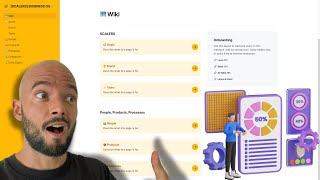
In this solo presentation Maxime Warnault walks viewers through his proprietary Business Operating System (referred to as the Skaters OS) designed to give founders a single, unified dashboard for every aspect of their company. He demonstrates a wiki‑style interface that centralises the vision, mission, values, multi‑horizon goals (10‑year, 3‑year, 1‑year, 90‑day, 30‑day, 7‑day), daily tasks, brand pillars, content and monetisation strategies, product pricing tiers, revenue‑client calculators, team roles, SOPs, and a daily‑digest habit tracker. The system is built on Airtable and integrates with Slack, Google Workspace, Canva and other tools. Warnault explains his “3S” framework – Start (clarify personal and business goals), Setup (define products, pricing, funnels), Scale (run ads, hire, automate so the business can run without him). He outlines his company values (speed, simplicity, client‑centricity, fun & freedom), brand pillars (mastery, media, monetisation), and a content funnel that moves prospects from free social media content to low‑ticket offers, recurring subscriptions and high‑ticket programmes. A built‑in calculator shows how many clients at each price point are needed to hit a $1 M ARR target, visualised with progress bars. He also showcases a daily Slack digest that asks team members to rate their day, note a highlight, and suggest improvements, fostering culture and accountability. The video ends with a call‑to‑action to join the free Scalers community and get a copy of the Business OS.
Chapters
In this video, I'm going to show you my business operating system that allows me to see everything in my business in one place, that allows me to set my goals, to have crystal clear clarity on my brand. What are the actions that I need to take? What are the actions that employees, contractors need to take? Who are the employees, who are the contractor, who do I need to hire? And what are the people, products and processes that need to be put into place to grow the company? And where do we actually grow the company? What are the products that we are going to sell? What is the price point? Who is the target audience? What is going to be the number of clients that we need to reach the revenue that we want to eat? So let's go ahead and go over all of this. So what you are seeing right now is the business operating system. I have created a simple wiki where every team member can come here and see the goals of the company, the brand, what we stand for, what is the content strategy, what is the monetization strategy, what are the tasks that we need to do on a daily basis? And if they just got onboarded, or to use Loom, or to use Slack, or to use airtable, which is the system behind this entire thing, the logos and icons. And as we keep growing, I would add more and more here. So every team member is aligned on all the tech that we use and where we are going as a business. Okay, so we have the goals first and here is the same as the personal operating system. So I have goals for my personal life and now I have goals for my business. So I have the vision. Mission values 10 year goals, 3 year goals, 1 year goals, 90 day goals, 30 goals and 7 day goals. And we have daily tasks that we need to execute on. Okay, so for the vision, we are the number one company for scaling courses, coaching and community businesses online. My mission is to install the Skaters OS into 1 million online education businesses. So what is the Skaters OS? Simple, it's 3S start setup and scale. Start is really getting clear on your goals, your personal goal and your business goals as I'm showing you in this video. Then we set up the business. So I have a software to help you scale your course, coaching or community business. So I show you how to use that or to get clear on exactly the products. What is going to be the monetization strategy or do you get clients, these kind of things and then scale. So this is where we start running ads, where we start hiring team members, where we set up literally the entire operation. So your business can run without you. Okay, so then we have the values. So these are the values for my company. Speed, we move fast. Done is better than perfect. Progress over progression. Action beats anxiety, motion beats meditation, and work beats worry. Okay, we simplify, we systemize and we scale. We simplify and systemize everything. Simplicity, scales, complexity fails. We don't rise to the level of our goals, we fall to the levels of our system. Less is more, we do less, but we do it better. Okay, we are client centric. So our number one goal is to make it easier, faster, cheaper for us and for clients to succeed with less time, effort and sacrifice. Results are the only thing that matters. So that speaks for itself. And then fun and freedom. This is probably my favorite one. I want to do all of this. I want to be able to scale a business while having fun and freedom. So there is this quote by James Michener and it says the master in the art of living makes little distinction between his work and his play, his labor and his leisure. He hardly knows which is which. He simply purchases his vision of excellence at whatever it does, leaving others to decide whether he's working or playing. To him he's always doing both. So that's where I have my vision of my business, my vision of my life, my vision where business is part of my life and life is part of my business. And I let others to decide whether I'm working or I'm playing. And personally I love what I'm doing. So it's never feeling like work, it's always, I'm always playing. So then I have the 10 year goals. So $10 million in revenue, 10 million across all of my audiences. Email list at 1 million. The software has 10,000 people, 10,000 users, I should say 10,000 coaching clients and the masterminds at 100 clients. Okay, then I have my three year goals, which is literally the same goals divided by by three and then I have the one year goal, 90 day goals. So what do I need to do? Launch the personal os, launch the business os, launch the scalars community, launch the systems to scale, launch secrets to scale and then for this month what do I need to do? So, so launch systems to scale and the scalars community with the personal and the business os and then this week launch the personal and the business os. So that's what I'm doing right now. I recorded the personal OS video. I'm actually recording the business OS video right now. And so I am on track to achieving my weekly goals, to achieve my monthly goals, to achieve my quarterly goals. To achieve my yearly goals and to ultimately achieve the vision. Okay, so then we have the brand. So the really branding is something that I'm getting into, recording these YouTube videos and things like that. So we have the brand pillars. So this is mostly about me. So the brand is called we are scalars. And the brand pillars are what is the content that I'm going to create. So the first category is about mastery. So this is mostly for myself. So I speak about mindset, fitness, gym, nutrition, the habits that I have, the routine that I follow and my sleep. Because really my sleep is the number one thing in my life. If I sleep well, like today I slept like close to nine hours and I feel on foging fire, then everything else is going to be easier. I think better, I think clearer, I think more positively and I'm really excited. So when I sleep poorly and I'm tired, everything else is impacted in my day. My relationship, my work, my, my task, the way I speak, everything is impacted. And then I want to share some personal stuff as well. Spirituality, plant medicine, these kind of things, really meditation and really the spiritual aspect of life because it, it plays a big role in, in my life. Then we have media recording these videos, AI tools, funnels, systems, software, automations and social media. So this is most the, mostly the technical aspect of the business. So the tools that I'm using and the softwares and like behind the scene of building some automations and things like that and recording content for social media. And then we have monetize. So sales, marketing, advertising, copywriting, offer creation, content creation is all the kind of content that I want to talk about. So every time that I record a video I'm asking myself which in which category is this falling? Is this in line with my brand? And you can see it's pretty, pretty wide. But at least I'm talking about the things that I love, that I enjoy and that I want other people to know me about. Okay, so the monetization strategy for the business. So I have free content. So this is the social media content that I release on YouTube. Pretty much all the platforms using the systems to scale. Then I have the scalars community, I have the personal OS and the business OS that I'm showing you right now. These are completely free. You get access when you join the skaters community. And honestly it's really something that I think everyone for the personal OS and every business owner should have in their business to get crystal clear and everyone aligned on the same vision, mission, values and goals and tasks that needs to be executed on okay, then we have low ticket products. So I'm still wondering if I should include this in the personal OS and the business os. I just like to keep it simple for the personal os. And I still haven't created this, but so what I'm doing with the personal OS is I have all of my goals set on the personal OS and I have my workouts, my, my weight, my all of my sleep data. Everything is going to be sent my journals to AI or is actually being sent right now to AI every Sunday. And it gives me recommendations on my sleep, my health and fitness and my mindset based on my journal, my goals, etc. So then we have the recurring products. So it goes from free content to the free community using lead magnets in the free community, people can buy low ticket products, they can buy recurring products and they can buy high ticket products. Okay, so then I have the content strategy amps the content strategy. I have content pillar. So I want to do entertainment. So this is education and entertainment. So mostly what I'm going to do is education, how to set up funnels, what is like how to do copywriting, these kind of things. So these are five categories of content that I'm going to create. So training content, O2 videos, story content, which is more raw and authentic video where I share my opinion, demo content. So behind the scene of what I'm doing and or helping clients. Then I have collab content. So partnering with other influencers and things like that or youtubers and creating case studies based on clients results. So daily I record short forms that I post on all the platforms using the social planner in the Systems to scale software. So I batch record this and I plan them every single day to go out on all the platforms and I record one or two. I think I'm probably going to record two videos on YouTube every week that I turn into a podcast. And really the strategy that I use is I consume content mindfully, I curate. So I bring the ideas into my brand and I recreate the content that I know is already working with my own spin on it and with my own brand on it. Okay, so consume, curate and create. Then I have creator inspiration for pretty much everything. Some ovens and Alex or Mozzie are big now with school. I'm not using school anymore since everything is inside of systems to scale that IO. Then I have ITKit coaching. Ravi Abura Abu and Ross Rufino are two people that I follow. And for the software go Ilevel, which is what systems to scale is built on. And in addition to all the system that I've personally created inside of the software. So this is literally all I use for my funnels, website, email, sms, course, community, social media management. Everything is in inside of system to scale IO and then I have slack to talk with the team, Airtable, Google, workspace, business, anywhere. This is where I created my LLC and then canva for design. I keep everything very, very, very simple. So then we have the tasks. So the task are what I need to do by category. So let me start with the categories. So inside of a business you have different departments. So marketing, media, client success, finances, operations, human resources, sales, prospecting, and then personal for individual members of the team. So all of these tasks are mine. So right now what I'm working on is the personal OS and the business os. I already recorded this video, but until it's posted I'm not going to consider it done because it's not posted on YouTube yet. So I'm going to plan it and when it's planned and posted I'm going to turn this on. Right now I'm recording this video on how to win in business and, and until it's done, then I'm not going to post it and consider it done. And then I have tasks for the scalars, community, systems to scale, secrets to scale, and the two other products that I might or might not create. So I'm crystal clear on exactly what I need to do for each category. And I go from left to right based on the importance of everything that I need to do. I have tasks so overdue, I can see all of the overdue tasks that I need to do. So we are on the 13th of November, I'm catching up on this. These three videos that I'm recording today and then for the week now I have other things to, to set up and then, and then for the months. So I'm pretty good on my goals and I probably have to have more tasks in here to make even more progress and move faster than I even thought I would move. So then we have the people who are in the company. So for example, right now it's just me. But even if you have someone that you need to hire, let's say an executive assistant or someone like that, then you need to click on add a person and you can create the job description and these kind of things right here, right there. And if you want to add a task to someone else in the human resources, you can add a task and the subcategory is going to be hr, human resources and then create a Description for the executive assistant job and so you can assign it to your HR people and then they do all of it for you, conduct the interviews and things like that. Okay, so then we have products and here this is where it gets pretty fun. You can see that right now I'm creating these two things. Then I'm going to have the community, then I'm going to have like other products basically. So if I sort by priority you can see that we have the free products, we have the low ticket, we have the community, then we have the paid products here. What I'm, I want to show you really is the, here the calculator. So what we can do inside of the data in the products is actually calculate what it is going to take to have a million dollar business. For example, so we have the actual number of clients and the target number of clients. And this is going to calculate your monthly recurring revenue and target and the annual recurring revenue and actual end target. So let's say we want to, let's just focus on this on, on these two products here. Let's say we want to make a million dollars a year with two products. So we have one that is I need to show the price and the frequency. So the price is going to be 99amonth of let's say 9.99amonth. Okay? So we have two products that we want to, to use to get to 1 million a month. Okay so I'm going to say target zero for all of this and then I'm going to focus on these two monthly here. Okay? So in order to, so right now you can see on a yearly basis annual recurring revenue target, we are making $156,000. Okay? So if we have 21 people in the software and 11 people in the coaching program, then we are making $156,000. Okay? But I want to 10x that and I want to make a million dollar business. So what I need to do is probably 250 here. So that's 297. And here let's see 100 people. So we are above 1 million already. So let's say 75. We are above 1 million. Let's say 200 here. Just want to get to right to 100. Okay, 1 million. So right here you can see that we need 200 people to pay $99 a month and 75 people to pay 999amonth to build a million dollar business. So now you can see where you need to put your focus on what are going to be the products that bring the most cash. So, for example, this one, the one at 999amonth, if we get 75 people in here, we can make $900,000 in a year. So if we want to actually make a million out of this, then we need probably 95. 90 people less than this. 85. 80 people. Okay, 82. 84. All right, 83. Okay, 84 people exactly. To cross the million dollar with this product only. So now it's clear if we want to make a million dollars from each of these product, then I need to shoot for 84 people to pay 997amonth for this product. For this one, if we want to make 1 million because it's 10 times lower price per month, then we need to make 210 times more. More people. So probably 840 would do the work here. 41. All right, there we go. So 845 people here to make 1 million per year. And as you can see, it's 83,000 per month in here. I just wanted to show you so you can play around with this and you know exactly where to focus on the number of clients that you want. And actually there is a progress bar as well. If we come here, you can see. So let's say right now for this we have 85 people, and on this one we have 25 people. You can see your 30% of reaching your goals, and you are 10% of reaching your goals. So now you need to the gap that you need to close to reach your goals. So that's pretty cool. That's like visual things that I want to have and a scorecard to know exactly where I'm at compared to my goals. Then we have processes, all the sops that you have to do in here. And you can add the SOPs, you can assign them. So that's all my processes. You can have like your entire team processes in here to know exactly which team member is responsible for what. And either it's creating the SOP or executing the sop. Okay, so the category already showed you this, but we have like subcategories as well. So for the client success, this is where I put all of my. And then we have sales, marketing, media operations, this kind of thing. So you can have literally as many departments as you want, as many subcategories as you want, so that you can customize the task and the people and everything, this entire system for your business. Okay. And then I have something cool in here to align everyone to really stay dedicated to the work. And it's A daily digest that each team member is going to receive a slack notification on. And when they come here, there is automatically going to these dates and the specific user that is logged in. And it basically is three questions to rate your day. And then a moment that I really appreciated today was and I could even do better if I I thought okay, so I was intentional in how I acted today. Yes. On a scale of 1 to 5, I remember to serve and lead our clients well today and have some fun while doing it. Yes. And if I repeated this day 1000 times over, there's no doubt that I will grow and accomplish my personal and business goals. Absolutely. So a moment I really appreciated was so that's going to be at the end of the day talking to this person in the sauna made my day. Okay. And then if I could have made today even better if I started working right after I woke up instead of procrastinating, for example. Okay. And then they submit this and then we can keep track of all the team is feeling or they are doing on a daily basis and we can be like more human towards the team members that we have and see if they are going through a hard time and what they can they could do or we can help to them do better. As usual. I like to keep these things simple. You see, it's a pretty complex thing, but it's like coming already done for you. So if you want a copy of the business operating system, click the link below. Join the Scadras community. You can get access to this entire thing for free and make it to use to your business. Really get clear on your company goals, your brand, what do you stand for, what are going to be the people, the processes, the products that you sell, how much money you want to make out of them, how many clients you need, what is going to be the monthly recurring revenue, the annual recurring revenue and what are the tasks that you need to execute on a daily basis? Weekly basis. Monthly basis. Quarterly basis, Yearly basis to reach the vision, mission and yeah, get everyone aligned on the business. This is not just a dream, but it's actually something that is happening. So that's it for this video. Click the link below to get access to the business operating system inside of the skaters community and I will see you guys in the next video. Peace.
More from Maxime



I was talking to one of my clients' husband today and she's very not tech savvy and her hu
Most of the time we undercharge in the marketplace because we feel we do is not valuable e
