How To Apologize & Why Apologies Still Matter with Scott Levin & Ellie Vilendrer
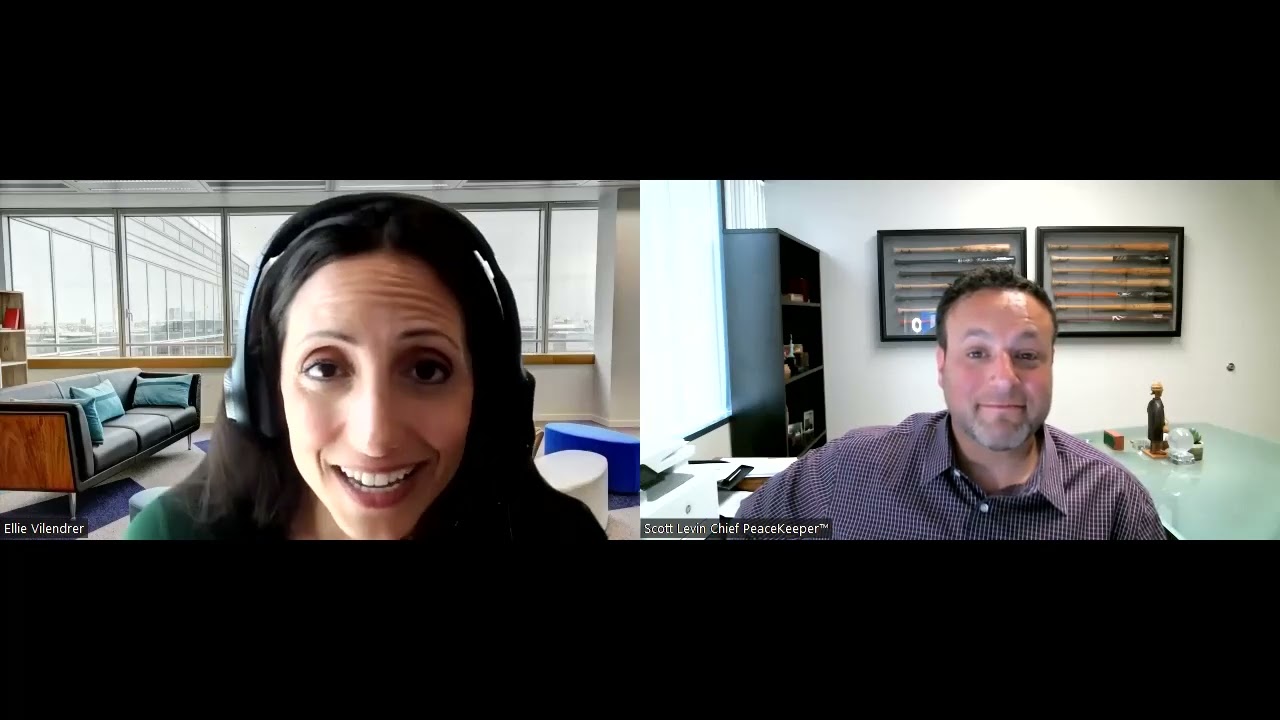
Business attorney and mediator Ellie Vilendrer explains what makes an apology actually work: remorse, acknowledgment of what you did wrong, responsibility, empathy, and sometimes restitution. Conditional apologies like "if I hurt you" backfire and worsen conflict. She mediates family, elder care, and business disputes nationwide via Zoom.
Chapters
Hey everyone, this is Scott Levin, Chief Peacekeeper, back for another quick interview with my good friend Ellie Viandre. Hi Ellie.
Hi Scott, thanks for having me here today.
It's so great to see you. So Ellie is a business attorney with a focus— with a niche focus on helping businesses resolve disputes outside of court by serving as a third-party neutral. AKA a mediator. She is licensed in California and Minnesota, and she has a passion and interest like myself in entrepreneurship. She started— she's co-founded and founded numerous startups over the last decade or so, so she's got a really interesting background. And we've worked together through the American Bar Association, and I just wanted to welcome Ellie and Thank you again for taking the time to talk with us today.
Thank you so much, Scott. Well, I'm excited to be here because this topic is one that is near and dear to my heart.
Well, yeah. And today the topic is actually going to focus on Ellie and my work in alternative dispute resolution. And Ellie also has a really great video that I encourage you to watch on negotiation. Which is really, really impactful and just full of tremendous information. So in my role as a mediator in, in family law and in elder care disputes, oftentimes one party or the other requests, or one party or the other initiates an apology. And apologizing can have tremendous benefits in negotiating settlement, but it has to be done in a way and received in a way where those intended benefits come about. And so that's our topic for today, apologies. And, and, and, and Ellie has a lot of great information to share. We've talked about this offline. So Ellie, what got you interested in apologizing? Or apologies, sorry.
Well, Scott, like you mentioned, we're both neutrals, and my practice also has a focus on early dispute resolution. And so the work we do focuses on both dispute prevention and also resolving disputes quickly. And apologies can play a big role in preventing a dispute dispute from escalating, both in the pre-dispute prevention phase, but also in, you know, after a dispute arises in an early kind of resolution timeframe. And so that mixed with also my own personal experiences of having felt wronged And noticing how I react and respond to that situation based on the other person's response, whether they are remorseful, understanding, empathetic, or show that they don't care at all. And I have found that those things do play a big role in the time it takes me to get over something. And whether I end up feeling angry about it or, you know, whether I can just move on quickly from it.
Yeah. So with that said, you know, what kind of words and phrases shouldn't and should be in a genuine apology in your experience or your opinion? Okay.
So, um, I've also done research on this topic because I find it very interesting. So, um, the information I share is not just based on my experience. I'll say it's confirmed by, by my, by my experience, but it's also based on research. So there are some key elements that an effective apology will contain, and that is an expression of remorse or shame or humility, an acknowledgement that social norms or expectations were violated, and taking responsibility for the harm. An empathy statement, which is also really important, and, and from the research I've read, the most overlooked part of an apology. So an empathy statement which acknowledges the full impact of our actions on the other person. And then depending on the circumstances, it could include an offer to compensate or a commitment to prevent future harm.
Interesting. Yeah. Go on. Sorry.
And, and I really want to distinguish that from a partial apology or an incomplete apology, which is something that we see a lot of times where someone will just say, I'm sorry. You know, you're sorry for what? A partial apology can actually make things worse And so it could have been better for someone not to apologize a lot of the time than to deliver a partial apology. So the statements that I don't like are if statements, such as, if mistakes were made.
Yes.
And that doesn't even acknowledge who made the mistakes. First of all, it's not acknowledging that mistakes were made. And secondly, it's not even taking any accountability by the person who's making that statement.
What about if they say, if, if I hurt your feelings, or if, you know, if, yeah, I mean, or, or if I did something wrong.
Well, you should know if you've done something wrong by that point, right? So that can really anger the recipient because the wrongdoer is failing to express any real remorse or accept responsibility for his role in the harm. And as part of the research I did, I found some corroborating statements by a couple of renowned experts on this topic. One was the late professor of psychiatry And a leading authority on apology, his name is Dr. Aaron Lazar, and he says what makes an apology work is the exchange of shame and power between the offender and the offended. And similarly, Dr. Carl Schneider has stated that an apology often requires a role reversal. The person apologizing relinquishes power and puts himself at the mercy of the offended party, who may or may not credit the apology. Yeah, and, and, and you can, you can think about that, you know, when you have been harmed, the other person was the one showing power or indifference to you, and now by apologizing and accepting responsibility, they're elevating you as the recipient. And an effective apology is focused on the other person's needs and feelings, not your own. So you want to really step into their shoes, and the other person should feel as if we get the full implications of our actions on them.
Have you, have you, do you, have you ever looked into restorative justice at all?
I have been a mediator with a couple different community organizations that have restorative justice arms, but I have not worked personally in those arms.
Yeah, those— a lot of these principles are, are really what I've worked as a mediator, a volunteer for the San Diego Restorative Justice Center, and everything that you just said, it if there's an if statement, there is no restorative justice. The other person doesn't feel the benefits of what it— what the apology is for.
Yeah.
And everything you just said is just exactly what we're taught in the— what I was taught through the Restorative Justice Center about explaining to the apologist, you know, how you need to deliver this in order for it to To try to resolve the issue. It's really interesting.
And I could imagine that a failed apology or an incomplete apology in those situations really makes things worse because the apologist— the apologizer now had the opportunity to make right.
Yeah.
And they failed and they didn't when given the opportunity. It was like, here's your second chance now, having had the opportunity to think it through. And you still aren't understanding the implications of your actions on me. You still don't understand.
Totally.
What you did was wrong.
So we've talked about the apologizer. Now, what do you— let's, let's kind of focus on, on receiving the apology. How should and/or shouldn't someone accept an apology once given?
So I think that is going to have to happen organically and naturally. Um, you know, you didn't put yourself in that situation to, to now have to be on the receiving end. So if the apology is sincere, authentic, heartfelt, And you are ready to forgive, thank you, and move on. But if you're not ready, you know, I, I wouldn't just forgive for the sake of allowing the other person to move on. But you could let them know that you still need time to process, and you still need time to heal, and you need that time and space.
Yeah, it can be, it can be, uh, it's a very important part of the process in family law when someone, you know, what, what I often tell people in my practice is that it's possible, but, you know, you might be the first time I've experienced where, where a person is 100% responsible for a divorce that's happening. There's usually a role played by both parties in some way. And so when someone does come out and really deliver a true sincere apology and it's not accepted, or they don't feel that the other person received it in the way that they were hoping for, it can have a really negative consequence to the outcome of the negotiation. Which is really what we're there to do in family law mediation is negotiate a settlement. So it's an important part of the— it's an important part of the process for sure.
Right. And I would, I would add to that, what, what precedes apology and forgiveness is an examination of one's own contribution to a problem. Like you said, it's usually not one person who causes the divorce, but it's an interaction between the two. Between actions and responses. And I think anytime there's a problem, you first want to look intrinsically and really examine your behavior and, and your contribution and, and own up to that. And that could be a good way to open the door to the other person looking internally and apologizing also. But if you've made any contribution to the problem, Then I think you should start with your own accountability.
So I think a lot of the, the, the ifs that you mentioned that we want people to avoid, it kind of comes from a self-desire to apologize but not necessarily accept all the blame. You know, that's what we're kind of tiptoeing around. So is there some way that a person can initiate a forthright genuine, full-hearted apology without taking all the blame? Is that— does that exist?
I think what— well, yeah, you could do it without taking all the blame. I mean, I think you, number one, should understand what your To the— what your contribution— If there was— if you weren't at all at fault, I think now what we're talking about is an empathy statement. Yeah. And in empathy statements, those are very important. Brené Brown has a really, really wonderful 2.5-minute short on empathy statements and how they should be delivered and should not be delivered. For example, she talks about not using the, well, at least, you know, at least this or that. Definitely Google Brené Brown's video on empathy. But yeah, you can make an empathy statement. Again, don't apologize for something that you're not at fault for, but you can still show that you're understanding and you can say, you know, thanks for letting me know. I feel badly for what you experienced. That must have been really tough. Brené Brown tells us that empathy is recognizing emotion in the other person and then communicating that, and empathy is really feeling with people.
That is one of the reasons I think Ellie is such a superstar in this field. She— whenever I am on a call with her, inevitably she'll say, oh, you know, that is so interesting that you just said that. Have you seen, or have you read, have you watched, or did you know about? And I'm like, uh, sometimes I can say yes, but most of the time I'm like writing down, I gotta learn about this now from Ellie. And she is so well-versed in, uh, the field, just in, in whatever. I feel like when whatever she touches, she's, she's well-read, she's reasoned, she has background information. Um, and I just am so impressed. I've always been impressed with, with that, your ability to kind of delve deep into all these issues that you're talking about. It's really—
Thank you. Thank you so much, Scott. Thank you. I really appreciate you saying that. This is such an important topic to me. And I find that it's more than my career. It's my life's passion. And I just, I like thinking about these, these issues.
Yeah. Well, I want to thank you today for coming and joining us. And hopefully this won't be the last time that we'll have an opportunity to record a video. And where, Ellie, can you give your, can you give your website, your information so people can— I'll put it in the description, obviously, but Yeah, thank you, Scott.
Um, my website is my last name, which is V-I-L-E-N-D-R-E-R-L-A-W, the word law, dot com. And, uh, you can, uh, reach me through my website and always happy to talk to folks.
All right, awesome. Well, thank you again. And oh, just one quick question for your Uh, mediation practice, your ADR practice, is that nationwide?
Yeah, I mean, with Zoom capabilities, it is nationwide. I am physically located in California. I practice law in California and Minnesota, but mediation, I have a national reach.
Great. All right, so, um, yeah, look, she really is a fantastic resource. I encourage you to, if you have litigation, corporate transaction needs, Ellie is a great attorney, but we're here talking more about our mediation practices today, and just so, so impressed with her. So thanks everyone for joining us today. Scott Levin, Chief Peacekeeper. We'll see you soon. Thanks again.
Thank you. Bye.
More from Scott

Divorce Mediation Starts With Clarity: Know the Financial Baseline Before You Negotiate

Divorce Mediation Can Keep Your Family Out of Court | San Diego Divorce Mediation


Your Parents Helped You Buy a House — But Could Those Funds Be Lost in a California Divorce?

Nesting Custody Explained: How to Successfully Implement This Child-Focused Divorce Solution


Dating During Divorce – It’s Not About Whether You Date… It’s How It Affects Your Divorce #divorce

The Co-Parenting App That Filters Conflict | Sol Kennedy Interview #coparenting #parenting


Managing Divorce Panic - How to Think Long-Term Settlements with CDFAs Scott Levin and Tatiana Sunik