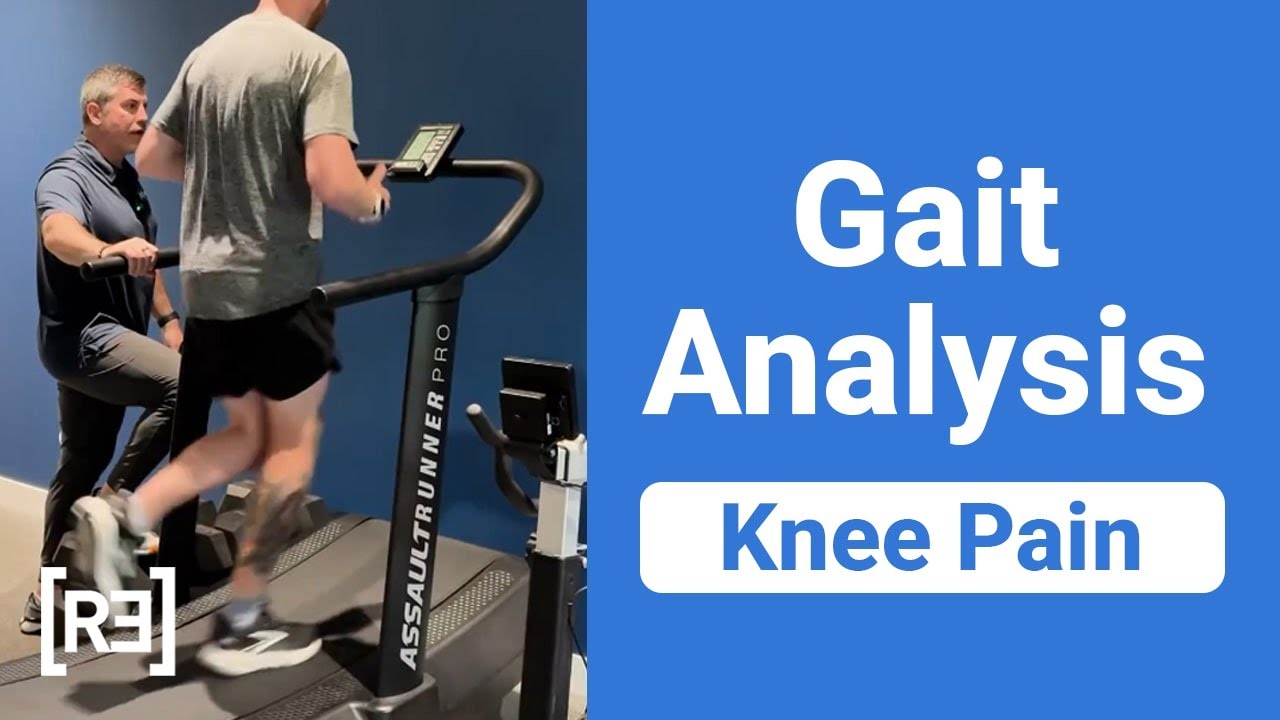
A runner training 15-20 miles per week reports knee pain that starts, eases mid-run, then returns. Gait analysis shows her feet point outward, knees collapse inward, and her center of mass leans forward. The analyst recommends increasing cadence and improving stride balance to reduce stress on the knee.
Chapters
Because of the pain, I reduced it to 3, so I just do like easy tempo long.
All right, have you been, have you been doing 4 times a week since February?
No, I've done probably average about 3 times a week.
Okay, what's your mileage up to now?
Still like 15 to 20 miles a week.
Okay.
It's been pretty slow increases.
Yeah, because again, you're not up to massive. Yeah, not distances yet.
The next couple of months is—
Yeah, now it's gonna start increasing. Okay, and then that's— so that's your volume.
Yeah.
What's your long run right now?
Longest has been 10.
10. All right. And then how do they feel? Like, is it worse at the beginning, then loosens up, and then worse after? Bad in the mornings?
Worse in the beginning, loosens up during the run, and then hurts after. Like when I go all out, I like put the sheet of ice packs and it sucks.
Yeah.
That kind of thing.
Like with like your 10-mile run where it's getting pretty painful and it's lasting longer.
So I did like the 10-mile one last weekend, and I did I think 3 on Tuesday, and that was really painful to the point where I'm like, I'm gonna stop and take a break now and get this checked out. Okay. I was trying to be the tough guy, but I can power through, I can do this.
And then what, have you done any other races?
Uh, no, nothing major.
Okay.
Just some 5Ks and stuff.
You doing Chicago? Yes. Add you to our list. Yeah. All right, and where are you from?
England.
England, where in England?
Uh, near Birmingham. Birmingham? Yeah. Okay.
Because we're not gonna do too much running and just kind of look at it, we're not gonna do too much warmup today.
Okay.
So it's a pretty casual jog. I want you to find a normal kind of like easy cadence for you, like sustainable, probably your 10-mile pace.
Yeah.
Okay. The only trick is we're gonna be using a self-propelled treadmill.
Okay.
Have you ever used one of those?
No, I haven't.
Okay. So we're gonna kind of start walking, kind of get your feet under you and get used to that.
Okay.
And then we'll kind of work into it. It's not ideal for running analysis because the self-propelled treadmills automatically Put you in a little bit better technique because if you overstride, which most people tend to, yeah, that get these injuries, yeah, it's going to accelerate. And so you're not gonna be able to consistently do that. So it's gonna force you to, um, kind of see that. And we'll see that where you're gonna have a— it's a hard time kind of maintaining a steady pace.
Okay.
And that's gonna tend to show us a little bit about how you're running already. So that's gonna tell us a bit as is, but It's— we're still going to be able to see some changes and like see what we need to kind of see from your run.
Yeah.
Okay, cool. Stay in the kind of trough right here.
Right here? Right here. Yeah.
You can see it doesn't move at all.
Yeah.
Okay, there you go.
It's a weird sensation.
It is a weird sensation, huh? So here's your miles per hour.
Yeah.
Okay, a little bit different than your KPH, but I think you're probably pretty— how long you been here?
4 years.
All right, you're pretty used to this by now.
Okay.
Do you— oh, you use a Garmin as well?
Yes.
Okay, cool. We'll talk about that later. I'll take a look. Do you track your runs?
Yeah. Perfect.
So we'll look at some of your previous runs when we start talking about getting to the evaluation side of things. Okay, so here's your pace, here's your speed. Okay, and so this is what we want to kind of keep this consistent when you start jogging. I just want to kind of get you so you're at a steady— pretty good. Okay. All right, near 2 minutes. That's perfect. All right, this is a pretty nice pace for you. What's your pacing?
10-mile pace. I was probably like 10:25.
Okay, well, this— yeah, this is all right because we're only going to do like— well, the video section of it, like each section is only going to be 10 seconds.
Okay.
Because I just need to look at like a certain thing, a few things with your stride. Yeah. Okay, we're gonna get you from behind here.
Good.
That's gonna go off, but we're gonna be able to see average run cadence, 150.
Yeah.
Okay. So, and the max was 222, which was— that's a lot. Play this and help you. So this is 180. Right, okay.
Okay.
Yeah. Right. So you can see the difference, right? So it's just hit, hit, hit, hit, hit. It's plump.
Yeah.
So we want to just be more elastic. Okay.
Okay.
And so we can talk about what you're doing with your feet, we can talk about all this other stuff.
Yeah.
But this is going to change a lot of that just by the nature of getting your feet off the ground. And so we're going to work on that.
Okay.
So that's your easiest thing that you can do is, is that work on increasing that cadence.
Okay.
Okay. And that's going to be a lot less impact on there. Okay. Now from behind.
Yeah.
Is going to show us I'm gonna keep this up so you can see this. Okay, do you see how— where is your foot turned?
Yeah.
It's out, right?
Yeah.
Okay, so, and do you see how it's— well, I'm just going to kind of go slow here. You see how it stays out but your knee goes where? Forward and actually in.
Yeah.
In a bit, right?
Yeah. I'm almost knocking knees.
You're almost knocking knees. Exactly. Okay, so what is taking the most stress? Yeah, the, the inside, right? These muscles are having to decelerate this from completely collapsing in, right? And so they're being stressed eccentrically, repetitively, right? Okay, and that's where you're getting that stress. Whereas if I was here and I'm going through and coming here and straight, Yeah. Okay, it's just rolling through and I'm using both sides of my leg equally, equally, and they're, they're doing this, right? Okay, muscles typically, when we look at how muscles work, they can work eccentrically because we're stronger there. Yeah, but it's a lot of work, right? Okay, and you're doing your full body weight on one leg. Okay, so that's kind of how ahead we are.
Okay.
Okay, we see that. And so there's your hip.
Yeah.
And head there, chest, shoulders. Okay, pretty stacked. So that's how far ahead you are over center of mass.
Yeah.
Okay, so we'll call this 0.
Yeah.
Okay, frame 0. We're gonna go 1, 2, 3, 4, 5, 6, 7. 7. Okay, so I'm gonna give you that as our— that looked pretty, pretty center of mass there. Okay, so 7. Whoa, so sorry, this is at 60 frames per second. We do this at 30 frames per second.
Okay.
Okay, I do this so we have a little bit more wiggle room. So we're gonna divide that by 2, so it's actually 3.5.
Okay.
Okay, so 3.5 because it's 7, so divided by 2. And then we're gonna go 0, we're gonna start over, and then we're gonna go 1, 2, 3, 4, 5, 6, 7, 8, 9, 10, 11, 12. That's off. So we'll get— we'll give it 12. So that's gonna be 6.
Yeah.
Okay.
Okay.
So initial score, 3.5. 6.0.
Okay.
Okay. So this is typically what we see, this back end. Okay. So that's the amount of time you're staying right on— it's ground contact time.
Yeah.
So initial strike to center of mass.
Yeah.
So that's the amount of time you're on the ground.
Okay.
Okay. So we're trying to— we're really trying to work this number down. Okay. This will get better.
Yeah.
Automatically, this is the one.
Right, quit at all. Yeah.
Right, and then I could be here and I can be very slowly going. All I'm doing is falling into it, and so we have to get comfortable with Okay, I'm accelerating, I'm falling into this more.
Yeah.
I'm decelerating, I'm going more upright.
Right.
Okay, and so we have to get used to that center of mass, and so it's understanding our body weight perception in space and where— what that does.
Yeah.
The more we accelerate, the more I'm going to shift to my toes.
Yeah.
Okay, the more I, I, I'm upright, I'm going to end up hitting— I'm going to even kiss my— like, I'm in place, my heels are going to kiss the ground. Right.